Wednesday, September 08, 2010

TV Tie-ins: Devenish

Devenish was a Granada comedy created and written by Anthony Couch, produced by John G. Temple and directed by Brian Mills. The show starred Dinsdale Landen (as Devenish), Terence Alexander, Geoffrey Bayldon and Geoffrey Chater.

Arthur P. Devenish was the chief games deviser for a games' company who had an overinflated sense of self-importance which irritated his colleagues. Devenish ran to two series, 13 episodes in all, broadcast on ITV in 1977-78.

Devenish: The Horizontal Rocket by Anthony Couch.
Mayflower 0583-12854-8, Feb 1978, 159pp, 75p.
In his secluded office, deep in thought, sits the man who is the creative mastermind behind Universal Pastimes Limited. What tortuously ingenious scheme will he conceive for the greater glory of UPL? What grandiose plan that will turn competitors' marketing strategies to dust? Suddenly, his eyes become filled with a strange, wild light; he reaches for the telephone...
__Biddlecombe of Personnel turns pale; House Manager Craddock quakes; Company Secretary Liversedge heads for the washroom; Fitzroy, UPL's dynamic managing director, even forgets whether it's Swiss roll or chocolate cake today...
__British industry holds its breath as Arthur P. Devenish strikes again!

About the Author
Anthony Couch has written extensively to TV, theatre and radio and was head of music departments for two television companies, one of them Yorkshire. His TV credits include episodes of ITV Playhouse, Crossroads, Hadleigh, Emmerdale Farm, All Our Saturdays, The Flaxton Boys, Our Kid, Crown Court and Yanks Go Home. He was the creator and author of a number of comedies, including Devenish (1977), Take My Wife (1979) and Nice Work (1980). He later penned episodes of The Gentle Touch and Perfect Scoundrels.

He is married to June, a publisher, and lives in Oxfordshire.

Novels
Devenish. London, Mayflower, 1978.
Memoirs of a Twelfth Man: The Recollections of J. A. P. Withers of Stipford Rural Cricket Club. Marlborough, Crowood, 1984; London, Unwin Paperbacks, 1985.
The Ring of the Niblicks; or, Siegfried's Revenge, illus. James Sykes. Lime Tree Publications, 2005.

Tuesday, September 07, 2010

TV Tie-ins: The Two Ronnies

Continuing the Ronnie Barker theme from yesterday, here's a cover gallery featuring The Two Ronnies.

It's Goodnight from Him. The best of The Two Ronnies by Ronnie Barker; illus. John Painter (London, Hodder & Stoughton, 1976; as The Two Ronnies, adapted by Bill Ridgway, Basingstoke, Macmillan Education, 1986)

The Two Ronnies: But First - the News edited by Peter Vincent.
Star 0352-39899-X, May 1977. Cover photo by Don Smith

Nice To Be With You Again! edited by Peter Vincent.
Star 0352-30108-2, Aug 1977. Cover photo by Don Smith

The Two Ronnies: In a Packed Programme Tonight edited by Ian Davidson; illus. Graham Allen.
Star 0352-30204-6, Jun 1978. Cover photo by David Edwards

The Bumper Book of the Two Ronnies edited by Ian Davidson & Peter Vincent.
Star 0352-30249-6, 1978.
A selection from But First the News, Nice to Be With You Again and In a Packed Programme Tonight.


The Two Ronnies Comic Book by Denis Gifford; cartoons by George Parlett.
Corgi-Carousel 0552-54137-0, Sep 1978.
The Two Ronnies Sketchbook edited by Peter Vincent.
Star 0352-30312-3, Oct 1978.

Ronnie in the Chair by Spike Mullins; illus. Frank Dickens (Walton-on-Thames, Surrey, M. & J. Hobbs, 1978)
Star 0352-30427-8, Oct 1979.

The Two Ronnies: And It's Hello From Him edited by Ian Davidson; illus. Ian Heath.
Star 0352-30796-X, Nov 1980.

The Two Ronnies: Time For a Few Extra Items edited by Ian Davidson; illus. Ian Heath.
Star 0352-30958-X, Oct 1981.

The Second Bumper Book of the Two Ronnies.
Star 0352-31207-6, Aug 1982.

The Two Ronnies: And It's Goodnight From Him edited by Ian Davidson; illus. Ian Heath.
Star 0352-31150-9, 1982.

It's Hello From Him! by Ronnie Barker with Sean Usher (autobiography) (London, New English Library, 1988)
New English Library 0450-50813-7, Oct 1989.

But I Digress by David Renwick.
New English Library 0450-50809-9, Oct 1989.

"All I Ever Wrote": The Complete Works by Ronnie Barker, edited by Bob McCabe (London, Essential, 1999)
Sidgwick & Jackson 0283-07334-9, Oct 2001.

High Hopes: My Autobiography by Ronnie Corbett (London, Ebury Press, 2000)
Ebury Press 0091-87917-5, Aug 2001.

The Two Ronnies. Their funniest jokes, one-liners and sketches.
Ebury Press 0091-89454-9, Sep 2003.

And It's Goodnight from Him. The autobiography of the Two Ronnies by Ronnie Corbett with David Nobbs (London, Michael Joseph, 2006)
Penguin 0141-02804-1, Jun 2007.


Monday, September 06, 2010

TV tie-ins: Porridge

Norman Stanley Fletcher first appeared in an episode of Seven of One, a series of one-off comedies all featuring Ronnie Barker. Barker had an undeveloped idea for a show with a prison setting and himself as a Sergeant Bilko type of wheeler-dealer; writers Dick Clement and Ian La Frenais came up with a far more biting storyline in 'Prisoner and Escort' which aired in 1973 and had the lowest ratings of the whole series.

However, producer Jimmy Gilbert, Barker and head of BBC Comedy Duncan Wood felt that it, of all the seven shows, had the most potential. Clement and La Frenais were not so confident until they were introduced to ex-convict Jonathan Marshall, author of How to Survive in the Nick. Over a meal, Marshall gave them the key to the series: "little victories". For Norman Fletcher it was the only way he could survive the dehumanizing world of prison: to beat the system in however small a way.

There's a very good article on the history of the show over at Television Heaven. The whole series is available on DVD at a knockdown price over on Amazon.

Porridge by Jonathan Marshall. BBC 0563-12898-4, 1975.
--, 2nd imp., 1975; 3rd imp., 1975; 4th imp., 1976; 5th imp., 1977.
Seven episodes in the life of the wily old lag Norman Fletcher and his mates doing time in a remote Cumberland prison. Contains: "Prisoner and Escort"; "New Faces, Old Hands"; "The Hustler"; "An Evening In" (A Night In); "A Day Out"; "Ways and Means"; "Men Without Women".
Another Stretch of Porridge by Paul Victor. BBC 0563-17085-9, 1976.
--, 2nd imp., 1976; 3rd imp., 1977; 4th imp., 1977.
Further adventures of Norman Fletcher and his fellow inmates of the remote Cumberland nick where the main object in life is screw-baiting, and Mr MacKay-baiting in particular. Contains: "Just Deserts"; "Heartbreak Hotel"; "Disturbing the Peace"; "No Peace For the Wicked"; "Happy Release"; "The Harder They Fall"; "A Christmas Tunnel" (No Way Out).
A Further Stir of Porridge by Paul Victor. BBC 0563-17214-2, 1977.
Seven more rounds of sparring, as Norman Fletcher and his fellow cons of Slade nick continue their struggle against authority in the shape of Messrs MacKay and Barrowclough. Contains: "The Desperate Hours"; "A Storm in a Teacup"; "Poetic Justice"; "Rough Justice"; "Pardon Me"; "A Test of Character"; "Final Stretch".
Going Straight by Paul Victor. BBC 0563-17487-0, 1978.
Norman Stanley Fletcher - Fletch to his mates - has been released on parole from Slade Prison. After travelling south in the unexpected and unwelcome company of Mackay, he arrives home intent on going straight - well, almost. But life - in the persons of his daughter Ingrid and his old cellmate Lennie Godber, now planning to get married, and of his probation officer Mrs Chapman - seems determined to thwart him. Even a job as a hotel night porter is not as simple as it might seem.

Porridge: The Inside Story by Paul Ableman. Pan 0330-25923-7, 1979.
It's Britain's favourite con, TV's legendary lag, Fletch, the man who's ticking off the days in Slade Nick and dreaming about freedom in Muswell Hill!
__Porridge: The Inside Story. The hair-raising and hilarious tale of how Grouty, the Godfather of Slade Nick, masterminds a prison break cunningly concealed in a celebrity soccer match... and how it meant that poor old Fletch and Godber had to break back inside again... all under the hawklike gaze of MacKay, Hammer of the Criminal Classes...
This last was based on the 1979 movie. IMDB.

Paul Victor

A "mysteries that have me mystified" column...

Paul Victor is a byline that cropped up briefly in the late 1970s, credited with a number of titles. The following listing may conflate more than one author, but I'm tempted to say they're all by the same hand simply because they fit into a neat chronology. Paul Victor appears to begin writing novels with Innocent Assassin, a paperback published in India in English, then adapts episodes of Porridge and Going Straight for the BBC, then the novelisation of Warlords of Atlantis before writing a number of educational short stories for Longmans, including the novella Lisa in London.

But who was he?

Novels
Innocent Assassin. New Delhi, India, Arnold-Heinemann (Mayfair), 1976.
Warlords of Atlantis (novelisation of the film). London, Futura, Jul 1978.
Lisa in London, illus. Brian Dennington. Harlow, Longman, 1983; adapted and revised as Laura in Los Angeles, illus. Judy Hans Price, New York, Longman, Jun 1984.

Collections
Another Stretch of Porridge (short stories adapted from the TV series). London, BBC, 1976.
A Further Stir of Porridge (short stories adapted from the TV series). London, BBC, Dec 1977.
Going Straight (short stories adapted from the TV series). London, BBC, 1978.
The Face on the Screen and other stories, illus. Gary Embury. London, Longman, Sep 1978.
The Spy, and other stories, photographs by Lance Brown. London, Longman, 1979 [Jan 1980].
The Psychic, illus. Ian McCraig. New York, Longman, Jun 1982.

Omnibus
Three Helpings of Porridge (contains: Porridge, Another Stretch of Porridge, A Further Stir of Porridge). London, Treasure, 1984.

Sunday, September 05, 2010

Ella M Scrymsour revisited


Ella Scrymsour has been something of a mystery to researchers for many years. A relatively minor author, her work nevertheless falls into a number of categories where people keenly seek out information: science fiction, horror and crime. As the bulk of her output was romances, often only a single work falls under the microscope, usually her novel A Perfect World. Researchers dig a little, find nothing, and move on.

I took my turn to dig a little last June, figuring any book that John Clute considers "remarkable" was worth a look. I've left the original post up since it shows what hoops you can jump through and still come up with the wrong answer. Some of that hoop-jumping can be found in the piece below as I've retained most of the original text as far as the picture below, after which we switch to new material.

So it is with The Perfect World that we start, and I'm grateful to Ned Brooks for allowing me to reprint a review of the book he wrote for It Goes On The Shelf (July 1995, online here):
I mention this book in connection with The Night Land because they are similar in several ways—both are from the same period, both are utterly humorless, and both make use of the idea of dehydrated water (Hodgson's is a powder that turns to water when the air hits it, while Ms Scrymsour's is a 1-inch cube of what looks like camphor that makes a quart of water when heated).
__The lack of humor makes these books hard to plow through, though The Perfect World is written in conventional English prose and reads far more easily than the obsessively-detailed pseudo-archaic first person narrative of The Night Land. In a way this makes the technical howlers in Ms Scrymsour's book more startling—her prose is conventional, her very British characters are conventional, and yet, in spite of her bizarre imagination, she apparently had a very dim grasp of physical reality.
__The story starts off as a supernatural thriller—our heroes come to a small village to learn the coal-mining business, as their uncle and guardian (who in his spare time is building an airship powered by a mixture of "petrol, radium, and theolin") owns the mine. They apparently set off a local curse (dating from Henry VIII's seizure of the monasteries) that forbids strangers in the village, but the link of this curse to subsequent events is never explained and is soon forgotten when one of them vanishes and the other is lost in a mine cave-in. As soon as the action moves underground, Ms Scrymsour's deficiencies in physics become noticeable—the hero lost in the cave-in finds himself by an underground stream and throws in a piece of coal to see how deep it is! "There was a slight splash, but no sound came to tell him that it had reached the bottom". He eventually comes upon humanoid creatures—"no more than three foot six inches", with purple skin, flaxen hair, and a ten-inch horn in the middle of the forehead. One of these attacks him—"he beat his horn in Alan's face". I find this impossible to visualize.
__The horned purple midgets (the High Priestess has "small and pretty" features, "almost of English mould") turn out to be the descendants of ancient Hebrews swallowed up by the earth for defying Moses (see Numbers 16, v.31); and our heroes (the one who vanished is found by the one lost from the mine—he had been dragged down into the bowels of the earth by an incomprehensible sort of electric rope that the troglodytes have for that purpose), who have had proper classical educations at Queens College, Cambridge, soon learn to speak their corrupted Hebrew. Moses is dated to 1400 BC here, so the people of the underworld have had 3300 years to turn purple and grow horns.
__After further underground adventures our heroes escape to the surface with one of the midgets, who turns to dust as soon as the sunlight strikes her. They find that five years have passed, they have missed WWI, and they are in Australia.
__As with the Curse, the plot now abandons the purple midgets. One of our heroes takes his Australian nurse home as his wife, and they find that the uncle, in his grief at their disappearance, has become a hermit and perfected his 900-foot aluminium aircraft, the Argenta. They take it up for a spin and then the world is destroyed.
__Fortunately, the Argenta is fitted with an optional outer hull that "unfolds and clips into position by means of strong clasps" at the pull of a lever. The space between the hulls is then filled with a "mixture of gases of which ether is the chief component". The ship with our heroes, wife, baby, uncle, and an engineer and a mechanic is hurled into outer space. After a year or so they reach Jupiter, almost dead of hunger and thirst. The mechanic goes out too soon and dies of the sulfurous gases of the upper atmosphere.
__Oddly enough, the basic data on Jupiter is about right—it is five times as far from the Sun as the Earth and our heroes realize that this would give it only 1/25 the solar radiation. The pleasant climate is explained by a crude version of the greenhouse effect. The surface gravity of Jupiter is given as three times Earth normal, and that checks with my reference book as well.
__Jupiter has a planet-wide advanced civilization of humans descended from an Adam and Eve who did not sin and so were never cast out of their garden. Sin, however, is not absent. After a battle with a devil-worshiper for the hand of the princess, our unmarried hero marries her and eventually becomes King of Jupiter and lives happily ever after.
__It would make a great movie...
A brief series about psychic investigator Shiela Crerar appeared in Blue Magazine in 1920 was rediscovered by Jack Adrian and reprinted in 2006.

Nothing is known about Ella M. Scrymsour beyond the information appearing in Who's Who in Literature, which gives her year of birth as 1888, a brief list of books and magazines contributed to—Pearson's Weekly, Novel Magazine, Blue Magazine, Corner Magazine, Lady's Companion, Woman's Companion, etc.—and an address c/o Literary Year Books Press, Ltd., 21 Breeze Hill, Bootle, Lancs., who were the publishers of Who's Who in Literature.

Bizarrely, a small clue to her identity may appear in the Spanish ABC magazine published in Madrid on 22 November 1925—our column header—which translates (roughly) as:
ABC in New York.
PRESENTATION OF "THE BRIDGE OF DISTANCES" IN THE INTERNATIONAL THEATRE

The International, founded and directed by Irma Kraft, finishes its inauguration shiningly. For the opening an interesting Chinese atmosphere work was chosen, written by two English. It is called, symbolically, The Bridge of Distances, and is by authors John and Ella Scrymsour.
So we now know that she had a husband called John. Checking for information on this play we find that The International Playhouse was founded by Irma Kraft in 1925 with the object of performing plays from around the world in New York. Kraft travelled around Europe before the first season began on 5 October 1925 buying plays and the 8 June 1925 issue of the New York Times announced that "Tsu Tsan or The Bridge of Distance" was to the International's first offering after an opening at the Morosco Theatre on 28 September). The cast, announced later, was led by Ullrich Haupt, Mary Newcomb, Beryl Mercer, Stephen Wright and Ray Collins.

The Bridge of Distances proved a little controversial as it featured a white woman having an affair with a Chinaman. Ned Brooks, again writing in It Goes On The Shelf (January 2000, online here), describes the novel thus: "This was published 2 years after her The Perfect World, mentioned in a previous issue. The first part of it is a standard racist pulp adventure involving two British rogues stealing a princess and a priceless jewel from a noble Chinese family in 1873—and the second part is theosophy about the karmic consequences of this adventure in 1923. Much better written than The Perfect World, but not as much fun!"

A big clue appears twice in the pages of the New York Times: the paper's "News and Gossip of The Rialto" column on 7 June 1925 notes that "Martin Lewis and Evan Thomas, of London, who aquired the world rights of an Anglo Chinese play by John and Ella Scrymgeour, have sold the American rights to the International Playhouse of New York." The paper's "Theatrical Notes" for 11 September 1925 also gives the authors' names as John and Ella Scrymgeour.

All of which turns out to be a red herring. Thanks to Pippa Rush, her grand-daughter, we now have some hard information. Pippa reveals that Scrymsour was indeed her name, although there is a twist. Her full name was Mrs. Ella M. Scrymsour-Nichol.

Ella was born Ella Mary Campbell Robertson in Battersea, London, on 25 December 1888, the daughter of Archibald (a bank cashier) and his wife Elizabeth (nee Shearim), who had married at St. Stephen, East Twickenham, on 18 September 1887. Archibald was born in Scotland, the son of a farmer, and his wife was born in Chiswick.

Their daughter, Ella, was baptized on 17 March 1889 at St. Stephen. She was soon joined by a younger brother, Allan Ian Peter Campbell Robertson, born on 26 June 1892. The family was then living at 59 St. Johns' Hill Grove, and Allan was baptized at St. Mark, Battersea Rise, in Wandsworth.

Archibald Robertson died young, aged 41 in 1896, and his widow Elizabeth found work as a postmistress and stationer in Hastings All Saints, Sussex. It is said that Ella spent some of her childhood in Oban on the west coast, abandoned by her mother to spinster uncles and aunts while she remained to London with Ella's brother. Ella dedicated 'Neath Burmese Bells to her.

Ella became an actress and, at the age of 22, in 1911, was living with her uncle John William Shearim—a boat builder, as his father was before him—in Staines, Middlesex. It is almost certainly through her acting that she was to meet her future husband

Her husband to be was Charles John Scrymsour Nichol, born at St. John's Lodge, Knaresborough, Yorkshire, on 15 October 1870, the son of the Reverend John George Scrymsour Nichol (b. Hetton, Durham, c.1845) who married Catherine Agnes Fawcett (b. Woodhouse, Leeds, Yorkshire, c.1830), a teacher, in 1870. In 1881 John George was the Rector of Litchfield, Hampshire, and the family were living at  the Rectory with his wife's sisters, Isabella and Edith and three servants.

By 1891 John George had become Rector of Amptill, Bedfordshire, and chaplain at the Cross Hospital, Amptill. He retired as incumbent at Amptill in 1911.

The Reverend Scrymsour Nichol later lived at The Red Cottage, Verulum Road, St. Albans, Herts., where he died on 21 January 1913, aged 68. His wife died three years later, also at St. Albans, aged 85.

Charles John Scrymsour Nichol entered Queens' College, Cambridge in October 1890, achieving a B.A. in 1894 and M.A. in 1898. He was married to Gertrude Jane Kneebone in 1900. Gertrude, born in Bedford in 1872, was the daughter of Frederick (a retired Army Major) and Henrietta Kneebone.

There is some mystery about what happens next. Charles John Scrymsour Nichol took to the stage and began using the name Nicholas Thorpe Mayne. His wife was also an actress and playwright, penning at least one one-act play, Curing Eliza as Gertrude Thorpe-Mayne as well as acting in it as Miss Gertrude Thorpe.

N. Thorpe Mayne is credited with writing A Life's Love Songs, and other poems (London, Francis Griffiths, 1907) and the play Mary of England: A tragedy in four acts (London, Francis Griffiths, 1909). In 1909 he was a founder-member of The Playwrights' Association, originally set up as The Unacted Authors' Association, although I can find nothing more than the initial announcement of their setting up and a mention in the 1910 Stage Year Book, in which N. Thorpe-Mayne was listed as Secretary.

N. Thorpe-Mayne was also credited with the one act play The Love of Leslie Heseltine, performed at the County Theatre in Kingston-upon-Thames, on 27 November 1909 and The Raffle-ing of Sherlock Holmes, a one act burlesque first performed as a curtain-raiser to Improper Peter at the Grand Theatre in Fulham on 17 March 1913.

There is also a novel credited to C. A. Scrymsour Nichol entitled The Mystery of the North Pole from the same publisher in 1908. Could this have been written by his mother, Catherine Agnes Scrymsour Nichol?

By the time of the 1911 census, Gertrude (under her married name rather than her nom-de-theatre) was living in Bedford with her family and Nicholas was lodging in Westminster. They must have divorced at some point because, at St. George Hanover Square, in 1916, Nicholas Thorpe Mayne married Ella M. Campbell-Robertson.

In 1920 Nicholas and Ella, now using the stage name Joan Thorpe-Mayne, travelled to Colombo, Sri Lanka, as part of the Warwick Comedy Company where they performed in Shaw's Arms and the Man in 1921.

Ella M. Campbell-Robertson had become Mrs. Ella M. Scrymsour-Nichol and as Mrs. Scrymsour-Nichol she was listed in the telephone directory at Basque Close, Hastlingleigh, near Wye on the north downs of Kent, in 1926-28. In 1928, Charles John Scrymsour Nichol died, aged 57. The couple had one daughter, Joanella Elizabeth Agnes Scrymsour Nichol, born in 1924.

Following her husband's death, Ella moved to Our Lady's Dowry, Benenden, near Tunbridge Wells, Kent, where she lived between 1932-58. She subsequently moved to Scaleby Shaw, Frant, in East Sussex, 1960-62. She died on 26 May 1962, aged 73, her death registered in Uckfield, Sussex.

Thanks to Pippa and a lot of additional digging around by myself and Jamie Sturgeon, we now have an outline of the life of Ella M. Scrymsour—and it turns out to be a far more interesting story than the bare bones I originally outlined.

Novels
The Perfect World. A romance of strange people and strange places. London, E. Nash & Grayson, 1922; New York, Stokes, 1922.
The Bridge of Distances. London, P. Allan & Co., Mar 1924.
'Neath Burmese Bells. London, T. Fisher Unwin, 1925.
Love's Crucifixion (as C. M. Scrymsour). London, Hornsey Journal (My Pocket 124), 1927.
Bungalow Love. London, Hornsey Journal (My Pocket 156), Apr 1928.
When Wings Are Folded. London, Mills & Boon, 1933.
The Girl Who Came Between. London & Dublin, Mellifont Press, 1933.
Gay—A Good Time Girl. London & Dublin, Mellifont Press, 1934.
Love Untold. London & Dublin, Mellifont Press, 1934.
Love Above All. London & Dublin, Mellifont Press, 1935.
Shiela Crerar, Psychic Investigator, ed. Jack Adrian. Ashcroft, BC, Ash-Tree Press, 2006.

(* My thanks to Ned Brooks for permission to reprint material from It Goes On The Shelf, a full run of which can be found here on the Fanac Fan History Project website.)

Saturday, September 04, 2010

TV Tie-in: Raffles

Raffles by David Fletcher. London, Pan 0-330-25141-4, 1977. Cover photo: Brian Cleasby
The prince of amateur cracksmen in the golden age of Victoria.
__Test hero, daring thief, idol of society and master of disguise, Raffles' ever-ready acceptance of a challenge leads him from one devil-may-care adventure to another.
__Aided by the faithful Bunny Manders, his audacious exploits range from robbery at the British Museum to returning the wedding present of a blonde sharpshooter.
__For the long-suffering Inspector Mackenzie it's one thing after another--an open and shut case that won't stay closed...
Raffles was based on the Yorkshire Television series produced by Jacky Stoller and written by Philip Mackie, itself based upon the character created by E. W. Hornung. In the TV show, Raffles was played by Anthony Valentine, with Christopher Strauli as Bunny.

About the Author
David Fletcher is the pseudonym of a full-time writer who has published several non-fiction titles. He lives in London with his writer wife, music-making stepson and three cats. He is passionately interested in opera. Raffles is David Fletcher's fifth novel and his latest, Only Children, will be published in the summer of 1977.
David Fletcher was the pseudonym of Dulan Friar Whilberton Barber, born in Reading on 11 October 1940. He was educated at Leamington College for Boys and Leeds University (1958-59) and worked as an editor at Calder & Boyars (1963-68), Charles Skilton (1968-72). He was married to writer Patricia Margaret (Paddy) Kitchen on 27 March 1968, becoming stepfather to her son, Dan Bowling. The two were funding founders of the Artists' Licensing and Collecting Society in 1977, which promoted Public Lending Rights and payments to authors. Barber was also a tutor at Morley College (1976-78) and City Literature College (1978-79).

As well as writing novels, Barber wrote television scripts and contributed articles, criticism and reviews to various periodicals.

After living in London for many years, Barber moved to the country in 1986, but died following a heart attack only a couple of years later on 7 October 1988.

Novels
The Marriage Ring, with Paddy Kitchen (novelisation of the TV series Couples). London, Star Books, 1976.
A Crime for the Family (for children). London, Macmillan, 1979.
Beasts (for children). London, Macmillan, 1980.
A World Without Wool Shops. London, Marion Boyars, 1990.

Novels as David Fletcher (series: Detective Sergeant Jolley; Martin/Nestor Rainbow)
A Lovable Man. London, Macmillan, 1974; New York, Coward McCann, 1975..
A Respectable Woman. London, Macmillan, 1975; New York, Coward McCann, 1975.
Accomplices. London, Macmillan, 1976.
Don't Whistle 'Macbeth'. London, Macmillan, 1976.
Raffles (novelisation of the TV series). London, Pan, 1977; New York, Putnam, 1977.
Only Children. London, Macmillan, 1977.
Rainbow in Hell (Rainbow). London, Macmillan, 1983.
Rainbows End in Tears (Rainbow). London, Macmillan, 1984.
On Suspicion. London, Macmillan, 1985.
The Accident of Robert Luman (Jolley). London, Macmillan, 1988; South Yarmouth, MA, Curley, 1991.
A Wagon-Load of Monkeys (Jolley). London, Macmillan, 1988.
Dismal Ravens Crying (Jolley). London, Macmillan, 1989.

Novels as Owen Brookes
The Widow of Ratchets. New York, Holt, Rinehart & Winston, 1979; London, Fontana, 1980.
Inheritance. New York, Holt, Rinehart & Winston, 1980; London, Hutchinson, 1980.
The Touch. London, Macdonald, 1981.
The Gatherer. New York, Holt, Rinehart & Winston, 1982; London, Macdonald, 1985.
Deadly Communion. New York, Holt, Rinehart & Winston, 1984; London, Futura, 1985.
Forget-Me-Knots. New York, Holt, Rinehart & Winston, 1986; London, Macdonald, 1986.

Novels as Robert Rush
The Birthday Treat. London, Futura, 1981.
The Birthday Girl. London, Macdonald, 1983.

Non-fiction
Pornography and Society. London, Skilton, 1972.
The Horrific World of Monsters (for children). London, Marshal Cavendish, 1974.
One Parent Families, ed. Dulan Barber. London, Davis Poynter, 1975.
Unmarried Fathers. London, Hutchinson, 1975.
'Members of the Jury--', ed. with Giles Gordon. London, Wildwood House, 1976.

Others 
Three Canterbury Tales by Geoffrey Chaucer, retold by Dulan Barber; illus. Geoffrey Fraser. London, Blackie, 1966.
Concerning Thomas Hardy. A composit portrait from memory, ed. D. F. Barber and based on material researched and collected by J. Stevens Cox. London, Skilton, 1968.

Friday, September 03, 2010

Comic Cuts - 3 September

Another fairly brief round-up of news again this week as I've not been up to much. Most of the week has been dedicated to scanning book covers, over 400 of them. Mostly my collection of TV tie-ins that I'm determined to sift through and try and halve in size, reducing two shelves down to one and free up some space for some of the reference books that are currently residing in boxes.

You'll have noticed that some of the information I've been grabbing from the books has been turning up on Bear Alley over the past few days. That doesn't mean that I've given up on the comics - far from it - but the books are to hand and I've rather enjoyed writing about one or two series that I remember watching as a kid (and a few others from when I was a bit older) and digging around to see what I can come up with on the authors. More cover galleries will be turning up over the next few weeks but I'm hoping to have a new comic strip running shortly.

Unbelievably, my copies of the Prion war library reprints that appeared back in April finally turned up. Only five months late but welcome. I've now posted pages for each of the books, which you can see if you scroll down. I've also received a copy of 500 Essential Cult Books from Ilex, published in June, which I'll post a piece on shortly so there's a permanent link available.

The only other thing worth mentioning work-wise is a piece I wrote on Matias Alonso for the Illustration Art Gallery blog which includes a complete strips' worth of original artwork from Pow Annual, the first page of which appears as today's column header. The IAG blog will hopefully be worth keeping an eye on - as will the Book Palace Books blog - as we're hoping to publish a regular series of pieces on various artists on the former and keeping people up-to-date on upcoming publications on the latter.

I've also been doing a bit of work on a book, but for the moment I'm going to have to keep that one under wraps as nothing has been announced yet. But it's something that I want to see published so I'm helping where I can to make it as comprehensive as possible. More news when I'm released from my vow of silence.

So not much news from me...

I guess the biggest news to hit British comics in... oh, ages... is the arrival of Clint. Issue 1 (September 2010) has just hit the newsstands and it's not bad. "Not bad" seems to be damning it with faint praise but I'm not one to throw superlatives around. There's some good bits and some not so good bits.

I'm not a big fan of lads mags and this seems to be aimed at the kind of teenager/young adult who picks up Nuts or Zoo. Most magazines would kill for the kind of circulations those two have, so it's positioning itself in the right kind of area with its provocative title (c'mon, you can't tell me they're not planning to cover up that gap between the L and the I) and celebrity photos on the cover (Frankie Boyle, Jonathan Ross, Jimmy Carr) and cover lines that include "Hot Mums" alongside a little pic of Holly Willoughby.

The contents lead off with "Kick Ass 2", the follow up to Mark Millar's hit comic and movie, drawn by John Romita Jr. I haven't read Kick Ass 1 or seen the film and 8 pages isn't enough to give new readers any of the back story, so it's not a very satisfying start. The features on foreign actors dubbing famous Hollywood stars and a list of five warrior princesses are brief, random and pointless.

So that's the not so good bits out of the way. Start reading from page 19 and you're into good bits territory with the opening (24-page) episode of Jonathan Ross's Turf, about vampires in Depression-era New York, beautifully evoked by artist Tommy Lee Edwards. The alien spacecraft might be a case of throwing in the kitchen sink but the story so far is strong enough for me to want to see where it's heading.

On the other hand, "Rex Royd" by Frankie Boyle & Jim Muir and artist Michael Dowling introduces too little and highlights the problem of splitting what should be a 22 or 24 page story down the middle (all of the stories here are being reprinted in US comic book form by Marvel Icon or, in the case of Turf, have already appeared). You get a sense of a world of superheroes, that the focus is on a Lex Luthor-type character, but nothing is fully introduced and I doubt that was intentional. This one is probably going to read better when issue 2 is out.

The fourth comic is "Nemesis", scripted by Millar and drawn by Steve McNiven. Unlike "Rex Royd" you learn in a few, bloody pages all you need to know about the hero and villain. Millar does widescreen violence well, but on the evidence here he's writing this one on autopilot.

While there's nothing cutting edge in Clint and it lacks the character that was immediately obvious in the pages of Deadline, the last attempt at a newsstand comic/magazine, I'd love to see Clint succeed. It's that rare beast: a British boys' adventure comic and if that isn't enough to attract you, think of the money you'll save paying £3.99 a month for Clint - compare that to what you'll have to pay for the Marvel Icon editions of the stories. And if it succeeds, who knows where it may lead.

Today's random scan. I clipped this out of the paper and I've had it stuck to a wall in my office for years. It still makes me laugh every time I see it... and although the original clipping is faded, badly creased and has gone a horrible smoky colour, it's about to go back onto the wall in my new office.

(* Mr. Tomorrow © IPC Media; Beau Peep © 2010 Northern and Shell Media Publications.)

TV tie-in editions cover gallery 2: The Tripods

Massive, alien machines, the Tripods had ruled Earth for hundreds of years and enslaved the minds and bodies of most adults through the silvery caps they made them wear.

The White Mountains by John Christopher
Puffin 0-14-031684-1, 1984. Cover photo by Chris Ridley
When Will Parker fled the Capping ceremony which would bring him under the mind-control of the Tripods, he set off for the distant White Mountains, where a growing pocket of rebels lived and fought for freedom. But travelling uncapped, Will was bound to attract attention and he soon discovered that his journey was to be even more dangerous than he imagined...

The City of Gold and Lead by John Christopher
Puffin 0-14-031685-X, 1984. Cover photo by Jeremy Grayson
Sent on a desperate mission to penetrate one of the Tripods' cities, Will Parker and his two companions were determined to discover something, anything, which could be used against their alien Masters. Getting into the city without arousing suspicion was certainly going to be tricky—but getting out was to prove well-nigh impossible!

The Pool of Fire by John Christopher
Puffin 0-14-031686-8, 1984. Cover photo by Jeremy Grayson
The rebels of the White Mountains planned to risk everything in a mad, daring scheme to capture one of the Masters from inside his Tripod machine, and Will Parker was soon in the thick of his new, daring exploit which could bring the rebels vital knowledge—or spell disaster of them all!

The Tripods Trilogy.
Puffin 0-14-031722-8, 1984. Cover photo by Douglas Playle


Thursday, September 02, 2010

TV Tie-ins: Bracken's World

Bracken's World was an American, NBC-TV series which ran for two seasons, the first (1969-70) of 26 episodes, the second (1970) of 15. The series starred Warren Stevens as John Bracken, the head of Century Studios in Hollywood. The show also starred Eleanor Parker (Sylvia Caldwell), Elizabeth Allen (Laura Deane), Peter Haskell (Kevin Grant), Linda Harrison (Paulette Douglas), Laraine Stephens (Diane Waring), Karen Jensen (Rachel Holt) and Dennis Cole (Davey Evans). Stevens left after the first season and was replaced by Leslie Nielsen (later of the Airplane movies). The show also featured cameos from real-life Hollywood stars like Edward G. Robinson and Debbie Reynolds.

Bracken's World by Doama Winston. Paperback Library 64-237, Nov 1969, 156pp, 75c. Cover: photo
These are the people of Bracken's World...
__Sylvia Caldwell, Bracken's Executive Secretary and the second most important person at Century Studios. Some say she is, or has been, in love with Bracken. But true or not, Century is her whole world.
__Laura Deane, dedicated head of the New Talent School, who often becomes emotionally involved with her students.
__Kevin Grant, a promising young producer/writer whose marriage becomes shaky as his career becomes more successful.
__Paulette Douglas, a warm, honest young actress, pushed by her ambitious, calculating mother to achieve the stardom her mother never had.
__Diane Waring, a Philadelphia socialite, fighting for fame harder than most, despite her wealth--or maybe because of it.
__Rachel Holt, the exciting young sexpot, who'll let nothing stop her from becoming a star.
__Bracken—the ruler of them all, the Hollywood Kingpin who could make or break their careers with a single word!
Bracken's World 2: The High Country by Doama Winston. Paperback Library 64-279, Apr 1970, 157pp, 75c. Cover: photo
Not since Valley of the Dolls has there been a story that lays bare the Hollywood scene like Bracken's World.
__Here's what the critics say about the NBC-TV hit:
__"Bracken's World is another of those TV shows that has 'hit' written all over it."—Paul Jones, Atlanta Constitution
__"Fulfilled its promise to take viewers behind the scenes in Hollywood...valid and interesting."—Cynthia Lowry, Associated Press
__"...juicy opus...The setting for 'Bracken' is the entire 20th Century lot, and ... Hollywood's big studios remain the most romantic American myth since the old west."—Variety.
Bracken's World #3: Sound Stage by Daoma Winston. Paperback Library 64-364, Jun 1970, 160pp, 75c. Cover: photo
Bracken's World takes you backstage at a major Hollywood studio and shows you the stark reality behind its glamour. It's a world both dreamlike and ruthless; a place where jealousy and power vie with dedication and talent for the brass ring—stardom.
__This real-life Hollywood is seen through the eyes of three beautiful starlets. Sometimes these glamorous young women compete for the same roles—and the same men. Yet the ties that bind them together are their careers, controlled by one man, the all-powerful head of the studio—Bracken.
Author Daoma Winston—full name Daoma Winston Strasberg (b. 3 Nov 1922)—was the author of many romances, mostly Gothics with strong occult themes. She also wrote as Dorian Winslow and Dee Winters. She was writing at least as early as 1949 for the cheap end of the paperback market (e.g. In Adams Country (Newsstand 87, 1949), The Woman He Wanted (Beacon B118, 1954), etc.) as well as writing small-press poetry (e.g. Doubtful Mercy, Prairie City, IL, Decker Press, 1950).

Wednesday, September 01, 2010

Wings of Death

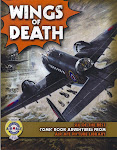
Officially released on 1 April 2010, Wings of Death is the follow-up to Aces High and the second volume of stories to be selected from the hugely collectable Air Ace Picture Library.

Order your copy now from Amazon.co.uk.

Contents:

Sky High (AAPL 5, Mar 1960) Art: Solano Lopez; Script: E. W. Evans.
Torpedo Alley (AAPL 18, Aug 1960) Art: Ian Kennedy; Script: David Satherley.
U-Boat Hunters (AAPL 21, Sep 1960) Art: Kurt Caesar; Script: (unknown).
Eagle Warrior (AAPL 23, Oct 1960) Art: Mike Western: Script: (unknown).
Last of the Gladiators (AAPL 37, Jan 1961) Art: Ferdinando Tacconi; Script: (unknown).
Killer Instinct (AAPL 43, Mar 1961) Art: Luis Bermejo; Script: (unknown).

Further information and details can be found in our book The Fleetway Picture Library Index Vol. 1: The War Libraries.

Synopsis:

Relive the daring and terrifying adventures of the flyers of the Second World War in six of the most exciting stories from Air Ace Picture Library.

These superbly drawn comic strips, which have been reproduced 25 per cent bigger than the originals, brilliantly evoke the fighting machines that were pitted against each other - the Spitfires, Hurricanes and Messerchmitts, the Lancasters, Wellingtons and Focke-Wulfs.

From Battle of Britain dogfights over Blighty to flak-blasted bombing missions over the Fatherland, these classic comic book adventures put you in the cockpit alongside the RAF heroes who helped to bring Nazi Germany to her knees.

No Surrender!

Officially published on 1 April 2010, No Surrender! is the latest volume to gather stories from the classic Fleetway War Picture Library, following on from Unleash Hell, Against All Odds and Up and At 'Em.

Order your copy now from Amazon.co.uk.

Contents:

Battle Drop (WPL 67, Sep 1960) Art: Gino D'Antonio; Script: A. Carney Allan.
Aces High (WPL 78, Dec 1960) Art: Nevio Zeccara; Script: I. B. Kellie.
Up the Marines! (WPL 58, Jul 1960) Art: Hugo Pratt; Script: Donne Avenell.
Close Range (WPL 63, Aug 1960) Art: Luis Bermejo; Script: Douglas Leach.
Bombers Moon (WPL 72, Nov 1960) Art: Ferdinando Tacconi; Script: D. M. Garbutt.
Danger Dives Deep (WPL 65, Sep 1960) Art: Jose Bielsa; Script: David Satherley.

Further information and details can be found in our book The Fleetway Picture Library Index Vol. 1: The War Libraries.

Synopsis:

Evoking the danger and excitement of the front line during the Second World War, these six classic stories from War Picture Library capture adrenaline-pumping action from battle zones across the world.

From the baking deserts of Africa to the steaming jungles of the Far East, from the beaches of Normandy to the waters of the Atlantic, these exhilerating comic book adventures were brilliantly created by artists whose attention to detail was second to none.

Now reproduced 25 per cent bigger than the originals, you can relive the heat of WW2 combat in all its intensity.

Hit the Dirt

Officially released on 1 April 2010, Hit the Dirt is a collection of six complete stories from Battle Picture Library, the third selection from Carlton following on from Death or Glory and Let 'Em Have It!.

Order your copy now from Amazon.co.uk.

Contents:

Top Secret (BPL 160, Jun 1964) Art: Aldoma Puig; Script: Norman Worker.
Diggers Defiant (BPL 128, Oct 1963) Art: Martin Salvador; Script: Paul Greenfield.
Fire - and Destroy (BPL 119, Aug 1963) Art: Victor de la Fuente; Script: Justin Long.
Honours Even (BPL 133, Dec 1963) Art: Jose Ortiz; Script: Douglas Leach.
The Scorpion's Sting (BPL 129, Nov 1963) Art: Josep Marti; Script: A. Carney Allan.
Blood Feud (BPL 123, Sep 1963) Art: Juan Gonzalez Alacreu; Script: R. P. Clegg.

Further information and details can be found in our book The Fleetway Picture Library Index Vol. 1: The War Libraries.

Synopsis:

Focusing on the intensity of the battle fought on land, these six gripping stories from Battle Picture Library carry you straight into life-or-death combat situations on the front line during the Second World War.

Hear the bullets fly, see the shells burst and feel the shockwaves of exploding grenades in these classic comic book adventures which are reproduced 25 per cent bigger than the originals for maximum fighting-action impact.

Raymond Hawkey (1930-2010)

Designer and author Raymond Hawkey died on Sunday, 22 August, aged 80. Born in Plymouth, Devon, on 2 February 1930, the only son of John Hawkey, a commercial traveller, and his wife Constance (née Steckhahn). Whilst his father hoped Hawkey would become an accountant, the young boy preferred drawing. He won a scholarship to the local grammar school and, at 16, began attending Plymouth School of art. Two years later he won a scholarship to the Royal College of Art, studying illustration for a year before switching to graphics course.

Hawkey became the assistant director of ARK, the RCA magazine, and supplemented his grant by working for the Central Office of Information and working part time for the picture department of the Sunday Graphic. He won a deign competition sponsored by Vogue and was offered a job by Condé Nast. Quickly establishing himself as an art director of note, he briefly worked for the advertising agency Colmon Prentis and Varley before joining the Daily Express in 1959 where he was considered a trailblazer in the use of illustration and graphics in news reports.

In 1964 he became presentations director of The Observer and helped launch their colour magazine, winning the Newspaper Design Award twice during his 11 years with the paper. From 1975 he worked as a consultant on numerous magazines and newspapers, his clients including IPC, the Daily Mail and The Independent.

To the wider world he was better known for his book cover designs. When Len Deighton, a fellow student at the RCA, sold his first novel to Hodder & Stoughton, he suggested that they employ Hawkey to design the dust jacket. Hodder were unimpressed by the stark, minimalist image of a Smith & Wesson revolver laying next to a chipped cup with a cigarette stubbed out on its saucer and refused to pay more than 15 guineas (its standard fee) out of the agreed 50. Deighton had to stump up the balance. The IPCRESS File became a best-seller and the cover an iconic image from the 1960s and was reused in the late 1960s for the Panther paperback.

The book's success meant that Hawkey was invited back, following Deighton to Jonathan Cape, who also published Ian Fleming's James Bond books. Hawkey then became the designer of the 1963 Pan editions of the Bond novels, with the innovation of putting the name JAMES BOND at the top of each book in larger type than both the title and Fleming's byline. Another Hawkey innovation on Thunderball was to have two bullet holes die-cut into the cover, a photograph of a girls' back. Hawkey used a similar device when he designed the covers for Richard Stark's novels published by Coronet in 1969-74. You can see more of Hawkey's innovative designs in two of the galleries I've published at Bear Alley: James Bond and Len Deighton. He also provided covers for Kingsley Amis, Frederick Forsyth and Gavin Lyall as well as designing the title sequence for the Deighton-scripted film, Oh! What a Lovely War.

The full title sequence for Oh! What a Lovely War can be found here.
Hawkey also wrote three novels: Wild Card (1974), Side-Effect (1979) and It (1983, also published as End Stage). He lived for many years in a flat in Notting Hill and is survived by his wife, Mary, whom he married in 1989.

Obituaries: Daily Telegraph (31 August), The Guardian (31 August). There is also an excellent tribute by Edward Milward-Oliver (24 August).

(* The photo I found here on a website dedicated to spy fiction, Mister 8. Not sure what the copyright situation is on this one.)

TV Tie-ins: Act of Betrayal

Act of Betrayal by Michael Chaplin. Corgi 0-552-13437-6, 1988, 265pp, £2.99. Cover: still [Elliott Gould].

A Griffin Production for TVS Television in association with ABC Australia, RTE and Strongbow. Producers: Nick Evans & Ray Alchin; Executive Producers: Graham Benson, Michael Deakin, Joe Mulholland, John Kelleher; Director: Lawrence Gordon Clark; Screenplay: Nick Evans & Michael Chaplin; Starring: Elliott Gould (Callaghan), Lisa Harrow (Eileen McGurk), Patrick Bergin (Michael McGurk), Bryan Marshall (Brian Kennedy), Krister Greer (Sean McGurk). IMDB.
A terrorist bomb explodes in London's West End a few days before Christmas, killing and maiming many. In Belfast, a top-ranking IRA man, Michael McGurk, sickened by the violence, walks into a police station and turns 'supergrass'.
__In revealing the secrets of his fellow terrorists, McGurk cuts himself off not only from his family and friends, but also from the beliefs that have previously ruled his life. He risks losing the love and respect of his wife and son - and earns the undying hatred of the movement he has damaged so badly.
__When a grateful British govenment provide the McGurks with new identities and a new home twelve thousand miles from the battered streets of Belfast, the IRA send their most experienced hitman on a chilling mission: to track down the family, and avenge the act of betrayal.
Michael Chaplin (1951- ) is a screenwriter and producer who went on to create Grafters and Monarch of the Glens. He won an Edgar Award from the Mystery Writers of America for his screenplay "On Beulah Heights" from the Dalziel & Pascoe series. More recently he was one of the writers on the BBC's Robin Hood.

BEAR ALLEY BOOKS

BEAR ALLEY BOOKS
Click on the above pic to visit our sister site Bear Alley Books