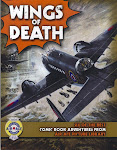
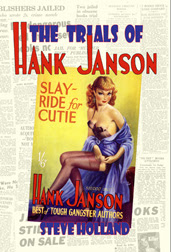
Work on the Gwyn Evans quartet of books continues. I now have book four scanned, although I haven't started on cleaning up the text yet. I'm still part-way through book three on that front. I'm still tinkering with cross-promotional adverts to put into the books and I still haven't gotten around to the covers. But as this is all being done in spare moments, I've surprised myself at how far I've managed to get!
I've produced a little chart so you can follow the progress of the books over the next couple of weeks.
As for paying work, I've almost run out and will be unemployed within the next couple of weeks. Being an eternal optimist – although that's against all the evidence of late – I'm sure something will come along.
I'm taking a look at Hanna below the picture... warning, there are spoilers galore here!
At only eight episodes, I managed to watch Hanna over only a couple of evenings while Mel was helping a friend at a convention. I was looking forward to this as I am a big fan of the original movie that the TV show is based on.
Hanna (Esme Creed-Miles) has been raised in isolation by her father, Erik Heller (Joel Kinnaman), who trains her in hunting, fighting, while trying to educate her about the world she has never seen beyond the confines of the Polish forest. Hanna begins to venture further into the forest and stumbles upon Arvo, a teenage logger who introduces her to chocolate. She spends time with Arvo, watching the stars atop a satellite dish. Unfortunately, climbing onto the dish triggers an appearance by the police, who arrest Arvo as Hanna runs.
Word of this encounter reaches Marissa Wiegler (Mireille Enos), a CIA agent who was involved in the death of Hanna's mother fifteen years earlier. Knowing that they have little time, Erik Heller leaves for Berlin and Hanna allows herself to be captured.
At a mysterious facility, Hanna asks to speak to Wiegler. The CIA instead introduce her to a lookalike. Hanna kills her and breaks out into the facility, grabbing some papers on the way before emerging in the desert. With an army of vehicles chasing her, she fortunately runs into a young teenage girl, Sophie (Rhianne Barreto), on holiday with her family and they drive to a Moroccan market town.
Beyond a little expansion, the TV show has followed the movie faithfully. However, as we hit episode three, things begin to diverge. Heller and Hanna meet in Berlin, and Heller recruits a team to help him observe and then kill Wiegler at her hotel. Wiegler, meanwhile, has located and threatened one of Heller's team and is expecting the attack.
Hanna (who ignores every effort to keep her out of danger) discovers that Heller is not her biological father, refuses to escape with him and instead we next find her in London. She is hiding in the camper van garaged around the corner from where Sophie and her family live. Her relationship with Sophie fractures when Hanna sleeps with a boy Sophie fancies. At that same moment, Marissa Wiegler arrives, having discovered a photo of Hanna' in Sophie's social media feed.
Hanna allows Marissa to take her away. She tells Hanna that Erik Heller is dead... but he is not. Instead, he is being tortured by the CIA operatives who have taken over the case from Marissa, who is now considered a rogue operative.
Comparing the new Hanna to the 2011 movie proves just how spare you can make a script without damaging the plot. You did not know Hanna's origins when she was played by Saoirse Ronan. There were hints at some bigger project – the movie's Marissa (Cate Blanchett) burning documents – and Erik (Eric Bana) revealing at the end that Hanna was part of an experiment to create super soldiers. But this was just the McGuffin that caused the movie – now, in the TV series, we get to meet those super soldiers.
I wonder whether this was writer David Farr's original intention. He was, after all, a regular writer on Spooks and may have pitched Hanna as a TV show first before stripping it back to become a movie.
For the TV show the action scenes are heightened, the storyline expanded and, as mentioned, we get to see the super soldier facility at the end. My initial thought that this would be an issue fizzled out as I was caught up in the continuing story. This is a tricky one to grade as I think I'd give the TV series higher marks and a rave review if I hadn't already seen the movie and rated that so highly. If you've not seen the movie, watch the TV series; if you have seen the movie, I think you'll find the expansion of the storyline satisfying. I certainly did.
Today's random scans... some novels by people also known for their comic strips...
Friday, April 12, 2019
Wednesday, April 10, 2019
Rebellion releases (2000AD)
Rebellion releases for 10 April 2019.
2000AD Prog 2126
Cover: D'Israeli
JUDGE DREDD: THE LONG GAME by Michael Carroll (w) M ark Sexton (a) John Charles (c) Annie Parkhouse (l)
SURVIVAL GEEKS: DUNGEONS & DATING (BASIC) by Emma Beeby, Gordon Rennie (w) Neil Googe (a) Gary Caldwell (c) Annie Parkhouse (l)
KINGMAKER: OUROBOROS by Ian Edginton (w) Leigh Gallagher (a) Ellie De Ville (l)
MAX NORMAL: HOW THE MAX GOT HIS STRIPES by Guy Adams (w) Dan Cornwell (a) Jim Boswell (c) Simon Bowland (l)
SCARLET TRACES: HOME FRONT by Ian Edginton (w) D'Israeli (a) Ellie De Ville (l)
2000AD Prog 2126
Cover: D'Israeli
JUDGE DREDD: THE LONG GAME by Michael Carroll (w) M ark Sexton (a) John Charles (c) Annie Parkhouse (l)
SURVIVAL GEEKS: DUNGEONS & DATING (BASIC) by Emma Beeby, Gordon Rennie (w) Neil Googe (a) Gary Caldwell (c) Annie Parkhouse (l)
KINGMAKER: OUROBOROS by Ian Edginton (w) Leigh Gallagher (a) Ellie De Ville (l)
MAX NORMAL: HOW THE MAX GOT HIS STRIPES by Guy Adams (w) Dan Cornwell (a) Jim Boswell (c) Simon Bowland (l)
SCARLET TRACES: HOME FRONT by Ian Edginton (w) D'Israeli (a) Ellie De Ville (l)
Monday, April 08, 2019
Eagle Times v32 no1 (Spring 2019)
The new volume of Eagle Times begins with a strong issue that feels like it concentrates on comics rather more than other subjects, which has not been the case for some while.
The issue begins with the story of an unlikely meeting with Nikita Kruschev at a filling station in Sussex might have led to Dan Dare inspiring the Russian space programme, and a piece about T. E. Lawrence (of Arabia), who was to have been the subject of a back-page biography.
The meat of the issue begins with Jim Duckett's article about Look-In, the colourful television tie-in comic that ran for 23 years in 1971-94, which had many connections to the Eagle group of comics through its artists.
Next, Steve Winders offers a first look (of two) at the travels of Marco Polo, hero of the 1959 back-cover saga drawn by Frank Bellamy and Peter Jackson (Bellamy, of course, was sidelined to draw Dan Dare, so was only able to contribute the first eight issues).
Jeremy Briggs' article on the centrespreads of the later 'New' Eagle introduces Peter Sarson, the regular artist, who produced almost 50 cut-away drawings between 1990 and 1991, almost half of which were subsequently reprinted in the Eagle monthly in 1991-93. Sarson is also interviewed in this issue with plenty of his cut-aways used as illustrations.
After a brief look back at some of the actors suggested to play Dan Dare in the proposed 1991 TV series, we're back to the printed page with part 4 of David Britton's history of Charles Chilton's Jeff Arnold and his activities during the Indian Wars, this episode offering a look at the historical reality vs. the comic strip version of the Battle of Little Big Horn.
Finally, even Steve Winders' PC49 short story turns into a meta-fiction as Archie meets Frank Hampson.
As ever, there's always something new that can be written about Eagle and, having opened the magazine up to other comics and other subjects, the Eagle Times always manages to remain fresh and interesting.
The quarterly magazine is the journal of the Eagle Society, with membership costing £29 in the UK, £40 (in sterling) overseas. You can send subscriptions to Bob Corn, Wellcroft Cottage, Wellcroft, Ivinghoe, Leighton Buzzard, Bedfordshire LU7 9EF; subs can also be submitted via PayPal to membership@eagle-society.org.uk. Back issues are available for newcomers to the magazine and they have even issued binders to keep those issues nice and neat.
The issue begins with the story of an unlikely meeting with Nikita Kruschev at a filling station in Sussex might have led to Dan Dare inspiring the Russian space programme, and a piece about T. E. Lawrence (of Arabia), who was to have been the subject of a back-page biography.
The meat of the issue begins with Jim Duckett's article about Look-In, the colourful television tie-in comic that ran for 23 years in 1971-94, which had many connections to the Eagle group of comics through its artists.
Next, Steve Winders offers a first look (of two) at the travels of Marco Polo, hero of the 1959 back-cover saga drawn by Frank Bellamy and Peter Jackson (Bellamy, of course, was sidelined to draw Dan Dare, so was only able to contribute the first eight issues).
Jeremy Briggs' article on the centrespreads of the later 'New' Eagle introduces Peter Sarson, the regular artist, who produced almost 50 cut-away drawings between 1990 and 1991, almost half of which were subsequently reprinted in the Eagle monthly in 1991-93. Sarson is also interviewed in this issue with plenty of his cut-aways used as illustrations.
After a brief look back at some of the actors suggested to play Dan Dare in the proposed 1991 TV series, we're back to the printed page with part 4 of David Britton's history of Charles Chilton's Jeff Arnold and his activities during the Indian Wars, this episode offering a look at the historical reality vs. the comic strip version of the Battle of Little Big Horn.
Finally, even Steve Winders' PC49 short story turns into a meta-fiction as Archie meets Frank Hampson.
As ever, there's always something new that can be written about Eagle and, having opened the magazine up to other comics and other subjects, the Eagle Times always manages to remain fresh and interesting.
The quarterly magazine is the journal of the Eagle Society, with membership costing £29 in the UK, £40 (in sterling) overseas. You can send subscriptions to Bob Corn, Wellcroft Cottage, Wellcroft, Ivinghoe, Leighton Buzzard, Bedfordshire LU7 9EF; subs can also be submitted via PayPal to membership@eagle-society.org.uk. Back issues are available for newcomers to the magazine and they have even issued binders to keep those issues nice and neat.
Sunday, April 07, 2019
Sydney Prior Hall
SYDNEY PRIOR HALL
by
Robert J. Kirkpatrick
For collectors of children’s books, Sydney Prior Hall is best-known for his illustrations, alongside those of Arthur Hughes, in the first illustrated edition of Tom Brown’s Schooldays, published in 1869. But in his time he was best-known as an illustrator for the weekly paper The Graphic between 1870 and 1910. He was also a noted painter and portrait artist.
He was born in Newmarket, Suffolk, on 18 October 1842, the first of eight children of Henry Hall (1815-1882), a noted painter of horses and sporting subjects, and his wife Ellen Anne, née Payne (1823-1905). (Note that his name is often incorrectly spelt as “Sidney” – he is also often referred to as “Sydney (or Sidney) P. Hall”, which is how he usually signed his work. However, he occasionally used “S.P. Hall” or “S.P.H.”).
He was educated at Newmarket Grammar School and then, from Easter 1855, at Merchant Taylor’s School, London – at the time of the 1861 census he was living as a boarder (and described as a scholar) at 18 Guilford Street, St. Pancras. He was then awarded a scholarship to Pembroke College, Oxford, where he obtained second classes in classical and modern moderations in 1863 and a first in literae humaniores in 1865. He was later awarded an MA in 1871.
Whilst at Oxford he produced a series of 100 “Oxford Sketches”, caricatures of local people and events, which were privately circulated before Hall had them published by James Ryman, an Oxford printseller and photographer, in 1870. From Oxford, having ignored his father’s desire for him to establish a career in the church, he entered the Royal Academy Schools, and he subsequently exhibited at the Royal Academy 15 times between 1875 and 1910.In 1870 he joined the staff of the newly-launched The Graphic, established as a rival to The Illustrated London News, after sending in a couple of sketches of Oxford sports and a large drawing of the University Boat Race. His first major commission was to cover the Franco-Prussia War (1870-1871) – famously, his drawings of the siege of Paris were sent to London by balloon. He also wrote about his experiences in a series of articles. A selection of his work from France was later published in Sketches from an Artist’s Portfolio in 1875. (An earlier selection of his Graphic drawings had appeared in 1873.) He subsequently undertook several foreign tours as a Graphic artist, for example accompanying the Prince of Wales on a trip to India in 1875; the Duke of Argyll (better-known as the Marquess of Lorne) on his trips to Canada in 1879 and 1881; and the Duke and Duchess of York when they sailed on the Royal Yacht H.M.S. Ophir to Australia in 1901-1902. Immediately prior to this last trip, he was appointed a Member of the Royal Victorian Order (MOV) in March 1901.
Throughout much of the first half of the 1870s Hall lived, at 39 Birkbeck Road, Islington, with Emma Dinah Holland, born in 1845 in St. Pancras and the daughter of John Holland, a cellarman. They had a son, Henry Reginald Holland Hall, born on 30 September 1873 (although he was not baptized, at St. Mary’s Church, Harrow, Middlesex, until 19 January 1884). Sydney and Emma subsequently married on 14 January 1877 at Islington Register Office, when they were living at 3 Pyrland Villas, Calverley Grove, Archway. (Henry Reginald, usually referred to as Harry Reginald Hall, went to become Keeper of Egyptian and Assyrian Antiquaries at the British Museum, and undertook several archeological excavations in the Far East. He received the MBE, and died in 1930.)
Sydney and Emma moved to 10 Lilyville Road, Fulham, and in the mid-1880s moved again to 20 Manor Mansions, Belsize Park Gardens, Hampstead. Between around 1876 and 1885 Sydney had a studio at 7 The Avenue, 76 Fulham Road, having earlier had a studio at 39A Queen’s Square, Bloomsbury. In 1889, the couple moved to 13 Chalcot Gardens, Belsize Park, and Sydney also moved to another studio at 5 Wychcombe Studios, Belsize Park.As well as being on the staff of The Graphic, where he continued to focus on Royal, political and other major events, Sydney Prior Hall also occasionally worked for other periodicals, such as The Quiver, Dark Blue, London Society, Cassell’s Family Magazine, Harper’s Magazine, Belgravia, The Girl’s Own Paper, The Million, The Golden Penny, The Art Journal and The Sketch. As a book illustrator, he was mainly associated with travel books, several of which contained his illustrations from The Graphic. He also illustrated a handful of children’s books, beginning with the first illustrated edition of Tom Brown’s Schooldays (dated 1869 but actually published in December 1868) in partnership with the illustrator Arthur Hughes. (Hughes was best-known as a Pre-Raphaelite painter and illustrator – he received his art training at the School of Design at Somerset House and then, from 1847, at the Royal Academy Schools.) Hall’s contributions to Tom Brown were a mixture of small sketches of Rugby School and scenes from the novel, 14 drawings in total (whereas Hughes supplied 43). He went to illustrate the sequel, Tom Brown at Oxford, in 1870. He also illustrated Recollections of Eton (published anonymously in 1870 but written by Charles Frederick Johnstone), a handful of boy’s adventure stories, and a couple of books for younger children.
Emma Hall died at 13 Chalcot Gardens on 6 April 1894. Eight years later, on 4 August 1906 at All Saints Church, Finchley Road, St. John’s Wood, Hall married Mary Lightbody Gow. Born in Islington on 25 December 1851, she was herself an artist and the daughter of James Gow, another artist. (In addition her brother Andrew Garrick Gow was also an artist, who became a member of the Royal Academy in 1891 and later Keeper of the Royal Academy.) Having been trained at Heatherley’s School of Art, Mary Gow had exhibited widely since 1869, with the Royal Society of British Artists and at the Royal Academy. She had also been a member of the Royal Institute of Painters in Watercolour between 1875 and 1903.In the 1911 census she and Sydney were recorded at 36 Grove End Road, St. John’s Wood, living with Charles Gow, Mary’s brother who was a widowed bank manager. Between 1910 and 1916 they were also recorded as having a home at 7B Elm Tree Road, St. John’s Wood (the address he gave when he exhibited at the Royal Academy in those years – he went on to exhibit there in 1918, 1919 and 1920).
Sydney Prior Hall died at 36 Grove End Road on 15 December 1922, leaving an estate valued at £1,700 (around £85,000 in today’s terms). His wife died on 27 May 1929, leaving £28,529.
As an illustrator, Sydney Prior Hall was always referred to in very positive terms. The Graphic commissioned numerous pencil portraits from him, most notably during the hearings of the Parnell Commission (a judicial inquiry into allegations of criminality by the Irish parliamentarian Charles Stewart Parnell in 1888-1889). Hall was present every day, producing over 200 drawings, with The Art Journal later observing (in 1905) that “The fighting figure of Parnell fascinated him, and he brought out the Irish leader’s personality very remarkably. This rendering of character in action necessitates a sense of humour, and in Mr Hall’s sketches appear frequent gleams of that faculty.” The journalist and author George Augustus Sala (in his 1896 autobiography) called him “that prince of rapid sketchers, and master of impressionist effects.”
He was also a prolific painter, in both oils and watercolours, and was a member of the Society of Portrait Painters and The Pastel Society, As well as exhibiting at the Royal Academy, he also exhibited widely elsewhere, including with the Dudley Art Society, the Grosvenor Gallery, and at the Paris Salon in 1904. Many of his portraits are held by the National Portrait Gallery. He was a founder member of the Arts and Literature Dilettetante Society in 1880, and in the mid-1890s he became a member of the International Society of Wood Engravers. He was also a member of the Savage Club.
PUBLICATIONS
Books written and illustrated by Sydney Prior Hall
Oxford Sketches, James Ryman, 1870
The Travellers’ Sketch Book: Pictures of People and Places in Europe, “The Graphic”, 1873
Sketches from an Artist’s Portfolio, Sampson Low, Marston, Low & Searle, 1875
Key Book to “Oxford Sketches”, Oxford Union, 1909
Books illustrated by Sydney Prior Hall
The Comic Aldrich: An Attempt to Induce Oxford Men to Chop Logic Instead of Cutting It by H.D. Traill, T. & G. Shrompton, 1866
Tom Brown’s Schooldays by Thomas Hughes, Macmillan & Co., 1868 (with Arthur Hughes) (re-issue)
From London Bridge to Lombardy by a Macadamised Route by W.R. Richardson, Sampson Low, Son & Marston, 1869
Recollections of Eton by Charles Frederick Johnstone, Chapman & Hall, 1870
Lost, or What Became of a Slip from “Honour Bright” by John Christopher Atkinson, Sampson Low, Son & Marston, 1870
Tom Brown at Oxford by Thomas Hughes, Macmillan & Co., 1870 (re-issue)
Old Town Folk by anon. (Harriet Beecher Stowe), Sampson Low, Son & Marston, 1870 (re-issue)
All Round the World: Adventures in Europe, Asia, Africa and America by Parker Gillmore, Chapman & Hall, 1871
Ben Burton, or Born and Bred at Sea by W.H.G. Kingston, Sampson Low, Marston, Searle & Rivington, 1872
Clara Vaughan by R.D. Blackmore, Sampson Low, Marston, Searle & Rivington, 1872
The Parisians with a prefatory note by Edward Bulwer Lytton, W. Blackwood & Sons, 1873
The Law and the Lady by Wilkie Collins, Chatto & Windus, 1867 (with other artists)
The Princes of Wales’ Tour: A Diary in India etc. etc. by Sir Howard Russell, Sampson Low, Marston, Searle & Rivington, 1877
Adventures in Many Lands by Parker Gillmore, Marcus Ward & Co., 1879
Canadian Pictures, Drawn with Pen and Pencil by John Douglas Cambell, Religious Tract Society, 1884 (with other artists)
Old England’s Story in Little Words for Little Children by “Brenda”, Hatchards, 1884 (with other artists)
Round the Ring: Stories, Pictures and Poems for All the Year, Worthington & Co., 1887
Our Little Dots’ Picture Scrap Book, Religious Tract Society, 1890 (with other artists)
Charles Stewart Parnell: An Illustrated Biography, “The Daily Graphic”, 1891(?) (with other artists)
Artistic Travel in Normandy, Brittany, the Pyranees, Spain and Algeria by Henry Blackburn, Sampson Low, Marston & Co., 1892 (with other artists)
Parliamentary Pictures and Personalities, Sampson Low, Marston & Co., 1893 (with other artists)
Czar and Sultan: The Adventures of a British Lad in the Russo-Turkish War of 1877-78 by Archibald Forbes, J.W. Arrowsmith, 1894
The King’s Reeve and How He Supped with His Master by Edward Gilliat, Seeley & Co., 1898
The Web of Empire: A Diary of the Imperial Tour of their Royal Highnesses the Duke and Duchess of Cornwall and York in 1901 by Donald Mackenzie Wallace, Macmillan & Co., 1902 (with Eduardo de Martino)
Cassell’s History of England, Cassell & Co., 1902 (part-work) (with other artists) (re-issue)
Western Odyssey 1881 by John Douglas Campbell, Public Archives of Canada, 1975
Friday, April 05, 2019
Comic Cuts - 5 April 2019
The week began with the frustrating non-appearance of my piece on Harry Bensley, perpetrator of the Iron Mask 'Walking Round the World' hoax, which was due to be broadcast on The One Show on Monday but which was then dropped. I must confess that having the arch hoaxer celebrated on April Fool's Day was more than I could have hoped for... but it was not to be. I have no idea why it was dropped, but it was almost certainly something as simple as another spot overrunning – not too difficult when your guests for the evening include Paddy McGuinness and Gyles Brandreth.
McGuinness was on to promote a new BBC quiz show called Catchpoint, which involves coloured balls being dumped onto contestants from above. They have to catch the right coloured ball. Is it any wonder that McGuinness was able to squeeze out any number of innuendos. At one point he stopped to tell the studio audience "Stop sniggering. You're not at school!" Meanwhile, some of Gyles Brandreth's jumpers are being exhibited at the V&A.
And for this Harry Bensley was bumped. I'll let you all know when he's due again. Hopefully soon, as I wasn't paid to do any of the filming or for supplying the images and clippings. I thought I'd make a bit of money back from a bump in sales of the book, which is languishing at number 1,683,890 in Amazon's bestsellers ranking. That's way below the first volume of Forgotten Authors, which is at 737,638 and sold just two copies last month. The fourth volume is two million places below that!
I can see the light at the end of the tunnel for the work I've been doing writing company profiles. I have a couple of week's worth of work left, after which I have some work to do on a book, but that should take only a few days. By the end of the month I'm going to be unemployed again.
The devil finds work for idle hands and, oddly enough, I've been working on Satan Ltd., the third of a quartet of reissues of old Gwyn Evans novels that I'm planning to publish under the Bear Alley imprint. This, I suspect, will not be a money-spinner, but it's a project close to my heart and while I can do it in my spare time while I'm earning money... well, that's the time to do it.
So I now have the text of the first two books done, the first book laid out and the second waiting in the wings while I work on the text for the third book. I've scanned the whole book and converted the scans into a text file using OCR and I'm now going through it, weeding out the inevitable errors that sneak into an OCR text.
Although doing it this way is a far quicker than retyping the whole book, it still takes time: 300 scans at high resolution, converting those into a format so that the images can be "read" and turned into text... I was working solidly all Saturday and something as simple as holding a book flat on a scanner 300 times can lead to a repetitive strain injury – in this case a nasty crick in the neck – that lasts for a couple of days.
And I've had an hour's less sleep, although, bizarrely, the clocks going forward has done me a favour. I had been waking up ridiculously early, any time between four and five. Well, now that's between five and six and I get up at six anyway. Thanks BST! Now, if only we could stick with it. A permanent move to British Summer Time would save a lot of hassle every year and everyone feeling jet-lagged for a couple of days.
Nightflyers began as a 23,000-word novella by George R. R. Martin (1980), was expanded by 7,000 words by Martin for a 1981 anthology collection, and subsequently filmed as the 1987 movie starring Catherine Mary Stewart and Michael Praed. Martin was co-credited with the screenplay for the latter but it was actually written by the film's producer Robert Jaffe who used the original version, inventing his own names for secondary characters who had been named by Martin in the 1981 expansion.
Now we have the 2018 SyFy TV serial version. For anyone who hasn't seen it but is planning to, look away now.
I'm not the biggest fan of the crossover sci-fi/horror genre that is essentially a haunted house yarn. Ridley Scott's Alien nailed it and everything after that has paled in comparison. There was a spate of films in the late 1990s that relied on cross-dimensional horrors on a spaceship: Event Horizon (1997) and Supernova (2000) were glossier versions of the Nightflyers movie, and films like Alien Cargo (1999) had equally familiar plots about bringing something on board that begins killing everybody that has been used most recently in Life (2017).
I didn't think much of Event Horizon when I saw it at the cinema, but at least it was over and done with after 90 minutes. The new Nightflyers TV series stretches out its movie-length premise to ten episodes. The show leaves no cliche unturned. The spaceship Nightflyer is sent off to contact an alien space craft, a mission headed by Karl D'Branin, who has brought a telepath (Thale) on board along with his doctor, Agatha Matheson, who happens to be Karl's ex.
And so the cliches begin: Karl has abandoned his wife following the death of his daughter, who he keeps seeing wandering the corridors of the Nightflyer; the glowering Thale has, of course, caused the death of people with friends on board, who fear and despise him; the Captain refuses to interact physically with the crew, instead only appearing as a hologram; the woman who plugs into the ship in order to pilot it is taken over by the ship; a HAL-like glowing eye signals bad activity within the shipboard computer; a probe brings back some biological substance which begins to grow; a pregnant woman gives birth to something not human; and there's even a scientist driven mad who turns into an axe-wielding maniac. Oh, and space cannibals.
Its all the scripts for the above mentioned films cut into strips and glued back together again in random order, like a William Burroughs cut-up experiment. Some of the individual elements were quite effective – the death of Tessia the bee lady's baby and her subsequent death – and some of it was just plain daft – she and her baby have to die to give motivation to the her boyfriend's descent into madness, which involves eating honey in a creepy way and doing a bad Jack Nicholson/Jack Torrance impersonation.
Too many times the crew suffer some trauma, only to forget/ignore it in the next scene where they're required for something else. Even the axe-man is invited back to work.
The show was cancelled at the end of the first season and I can't say that I'm surprised. Jump scares are part of the language of horror on the screen, but viewers need to give a damn about the characters if you want to bring some genuine horror to your haunted spaceship. There's nothing new here.
To end, we'll have a few more covers on the theme of time...
McGuinness was on to promote a new BBC quiz show called Catchpoint, which involves coloured balls being dumped onto contestants from above. They have to catch the right coloured ball. Is it any wonder that McGuinness was able to squeeze out any number of innuendos. At one point he stopped to tell the studio audience "Stop sniggering. You're not at school!" Meanwhile, some of Gyles Brandreth's jumpers are being exhibited at the V&A.
And for this Harry Bensley was bumped. I'll let you all know when he's due again. Hopefully soon, as I wasn't paid to do any of the filming or for supplying the images and clippings. I thought I'd make a bit of money back from a bump in sales of the book, which is languishing at number 1,683,890 in Amazon's bestsellers ranking. That's way below the first volume of Forgotten Authors, which is at 737,638 and sold just two copies last month. The fourth volume is two million places below that!
I can see the light at the end of the tunnel for the work I've been doing writing company profiles. I have a couple of week's worth of work left, after which I have some work to do on a book, but that should take only a few days. By the end of the month I'm going to be unemployed again.
The devil finds work for idle hands and, oddly enough, I've been working on Satan Ltd., the third of a quartet of reissues of old Gwyn Evans novels that I'm planning to publish under the Bear Alley imprint. This, I suspect, will not be a money-spinner, but it's a project close to my heart and while I can do it in my spare time while I'm earning money... well, that's the time to do it.
So I now have the text of the first two books done, the first book laid out and the second waiting in the wings while I work on the text for the third book. I've scanned the whole book and converted the scans into a text file using OCR and I'm now going through it, weeding out the inevitable errors that sneak into an OCR text.
Although doing it this way is a far quicker than retyping the whole book, it still takes time: 300 scans at high resolution, converting those into a format so that the images can be "read" and turned into text... I was working solidly all Saturday and something as simple as holding a book flat on a scanner 300 times can lead to a repetitive strain injury – in this case a nasty crick in the neck – that lasts for a couple of days.
And I've had an hour's less sleep, although, bizarrely, the clocks going forward has done me a favour. I had been waking up ridiculously early, any time between four and five. Well, now that's between five and six and I get up at six anyway. Thanks BST! Now, if only we could stick with it. A permanent move to British Summer Time would save a lot of hassle every year and everyone feeling jet-lagged for a couple of days.
Nightflyers began as a 23,000-word novella by George R. R. Martin (1980), was expanded by 7,000 words by Martin for a 1981 anthology collection, and subsequently filmed as the 1987 movie starring Catherine Mary Stewart and Michael Praed. Martin was co-credited with the screenplay for the latter but it was actually written by the film's producer Robert Jaffe who used the original version, inventing his own names for secondary characters who had been named by Martin in the 1981 expansion.
Now we have the 2018 SyFy TV serial version. For anyone who hasn't seen it but is planning to, look away now.
I'm not the biggest fan of the crossover sci-fi/horror genre that is essentially a haunted house yarn. Ridley Scott's Alien nailed it and everything after that has paled in comparison. There was a spate of films in the late 1990s that relied on cross-dimensional horrors on a spaceship: Event Horizon (1997) and Supernova (2000) were glossier versions of the Nightflyers movie, and films like Alien Cargo (1999) had equally familiar plots about bringing something on board that begins killing everybody that has been used most recently in Life (2017).
I didn't think much of Event Horizon when I saw it at the cinema, but at least it was over and done with after 90 minutes. The new Nightflyers TV series stretches out its movie-length premise to ten episodes. The show leaves no cliche unturned. The spaceship Nightflyer is sent off to contact an alien space craft, a mission headed by Karl D'Branin, who has brought a telepath (Thale) on board along with his doctor, Agatha Matheson, who happens to be Karl's ex.
And so the cliches begin: Karl has abandoned his wife following the death of his daughter, who he keeps seeing wandering the corridors of the Nightflyer; the glowering Thale has, of course, caused the death of people with friends on board, who fear and despise him; the Captain refuses to interact physically with the crew, instead only appearing as a hologram; the woman who plugs into the ship in order to pilot it is taken over by the ship; a HAL-like glowing eye signals bad activity within the shipboard computer; a probe brings back some biological substance which begins to grow; a pregnant woman gives birth to something not human; and there's even a scientist driven mad who turns into an axe-wielding maniac. Oh, and space cannibals.
Its all the scripts for the above mentioned films cut into strips and glued back together again in random order, like a William Burroughs cut-up experiment. Some of the individual elements were quite effective – the death of Tessia the bee lady's baby and her subsequent death – and some of it was just plain daft – she and her baby have to die to give motivation to the her boyfriend's descent into madness, which involves eating honey in a creepy way and doing a bad Jack Nicholson/Jack Torrance impersonation.
Too many times the crew suffer some trauma, only to forget/ignore it in the next scene where they're required for something else. Even the axe-man is invited back to work.
The show was cancelled at the end of the first season and I can't say that I'm surprised. Jump scares are part of the language of horror on the screen, but viewers need to give a damn about the characters if you want to bring some genuine horror to your haunted spaceship. There's nothing new here.
To end, we'll have a few more covers on the theme of time...
Labels:
Comics News
Thursday, April 04, 2019
Commando 5215-5218
From the Soviet Union to World War One France, and from Italy to Crete, join Commando for brand new issues out today!
5215: A Matter Of Honour
Keith Burns returns for his second ever Commando cover! This time taking to the skies above no man’s land in the First World War! Burns’ sublime cover shows the dogfight duel between Iain McLaughlin’s protagonist, Pierre Lafitte, and his bitter rival, Gustav Von Brunnner. The war is just a backdrop for their hatred because for them, whoever wins, it is a matter of honour!
Story: Iain McLaughlin
Art: Khato
Cover: Keith Burns
5216: Suicide Squad
What a stunning cover on ‘Suicide Squad’ by Jordi Penalva on its first outing since 1972! Leach’s story has some strong themes, with his tortured main character at the end of his tether! Lieutenant Don Lockton is plagued by both guilt and his tough sergeant, who blames him for the death of his brother! With a fiery climax to this Commando, you won’t want to miss it!
Story: Leach
Art: Fleming
Cover: Penalva
Originally Commando No. 634 (1972).
5217: Lady Death
The female soviet sniper was a deadly huntress in the battered wastes outside Odessa in Ukraine. The Romanian and German Armies were laying siege to the countryside in a deadly Blitzkrieg and they had to be stopped! Private Svetlana Korzh was just the woman for the job – and hell hath no fury like a woman scorned! Something a certain German sniper was about to find out!
Story: Andrew Knighton
Art: Manuel Benet
Cover: Manuel Benet
5218: Escape from Crete
When the Germans took Crete – they took it hard and fast, leaving the British reeling! Something that Ian Clark’s Frank Wilson would learn the hard way! But Frank had more reason than anyone to want to Escape from Crete – he had been accepted for aircrew training and he wanted nothing more than to get off the island and into a plane!
Story: Ian Clark
Art: Vila
Cover: Ian Kennedy
Originally Commando No. 2711 (1993).
5215: A Matter Of Honour
Keith Burns returns for his second ever Commando cover! This time taking to the skies above no man’s land in the First World War! Burns’ sublime cover shows the dogfight duel between Iain McLaughlin’s protagonist, Pierre Lafitte, and his bitter rival, Gustav Von Brunnner. The war is just a backdrop for their hatred because for them, whoever wins, it is a matter of honour!
Story: Iain McLaughlin
Art: Khato
Cover: Keith Burns
5216: Suicide Squad
What a stunning cover on ‘Suicide Squad’ by Jordi Penalva on its first outing since 1972! Leach’s story has some strong themes, with his tortured main character at the end of his tether! Lieutenant Don Lockton is plagued by both guilt and his tough sergeant, who blames him for the death of his brother! With a fiery climax to this Commando, you won’t want to miss it!
Story: Leach
Art: Fleming
Cover: Penalva
Originally Commando No. 634 (1972).
5217: Lady Death
The female soviet sniper was a deadly huntress in the battered wastes outside Odessa in Ukraine. The Romanian and German Armies were laying siege to the countryside in a deadly Blitzkrieg and they had to be stopped! Private Svetlana Korzh was just the woman for the job – and hell hath no fury like a woman scorned! Something a certain German sniper was about to find out!
Story: Andrew Knighton
Art: Manuel Benet
Cover: Manuel Benet
5218: Escape from Crete
When the Germans took Crete – they took it hard and fast, leaving the British reeling! Something that Ian Clark’s Frank Wilson would learn the hard way! But Frank had more reason than anyone to want to Escape from Crete – he had been accepted for aircrew training and he wanted nothing more than to get off the island and into a plane!
Story: Ian Clark
Art: Vila
Cover: Ian Kennedy
Originally Commando No. 2711 (1993).
Wednesday, April 03, 2019
Rebellion Releases (2000AD)
Rebellion releases for 3 April 2019.
2000 AD has taken a pointed swipe at President Donald Trump’s proposed border wall with its latest cover.
Well known for its acerbic political satire, the legendary British comic’s latest cover depicts alien immigrants from the strip ‘Grey Area’ sneaking through a gap in a familiar looking fence emblazoned with anti-alien slogans.
The cover by ‘Grey Area’ series artist Mark Harrison cover adorns 2000 AD Prog 2125, which is on sale in print and digital this Wednesday (3rd April).
“I wanted to depict an alien family escaping the Grey Area and have the father nervously regarding the ‘Welcoming signage’,” said Harrison. “The mother dubious about the first steps into a ‘Brave New World’ that would have obvious parallels to images we have seen on the news.”
With its on-the-nose political satire and high octane science-fiction action, the strip follows the heavily-armed enforcers of The Grey Area, a huge ‘Exo Segregation Zone’ in future Arizona where aliens wishing to visit Earth are quarantined.
Writer Dan Abnett has used the series to explore contemporary attitudes to immigration and hold a mirror up to inflammatory rhetoric and politics on the issue.
Harrison’s cover cunningly draws not just on contemporary politics and the proposed design of Trump’s controversial wall, but also the shifting use of iconography by often competing political groups.
“I wanted to express in part ludicrous officialdom in a humorous way,” added Harrison, “so I looked at Area 51 and any signage referring to immigrants that seemed ‘official’ and found a sign created in the 1980s by a Caltran worker John Hood after deaths of illegal immigrants on the freeway, a sign designed to save lives has also been appropriated by some supporters of the Far Right who may not be aware of its original meaning. With that in mind I adapted it as a flyers for such human groups outside the Grey Area expressing their dissatisfaction, along with using the warning signs as target practice!
“The warning signs themselves also parody the alien encounter clichés found in science fiction films; an acceptable fiction to make the grey more black and white and palatable and to popularise the “Easy narrative" over the complex and more nuanced reality.”
Matt Smith, editor of 2000 AD, said: “2000 AD has always used parody and satire to lampoon and undercut contemporary politics, from the overt authoritarianism of 'Judge Dredd' to the prejudice faced by characters in 'Strontium Dog'. Mark’s ‘Grey Area’ cover continues this tradition of not shirking from satirizing populist politics.”
2000AD Prog 2015
Cover: Mark Harrison
JUDGE DREDD: UNEARTHED by Rob Williams, Chris Weston (w) Patrick Goddard (a) Chris Blythe (c) Annie Parkhouse (l)
KINGMAKER: OUROBOROS by Ian Edginton (w) Leigh Gallagher (a) Ellie De Ville (l)
SURVIVAL GEEKS: DUNGEONS & DATING (BASIC) by Emma Beeby, Gordon Rennie (w) Neil Googe (a) Gary Caldwell (c) Annie Parkhouse (l)
MAX NORMAL: HOW THE MAX GOT HIS STRIPES by Guy Adams (w) Dan Cornwell (a) Jim Boswell (c) Simon Bowland (l)
GREY AREA: MAKING HISTORY by Dan Abnett (w) Mark Harrison (a) Ellie De Ville (l)
2000 AD has taken a pointed swipe at President Donald Trump’s proposed border wall with its latest cover.
Well known for its acerbic political satire, the legendary British comic’s latest cover depicts alien immigrants from the strip ‘Grey Area’ sneaking through a gap in a familiar looking fence emblazoned with anti-alien slogans.
The cover by ‘Grey Area’ series artist Mark Harrison cover adorns 2000 AD Prog 2125, which is on sale in print and digital this Wednesday (3rd April).
“I wanted to depict an alien family escaping the Grey Area and have the father nervously regarding the ‘Welcoming signage’,” said Harrison. “The mother dubious about the first steps into a ‘Brave New World’ that would have obvious parallels to images we have seen on the news.”
With its on-the-nose political satire and high octane science-fiction action, the strip follows the heavily-armed enforcers of The Grey Area, a huge ‘Exo Segregation Zone’ in future Arizona where aliens wishing to visit Earth are quarantined.
Writer Dan Abnett has used the series to explore contemporary attitudes to immigration and hold a mirror up to inflammatory rhetoric and politics on the issue.
Harrison’s cover cunningly draws not just on contemporary politics and the proposed design of Trump’s controversial wall, but also the shifting use of iconography by often competing political groups.
“I wanted to express in part ludicrous officialdom in a humorous way,” added Harrison, “so I looked at Area 51 and any signage referring to immigrants that seemed ‘official’ and found a sign created in the 1980s by a Caltran worker John Hood after deaths of illegal immigrants on the freeway, a sign designed to save lives has also been appropriated by some supporters of the Far Right who may not be aware of its original meaning. With that in mind I adapted it as a flyers for such human groups outside the Grey Area expressing their dissatisfaction, along with using the warning signs as target practice!
“The warning signs themselves also parody the alien encounter clichés found in science fiction films; an acceptable fiction to make the grey more black and white and palatable and to popularise the “Easy narrative" over the complex and more nuanced reality.”
Matt Smith, editor of 2000 AD, said: “2000 AD has always used parody and satire to lampoon and undercut contemporary politics, from the overt authoritarianism of 'Judge Dredd' to the prejudice faced by characters in 'Strontium Dog'. Mark’s ‘Grey Area’ cover continues this tradition of not shirking from satirizing populist politics.”
2000AD Prog 2015
Cover: Mark Harrison
JUDGE DREDD: UNEARTHED by Rob Williams, Chris Weston (w) Patrick Goddard (a) Chris Blythe (c) Annie Parkhouse (l)
KINGMAKER: OUROBOROS by Ian Edginton (w) Leigh Gallagher (a) Ellie De Ville (l)
SURVIVAL GEEKS: DUNGEONS & DATING (BASIC) by Emma Beeby, Gordon Rennie (w) Neil Googe (a) Gary Caldwell (c) Annie Parkhouse (l)
MAX NORMAL: HOW THE MAX GOT HIS STRIPES by Guy Adams (w) Dan Cornwell (a) Jim Boswell (c) Simon Bowland (l)
GREY AREA: MAKING HISTORY by Dan Abnett (w) Mark Harrison (a) Ellie De Ville (l)
Tuesday, April 02, 2019
Vonda N. McIntyre (1948-2019)
Vonda N. McIntyre died on April 1, peacefully at her home in Seattle, at the age of 70. She was suffering from pancreatic cancer, discovered when she was hospitalized with jaundice in early February during the snowy weather.
Born in Louisville, Kentucky, in 1948, Vonda Neel McIntyre began writing in the 1960s, publishing her first story in 1970. She came to the forefront with short stories, amongst them ‘Wings’ (1973), ‘The Mountains of Sunset, the Mountains of Dawn’ (1974), ‘Aztecs’ (1977), ‘Fireflood’ (1979), ‘Transit’ (1983), ‘Malheaur Maar’ (1989) and ‘Steelcollar Worker’ (1992). Her Nebula Award-winning short story 'Of Mist, and Grass, and Sand' was expanded into the novel Dreamsnake, which won the Hugo and Nebula awards.
A fuller obituary appeared in The Guardian, Monday, 8 April 2019. It can be found online here.
The Exile Waiting (Garden City, New York, Nelson Doubleday, 1975; revised, London, Victor Gollacz, 1976)
Pan Books 0330-25295-x, (Feb) 1978, 236pp, 75p.
---- [2nd imp.] n.d. (May 1987), 236pp, £2.95. Cover by Michael Embden
Dreamsnake (Boston, Massachusetts, Houghton Mifflin, 1978)
Pan Books 0330-25863-x, (Oct) 1979, 287pp, 95p. Cover by George Underwood
Gollancz/VGSF 0575-04497-7, (Jun) 1989, 313pp, £3.50. Cover by Brian Salmon
Jo Fletcher Books 978-0857-05426-5, (Feb) 2016, 288pp, £8.99.
The Entropy Effect (New York, Pocket Books, 1981)
Orbit 0708-88083-5, (Oct) 1981, 224pp, £1.25. Cover by Wayne Barlowe (rpts New York, Pocket Books/Timescape, Jun 1981)
Titan Books 1852-86073-1, Nov 1988, 219pp, £2.95. Cover (as above)
Star Trek: The Wrath of Khan (New York, Pocket Books, 1982)
Futura 0708-88095-9, (Jul) 1982, 223pp, £1.25.
Titan Books 1852-86071-5, (Sep) 1988, 223pp, £2.95/
Superluminal (Boston, Massachusetts, Houghton Mifflin, 1983)
New English Library 0450-05890-5, (Jul) 1986, 298pp, £2.50
Star Trek III: The Search for Spock (New York, Pocket Books, 1984)
Panther 0586-06442-7, (Aug) 1984, 287pp, £1.95.
The Bride (New York, Dell Books, 1985)
(no UK paperback)
Star Trek IV: The Voyage Home (New York, Pocket Books, 1986)
Grafton 0586-07318-3, 1987, 274, £2.50.
Star Trek: Enterprise: The First Adventure (New York, Pocket Books, 1986)
Grafton 0586-07321-3, (Apr) 1987, 371pp, £2.95. Cover by Boris Vallejo
---- [reprinted six times]
Voyager 0586-07321-3, 1995, £4.99. Cover (same as above)
Barbary (Boston, Massachusetts, Houghton Mifflin, 1986)
(no UK paperback)
Starfarers (New York, Ace Books, 1989)
(no UK paperback)
Transition (New York, Ace Books, 1991)
Big Engine 1903-46816-7, 2002, £9.99.
Metaphase (New York, Ace Books, 1991)
(no UK paperback)
Nautilus (New York, Ace Books, 1994)
(no UK paperback)
Star Wars: The Crystal Star (New York, Pocket Books, 1994)
Bantam Books 0553-40878-x, (Nov) 1995, 352pp, £5.99. Cover by Drew Struzan
The Moon and the Sun (New York, Pocket Books, 1997)
Jo Fletcher Books 978-0857-05424-1, (Jul) 2015, 448pp, £8.99.
COLLECTIONS
Fireflood and Other Stories (Boston, Massachusetts, Houghton Mifflin, 1979)
Pan Books 0330-26537-7, (Nov) 1982, 256pp, £1.95. Cover by Chris Achilleos
---- [2nd imp.] n.d., £2.50
ANTHOLOGIES
Aurora: Beyond Equality, with Susan J. Anderson (Greenwich, Connecticut, Fawcett Gold Medal, 1976)
(no UK paperback)
Nebula Awards Showcase 2004 (New York, Penguin/Roc, 2004)
(no UK paperback)
Born in Louisville, Kentucky, in 1948, Vonda Neel McIntyre began writing in the 1960s, publishing her first story in 1970. She came to the forefront with short stories, amongst them ‘Wings’ (1973), ‘The Mountains of Sunset, the Mountains of Dawn’ (1974), ‘Aztecs’ (1977), ‘Fireflood’ (1979), ‘Transit’ (1983), ‘Malheaur Maar’ (1989) and ‘Steelcollar Worker’ (1992). Her Nebula Award-winning short story 'Of Mist, and Grass, and Sand' was expanded into the novel Dreamsnake, which won the Hugo and Nebula awards.
A fuller obituary appeared in The Guardian, Monday, 8 April 2019. It can be found online here.
The Exile Waiting (Garden City, New York, Nelson Doubleday, 1975; revised, London, Victor Gollacz, 1976)
Pan Books 0330-25295-x, (Feb) 1978, 236pp, 75p.
---- [2nd imp.] n.d. (May 1987), 236pp, £2.95. Cover by Michael Embden
Dreamsnake (Boston, Massachusetts, Houghton Mifflin, 1978)
Pan Books 0330-25863-x, (Oct) 1979, 287pp, 95p. Cover by George Underwood
Gollancz/VGSF 0575-04497-7, (Jun) 1989, 313pp, £3.50. Cover by Brian Salmon
Jo Fletcher Books 978-0857-05426-5, (Feb) 2016, 288pp, £8.99.
The Entropy Effect (New York, Pocket Books, 1981)
Orbit 0708-88083-5, (Oct) 1981, 224pp, £1.25. Cover by Wayne Barlowe (rpts New York, Pocket Books/Timescape, Jun 1981)
Titan Books 1852-86073-1, Nov 1988, 219pp, £2.95. Cover (as above)
Star Trek: The Wrath of Khan (New York, Pocket Books, 1982)
Futura 0708-88095-9, (Jul) 1982, 223pp, £1.25.
Titan Books 1852-86071-5, (Sep) 1988, 223pp, £2.95/
Superluminal (Boston, Massachusetts, Houghton Mifflin, 1983)
New English Library 0450-05890-5, (Jul) 1986, 298pp, £2.50
Star Trek III: The Search for Spock (New York, Pocket Books, 1984)
Panther 0586-06442-7, (Aug) 1984, 287pp, £1.95.
The Bride (New York, Dell Books, 1985)
(no UK paperback)
Star Trek IV: The Voyage Home (New York, Pocket Books, 1986)
Grafton 0586-07318-3, 1987, 274, £2.50.
Star Trek: Enterprise: The First Adventure (New York, Pocket Books, 1986)
Grafton 0586-07321-3, (Apr) 1987, 371pp, £2.95. Cover by Boris Vallejo
---- [reprinted six times]
Voyager 0586-07321-3, 1995, £4.99. Cover (same as above)
Barbary (Boston, Massachusetts, Houghton Mifflin, 1986)
(no UK paperback)
Starfarers (New York, Ace Books, 1989)
(no UK paperback)
Transition (New York, Ace Books, 1991)
Big Engine 1903-46816-7, 2002, £9.99.
Metaphase (New York, Ace Books, 1991)
(no UK paperback)
Nautilus (New York, Ace Books, 1994)
(no UK paperback)
Star Wars: The Crystal Star (New York, Pocket Books, 1994)
Bantam Books 0553-40878-x, (Nov) 1995, 352pp, £5.99. Cover by Drew Struzan
The Moon and the Sun (New York, Pocket Books, 1997)
Jo Fletcher Books 978-0857-05424-1, (Jul) 2015, 448pp, £8.99.
COLLECTIONS
Fireflood and Other Stories (Boston, Massachusetts, Houghton Mifflin, 1979)
Pan Books 0330-26537-7, (Nov) 1982, 256pp, £1.95. Cover by Chris Achilleos
---- [2nd imp.] n.d., £2.50
ANTHOLOGIES
Aurora: Beyond Equality, with Susan J. Anderson (Greenwich, Connecticut, Fawcett Gold Medal, 1976)
(no UK paperback)
Nebula Awards Showcase 2004 (New York, Penguin/Roc, 2004)
(no UK paperback)
Sunday, March 31, 2019
Fred Barnard
FRED BARNARD
by
Robert J. Kirkpatrick
Fred Barnard was an illustrator, caricaturist and painter who was once best-known for his illustrations for several of Charles Dickens’s novels published by Chapman & Hall in the 1870s. He also illustrated several other novels and children’s books, and worked for a wide range of periodicals.
He was born, and christened Frederick Barnard, on 16 May 1846 in Angel Street, St. Martin’s-le-Grand, in the City of London. His father, Edward Barnard (1796-1867), was a Master Silversmith (who, at the time of the 1851 census, was employing 110 men, and who, when he died, left an estate valued at just over £1 million in today’s terms), who had married Caroline Chater (1797-1876) in 1822. Fred was the last of their twelve children.
He studied art at Heatherley’s Art School in Newman Street, London, from where he exhibited his first painting at the Royal Academy of Arts in 1866. (In The Royal Academy of Arts: A Complete Dictionary of Contributors and Their Work from its Foundation in 1769 to 1904, Frederick Barnard is credited with exhibiting as early as 1858, when he was only 12 years old – this seems highly unlikely.) He then studied in Paris under Leon Bonnat – his stay there resulted in his first book, The People of Paris, a collection of charcoal drawings published by H. & C. Barnard in 1867.
By then, Barnard had already established himself as an illustrator, having been contributing to Punch and The Illustrated London News since 1863. (He continued contributing to The Illustrated London News until his death in 1896.) Throughout the remainder of the 1860s he contributed to The Broadway, Cassell’s Illustrated Readings, London Society, Cassell’s Family Magazine, Once a Week, Good Words, Good Words for the Young, and Fun.
In 1868 he moved to 2 Devonshire Place, Haverstock Hill, Hampstead, and two years later, on 11 August 1870 on the Isle of Wight, he married Alice Faraday, born in Westminster in 1847 and the daughter of James Faraday, a gas fitter (and a niece of the scientist Michael Faraday). They returned to Hampstead, where they went on to have three children: Geoffrey (born in 1871), Marion (born in 1874), and Dorothy (born in 1878).
Fred Barnard’s breakthrough as an illustrator came in 1871, when he was commissioned by the publishers Chapman & Hall to illustrate eleven volumes in their Household Edition of the Works of Charles Dickens, including the novels Martin Chuzzlewit, David Copperfield, Bleak House, Barnaby Rudge, A Tale of Two Cities, Nicholas Nickleby and Dombey and Son.. These appeared between 1872 and 1879, and contained around 450 black and white illustrations. He famously focused on scenes other than those that Dickens’s original illustrator, Hablot K. Browne (“Phiz”) had portrayed, and for a while was regarded as one of the best interpreters of Dickens’s work. (Unlike “Phiz”, he was able to read the whole of each novel before he started work on the illustrations, whereas “Phiz” was illustrating each instalment immediately it had been written.) He went on to produce three series of Character Sketches from Dickens, published by Cassell & Co. between 1879 and 1886, and many of his Dickens illustrations appeared in other books before and after his death.
During the 1870s he also found time to illustrate a handful of books, and to contribute to several more periodicals, including Cassell’s Magazine, The Quiver, The Day of Rest, The Illustrated Sporting and Dramatic News, Belgravia, The Penny Illustrated Paper and Judy. His work also appeared in number of annuals from 1868 onwards, including Routledge’s Christmas Annual, Tom Good’s Comic Annual, Judy’s Almanack, Yuletide, and The Queen Annual.
He remained in Hampstead until sometime after 1881 – firstly at 2 Devonshire Place (1871 census, which gave his name as Frederick R. Barnard – his middle name remains a mystery) and then at Warrington House, Steeles Road (1881 census, when he was recorded with his wife, three children and three servants).
During the 1880s his work appeared in many more periodicals, including Life, The Theatre, The Pictorial World, Great Thoughts, The Magazine of Art, The British Workman and Cassell’s Saturday Journal. He also illustrated a variety of books, for publishers such as Chatto & Windus, Cassell & Co., Vizetelly & Co., Hodder & Stoughton and J.W. Arrowsmith. Amongst his best-known work from this period were his illustrations for How the Poor Live by George R. Sims (which had originally appeared in The Pictorial World before appearing in hardback in 1883); Henry Irving: A Biographical Sketch (1883), and Shakespearean Scenes and Characters (1887).
As a painter, he had exhibited at the Royal Academy eight times between 1866 and 1879, and he went on to exhibit a further five times up until 1887. He was elected a member of the Society of British Artists in 1887, and he also exhibited with the Institute of Painters in Oil Colours, the Institute of Painters in Watercolours, the Fine Art Institute, and in galleries throughout the country.
In 1886 he travelled to America, staying for a couple of years and working for Harper’s New Monthly Magazine and Harper’s Weekly. On his return he moved to Main Street, South Broadway, Worcestershire, joining a small colony of artists, which over time included John Singer Sargent, Francis Millet, and the writers Henry James and Edmund Gosse.
On 18 December 1891 his son Geoffrey, who was himself an artist, died in Broadway of congenital heart disease. Fred, who by then had moved back to London and was living at 34 Hamilton Gardens, St. Johns Wood, continued working, with his illustrations appearing in many more periodicals, including Black and White, Lika Joko, Chums, The Boy’s Own Paper, The Girl’s Own Paper, The Pictorial Times, The English Illustrated Magazine (for which he illustrated stories by George Gissing), Cassell’s Family Magazine, Pearson’s Weekly, The Friendly Visitor and The Pall Mall Budget. He also continued illustrating books for Chatto & Windus and Cassell & Co., and also worked for the S.P.C.K., Strahan & Co., Dean & Son and George Routledge & Co.
However, the death of his son had deeply affected him, and he began suffering from depression for which he was prescribed laudanum. His relationship with his wife deteriorated, and they eventually separated, with Alice moving to Wenman Road, Hampstead, and Fred moving in as a lodger with Annie Laura Myall at “Abermaw,” Merton Hall Road, Wimbledon. (She lived there with her husband, Ambrose Augustus Myall, a civil engineer, although they, too, had separated and were living separate lives.) On 27 September 1896 Fred died in a fire in his bedroom, a consequence of smoking in bed. The subsequent inquest heard evidence that Fred suffered from insomnia, and was prone to reading in bed for several hours. His landlady said that he did not appear to be in good health, and she thought he was at least 60 years old, rather than 50. It was agreed that the cause of the fire was smouldering ash from Fred’s pipe, which set light to his bedding and mattress, which was made of wool and straw – the cause of death was suffocation from the resultant intense smoke, and burns.
By a bizarre coincidence, one of Fred’s brothers, a commercial traveller, was slightly burned in a fire, the cause of which remained unknown, in his hotel bedroom in Torquay just two weeks later. (None of the local newspapers which reported this gave his name.) Even sadder, however, was the death of his 31 year-old nephew Walter Cecil Barnard, a member of the Savage Club and a talented musician and entertainer, who fell from a second storey window of the Savage Club on 31 November 1897. At first it was thought he had committed suicide, but the inquest settled on a verdict of accidental death.
Barnard’s wife Alice died on 29 March 1924 at her home at 6 Elm Park Road, Chelsea, leaving an estate valued at £2,786, with probate being granted to her two unmarried daughters. They had become very close to John Singer Sargent, who often painted them and took them on painting trips to Europe. He had died on 14 April 1925, and had left Alice Barnard £5,000 in his will – this bequest presumably went to her two daughters.
Fred Barnard’s legacy as an illustrator was undoubtedly his hundreds of Dickens illustrations, which were, at the time they were published, very highly regarded. Unfortunately, they have since been rather neglected. Barnard was not, for example, included in the Oxford University Press’s The Dickens Index (1988), or in The Cambridge Companion to Charles Dickens (2001), or in Blackwell’s A Companion to Charles Dickens (2008).
Nevertheless, his contemporaries recognized his talents. In The Brothers Dalziel: A Record of Fifty Years’ Work in Conjunction with Many of the Most Distinguished Artists of the Period 1840-1890 (Methuen & Co., 1901) the authors noted:
“Barnard ranks as one of England’s truly comic artists; but he was not only comic, he was one of the most versatile artists of our time. He unquestionably stands among the foremost illustrators of Dickens. The many drawings he made for the household Edition, as well as some larger pictures, illustrating the works of the great author, all possess a certain peculiarity: while the drawings are strictly in his own style, there is just enough resemblance to the figures created by H.K. Browne to save you a shock… Our long connection with Barnard was of close intimacy and friendship; he was a delightful companion, amusing, and full of bright repartee…”
To add insult to injury, his most famous, and ambitious, painting, “Saturday Night in the East End,” painted in 1876 and widely exhibited, was lost sometime after it was bought by George R. Sims in 1883.
PUBLICATIONS
Books Illustrated by Fred Barnard
“Household Edition of the Works of Charles Dickens” published by Chapman & Hall:
The Life and Adventures of Martin Chuzzlewit, 1872 (59 illustrations)
The Personal History of David Copperfield, 1872 (61 illustrations)
Bleak House, 1873 (61 illustrations)
Barnaby Rudge, 1874 (46 illustrations)
A Tale of Two Cities, 1874 (25 illustrations)
The Life and Adventures of Nicholas Nickleby, 1875 (59 illustrations)
Sketches by Boz, 1876 (34 illustrations)
Dombey and Son, 1877) (62 illustrations)
Christmas Books, 1878 (28 illustrations)
The Mystery of Edwin Drood, 1879 (with L. Fildes and A.G. Dalziel)
Life of Charles Dickens by John Forster, 1879
A Few Character Sketches, publisher not known, 1892(?)
Other titles
The People of Paris, H. & C. Barnard, 1867
Petsetilla’s Posey: A Fairy Tale for Young and Old by Tom Hood, George Routledge & Sons, 1870
Episodes of Fiction, or Choice Stories from the Great Novelists, William P. Nimmo, 1870 (with other artists) 1870
Pictures from English Literature by John Francis Waller, Cassell, Petter, Galpin & Co., 1870 (with other artists)
The Holiday Papers of the Circle Club, Grant & Co., 1873 (with other artists)
Ginx’s Baby: His Birth and Other Misfortunes by Edward Jenkins, W. Mullan & Sons, 1876
The Devil’s Chain by Edward Jenkins, Strahan & Co., 1876 (re-issue)
Life in Lodgings by Tom Hood, The “Fun” Officer, 1879
Jobson’s Enemies: A Tale by Edward Jenkins, Strahan & Co., 1879
A Series of Character Sketches from Dickens, Cassell, Petter, Galpin & Co., 1879
The Four Georges by W.M. Thackeray, Smith, Elder & Co., 1879 (with other artists)
God and the Man: A Romance by Robert Williams Buchanan, Chatto & Windus, 1880
Children of the Village by Mary Russell Mitford, George Routledge & Sons, 1880 (with other artists)
Joseph’s Coat by David Christie Murray, Chatto & Windus, 1881
Sussex Stories by Mrs R. O’Reilly, Strahan & Co., 1881
All Sorts and Conditions of Men: An Impossible Story by Walter Besant, Chatto & Windus. 1882
A Baker’s Dozen by L.H. Apaque, S.P.C.K., 1882
Sunlight and Shade, Being Poems and Pictures of Life and Nature, Cassell & Co., 1883
People I Have Met by E.C. Grenville Murray, Vizetelly & Co., 1883
How the Poor Live by George R. Sims, Chatto & Windus, 1883
Behind a Brass Knocker by Charles H. Ross, Chatto & Windus, 1883
Henry Irving: A Biographical Sketch by Austin Brereton, David Bogue, 1883 (with other artists)
Character Sketches from Dickens, Cassell & Co., 1884
Meg’s Mistake, and Other Sussex Stories by Eleanor Grace O’Reilly, Hodder & Stoughton, 1884
Sheridan’s Comedies: The Rivals and The School for Scandal by Richard Brinsley Sheridan, J.R. Osgood, 1885 (with other artists)
Called Back: A Novel by Hugh Conway, J.W. Arrowsmith, 1885
A Round of Sunday Stories by L.G. Séguin, Hodder & Stoughton, 1886 (with other artists)
Character Sketches from Dickens, Cassell & Co., 1886
Strawberry Hill by Mary A. Denison, Hodder & Stoughton, 1886
A Series of Character Sketches from Thackeray, Cassell & Co., 1886
The Talbury Girls by Clare Vance, Hodder & Stoughton, 1886 (re-issue) (with other artists)
David Broome, Artist by Mrs Robert O’Reilly, W. Bartholomew, 1886 (re-issue)
The Plays of William Shakespeare, Cassell & Co., 1886-1890 (with other artists)
Shakespearean Scenes and Characters by Austin Brereton, Cassell & Co, 1887 (with other artists)
The Sunday Book of Story and Parable, Hodder & Stoughton, 1888 (with other artists)
The Dead Man’s Secret, or The Valley of Gold by J.E. Muddock, Chatto & Windus, 1889
The Romance of Jenny Harlowe, and Sketches of Maritime Life by William Clark Russell, Chatto & Windus, 1889
The Holy Rose by Walter Besant, Chatto & Windus, 1890
A Pearl in the Shell: A Tale of Life and Love in the North Countrie by Austin Clare, S.P.C.K., 1890
The Young Folks Pilgrim’s Progress by John Bunyan, Strahan & Co., 1890 (with other artists)
Armorel of Lyonesse by Walter Besant, Chatto & Windus, 1891
Sunny Stories, and Some Shady Ones by James Payn, Chatto & Windus, 1891
Colonel Starbottle’s Client, and Some Other People by Brett Harte, Chatto & Windus, 1891
Players of the Period: A Series of Anecdotal, Biographical and Critical Monographs of the Leading English Actors of Today by Arthut Goddard, Dean & Son, 1891 (with other artists)
Twilight Dreams: Being Poems and Pictures of Life and Nature, Cassell & Co., 1891 (with other artists)
Painted Faces “On” and “Off” by Charles H. Ross, W.J. Sinkins, 1891 (with other artists)
A Perilous Secret by Charles Reade, Chatto & Windus, 1892
The Uttermost Farthing by Helen Shipton, S.P.C.K., 1893
Jewel Mysteries I Have Known: From a Dealer’s Note Book by Max Pemberton, Ward, Lock & Bowden, 1894 (with R. Caton Woodville)
Charles Dickens: A Gossip About His Life, Works and Characters by Thomas Archer, Cassell & Co., 1894 (with other artists)
Pixton Parish: A Story for Young Men and Women by Florence Moore, S.P.C.K., 1895
Pictures from Dickens, With Readings by Charles Dickens, Ernest Nister, 1895 (with other artists)
Smith’s Weakness: The Simple Tale of an Uphill Fight by George Manville Fenn, S.P.C.K., 1896
A Little Mother to the Others by L.T. Meade, F.V. White & Co., 1896
The King’s Stirrup: A Tale of the Forest by Elizabeth Harcourt Mitchell, S.P.C.K., 1896
Whispering Tongues by Phoebe Allan, S.P.C.K., 1896
Ruth Davenant by W.J. Bettison, S.P.C.K., 1896
Frank Mildmay, or The Naval Officer by Frederick Marryat, George Routledge & Sons, 1896 (with W.H. Overend) (re-issue)
Stage, Study and Studio, as Pictured by Fred Barnard ed. by John Alexander Hammerton, London Educational Book Co., 1900
John Strong the Boaster and Other Pithy Papers by George Mogridge, Religious Tract Society, 1904
Scenes and Characters from the Works of Charles Dickens, Chapman & Hall, 1908 (with other artists)
Little Books on Great Writers: Charles Dickens by William Teignmouth Shore, Cassell & Co., 1910
William Makepeace Thackeray by Sidney Dark, Cassell & Co., 1912
Sports and Pastimes ed. by J.A. Hammerton, Educational Book Co., 1912(?) (with other artists)
Some Rogues and Vagabonds of Dickens by Walter Dexter, Cecil Palmer, 1927
Labels:
Artist,
Fred Barnard
Friday, March 29, 2019
Comic Cuts - 29 March 2019
I had a break mid-week from the work that I've been doing for the past few months as a commission came in from a newspaper for an obituary that will now go on file until the appropriate time. (Obviously I'm not going to say who it was for, but it was an author whose work I know and like.) Around that, I've managed to almost finish the text of the first two Gwyn Evans books, which are now properly sized and laid out. I just need to put in something at the back of the book to cross-advertise the rest of the series, so I'm not far off finishing.
I also still have to do the covers. I have a slightly firmer idea of what I'm hoping to do with them, but I haven't had a chance to actually put that idea to the test of actually doing it. Are my Photoshop skills up to it? Are my ideas workable, or will the whole thing turn into a disaster? Honestly, I don't know. I haven't had a spare day for weeks to even begin experimenting.
I did, on the other hand, have a brilliant family day out on Sunday. We even went to the pub and had a nice walk in the afternoon. I'm aware that it sounds like my niece and her husband came round to the care home to take me out for the day, but that's kind of what it felt like. Sundays have been the only day of the week I've had to work on things that I want to work on for the past few months but even I have to admit that it can be a little claustrophobic in my little office, especially when the sun is shining outside. I've had magazines that need indexing (I still try to contribute to the FictionMags Index when I can), tidying up cover photos, answering emails from sometimes weeks earlier, do bits of research, sort out more things ready for Ebay, and make tiny inroads into tidying up. It all takes time and getting out of the house was a treat.
I finally knuckled down to watch The Titans, which had mixed reviews when the first episode appeared. I was almost tempted not to bother, but I do want to watch Doom Patrol and that is tied in to The Titans, making the latter required viewing.
There are a lot of introductions in The Titans. The Doom Patrol are introduced in episode four, but its a bit like paying a fortune for a comic that has the first appearance of a character, only to find that actually they're in the background of panel three, page eight. The Doom Patrol are here, but they're little more than set dressing and have nothing to do with moving the plot forward.
So let's start at the beginning.
Dick Grayson is a detective with the Detroit PD, having walked away from his life in Gotham City. Still tormented by the death of his parents, he has found solace in being Robin... but his association with Batman is turning him darker and more violent. In an effort to step out from Batman's shadow, he tries to discard the Robin side of his persona, but finds that being a vigilante is sometimes the only way to dispense justice in Detroit.
He is recognised by Rachel Roth, a young teen whose stepmother has just been murdered, but whose psychic abilities allow her to flee to Detroit, where she is arrested. Dick, living up to his name, refuses to help her, but does ask after the stepmother. By the time he realises Rachel has been telling the truth, she has been abducted from the police station.
Meanwhile, a girl awakens in a car with no memory of how she got there. Kory Anders, aka Starfire (for it is she) has betrayed gangster Konstantin Kovar, who she subsequently burns to a crisp when he threatens to kill her while she is questioning him about who she is.
Meanwhile, Rachel kills her kidnapper by allowing her dark side to emerge.
Meanwhile, a green tiger steals some stock from a store before turning into a young boy with green hair. Gar Logan later befriends Rachel and these two are probably the most enjoyable pair in the show.
Dick and Kory both have a habit of running off whenever problems get too much for them. Brooding and conflicted, especially after the new Robin shows up, Dick Grayson shows none of the leadership qualities that you'd want in a leader. In fact, it is only with the arrival of Donna Troy (Wonder Girl) that you think "Finally, a grown up!" Despite the sex and language (both of which are still relatively mild), this is certainly not an adult show... young adult maybe, but for the most part everyone is reacting to situations at the level of early teen (the same problem DC's shows have over on The CW). That works fine for Rachel and Gar, but not for other characters.
But it's not all bad. The aforementioned Wonder Girl shows promise, and Hawk and Dove, introduced in episode two, have potential. They have problems founded in their troubled relationship and troubled pasts, but they have genuine affection for each other. The murderous family who are sent to track down Rachel are bickering, funny and chilling. And, yes, the Doom Patrol seem an interesting bunch. The main cast, incidentally, are fine... it's the characters that need a bit of work.
Overall, I'm glad I stuck around to the end. There is to be a second season, and if the writers can get to grips with Dick Grayson and let him come to terms with who he is, maybe that will stop him sucking all the fun out of the show. The show raises a few questions about the violence of vigilantes in the DC Universe, but doesn't yet have any answers. It will be interesting to see where it goes while searching for them.
To end this week's column with something I spotted on Flickr, where someone had sourced the two elements that went into the making of the cover to Hate by Hank Janson. I've added a couple of additional bits here, but I need to acknowledge Uilke, who spotted this.
The artist who put together the Hate cover took elements from two American paperbacks, Beyond Defeat by Hans Werner Richter (Crest Books) and We Walk Alone by Ann Aldrich (Gold Medal Books). The original of the Richter was subsequently used by Digit Books and was also used abroad.
I also still have to do the covers. I have a slightly firmer idea of what I'm hoping to do with them, but I haven't had a chance to actually put that idea to the test of actually doing it. Are my Photoshop skills up to it? Are my ideas workable, or will the whole thing turn into a disaster? Honestly, I don't know. I haven't had a spare day for weeks to even begin experimenting.
I did, on the other hand, have a brilliant family day out on Sunday. We even went to the pub and had a nice walk in the afternoon. I'm aware that it sounds like my niece and her husband came round to the care home to take me out for the day, but that's kind of what it felt like. Sundays have been the only day of the week I've had to work on things that I want to work on for the past few months but even I have to admit that it can be a little claustrophobic in my little office, especially when the sun is shining outside. I've had magazines that need indexing (I still try to contribute to the FictionMags Index when I can), tidying up cover photos, answering emails from sometimes weeks earlier, do bits of research, sort out more things ready for Ebay, and make tiny inroads into tidying up. It all takes time and getting out of the house was a treat.
I finally knuckled down to watch The Titans, which had mixed reviews when the first episode appeared. I was almost tempted not to bother, but I do want to watch Doom Patrol and that is tied in to The Titans, making the latter required viewing.
There are a lot of introductions in The Titans. The Doom Patrol are introduced in episode four, but its a bit like paying a fortune for a comic that has the first appearance of a character, only to find that actually they're in the background of panel three, page eight. The Doom Patrol are here, but they're little more than set dressing and have nothing to do with moving the plot forward.
So let's start at the beginning.
Dick Grayson is a detective with the Detroit PD, having walked away from his life in Gotham City. Still tormented by the death of his parents, he has found solace in being Robin... but his association with Batman is turning him darker and more violent. In an effort to step out from Batman's shadow, he tries to discard the Robin side of his persona, but finds that being a vigilante is sometimes the only way to dispense justice in Detroit.
He is recognised by Rachel Roth, a young teen whose stepmother has just been murdered, but whose psychic abilities allow her to flee to Detroit, where she is arrested. Dick, living up to his name, refuses to help her, but does ask after the stepmother. By the time he realises Rachel has been telling the truth, she has been abducted from the police station.
Meanwhile, a girl awakens in a car with no memory of how she got there. Kory Anders, aka Starfire (for it is she) has betrayed gangster Konstantin Kovar, who she subsequently burns to a crisp when he threatens to kill her while she is questioning him about who she is.
Meanwhile, Rachel kills her kidnapper by allowing her dark side to emerge.
Meanwhile, a green tiger steals some stock from a store before turning into a young boy with green hair. Gar Logan later befriends Rachel and these two are probably the most enjoyable pair in the show.
Dick and Kory both have a habit of running off whenever problems get too much for them. Brooding and conflicted, especially after the new Robin shows up, Dick Grayson shows none of the leadership qualities that you'd want in a leader. In fact, it is only with the arrival of Donna Troy (Wonder Girl) that you think "Finally, a grown up!" Despite the sex and language (both of which are still relatively mild), this is certainly not an adult show... young adult maybe, but for the most part everyone is reacting to situations at the level of early teen (the same problem DC's shows have over on The CW). That works fine for Rachel and Gar, but not for other characters.
But it's not all bad. The aforementioned Wonder Girl shows promise, and Hawk and Dove, introduced in episode two, have potential. They have problems founded in their troubled relationship and troubled pasts, but they have genuine affection for each other. The murderous family who are sent to track down Rachel are bickering, funny and chilling. And, yes, the Doom Patrol seem an interesting bunch. The main cast, incidentally, are fine... it's the characters that need a bit of work.
Overall, I'm glad I stuck around to the end. There is to be a second season, and if the writers can get to grips with Dick Grayson and let him come to terms with who he is, maybe that will stop him sucking all the fun out of the show. The show raises a few questions about the violence of vigilantes in the DC Universe, but doesn't yet have any answers. It will be interesting to see where it goes while searching for them.
The artist who put together the Hate cover took elements from two American paperbacks, Beyond Defeat by Hans Werner Richter (Crest Books) and We Walk Alone by Ann Aldrich (Gold Medal Books). The original of the Richter was subsequently used by Digit Books and was also used abroad.
Labels:
Comics News
Subscribe to:
Posts (Atom)