Showing posts with label Comic Review. Show all posts

Monday, July 04, 2022

Battle Action


Since it was announced, I have been clinging to the edge of my seat waiting for Battle Action, a celebration of all that was brilliant about the weekly that helped shake up comics back in the mid-Seventies. It's here and, I'm punch-drunk happy to say, it doesn't disappoint.

Having Garth Ennis lord over this body-strewn battlefield might be the key to why the book works so well. Comics based on old Fleetway characters have had a mixed reception, not least from me. You have to be in your fifties to have any nostalgic memories of the majority of these old stories, older still to remember the delights of mid-Sixties Valiant and its weird and wonderful weekly line-up.

Bringing together dozens of characters into one storyline in the hope of creating a cohesive universe just doesn't work. You need the long term approach of the MCU, introducing individuals and establishing them before teaming them up. Otherwise you don't establish anyone, you spend half your running time trying (and usually failing) to tell the audience why they should give a shit about this or that person, and then wonder why people shrug and never bother to go back.

That's not the case here, but having a single author — the guy who did what was arguably the most successful revival of any Fleetway character in years in the shape of the Johnny Red mini-series — gives the volume a cohesion it might not otherwise have had. Garth Ennis is the perfect choice to bring all these characters back to life as he is both a brilliant writer and has a fondness for the old comic characters he is writing about. He's also  a master of writing tales that are just far enough over the top that they're fun without being ridiculous. (They were masters of this back in the Fifties and Sixties when the likes of Battler Britton would pull flying stunts that were just this side of believable.)


Re-teamed with Keith Burns, the volumes starts with a bang as Johnny Red has to outsmart Captain Von Jurgen of the German Eagle Squadron, who thinks he is one step ahead when he teams up with Otto Skreamer ('Skreamer of the Stukas'). Next up, The Sarge, drawn by PJ Holden, and here's what I mean when I say having the one author write all the stories has helped. The story dials down the wild heroics and action-packed aerial combat of its predecessor to reintroduce a whole squad of characters, weaving each member into a story that examines the gruelling combat engaged in by the tommies on the road to Berlin that relied on closely-knit bonds to get the men through extraordinarily horrific battlefields.

The action picks up in the next two stories featuring 'Crazy Keller' (art by Chris Burnham) and 'Dredger' (art by John Higgins), both dialing up the violence but in an entertaining way and both featuring a twist in the tail. By comparison, Hellman of Hammer Force being pitched against Jeb 'Glory' Rider takes an unexpected philosophical turn as Hellman and Rider's frustrated Sergeant, Steve Hilts, find themselves sheltering from tank fire together. It's one of my favourite stories in the volume, drawn by a returning (and very welcome) Mike Dorey, who drew Hellman back in the days  of Action.
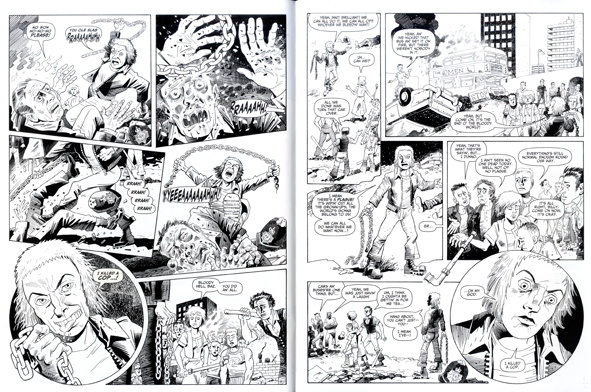

Ennis breaks the fourth wall with 'Kids Rule O.K.!', with Kev O'Neill depicting what happened in the strip behind the infamous Carlos Ezquerra cover (a chain-wielding lout about to slam a fallen policeman)... what was the reaction to the immediate violence on the streets?... what justice was ever served for the fallen officer?... was he even a policeman?

The books wraps up with 'Nina Petrova and the Angels of Death', brought back from the pages of Johnny Red's adventures and tying up the earlier story in a neat little bow, illustrated by Patrick Goddard, who, if Nina doesn't get her own strip, has just become my number one choice should Rebellion ever revive Black Max.

For fans of the original papers, this has the balance of nostalgia and good storytelling just right, and each story is pitched to just the right level. There isn't a single duff note in the whole volume.

Battle Action by Garth Ennis and various artists.
Rebellion ISBN 9780178618673-7, June 2022, 96pp, £19.99 / $24.99. Available via Amazon.

Monday, January 03, 2022

Eagle Times v34 no4 (Winter 2021)

The Eagle Times landed just before Christmas but this is the first chance I've had to read it. As always, the Eagle Society crew go all-out to bring some festive cheer to the magazine, from the snow-capped logo to holly-lined pages. The original Eagle did the same, and I'm always pleased to see the tradition continue.

There's another bumper line-up in the magazine's 56 pages, ranging from a tribute to Greta Edwards (nee Tomlinson), who died in September by Steve Winders and David Britton, nicely illustrated with photos from various events she attended in later years, to a report on the Society's 70th anniversary gathering at the Bliss Hotel, Southport, originally planned for April 2020, but delayed until September 2021. The issue also includes the text of Steve Winders' address, 'A Foreign Country', about how Eagle dealt with historical subjects, including the accuracy or inaccuracy of some of the strips set in the past.

A year in the making, part two of Andrew Newman's look at Eagle's Christmas celebrations over the years covers the years 1959-1962, when snow disappeared from the logo at the turn of the decade, although Christmas still featured heavily inside and through messages on the covers. Will things improve during the Sixties? Only time (and a third part next winter) will tell.

We get into the meat of the issue with the latest episodes of some of the paper's features, including David Britton's look back at how Charles Chilton tackled the historical truths of the Indian Wars in his strip 'Riders of the Range'. Steve Winders' PC49 short story concludes, the setting of the World Science Fiction Convention in London allowing the author to introduce a number of real science fiction writers and editors into the narrative as Archie investigates the murder of an American SF author. The Dan Dare Studio Ideas Book reveals how some Phant machinery was developed.

'Artists of the Range' looks at the payment book for the Riders of the Range Annual for 1961, found in a charity shop in Bath (you have to wonder how they got there), which gives a few clues as to who did what, although much of the content was paid to agencies. It won't surprise you to hear that I love this sort of thing!

Wrapping up the issue, Steve Winders (again) begins his look back at how Eagle's biography of David Livingstone matched the reality of his life and journeying through Africa.

The quarterly magazine is the journal of the Eagle Society, with membership costing £30 in the UK, £45 (in sterling) overseas. You can send subscriptions to Bob Corn, Wellcroft Cottage, Wellcroft, Ivinghoe, Leighton Buzzard, Bedfordshire LU7 9EF; subs can also be submitted via PayPal to membership@eagle-society.org.uk. Back issues are available for newcomers to the magazine and they have even issued binders to keep those issues nice and neat.

Sunday, January 02, 2022

Space Ace Special Edition (December 2021)

John Lawrence has done everyone a great service by reprinting dozens of stories featuring Ron Turner's long-lost Space Ace over the past few years, newly coloured by John Ridgway which brings them to remarkable life for a modern audience.

It has been a while since the last issue — which was, in fact, billed as the final issue — but Lawrence has managed to find a few more stories that are worth rescuing from obscurity. To do this he has employed the Frankenstein surgery successfully used in earlier issues to seamlessly bring together elements of three stories to make a new 21-page tale. This is the centrepiece of this new Special Edition of Space Ace, 'Space Ace and The Search', in which Ace and his sidekick, Bill Crag, crash into a dome that mysteriously appears in their path.

Abandoning their spaceship, Ace and Bill find an airlock and enter, to find the dome contains a pleasant eco-system of water and trees, and friendly natives who explain that they are fleeing from a would-be dictator, the power-made Zalkar. The Earthmen help return the dome to Gylon, but before Space Patrol can rescue them, the newly arrived dome is spotted by one of Zalkar's scouts.

After dispatching the scout ship, the arrival of the Peace Patrol allows Ace and Bill to search the neighbouring planets for Zalkar. On the first they find a race living on flying islands suffering from near starvation while Zalkar drills for minerals; on the second they join a rebel group and finally face Zalkar.

While the serialised tales of earlier issues were the most smartly plotted yarns of Space Ace's career, this new, long story thunders along and makes for a satisfying conclusion to the current volume. You'll barely see the joins.

Before that there are two shorter stories, 'The Plot', the title referring to a planned hostile takeover of Kantor and all the planets in its system, and 'Space Ace & the Kidnappers', about the kidnapping of the Premier of the United Planets Organisation as he heads for Mars City. One is an early tale, the other one of Turner's last featuring the character, but the artist had clearly not lost his enthusiasm for Space Ace.

John Lawrence has included two articles, on Turner's Practical Mechanics covers (1954-62) and his foray into cut-away drawings for Express Weekly (1956). Both feature illustrations many will not have seen before.

The long-promised collection of Ron Turner Tit-Bits comic strips is still promised, but John Lawrence has said that it is likely that another collection of vintage tales will appear first. I look forward to whatever he can rescue from Ron Turner's fantastic archives.

You can get hold of this latest volume of Space Ace for £9.95 UK, £13.50 Europe and £15.50 International, all prices including p&p, with payments through Paypal via spaceace.54 AT virginmedia.com or by cheque or postal order to John Lawrence, 39 Carterweys, Dunstable, Beds. LU5 4RB.

Sunday, October 10, 2021

Vworp Vworp! #4 (September 2021)

After mentioning that I had received quite a haul of books recently and that reviews might take a while to appear, I offered Colin Brockhurst, editor of Vworp Vworp!, a one sentence instant reaction—"WOW! I'm amazed, astonished and in awe of the work you've put in. Five stars.

Now that I've had a chance to actually read some of the content, I stand by that fifteen word review.

That it is an astonishing production shouldn't be a surprise because I was blown away by issue 3 when that appeared back in 2017. 4½ years later, we have issue 4 – a shorter gap than the 5½ years between 2 and 3 – and I'm blown away all over again.

This issue is a 172 page look at the Doctor Who comic strips from the sixties and seventies as they appeared in TV Comic and Countdown/TV Action. Now, this is not a study of the comic strips themselves (there has already been a book covering most of that same period, Paul Scoones The Comic Strip Companion 1964-1979) nor is it a history of TV Comic or Countdown/TV Action (there has already been a book covering the latter, Countdown to TV Action by... ahem... ). Instead, it is an anthology of articles about the comics and the creators behind the strips that appeared in them, plus a couple of extra pieces covering other Who related works.

The whole thing kicks off with a look back at an art agency that supplied artwork for the 1976 Artus Publishing volume Doctor Who and the Daleks Omnibus. Simon Brett interviews everyone involved (those still living, I should say) and it becomes a fascinating story of how small agencies worked in the 1960s through to the 1980s, described by Ivan Rose, one of the co-founders of General Illustration Company, as a time of "earning money like crazy!"

Then onto TV Comic, introduced by Paul Scoones and Michael Baxter before we reach a feature on Neville Main, the first of a number of insightful looks at the creators working on Doctor Who's comic strip over a period of two decades.

The list of creators covered is astonishing: David Motton, Roger Noel Cook, Bill Mevin, Tom Woodman, John Canning, Pat Williams, Dick Millington, Alan Fennell, John Woods, Leslie Waller, Harry Lindfield, Dennis Hooper, Gerry Haylock, Alan Gilham, Frank Langford, Geoff Cowan and Martin Asbury. Phew! Some are interviews (Mevin, Lindfield, Asbury) while others are essays, some long, some relatively brief. I know how tricky it is to research the often anonymous creators of comics, but the magazine contains an array of photos (gold dust!), and snippets of conversations with people tangentially involved (even the guy who won a prize creating a monster for TV Action+Countdown).


The magazine also covers various modern takes on these old strips, a top 40 of weird facts about the TV Comic/Countdown strips, and collecting Who artwork. There is even a free gift in the shape of a packet of Vworp's Sugar Pats, which will enable you to make your own Trod. Oh, and there are comic strips, too.

There's so much information packed in here that, half way through, I was starting to feel a bit redundant. Brockhurst and his team of writers had everything covered and in astonishing detail. But wait... what's this? They didn't know George Marler died in 2007... I can breath again. Surely that will cost the Vworp team half a star.

Only kidding, Colin. You know what? After that sly dig, I'm going to give the magazine 5½ stars.

Order your copy from the official website. And pick up those back issues while you're there. They're well worth the tenner each of them costs.

Monday, June 07, 2021

Roy of the Rovers: The Best of the 1980s — Who Shot Roy Race?


This truly must be the editorial choice of the best of Roy's adventures from the 1980s. Back in 2008, Titan Books reprinted the same storyline (and more) in their The Best of Roy of the Rovers: The 1980s in a now-out-of-print flexiback format volume. It's not surprising, really, that this particular storyline is chosen. One of the strengths of the strip when it appeared in the pages of Tiger and Roy of the Rovers was that a storyline, or series of storylines, would play out over a whole season, and finding a self-contained few episodes to reprint is almost impossible. Storylines would often dramatically reboot the strip, involve the demise of major characters in the best soap-opera tradition of, say, EastEnders. Unlike EastEnders (and American superhero comics), dead characters were never brought back to life in desperate grabs for ratings or sales.

This volume reprints the weekly saga of Melchester Rovers from the pages of Roy of the Rovers between January 1981 and June 1982, picking up the storyline halfway through the 1980-81 season. The 1981-82 season contained one of the most heart-stopping of all Roy stories, as, on 12 December 1981, he was shot by a mysterious gunman. Inspired by the 'who shot JR' publicity that had surrounded Dallas, the identity of the mystery shooter was kept secret for months.

The book opens with an injury-depleted Melchester Rovers struggling to find form as the season opens. There's plenty of action on the pitch and, because a match can last for a month or more, every game has something vital to the plot, whether it's the form of old players, the arrival of a new team-mate or trouble at the top or the bottom of the league table that makes it crucial that Rovers win.

But the action wasn't always on the playing field: there was as much drama off the pitch as team-mates fall out with each other and—as in this volume—Roy has as many problems at home as he does at Melchester Stadium. Roy was one of the few characters in comics aimed at boys where Roy had a home life: he's married, to Penny, and has twin children, and author Tom Tully made sure that Penny was sometimes at the heart of a storyline long before WAGS took on a celebrity all of their own.

Roy's cousin, Arnie Meckiff, is another off-field troublemaker, as is Elton Blake, an actor who is to play Roy in a TV show... the list of people unhappy with Roy Race begins to grow as the new season kicks off, leading to the shocking sight of Roy being shot. Hospitalised and in a coma, Melchester Rovers' directors turn to one of the biggest names in football to take over the team—former England manager Sir Alf Ramsey.

And here we have another soap-opera staple: the strips are played out in a bizarre version of real time where a 90-minute football match can last four weeks but a season lasts a season and real world events are referred to (the Royal Wedding of Prince Charles and Diana Spencer, for instance). Real people were part and parcel of the storylines, making the standard "any resemblance to actual persons is entirely coincidental" notice at the front of the book completely redundant—star guests were always popping up to Melchester to visit the team, some playing key roles in various plots.

Keeping all these elements bubbling along season after season took as much skill as Roy showed on the pitch, so all praise goes to Tom Tully, one of the finest writers British comics ever had. His was the hand behind the twisting plotlines and constant Greek chorus of terrace commentary that kept Roy at the top of the comics' league for twenty years. For eleven of those years he worked with artist David Sque who saw Roy through his mid-1970s to mid-1980s fluffy haircut era.

The Rebellion reprint, although not as generous as the Titan volume — which offered two whole seasons, beginning in September 1980 — benefits from not removing all the yellowing of the newsprint the strip was originally printed on, which makes the colours stand out a little better. As a bonus, they also include a story from the 1982 Roy of the Rovers Annual.

Roy of the Rovers: The Best of the 1980s — Who Shot Roy Race? by Tom Tully and David Sque
Rebellion ISBN 978-178108896-8, 10 June 2021, 176pp, £19.99. Available via Amazon.

Monday, May 24, 2021

A Life With Comics by G. M. Wilson

Alan Clark is one of the few writers who continues to tackle the subject of British comics prior to the Second World War. His previous books on Edwardian comics and (chiefly) pre-War artists and editors have been welcome additions to reference shelves in recent years, and now he has published a third which fits in very nicely alongside them. Keeping his output diverse, his latest title is the memoir of G. M. Wilson—Gertrude Mary Wilson, the wife of comic artist Roy Wilson.

Compact, at 153 double-spaced pages it is not as dense as an autobiography tends to be. Rather, it is written in an entertaining and breezy manner, detailed enough for the avid comics’ fan who wants to know more about the era covered, beginning with husband Roy’s work in the 1920s and covering her own parallel career writing comic serials, and later novels and radio plays, from 1932.

Wilson paints a detailed picture of the life she shared with her husband. Roy Wilson began his career in Norwich as an assistant to Don Newhouse, who was already established as a busy artist with Amalgamated Press. Before long, Wilson began to outshine his master and was drawing not only backgrounds, but the main characters, while Newhouse continued to letter the pages. Norwich, at that time, was home to a number of artists, and Wilson was soon invited to submit his own sets to supplement his income working with Newhouse.

This was necessary as he was married in 1924 and he was soon drawing the likes of ‘Pitch and Toss’ and ‘Basil and Bert’ against a background of house hunting and other family commitments.  Overworked and overstressed, Wilson came near to having a breakdown in 1931. His wife, at the suggestion of editor Len Stroud, tried her had at a detective tale and, before long, she was writing complete stories and serials for the same papers her husband was contributing to.


Her memoir mixes family exploits, from fun holidays to the worry of their daughter’s operation for a congenital dislocation of the hip. There are many more worries to face, especially during the War when Wilson, whose work ethic meant long nights making sure every set, every cover and every frontispiece met his high expectations, was drafted into the Home Guard, and together, from their house in Surrey, they could watch doodle bugs passing overhead.

Charting their friendship with artists and editors, and the passing of an era when the War devastated the publishing of comics, A Life With Comics is a fascinating look at those lost times by someone who was intimately involved in them. It is also a warm, welcoming invitation into the Wilson household, where Roy would be busily drawing on the dining room table while his wife tapped out the latest adventure of ‘Roy Keen’ or ‘Tilly of the Tuck Shop’ nearby.

Privately published, it can be purchased via Ebay: https://www.ebay.co.uk/usr/boris9999494?_trksid=p2047675.l2559.

A Life With Comics… A Personal Memoir by G. M. Wilson
Alan Clark, April 2021, 154pp (A5), £12.00.

Saturday, March 27, 2021

Contraband (review)


When you set a book five minutes into the future, you might expect the passing of even a few years will make your story outdated and irrelevant. That's certainly not the case with Contraband, which was first published by Slave Labor Graphics in 2008 and is now getting its first British edition from Markosia in May.

The book could not be more relevant. With social media platforms battling for billions in advertising revenue, there is a tendency to pay lip service to protecting younger users while doing nothing concrete to end various forms of abuse. Algorithms can send you down rabbit holes that have radicalized significant numbers of the middle-aged and middle classes around the world. When Facebook became the world's most popular source of news, it also meant that readers became less likely to check sources and less able to distinguish real news from calculated falsehoods. Lies propagate and any hope of quashing them would require a huge paradigm shift from Facebook, Instagram, TikTok and all the other platforms that rely on user numbers to attract advertising.

Contraband tackles this explicitly when Toby, discussing porn available on Whisper, says "Seems Whisper's a bit sloppy enforcing a censorship policy." "Not sloppy, crafty," replies Plugger. "Feigning ignorance means avoiding legislation — and that enables Whisper to make more money." Nothing has changed in the past dozen years and hiding responsibility behind the guise of "Free speech" has taken on chilling new meaning since January 6.

The premise of filming violence on mobile phones was not author Thomas Behe's invention. The inaptly named "happy slapping" was a phenomenon in 2005-10, with the filming of random attacks quickly giving way to filming sexual assaults and horrific violence that resulted in death from injuries. In Contraband these films have a dedicated platform—Contraband—where clips that reach the top of the viewing chart can earn tens of thousands.

Toby, a "citizen journalist", has become seduced by the notion of filming popularly acclaimed content, joining the voyeur underground, prowling the city hoping to film something sensational. He becomes embroiled in the vicious battle between Tucker Scott, a mercenary with a fetish for filming violent attacks while working under contract in Afghanistan, and Charlotte, who is working with him when she is knocked unconscious in the opening pages.


The storyline isn't always easy to follow as it jumps between action in London and Belgium, one month apart. Keep your eye on the timestamps at the beginning of each chapter, because it can be confusing when characters you believe dead suddenly reappear. Complexity doesn't make Contraband a bad read but it does mean you need to concentrate across all 144 pages.

In London, we discover cyber cafe worker Toby being blackmailed by Tucker into searching for Charlotte. Contraband is being taken down by various means by Jarvis Stevens, a former intelligence officer with whom Charlotte has been working to recruit supporters.

A month later, Tucker's sidekick Plugger has been killed, Toby is in Belgium looking for Jarvis and Tucker has Charlotte — and if Jarvis doesn't send Tucker a memory chip before Charlotte's live-stream drops into second place on Contraband, she'll be killed.

The plot weaves between these various settings with Toby the thread linking the action as he encounters all the other characters.

The artwork by Phil Elliott is clean and elegant where he dialogue is heavy and perhaps tending towards being over-philosophical. Every character has a back story which they recount in detail, which slows the story down and burdens the reader with too much information. Contraband is a book that is more enjoyable the second time you read it: on second reading you can enjoy the languid pace and diversions and take time to learn more about the various characters without worrying about missing a crucial plot point. (One minor complaint about the original SLG edition: the small paperback format means panels packed with dense dialogue in tiny lettering, which my old eyes struggled with. Hopefully the Markosia edition will be slightly larger.)

Twelve years ago, Contraband could be marketed as science fiction, extrapolating on how mobile phones with cameras and the ability to share high resolution videos might develop into something nasty. Now we're living in that nasty world, it's a present day thriller that still has much to say about the ethics of living with unregulated social media platforms.

Contraband by T. J. Behe & Phil Elliott
Markosia Enterprises ISBN 978-191380260-8, 10 May 2021, 148pp, £14.99. Available via Amazon.

Thursday, March 11, 2021

Review: The Stormbringer Sessions: Sketches for a Graphic Novel by James Cawthorn


While he was organising the archive of artist James Cawthorn, John Davey—a long-time fan of Mike Moorcock and publisher, through his Jayde Design company, of James Cawthorn: The Man And His Art—stumbled upon two boxes labelled "Stormbringer Roughs" and "Stormbringer Strip Photocopies". Together, they comprised a complete set of roughs for a two-part, 250-page adaptation of Moorcock's Elric of Melniboné novel, Stormbringer.

Cawthorn had adapted Stormbringer for publication in 1976 by Savoy Books, but the results were patchy and rushed in order to take advantage of a distribution offer. Many years later (the work is undated except for one piece, the cover, dated 1989), Cawthorn returned to Stormbringer with far more ambition, a fully worked out script and time to sketch out all 250 pages. The first volume was complete in 95 pages, the second ran to 157.

"Sketches" may give the wrong impression of the artwork... these are dense, loose pencils of pages, with corrections and, in a few cases, alternate versions of pages. Cawthorn stuck corrections over panels with sellotape, corrected text on the page by scribbling out errors, and did not worry about finessing the art. This was never expected to be seen by many, after all. It was there to sell the idea.


Which makes it all the more frustrating that it never did progress any further, because this version of Moorcock's novel really does capture the essence of the albino hero of Moorcock's first great work.

The book itself is available in a gorgeous slipcased hardcover edition limited to 100 numbered copies, with a loose-leaf print of the cover. There is also a trade edition, also limited to 100 copies.

The Stormbringer Sessions: Sketches for a Graphic Novel by James Cawthorn
Jayde Design in association with Savoy Books ISBN 978-095757643-8, 1 March 2021, 272pp, £35.00. Available from Jayde Designs. [Limited ed. h/c, £90.00]

Tuesday, March 09, 2021

Review: Misty Winter Special 2020


Charlotte Baker, a newcomer to Lewin Girls’ Academy, writes in a journal. A science scholarship girl, Char (as she prefers to be called) is picked on by others in her dormitory and feels excluded. Teacher Mr Marks tries to persuade her to give the school a chance, but Char begins to notice small, odd things, like the way the girls hold their pens, the odd rituals and changing rules. She might have believed that they are just trolling her, but everything seems so elaborate and coordinated.

When she approaches the headmistress, Ms. Goldwyn, she finds her words twisted against her and is told that it is she who has the bad attitude, leading her to put up defensive barriers. Ms. Goldwyn advises her to join it, that the quirky nature of the school is because they have no timetables or formal structure.

Char continues to study the problem scientifically, through observation and evidence, writing up her thoughts in her field journal. Although it is not allowed, when the chance comes to read the journals of the other girls, she takes it—and discovers that they are all full of rambling, fearful paragraphs, troubling  and repetitive reflections and a fearful preoccupation  about an outbreak of TB that killed many pupils nearly two centuries earlier.

The aptly named 'Infection' by V.V. Glass & Anna Savory is a genuinely creepy and surprising story and has an ending that, like Picnic at Hanging Rock, doesn’t tie everything up in a nice bow.


In 'Home For Christmas', a babysitter, Martha, finds herself stuck in a smart house – a former orphanage – on Christmas Eve when the parents of her two wards cannot return home. The story has all the right ingredients for a holiday horror yarn: a well; a power cut; a creepy boy; a smart phone that shouldn’t be calling; and a terrible secret.

Delightful stuff from Lizzie Boyle and artist David Roach.

Monday, March 08, 2021

Review: Edwardian Comic Papers by Alan Clark


Edwardian Comic Papers is a step up in production value from Clarke’s other recent book. It reveals, in exquisite colour, how comics developed during the brief tenure of King Edward, the son of Victoria who grew from being known as the ‘prince of pleasure’ to a much-loved monarch.

The comics published during his reign – 1901-1910 – also went through an astonishing transformation. The late Victorian comics were weekly papers containing cartoons and and humorous features, satirical stories and caricatures, and were aimed at adults. Advanced print technology became the norm, with photo engraving replacing woodblocks and colour printing becoming economical for the first time.


What many might find surprising is just how colourful these magazines are. Experiments with colour comics date back to 1896 and the first regular colour title, the clue being in the name The Colour Comic, dated from 1899.

In his introduction, Clarke charts the many changes that occurred in society in the early years of the new century and how these were exploited by publishers, who expanded their output with magazines and papers for all classes and all ages. There were stumbles along the way—even the beginning of the Edwardian era was delayed six weeks because of the King’s appendicitis—but, for the most part, comics expanded in a market that was ready to be entertained by smart, satirical drawings by the likes of Ralph (“Yorick”) Hodgson, W. F. Thomas and Tom Browne.


Many other artists are celebrated throughout the book, including some names that might be little known to modern readers: Oliver Veal, Leonard Shields, Will Spurrier, Frank Holland, Julius Stafford Baker, George Davey, Tom Wilkinson, Percy Cocking, Alex Akerbladh, G. M. Payne, Charles Genge and H. O’Neill, with sidelines into a number of American contributors like George McManus and James Swinnerton.

The book is very heavily illustrated throughout, with rarely seen images from a wide variety of penny papers and tuppenny coloureds.

Privately published, it can be purchased via Ebay: https://www.ebay.co.uk/usr/boris9999494?_trksid=p2047675.l2559.

Edwardian Comic Papers by Alan Clark
Alan Clark, 2021 [December 2020], 190pp (A5), £15.00.

Review: Blade Runner 2019 Volume Two: Off-World


Blade Runner 2019
has earned much praise for its pich-perfect blend of hardboiled noir and grungy sci-fi that meant it hit all the right notes with fans of the movies. Little wonder, as its co-writer, Michael Green, was also the co-writer of the sequel movie, Blade Runner 2049

The first volume, comprising the first four issues of Titan’s Blade Runner spin-off, was set in Los Angeles and introduced Aahna ‘Ash’ Ashina, a Blade Runner. The initial storyline ended with Ash leaving Earth with Cleo Selwyn, a young girl who is being sought by the Tyrell Corporation for genetic experimentation.

 
As volume two opens, the year is 2026 and the two are hiding out with new identities at a mining colony. Snatched by a group of rogue Nexus 8 models, Cleo bargains her way to Ramanuja and the possibility of escape. Ash, meanwhile, meets Hythe, a British Blade Runner who threatens to arrest her for the murder of Isobel Selwyn unless she helps track down Cleo. With a newly restored cybernetic back-brace to help her walk, Ash accepts, but there are still twists and turns to go through before the three are reunited… but which three?
 
While Andres Guinaldo’s anime-tinged artwork is superb, this volume lacks that little something special of the first volume. The bustling, rain-soaked streets of Los Angeles are such a part of the original Blade Runner movie, that distancing the story from Earth – necessary for the plot – unfortunately, also distances the story from the noirish nightmare world of the Blade Runners, something that the next volume promises to remedy.

Blade Runner 2019 Volume Two: Off-World by Michael Green, Mike Johnson & Andres Guinaldo
Titan Comics ISBN 978-1787-73192-9, 15 September 2020, 112pp, £13.99. Available on Amazon.

Tuesday, March 02, 2021

Review: Illustrators: Crime Comics Special

The latest Illustrators special begins with a whistle-stop overview of crime comics which leaps from tales of Jack the Ripper in the pages of The Illustrated Police News to the American comic book Detective Comics, the arrival of Superman in Action Comics, the development of colourful villains to fight superheroes and the rise of violent crime comics in the wake of Crime Does Not Pay.

The huge success of increasingly gory crime comics, the gateway to similarly gruesome horror comics, would result in the Comics Code Authority and the suppression of crime comics in America for thirty years.

While readers in Europe could enjoy ‘Torpedo’ (Bernet) or ‘Nestor Burma’ (Tardi), crime noir would only re-emerge in titles like Ms. Tree (1981-93), V For Vendetta (1988-89), Sandman Mystery Theatre (1993-99) and the works of Frank Miller, David Lapham, Brian Azzarello, Brian Michael Bendis and, especially, Ed Brubaker.

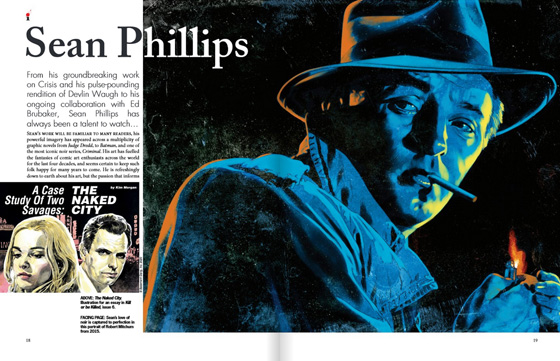
Brubaker’s regular collaborator, Sean Phillips, is the first subject of this special. Phillips was a rare comics’ prodigy, his first comic strip appearing in a local newspaper at the age of 12, working professionally for D C Thomson from his early teens and exploding into the pages of Crisis at the age of 23, just out of college but already a veteran of British comics. By the time ‘Devlin Waugh’ debuted in Judge Dredd Megazine, Phillips had already made his US debut on Hellblazer and would go on to draw Kid Eternity, Shade the Changing Man, and the graphic novel The Heart of the Beast before first teaming with Ed Brubaker on Scene of the Crime in 1999.

Their subsequent collaborations have included Sleeper, Criminal, Incognito, Fatale, The Fade Out and Pulp, mostly creator-owned and produced without any interference from publishers—resulting in a series of award-winning stories that exemplify the crime noir genre.

Included here are many illustrations that many may have missed, including Blu-ray and album sleeve art and examples of Phillips’ ‘Femme Fatale’ prints.


The story of Crime Does Not Pay has its roots in Lev Gleason’s talent-spotting abilities. In 1941 he offered Charles Biro and Bob Wood, alumni of Harry Chesler’s ‘shop’, staff positions and offered them a share in profits, unheard of in those times. Looking for something to make the Gleason line stand out on newsstands awash with superhero titles, Biro and Wood created a comic featuring “All true crime stories!” that would eventually sell a million copies a month.

Success led to exhaustion for the ever-busy Biro and a drink-and-gambling addiction for Wood. The first inkling of problems came in 1947 when the comic was banned in Chicago and the final bell tolled at the Senate Subcommittee on Juvenile Delinquency in 1954. Gleason’s publishing ventures were shuttered in 1956. The tragedy did not end there. While Biro found work in television, Wood went to prison for bludgeoning his girlfriend to death and later died under the wheels of a car. All true, as his comic once boasted.

‘Torpedo 1936’ also had its problems. Originally, it was offered to Alex Toth, who fundamentally disagreed with the notion of a merciless killer as hero. Instead, he rewrote Enrique Sanchez Abuli’s script to make him show remorse. Javier Mesón reveals how the classic hardboiled series was then taken over by Jordi Bernet, and the character went on to star in 15 albums and his own comic.

Always filled with an incredible choice of images, this crime special is another fine addition to the Illustrators range.

Illustrators Crime Comics Special by various
Book Palace Books ISBN 978-191354801-8, October 2020, 144pp, £25.00.

Monday, March 01, 2021

Review: Roy of the Rovers: Pressure

The latest graphic novel completes the 2019-20 season, delayed from its planned release in July due to the Covid-19 pandemic. Each season consists of three illustrated novels and three graphic novels. Thus, season two of the newly relaunched saga has played out over five books already (On Tour, From the Ashes and Rocky in text form by Tom Palmer, Transferred and All to Play For in graphic form) and has seen Roy and his fellow striker Paco Diaz sold by unscrupulous chairman Barry ‘Meat’ Cleaver to Melchester’s arch rivals, Tynecaster.

Cleaver’s dodgy dealings have been uncovered and Melchester are stuck at the bottom of the League One table, thanks to a huge thirty-point deduction. Roy and Paco return to Melchester Park hoping to get to the bottom of Cleaver’s criminal activities, only to find the stadium on fire!

With the team’s captain Vic Guthrie benched, but relegation averted thanks to a review of the points deduction, Melchester enter the final leg of the season under instense pressure, with the chance of promotion to the Championship League in their sights. But who is going to take over the Rovers and rebuild Mel Park?

Another footballing legend steps forward to save the day…

This isn’t your dad’s Roy of the Rovers – your dad’s Roy is in a wheelchair and Roy’s mum is exhausted. It’s good to see that Roy of the Rovers has lost none of the soap opera elements that made it such a great read in the eighties, which was when I was last following the action, week in, week out. The artwork is super stylised compared to the old Barrie Mitchell and Mike White era, but has lost none of its attraction for it. Lisa Henke has a clear, clean line that is at home on and off the pitch. You can feel the ball-bending power of a Racy’s Rocket in the flattened curves of her artwork.

Roy of the Rovers: Pressure by Rob Williams & Lisa Henke
Rebellion ISBN 978-178108764-0, 29 October 2020, 56pp, £9.99. Available via Amazon.

Sunday, February 28, 2021

Review: Photographs & Images of Artists, Writers & Editors of 19th and 20th Century British Comic Papers

If ever there was a book that “does exactly what it says on the tin”—as the famous Ronseal advertising slogan once said—this is it. Alan Clark has collected together over 100 photographs of some of the men and women who helped create vintage British comics and story papers, starting chronologically sensibly with he creators of Ally Sloper (Charles H. Ross, Marie Duval, W. G. Baxter). The rest of the book is somewhat random, but covers many of the creators who worked for Amalgamated Press and D. C. Thomson, including such notables as Tom Browne, Leo Baxendale, Ken Reid, Reg Parlett, Robert Nixon, Dudley D. Watkins, Denis McLoughlin and Derek Eyles.

Along the way he dips into the careers of editors like H. J. Garrish, G. H. Cantle, Fred Cordwell, Monty Haydon, George Moonie and R. D. Low in a series of snap shot biographies that accompany each of the photos, company founders like Alfred Harmsworth and James Henderson, and often-forgotten stalwarts of the comics like Charlie Pease, George Wakefield, Roy Wilson, Frank Minnitt and George Ramsbottom.

A random dip into the book reveals that Tiger Tim’s Weekly editor Will Fisher died in a car accident, Eileen Soper, who illustrated many books by Enid Blyton, was the daughter of Royal Academy artist George Soper, and Bert Wymer, coincidentally one of the artists of Tiger Tim, was also an amateur archaeologist, his family responsible for the discovery of the Swanscombe Skull.

It’s a fascinating little book to dip into as you’ll never know what you will stumble across next. Privately published, it can be purchased via Ebay: https://www.ebay.co.uk/usr/orsonwelles99.

Photographs & Images of Artists, Writers & Editors of 19th and 20th Century British Comic Newspapers by Alan Clark
Alan Clark, Autumn 2020, 119pp (A5), £15.00.

Saturday, February 27, 2021

Review: Essential Judge Dredd & The Rediscovered Scripts

Rebellion have launched a new line of ‘Essential Judge Dredd’ volumes bringing together some of the key stories that have helped establish Dredd as a character who has grown from the Lawgiver-toting roots of cookie-cutter Judges in his early appearances in 2000 AD into a complex and nuanced individual. In the dystopian world of Mega-City One, the lawmen are judge, jury and executioner… but the city, its citizens and its political establishment that control and inhabit the Justice Department have become more multifaceted as John Wagner has explored the world of Dredd more deeply.

In ‘Letter From a Democrat’, Wagner gave a voice to citizens who lived in fear of the self-elected Judges, who, after forty years, wanted to put power back in the hands of the people. A trio of ‘terrorists’ demanding freedom and democracy storm a TV studio knowing that, to get their point across, they must die as martyrs to the cause if their actions are to be remembered beyond the next news cycle.


The idea simmers until a march on the Hall of Justice boils over in ‘Revolution’ when Dredd is given carte blanche to stifle the march any way he can. “Democracy is a cancer eating at the heart of society. Any action we have to take to stamp it out – however regrettable – is justified,” he growls.

In ‘America’ we see the life of America Jara, the daughter of immigrants, through the eyes of her lovelorn neighbour Bennett Beeny. At the age of 15 America had already spent three months in the juve cubes for posting bills promoting democracy; her passion grows with the years, until she leaves her past behind to study politics. One night, Bennett stumbles upon her in the street. Now a member of Total War, she is part of an ambush that results in the killing of four judges.

Bennett covers for her and they later meet, but America admits that she wants money to buy explosives to destroy the Statue of Justice. Bennett gives her the money but informs on her, hoping to save her. The Judges allow the plot to unfold… they, too, know the power of symbolism – that shooting down the perps at the feet of the statue sends a powerful message.

The Democracy Now movement results in a referendum on whether Judicial control should continue, or make way for legislation by the people. The leaders of the democratic coalition want to separate the police for from the judiciary. Dredd believes that citizens will vote for the devil they know: “We’re not perfect. There may be room for us to take more account of the citizens’ wishes – some laws may be in need of revision – but otherwise, nothing’s changed. Discipline, good order, the rigid application of the law – those are the principals on which we stand.”

As Referendum Day approaches, even some of his fellow Judges target Dredd. It all boils down to the push of a button as over 100 million citizens vote…

Predicting the use of low-frequency sonics on marches (LRADs were used recently in the USA) and widespread misinformation to undermine the legitimacy of the march and those leading it, this classic series of stories have an undeniable ring of terrifying precience in these days of Donald Trump’s attempts to delegitimise the 2020 election and shock tactics at BLM marches. As Dredd chillingly says: “Justice has a price.”


America: Lost and Found
, meanwhile, presents John Wagner’s original script (minus episodes two and six, now long lost) along with selected panels from Colin MacNeil’s interpreation of the script. Apart from being the very model of how a comic script should be presented and an insight into how Wagner shaped the story through both dialogue and the images he created in his panel descriptions, the script adds little to the America story, the major change being her surname (from Ortega to Jara). Wagner commentary, on the other hand, is interesting. We learn, for instance, that he prefers to let a story grow organically rather than plot it out in full synopsis. “Sometimes I have an ending in mind and a few incidents along the way, but not always. Then I shake the pieces and see how they fall.”

The book also contains the full story from Judge Dredd Megazine and a gallery of cover images and character sketches by MacNeil.

Essential Judge Dredd: America by John Wagner, Alan Grant, Garth Ennis (w), Colin MacNeil, John Higgins, John M. Burns, Jeff Anderson (a)
Rebellion ISBN 978-1781-08860-9, 3 September 2020, 160pp, £19.99. Available via Amazon.

America: Lost and Found The Rediscovered Scripts by John Wagner & Colin MacNeil
Rebellion ISBN 978-1781-08894-4, 30 September 2020, 128pp, £19.99. h/c.

Thursday, July 04, 2019

Comic Scene #5 (August 2019)

This issue celebrates summer and, for comics' fans, that mean Summer Specials. If the phrase doesn't take you back to your childhood, you're also too young to remember that we used to have dozens of comics on the shelves aimed at boys and girls and nearly all of them would release a bumper issue in time for the school holidays to see you through boring car trips to castles you'd never heard of (most of which had collapsed in on themselves centuries ago), zoos with a few motheaten big cats or lakes (too dangerous to swim in) with mountains behind them (too lofty to climb)... just for the view. The VIEW?

Lew Stringer's lead article on Comic Scene #5 (in shops now) revels in the glory days of the sixties and seventies when the Summer or Holiday Special had their heyday. I remember the first specials I read were thick, 96 page monsters that you had to talk your mum into buying (and then talk aunts and nans into buying others) because, at 2/6, they were out of the pocket money range of many.

Rebellionhave been doing their best to revive the tradition of the summer special and their latest combines the worlds of Tammy and Jinty, two classic seventies girls' titles. Editor Lizzie Boyle explains how the two have been combined to create the latest summer anthology comic in their Treasury line and hopefully we'll see more.

Peter Gouldson's article about Spider-Man's trips to the UK is timely reminder that the movie Spiderman: Far From Home isn't his first time he's visited these shores; Irmantas Povilaika looks at Leo Baxendale's Sweeny Toddler; Stephen Jewell talks to Geoff West about his picture library reprints; Martin Dollard's series about Batman reaches the 1970s; Joel Meadows looks at the Spiderman movie; and there is the usual exceptionally good round-up of independent comics.

Comic strips for this issue include dashing highwaywoman Lady Flintlock and Andy Clifts's Captain Cosmic (launched via a Kickstarter in 2018), plus Phil Elliott provides the artwork for The Dummy, which is more samhain than summer solstice, I'd suggest.

Altogether it's another excellent package, even if it lacks the acerbic comments of Pat Mills which have been a feature of early issues. Perhaps he's taking a summer holiday.

Details about subscriptions can be obtained from www.comicscene.org. Rates for print issues for the UK are £5.99 for one issue; £35 for 6 issues; £68 for 12 issues.You can get a pdf version for £3.99 (1), £22 (6) or £40 (12).

Payment can be made via PayPal to comicsceneuk@gmail.com. For other options, and for international rates for the print edition, visit the website.

BEAR ALLEY BOOKS

BEAR ALLEY BOOKS
Click on the above pic to visit our sister site Bear Alley Books