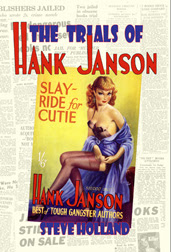


H. J. S. Anderton was briefly a writer of crime stories in the 1930s, writing for the cheap paperback market. The bibliography below disguises the fact that most of the stories were short (64 or 80 pages), not more than novelette or novella length. Anderton barely makes a blip on any radar bar the comprehensive listings of Crime Fiction Bibliography, which, of course, means that he has to be investigated by the CFB Brains Trust.
Henry James Sebastian Anderton was born Birkenhead, 1871, the son of Henry Anderton, a theological student at St. Aidan’s College, Birkenhead, and his wife Ellen Cuerden Anderton (née Naylor) (c.1845-1922). Henry Anderton went on to become Curate of St. Lawrence in Haughton, Lancashire, then Vicar of Hopton Cangeford (1881), Garway (1883-84) and Ratlinghope (1886-91). He resigned in 1891 and went to live in Chester.
His son, Henry J. S. Anderton, attended a boarding school in Tattenhale, Cheshire, run by James Stephens and, in the 1891 census, had the profession of organist, at the time boarding with his father at a temperance hotel in Church Stretton, Shropshire. By 1901 he was “living on own means” in Formby, Lancashire, with his mother and younger brother, Augustus (1877- ). In 1911 the family was living together in West Derby, Lancashire. His death was registered in W. Cheshire in 2Q 1946, aged 75.
He was probably related to Henry Anderton (1809-1855), who wrote poems and became a leading advocate of temperance.
This is hardly the most comprehensive biography. I do get the feeling that his writing was probably low grade and typical of the kind of hackwork that appeared from Mellifont, although that doesn't automatically mean it won't be entertaining. They did come up with some glorious titles. I believe his first novel was a "yellow peril" crime yarn and some of the others sound as if they may be in the same style.
Novels
The League of the Yellow Skull. Dublin, Mellifont Press 211, 1932.
The Quest of the Crimson Idle. Dublin, Mellifont Press 217, 1932.
The Panther. Dublin, Mellifont Press 236, 1933.
Yellow Claws. Dublin, Mellifont Press 262, 1934.
The League of Death. Dublin, Mellifont Press 2103, 1934.
The Golden Idol. Dublin, Mellifont Press 2148, 1936.
The Dope King. Dublin, Mellifont Press 2179, 1937.
A King of Crime. London, Archer Croft, c.1939.
Shadow of Chu Kong. London, Popular Fiction [Everyday Novels 37], c.1940.
Saturday, May 16, 2009

Friday, May 15, 2009
Comic Cuts
 I've just about shaken off the cold I picked up a couple of weeks ago. Mind you I still feel completely wiped out so don't expect much sense out of me.
Above is the cover to the upcoming Frank Bellamy's The Story of World War 1 and I'm pleased to say that we're almost heading to the printers with this one. It's still a couple of months away from publication but it should look incredible. Proofs have been proofed but we still have to see printed proofs before the 'go' button gets pressed.
Yesterday I hit the halfway mark on the clean-up for "Wells Fargo", one of the Don Lawrence strips Book Palace is planning to publish in the not-too-distant future. It's a superbly drawn strip, as you'd expect from Lawrence, and almost unseen by even his biggest fans. The strip started in Zip back in 1958 and ran for 85 episodes before Zip merged with Swift, where the strip continued for another 65 weeks. Whilst most fans of British comics are aware of Swift, even if they don't own copies, Zip is almost unknown. I know one person who has a complete set, which I was fortunate enough to borrow for scanning. There were a couple of other excellent strips in Zip that deserve to be revived. One day...
Talking of which, my little publishing venture is coming closer to seeing the light of day. I appreciate it's a little frustrating for you all not to know what I'm talking about but I've already had to rethink this whole thing two or three times over the last few months and I'd rather keep disappointment down to a minimum. Best way to do that is say nothing. But I can't help saying something... so I'll say this: I've now seen a rough cover sketch for the first book, which looks great, and the book will be bigger than I originally planned. I've already started work on books two and three and I'm mulling over what to do for book four. Beyond that, my lips are sealed.
 I've been doing my usual mid-month check on upcoming titles so here's a round-up of the latest news. I repost the recent releases and upcoming comics listings around the 1st of the month, but I try to keep them updated as best I can, so it's worth revisiting them during the month.
Carlton's new collection, Commando: D-Day Fight or Die, is out and copies have been shipping from Amazon. The cover by Ian Kennedy is, in my opinion, the best they've had on any of the Commando collections. We're still four weeks away from the release of Aces High: Air Ace Picture Library Vol. 1. Go out and buy it so I can do volume two, please!
Titan have managed to get a few of their titles out on time recently, namely Dan Dare: The Phantom Fleet and Modesty Blaise: The Lady Killers, which are both now on sale, but there's a chance that The Best of Battle: Volume 1 book has been delayed again, as has James Bond: The Girl Machine. If I can get confirmation of the latest release dates, I'll update this note later today. The Best of Roy of the Rovers: The 1970s is on schedule.
Waverley's The Broons' Day Oot and Classical Comics' The Tempest have also been pushed back to next month.

 Above are covers for a couple of titles that aren't due out until September: Eagle Annual: The Best of the 1960s and Football's Comic Book Heroes: Celebrating the Greatest British Football Comics of the Twentieth Century.
 If you fancy something completely different, I suggest you try the Manhwa exhibition at the Korean Cultural Centre. Full details can be found here and its worth noting that our very own Paul Gravett will be on hand to discuss Asian comics at the live drawing performance of Manhwa artist Chul-Ho Park on 21 May. The exhibition and events celebrate 100 years of Korean comics and cartoons.
Talking of events, the ICA has a talk on 2 June starring Alan Moore and Kevin O'Neill, who will be exploring the vast referential cosmos of their League of Extraordinary Gentlemen: Century trilogy with Christopher Frayling, rector of the RCA and popular culture guru.
And talking of popular culture (see how this all hangs together?) I went to see the new Star Trek movie last night. Best described as a roller-coaster ride that works just fine as long as you don't start thinking about gravity works while you're upside down doing a flip. Physics doesn't work in the Trek universe the same way it does in this universe, so just let yourself be carried around the loop and out the other end and you'll be OK. As a reboot of a tired franchise, it's a great start. I hope the film does well enough for there to be more of the same.
And that, I think, is all the news that's fit to print.
Anne Scott-James (1913-2009)
 Anne Scott-James, who died on Wednesday, 13 May 2009, aged 96, was a writer and editor of remarkable talent, although I mention her here for her connections with two comic and cartoon creators.
In 1941 she left Vogue magazine to became the women's editor of Picture Post where she met the paper's chief war correspondent Macdonald Hastings, later to become the Eagle's Special Investigator between 1950 and 1957. Although temperamentally and politically unsuited, the marriage (Scott-James' second) lasted 18 years.
 She became a novelist, and Fleet Street writer and columnist, writing for the Sunday Express and Daily Mail, later turning freelance as a writer and broadcaster following her marriage to cartoonist Osbert Lancaster in 1967. She subsequently became best known for her gardening articles in Queen magazine and a series of best-selling books on gardening, some illustrated by her husband, who died in 1986.
Obituaries: The Times (15 May), Daily Telegraph (15 May), The Guardian (15 May), The Independent (18 May).
Thursday, May 14, 2009
John Donegan (1926-2009)
 "It's The Wild again"
Cartoonist and designer John Donegan died on 27 April 2009, aged 82. Born in Lewisham on 23 August 1926, John Peter Michael Donegan was the eldest son of Thomas Kieran Donegan and his wife Anne (nee Carley).
After working as a junior draughtsman at United Dairy Engineering Company (1942-45), he found employment in a number of technical drawing and advertising jobs before being appointed art director of David Williams & Ketchum advertising agency in 1958. He left in the early 1960s to join the Sunday Times and designed the Sunday Times Magazine when it launched in 1962. In 1968 he came Creative Director of Sharps Advertising, drawing cartoons in his spare time. In 1975 he became a full-time cartoonist.
His work appeared in Punch and the Sunday Express, where he drew the weekly "Waldo" strip (1981-84). He also worked widely in advertising and was the director of Clixby, three short animated stories for deaf and speech-impaired children, for Pacesetter Enterprises (1983). He often drew dogs in his cartoons, some of which were collected in book form, although he never owned a dog himself. He retired in 1991 to live in France.
Examples of his Punch cartoons can be found here.
Obituaries: The Independent (14 May).
Books
Dog Almighty! London, Souvenir Press, 1986.
Dog Help Us! London, Souvenir Press, 1987.
For Dog's Sake! London, Souvenir Press, 1990.
For the Love of Dog! (omnibus: collection of above three titles). London, Chancellor, 1994.
Books Illustrated
Dogs' Tales by June Whitfield. London, Robson, 1987.
(* artwork © Punch Ltd.)
Tuesday, May 12, 2009
Bryan Talbot's Grandville
 Bryan Talbot has just posted a trailer for his latest graphic novel on YouTube. Grandville is an anthropomorphic steampunk detective thriller.
Bryan has been working on the series, to be published by Jonathan Cape and Dark Horse in October, since completing work on Alice in Sunderland. "I was looking through a book I have on the work of 19th century French illustrator Jean Ignace Isidore Gérard, who worked under the nom-de-plume Grandville. He was a big influence on the original Alice in Wonderland illustrator John Tenniel. he frequently drew anthropomorphic animal characters dressed in contemporary French fashions and his pictures were often politically satirical. It suddenly occurred to me that it could be the basis of a graphic novel -- Grandville could be the name of Paris in the centre of a French Empire in a steampunk setting. The 19th century proto-SF French illustrator Albert Robida is another influence."
 Of his hero, Detective-Inspector LeBrock of Scotland Yard, Bryan says: "LeBrock's a large working class badger. He has the deductive abilities of Sherlock Holmes but, being a badger, he's also a bruiser and is quite happy to beat the crap out of a suspect to get information. His adjunct and close confidant is the diminutive and elegant Roderick Ratzi, who talks like Bertie Wooster and Lord Peter Wimsey. I wanted to do one of those sorts of adventure stories that starts very small and parochial but gets bigger and more exciting as it goes along until it finishes in an epic climax. The story begins with LeBrock investigating a murder in a small English village (in actuality Ruper Bear's Nutwood). The trail leads him to Grandville, where he discovers a shocking and far-reaching conspiracy. It's basically fin-de-siecle Paris, populated by animals and furnished with speaking tubes, automatons and steam-driven hansom cabs."
Bryan was recently in touch on a different but related subject: Racey Helps. Helps was a hugely popular anthropomorphic animal artist and Bryan sent over a photo of some Woodland Snap cards he had. I'm sure he won't mind me sharing it with you.
 (* Quotes from an interview with Bryan by John Reppion originally published online in SteamPunk Magazine (30 November 2008); Grandville artwork © Bryan Talbot. You can find more images from Grandville at the Official Bryan Talbot Fanpage website. Racey Helps cards probably © Estate of Racey Helps.)
Sunday, May 10, 2009
J. V. Turner (aka David Hume)
 John Victor Turner is a name not widely remembered now but, in his day, he was compared to Edgar Wallace and was turning out new books at a tremendous rate, a new title appearing every 3 or 4 months. Turner, using the pen-name David Hume, was of the hard-boiled school of crime writing, his best-known creation being private eye Mick Cardby, the son of a Scotland Yard Chief Inspector (who later joins his son in the private detection game), who featured in a series of fast-moving thrillers. Cardby often pitted himself against master criminals (often given a Master Criminal name, like The Boss or, in one case, Jonathan Wild) in London's seamier districts.
I'm not 100% certain, but Hume's Mick Cardby novels might be the first to feature a hardboiled British private detective. Not the first British hardboiled stories: Hugh Clevely, John G. Brandon, John Hunter and Edgar Wallace had already featured gangs and gangsters in London; nor the first British private detective of which there had been countless examples; he wasn't the first fist-swinging crime solver, either, but Mick may have been the first bonafide British private eye fighting gangs and gunmen in the UK.
The David Hume novels were fast and furious, Maurice Richardson, in his "Crime Ration" column in The Guardian, claiming that Hume's main virtue was for rapid but concise violent action. For the most part, the Hume novels were not driven by complex plots and the action tended to be a bit repetitive. 'Torquemada' of The Observer, considered Hume's talent was for "tales where the strength is more of body and endurance than of brian". Cardby certainly solved more problems with his fists than his brains but that made them no-less popular and two Cardby novels were adapted as movies: Crime Unlimited (1935, remade in 1939 as Too Dangerous to Live) and They Called Him Death (as The Patient Vanishes, 1941).
 Hume's second string hero was Tony Carter, a wise-cracking crime reporter who had an ongoing battle with gang bosses in Soho, but Hume—or, rather, John Victor Turner—was also capable of writing reasonably solid, if a little gruesome, mysteries, which he did under his own name (J. V. Turner) and the nom-de-plume Nicholas Brady. Under the latter name he created the eccentric mystery solver Reverend Ebenezer Buckle. Turner, as Hume, participated in the round-robin novel Double Death (1939), written with Dorothy L. Sayers, Freeman Wills Crofts and other members of the Detection Club, and at Turner's suggestion, the book also included notes on the ideas and doubts of each of the contributors, offering a glimpse behind the scenes.
But Turner seemed to be at his best, and most popular, when he was dealing with the gangs in Soho and Limehouse. This was an area of London he knew intimately. Turner had spent nine years as a newspaper reporter before becoming a full-time crime novelist and the dust jackets of his novels made great play of the fact that, in order to keep in touch with the criminal world, Turner would leave his home two or three times a year and live amongst criminals for weeks at a time. It was by this method that he was able to bring an authenticity to his novels, albeit an exaggerated authenticity, and Howard Spring could claim that Turner "shares Edgar Wallace's practical knowledge of the techniques of crime."
 The critic 'Torquemada' noted Hume's use of slang:
Mr. Hume contributes to his latest supercharged thriller an introduction of underworld slang. He rightly pleads, as Edgar Wallace by example pleaded, for verisimilitude in the criminal speech of his contemporaries. On the jacket the reader is asked to translate: "I was banged to rights. A snow split, and a couple of bogies lumbered me in the drum. Pete came grass, and I went up the steps to take a stretch." The substitution of "snow split" for "snout split" is probably a little printer's jest to make the whole thing more difficult. Mr. Hume makes no attempt to distinguish the old from the new; he defintes "glim," which has been current since the seventeenth century, merely as "an electric torch with only a small aperture revealing the bulb." But to return to the quoted and corrected sentence, the reader will notice that out of nine definitely argotic expressions, only one, "come grass," is American, that five are modern, and that three are classical, "split," "drim," and "stretch," which range from seventy to a hundred and fifty years old. Mr. Hume, whose energy seems equal to that of his own Mick, should be able to write a most interesting history of outlaw language. If he does so, he may be able to throw some light on the changes of fashion which shift the same word to different meanings with the change of generations. his own present-day definitions will exemplify this: "A police informant is a 'snout,' 'nose,' or 'nark'; while the uniformed police are 'flats,', 'flatties,' or 'rozzers.' The detectives are 'splits,' or 'bogies.'" But I believe that fifty years ago a "rozzer" was synonymous with a nark, and so too was a "split." Can there be any sociological significance in this confusion? (Torquemada, "The Tongue of Crime", The Observer, 26 May 1935)Argot aside, Turner's novels delivered to his readers a London filled with guns and gangsters, a genre that was growing increasingly popular. The weekly story paper The Thriller was full of this kind of story and it is no surprise that David Hume was one of the invited writers, penning a series of stories featuring police Detective Inspector Sanderson (subsequently collected in Call In The Yard and The Crime Combine). Many of Turner's early novels published in the period 1932-36 were also published in America. He also co-wrote the screenplay for the 1941 adaptation of Peter Cheyney's Lemmy Caution novel, This Man Is Dangerous.
 Sadly, Turner's reign as one of the most popular crime writers in the UK came to a sudden end. On Saturday, 6 February 1945, he died at Haywards Heath, W. Sussex, aged only 39.
His age at death is important as it highlights a widespread error in what we know about Turner. Every source that mentions him gives his details as John Victor Turner, 1900-1945. Yet his death record shows that he was born in 1905/06 and this can be further proven elsewhere. In the 1911 census he is only 5 years old and a very likely candidate can be found in the birth records for 3Q 1905. His age also alters other presumptions, for example that he was the second of three boys; he was, in fact, the third son and youngest of six children.
Turner's father was Alfred Turner, a Staffordshire-born saddle and harness maker, who married Agnes Mary D. Hume in 1890. The marriage was registered in Chorlton, Manchester, and the young couple lived in Withington, now a suburb in the south of Manchester, a mile east of Chorlton-cum-Hardy.
The Turners had six children: Lilian Mary A. Turner (b. 1890), Agnes Annie Turner (b. 1893), Flora Turner (b. 1896), Alfred Hume Turner (b. 1897), Joseph Turner (b. 1902) and John Turner (b. 1905).
It is worth noting that John had no second name according to birth records and a middle initial (his first novels appearing as by J. V. Turner) may have been added to distinguish him from popular playwright and novelist John Hastings Turner.
 Turner grew up in Withington and was too young to serve during the war, although his elder brother, Alfred, signed up at the age of 16; Alfred suffered from shell shock for the rest of his life, leaving him unable to hold down a job. Joseph would eventually travel down to London where he became a police officer, eventually rising to a senior rank in Scotland Yard.
John (known to his family as Jack), attended Warwick School and found work on a local paper before moving to Fleet Street where he worked for the Press Association, Daily Mail, Financial Times and as a crime reporter on the Daily Herald.
Judith Gavin, related through her grandfather, Turner's brother Alfred, noted in correspondence with Steve Lewis (published on his Mystery*File blog recently) that Turner was married twice; his first wife (with whom he had a daughter) drowned and he subsequently remarried (and had a son).
The cause of Turner's death remains something of a mystery. To quote Judith Gavin, "The cause of death has always been rather glossed over as something of a mystery in the family, not because it was thought to be sinister or suspicious, or heroic, but because it may have been linked to TB which was “hushed up” by the family partly because it was notifiable and contagious, but also as it was associated with poor living conditions etc."
Turner's legacy is a set of some 45 novels and two collections written over a period of 14 years best summed up by a New York Times reviewer who said of one book: "Swift action and plenty of it make this story a good example of the mystery-adventure type of thriller. If you prefer subtle deduction, you must look elsewhere."
UPDATE: 19 May 2009
Steve Lewis posted a note on his Mystery*File blog about the above bit of research (itself based in part on research that Steve L. had done in the past) and received an interesting comment from David Vineyard which backs up my claim that Mick Cardby may well be the first British version of the American private eye. Until evidence to the contrary comes along, it would seem that J. V. Turner was something of a trendsetter in his all-too-brief career.
 Novels (series: Amos Petrie in all)
Death Must Have Laughed. London, G. P. Putnam’s Sons, 1932; as First Round Murder, New York, Holt, 1932.
Who Spoke Last?. London, G. P. Putnam’s Sons, 1932; New York, Holt, 1933.
Amos Petrie’s Puzzle. London, Geoffrey Bles, 1933.
Murder—Nine and Out. London, Geoffrey Bles, 1934.
Death Joins The Party. London, Geoffrey Bles, 1935.
Homicide Haven. London, Collins, 1935.
Below The Clock. London, Collins, 1936; New York, D. Appleton-Century Co., 1936.
Novels as Nicholas Brady (series: Rev. Ebenezer Buckle)
The House of Strange Guests (Buckle). London, Geoffrey Bles, 1932.
The Fair Murder (Buckle). London, Geoffrey Bles, 1933; as The Carnival Murder, New York, Holt, 1933.
Week-End Murder. London, Geoffrey Bles, 1933.
Ebenezer Investigates (Buckle). London, Geoffrey Bles, 1934.
Coupons for Death. London, Hale, 1944.
Novels as David Hume (series: Mick Cardby; Tony Carter)
Bullets Bite Deep (Cardby). London, G. P. Putnam’s Sons, 1932.
Murders Form Fours (Cardby). London, G. P. Putnam’s Sons, 1932; as The Foursquare Murders, New York, McBride, 1933.
Crime Unlimited (Cardby). London, Collins, 1933; New York, McBride, 1933.
Below The Belt (Cardby). London, Collins, 1934.
They Called Him Death (Cardby). London, Collins, 1934; New York, D. Appleton-Century Co., 1935.
Too Dangerous To Live (Cardby). London, Collins, 1934.
Dangerous Mr. Dell (Cardby). London, Collins, 1935; New York, D. Appleton-Century Co., 1935.
The Gaol Gates Are Open (Cardby). London, Collins, 1935; as The Jail Gates Are Open, New York, D. Appleton-Century Co., 1935.
Bring 'Em Back Dead (Cardby). London, Collins, 1936; New York, D. Appleton-Century Co., 1936.
Meet The Dragon (Cardby). London, Collins, 1936.
Cemetery First Stop! (Cardby). London, Collins, 1937.
Halfway To Horror (Cardby). London, Collins, 1937.
Corpses Never Argue (Cardby). London, Collins, 1938.
Good-Bye To Life (Cardby). London, Collins, 1938.
Death Before Honour (Cardby). London, Collins, 1939.
Heads You Live (Cardby). London, Collins, 1939.
Make Way For The Mourners (Cardby). London, Collins, 1939.
Eternity, Here I Come! (Cardby). London, Collins, 1940.
Five Aces. London, Collins, 1940.
Invitation To The Grave. London, Collins, 1940.
You’ll Catch Your Death (Carter). London, Collins, 1940.
Stand Up And Fight. London, Collins, 1941.
The Return Of Mick Cardby (Cardby). London, Collins, 1941.
Destiny Is My Name (Cardby). London, Collins, 1942.
Never Say Live! (Carter). London, Collins, 1942.
Requiem For Rogues (Carter). London, Collins, 1942.
Dishonour Among Thieves (Cardby). London, Collins, 1943.
Get Out the Cuffs (Cardby). London, Collins, 1943.
Mick Cardby Works Overtime (Cardby). London, Collins, 1944.
Toast To The Corpse (Cardby). London, Collins, 1944.
Come Back for the Body (Cardby). London, Collins, 1945.
They Never Come Back (Cardby). London, Collins, 1945.
Heading For A Wreath (Cardby). London, Collins, 1946.
Collections as David Hume (series: Det. Insp. Sanderson in all)
Call In The Yard. London, Collins, 1935.
The Crime Combine. London, Collins, 1936.
Others
Double Death, with Dorothy L. Sayer, et al. London, Victor Gollancz, 1939.
Screenplays
This Man Is Dangerous, with John Argyle & Edward Dryhurst, 1941; also released as The Patient Vanishes.
(* A huge thanks to Lyndsey Greenslade for the cover images except the column header scanned by Bill Pronzini via Steve Lewis.)
J. T. Edson... stories and comic strips (part 2)
JT’s Victor: The Comic Strips
by Jeremy Briggs
As related in the previous part of this article, western author JT Edson worked as a freelance writer for DC Thomson in the early Sixties. In his collection of short stories, JT’s Hundredth, he discussed his work on text stories and comic strips which mainly appeared in The Victor. The previous article covered his text story work so this time we will look at his comic strips.
 The Victor's original editor, Willie Mann, ran the comic from its inception in January 1961 until 1964 when James "Buff" Halley took over and it is notable that Edson’s final text story, the last part of “The Sheriff Of Rockabye County”, was published in The Victor issue 193, dated 31 October 1964. After that his work comprised completely of comic strips and Edson describes his work for these as "artist's scripts".
While writing the first Dan Hollick text series, Willie Mann sent him a comic strip and the script that it had been drawn from and asked if he could write stories in this style. Edson’s answer was yes and his first comic strip was “Johnny Orchid, White Hunter” which began in The Victor issue 149, dated 28 December 1963.
In describing the writing of a comic strip script for The Victor, Edson says, “In a script, the plot had to be set down in thirty or forty separate frames, with not more than three ‘forties’ in a twelve episode series. There was a limit to how much written explanation was permissible. Speech was restricted to two or rarely three balloons per frame – and then only if not more than a couple of short words were involved. The action had to be kept flowing and the amount of people, or background detail, one could use was not great. As far as the latter was concerned, how much appeared depended upon the artist assigned to illustrate the strip. With a few exceptions, I was fortunate in having my work given to excellent illustrators.”
Unusually for a short story collection, JT’s Hundredth reprints a Johnny Orchid comic strip, illustrated by Arnau whom Edson describes as one of his favourite artists. His comment about the inclusion of the comic strip in the book is “Don’t blame me. Transworld said they didn’t believe they could get the full script in.” What would have been a 4 page story in The Victor becomes an 8 page story in the trade paperback with the original pages split in half and each half page turned 90 degrees to allow for the largest possible printing. The first Johnny Orchid series, which follows the adventures of a modern day professional hunter in Africa, ran for 12 weeks into 1964 and was popular enough to appear in the 1966 Victor Book For Boys. A prequel, “The Making Of A White Hunter”, began a 13 week run in issue 291, dated 17 September 1966, while issue 308 on 14 January 1967 had a single one-off episode.
 Edson states in the introduction to the book, "I was one of very few writers to have had three series running at one time in any of Thomson's boy's papers and quite often had two running concurrently in Victor" and this can certainly be seen in the dates of publication of his initial batch of comic strips. The first episode of “Johnny Orchid, White Hunter” was published one week ahead of “Guns That Won The West” which ran for 14 weeks and told stories of various types of firearms. Edson wrote the characters of Dusty Fog and the Ysabel Kid into several of these stories before they appeared in “The Town Tamers” strip which began in The Victor issue 191, dated 17 October 1964 and ran for 13 issues. Before “The Town Tamers” appeared, three more Edson comic strips were published. “Johnny Boyes Of Kenya Colony”, whom Edson describes as "a legendary character”, began in issue 166, dated 25 April 1964, and ran for 13 episodes. “Dawson Of Dumballa” began in issue 189 dated 3 October 1964 and also lasted 13 weeks. This was set in the early days of African safaris and Edson had originally entitled it “Fungua Safari” which is Swahili for Start The Journey. Also pre-dating “The Town Tamers” was “Cottrell of The Rangers” which was about the United States National Park Service Rangers and ran for 12 episodes beginning in issue 177, dated 11 July 1964.
After “The Town Tamers” ended in issue 203, the next Edson series was about a roving reporter for an American hunting and fishing magazine entitled “The Rifle And The Rod” which began in issue 205, dated 23 January 1965, and ran for 12 episodes. Issue 217, dated 17 April 1965, started the 12 part “It’s A Dog’s Life” which were individual stories of working dogs through the ages. Edson then moved his stories north to Canada for “The Boot And The Saddle” which told individual stories of the forerunners of the Royal Canadian Mounted Police with a selection of different recurring characters including Tex Yandel who began as a constable. 12 episodes of these stories of the Mounties began in issue 229, dated 10 July 1965, and were followed up in 1970 by another 14 episodes under the title “The Queen’s Cowboys” which began in issue 481, dated 9 May 1970. Both these series were reprinted intermittently as “Boot And Saddle” beginning in issue 859 in 1977.
 Next came “The Catchem Company”, individual stories of animal trappers based in Asia, Africa, America which began in issue 251, dated 11 Dec 1965 with a batch of 9 episodes (missing out issue 256) while another batch of 3 episodes began with issue 269, dated 16 April 1966. Two further one-shots appeared in issue 326 and 338 in May and July 1967. “Lord Of The White Highlands” began in issue 270, dated 23 April 1966. This 13 episode series was a tribute to Lord Delamere who opened up Kenya to European agriculture at the beginning of the 20th century. From Kenya to Florida and from farming to fishing, “Duke Farlow, Big Game Fisher” was a modern professional deep-sea fishing guide who began in issue 282, dated 16 July 1966, and ran for 13 episodes plus an appearance in the 1968 Victor Book For Boys.
 Beginning in issue 242, dated 9 October 1966, “Rebel Of The Iron Road” told the 13 episode story of Lee Christmas, a train driver who got caught up in a revolution in Central America, while “The Building Of The Albemarle”, about a famous American Civil War warship and in which Dusty Fog reappeared, began in issue 296, dated 22 October 1966, and also ran for 13 episodes. Edson returned to his love of dogs with “Hounds Of The Hunter” beginning is issue 311, dated 4 February 1967, which spent 11 episodes with an American hunter and his hunting dogs. “Steamboat Jim” was Jim Bludso, a Mississippi river boat engineer from the 1880s, who first appeared in issue 325, dated 13 May 1967, and continued for another 13 weeks. Finally came a selection of single stories about Sam and Eddy Dayton, two brothers who were action cameramen for a TV company in the USA. The first story of “The Thrill Seekers” appeared in issue 414, dated 25 January 1969, with others following in issues 416 and 420 plus the 1969 Victor Book For Boys. A further batch of five episodes began in issue 692, dated 25 May 1974, with the others in issues 694, 695, 696 and 698. Edson makes no mention of any of these Thrill Seeker stories in JT’s Hundredth so we can only speculate why there was a five year gap between them.
 The Illustrated Comics Journal, from which much of the dating information for this article originates, also lists “The Drainpipe Destroyer” in the 1975 Victor Book For Boys as being written by Edson. Edson does not mention this one himself and being a World War Two story it would be atypical of his output if it was indeed written by him.
As with his text story “Son Of A Yellow Cop”, Edson had a comic strip story paid for but apparently never published. “The Lunatic Line” told the story of the building of the railway from Mombasa to Lake Victoria. In addition to this he had at least two comic strip ideas rejected. “Bring Law To The Kenya Colony” would have been about the colonial Kenyan police force, while the stories of gunsmith John Moses Browning were reworked into the Johnny Boyland text stories in the Boy’s World annuals.
JT Edson stopped writing for Thomson's boy's papers because of a change in editorial policy which he does not detail. Since, at that point, he could not live on just the earnings of his novels he took a job as a postman. This lasted for three years until his writing could once again support him and his family as a full time job.
He describes the style of many of his comic stories as “factional”, fiction based on fact. Since his book readers would have known him as a western writer, in JT’s Hundredth he says of his comics writing, “I did very few Western scripts. "The Town Tamers", which DC Thomson & Co. Ltd. kindly permitted me to turn into the book of the same name, was one.” This would suggest that, after all, there was only one novel based on “The Town Tamers” comic strip.
Time will tell.
The information for these two JT Edson articles comes from the short story collection JT’s Hundredth, written by JT Edson and published by Corgi in 1979 and The Illustrated Comics Journal Issue 35 article/interview with JT Edson by Alan Smith with research by Ray Moore. With thanks to Norman Boyd.
For more information on The Victor comic, visit Adrian Banfield’s Victor and Hornet website.
Saturday, May 09, 2009
J. T. Edson... stories and comic strips (part 1)
JT’s Victor: Text Stories
by Jeremy Briggs
by Jeremy Briggs
A short time back I highlighted the JT Edson novel The Town Tamers which was based on the comic strip of the same name published in The Victor in 1964. As part of his interview with the British author in The Illustrated Comic Journal in 1998, Alan Smith indicated that “The Town Tamers” comic strip had actually been the basis of two JT Edson novels. The second title was not named in the interview and was proving elusive to find. Its title remains a mystery but the hunt for it has thrown up an even more interesting Edson book with connections to comics.
 Firstly a reminder about the author; John Thomas Edson was a writer of westerns who had his first novel, Trail Boss, published in 1963 by the relatively small publisher Brown Watson. His popularity grew through to the end of the Sixties and reached its height in the Seventies when he was writing for the Transworld Publishers imprint Corgi. Published as a trade paperback in 1979, JT's Hundredth is exactly what it says on the cover, his one hundredth book and in it he was able to collate a batch of short stories each featuring one of his regular characters. However what makes it unusual is that Edson gave an introduction to each story describing the backgrounds and creation of the characters in each of the stories. As we already know, Edson had written “The Town Tamers” comic strip in The Victor and throughout the various introductions he mentions his work for comics which included both text stories and comic strips. What follows is an amalgamation of that information with dating information from The Illustrated Comics Journal.
Born in 1928, JT Edson was too young to fight in the Second World War but was called up in 1946 for National Service. He stayed in the army until 1958, serving as a dog trainer in the Royal Army Veterinary Corps and being posted as far and wide as Hong Kong and Kenya. It was in the army that he first began writing and on leaving he had several novels and various other stories written but unpublished. He sent a version of one of the chapters of Trail Boss to DC Thomson as a potential idea for a text western series in a boy's comic but received a rejection letter. Later, having had the novel version of Trail Boss accepted by Brown Watson, Edson tried DC Thomson again with an idea based on his army career.
“The Guard Had Pointed Ears” was set in Hong Kong and told the story of Army dog handler Sergeant Dan Hollick and his Doberman Pinscher Kano. The text story was accepted and this first Dan Hollick series, retitled by the comic’s editor as “The Dogs Of Kwang”, ran for a total of twelve episodes beginning in The Victor issue 82 dated 15 September 1962. During this time Edson was sending Thomson's three episodes a week with 3000-4000 words per episode. The first episode of “The Dogs Of Kwang” is reprinted as chapter 13 of JT’s Hundredth.
 Another four series of Dan Hollick's adventures would follow. “Dan Hollick, Dog Handler” was a prequel telling how Hollick transferred into the RAVC, his training at the War Dog Training Wing in Sennelager, Germany and his promotion to Lance Corporal. It began in The Victor issue 103, dated 16 February 1963, and lasted 12 issues. “The Dogs Of Dan Hollick” took this a step further with his training with specialist dogs, his promotion to Sergeant and his introduction to Kano. It began in The Victor issue 122, dated 22 June 1963 and lasted 12 issues. “Tracker One, Shambulia” moved the story on from Hong Kong to the Mau Mau emergency in Kenya although once again its name was changed for publication to the previously used and generic “Dan Hollick, Dog Handler”. It began in The Victor issue 165, dated 18 April 1964 and lasted 10 issues. “The Saga Of Samburu Scouts” was the final Hollick series and was a prequel to the previous stories telling how he was posted to Kenya. It began in The Victor issue 206, dated 30 January 1965 and lasted 10 issues.
 Edson's second text series for The Victor was “The Sheriff of Rockabye County”. This began as an idea for a modern western set in a sheriff's department that he had originally tried to interest Brown Watson in, but his editor at Brown Watson at the time was only interested in his historical western novels. Instead Edson sold the idea to The Victor and 16 episodes of the series appeared in 1964 in three batches beginning in issue 167, dated 2 May. Setting the series in Gusher City, he named his main protagonist Bradford Counter but this was changed to Mike Counter as The Victor’s editor didn't want a character with a name similar to DC Thomson's long standing pilot character Matt Braddock. After the stories had appeared in The Victor, Edson would eventually get the Rockabye County concept published as novels by Corgi. In these novels the renamed Deputy Sheriff Bradford Counter was shown to be the great-grandson of the Town Tamer character Mark Counter. There were a total of eleven Rockabye novels beginning with The Professional Killers in 1968.
A third text series entitled “Son Of A Yellow Cop” concerned an FBI agent hunting the criminal who could clear the name of his dead policeman father of cowardice. This series was accepted and paid for but, apparently, was never published by DC Thomson.
While the vast majority of his text stories appeared in The Victor, three others appeared in DC Thomson titles. The first was” The Sixteen Dollar Shooter” which appeared in The Wizard issue 1962, dated 21 September 1963 just after the third Dan Hollick series had appeared in The Victor.
The next came in 1964 after The Wizard had amalgamated into the older Rover. This was about the World War Two allied pilots who flew the RAF's Westland Lysander aircraft that were used to supply European resistance groups behind German lines. Edson wrote this story with a South African character called van Rensburg but this was changed to Finnegan by editorial decision and the story was published in Rover and Wizard dated 18 July 1964 as “Finnegan Flies The Black Phantom”.
The final JT Edson text story that DC Thomson published was “Long Bow”. This told the story of an American pioneer in the old West who preferred to use a bow and arrow rather than a rifle. It ran for 8 episodes in The Hotspur beginning in issue 271, dated 26 December 1964.
 The final text stories that Edson wrote for comics appeared in the Boy’s World annuals published by Odhams. In 1968, after he had started writing novels for Corgi, Edson was contacted by the Boy’s World editor to see if he would write a western text story for the annual. This was “Black Hogan’s Mistake” and appeared in the annual for 1969. This lead on to him supplying a text story for every other Boy’s World annual – “Johnny Boyland and the Clonmel Code” in 1970, “Johnny Boyland and The Quail Hunters” in 1971 and “Sheriff Wendley’s Cannon” in the final annual in 1972. Johnny Boyland was a sixteen year old gunsmith in the old West who Edson based on the real John Browning, the designer of the Browning machine guns. The original idea for these four stories, which all featuring Johnny Boyland, had been submitted to The Victor as potential comic strips featuring Browning but was rejected. Not being one to waste an idea, Edson renamed the character and John became Johnny. “Johnny Boyland and The Quail Hunters” is reprinted as chapter 15 of JT’s Hundredth and it is worth noting that, when it was originally published in the Boy’s World annual, it was illustrated by Frank Bellamy.
 Returning to Edson’s work with DC Thomson; while writing the first Dan Hollick series, Willie Mann, the then editor of The Victor, sent Edson a comic strip and the script that it had been drawn from and asked if he could write stories in this style, a style that Edson refers to as "artist's scripts". His answer was yes and he would be even more prolific as a comic strip writer for The Victor than he was as a text story writer.
The details of JT Edson’s comic strips will appear in the concluding part of JT’s Victor.
(* illustrations for "Dogs of Kwang" and "Samburu Scouts" © D. C. Thomson Ltd.; illustration for "Johnny Boyland and the Quail Hunters" © Octopus Publishing Group; cover for JT's Hundredth © Random House Group Ltd.)
Friday, May 08, 2009
Comic Cuts
 I have a few bits of news that I'll try to wrap up quickly so you can get on with the final episode of The Hunchback of Notre Dame. Hope you've all enjoyed this... and for fans of "Eagles Over the Western Front", don't panic—Harry will be back on Monday in another story.
The cold seems to be abating. Good news as I've not been very enthusiastic about doing any work for a few days and the clean-up on the latest book has been crawling along at a snail's pace. I did get some additional scanning done but I've not written anything longer than an e-mail all week.
Talking of which, I've had my usual bizarre selection of e-mails this week, everything from the usual "how much is this worth" kind of thing to friendly contacts with relatives of some of the people I've written about here on Bear Alley over the years. These are always exciting as there's a chance of getting fresh information—the lifeblood of Bear Alley. I'd love to get more insight into the people I write about; lists of work are just the bare bones of a career and don't tell you much about the people themselves, which is why I always welcome comments from colleagues and family.
I also heard from someone who wants to challenge the information on an author's date of birth listed at the Library of Congress based on evidence they found here on BA (it's the piece I wrote on Hal Dunning, if you're interested). I'm going to have to be doubly careful about the information I present from hereon.
The post this week has also brought in new articles by Jeremy Briggs and Gordon Howsden, so I'll be posting those shortly. Hopefully I'll also get a chance to write up some notes on a couple of people myself once I get back into the swing of working a full day.
 I heard from Rob van Bavel, publisher of Don Lawrence Collection, who has been working hard these past few months on the relaunched Eppo Stripblad. Rob has just published a new Storm album (the 24th) in Dutch and I took the opportunity to ask him what his plans were for upcoming English-language editions. He tells me that, if things work out, we'll be putting together the next two volumes for publication in October or November. There will also be a third Legacy book of Don Lawrence's sketches when he has the time and—the one some of you have been waiting for—Olac the Gladiator is still on the books. But not for this year. Probably 2010.
My own publishing plans are creeping forward and I'll hopefully have an announcement shortly.
 Long-time readers will know I'm a bit of a Roland Davies fan. I've was sent some original strips by Davies recently but I've no idea where they appeared. The main character is one Berty Bantam, who seems to get involved in different adventures. The first (as can be seen above) is set in the Wild West, the second was entitled "Berty Bantam and the case of the Howling Hound", a Sherlockian mystery story featuring Leghorn Soames, and the third was entitled "Berty Bantam in The Bohemians" and was set in the artists' quarter of Paris. They were initially signed with the initials RD and, from episode 4, ROD (for Roland Oxford Davies). But where on earth were they published? Any help would be appreciated.
(* The column header is a Look and Learn cover by Ron Embleton that I cleaned up recently; it's just too good not to share. Artwork © Look and Learn Ltd.)
Tuesday, May 05, 2009
Cold Cuts (pun intended... sorry)
I'm laid up with a cold so no comics today. Please, no swine flu gags. I've had them all weekend.
Tomorrow, I'll post the first part of a new strip (new to Bear Alley, anyway) which will run until the end of the week in 3 and 4 episode chunks. It's an adaptation of Notre-Dame de Paris by Victor Hugo, popularly known as "The Hunchback of Notre Dame". What makes this a special treat is that it's drawn by Arthur Ranson.
Ten years before he began drawing "Anderson Psi Division" for 2000AD, during the fifteen years he worked almost exclusively for Look-In, Arthur drew a black & white adaptation of Hugo's famous novel for Look and Learn. The strip hasn't been seen since and I doubt if many fans of Arthur's work are even aware of it.
Drop by tomorrow for the first four episodes. Meanwhile, here's a taste of what's in store...
 (* artwork by Arthur Ranson © Look and Learn Ltd. Reprinted by permission.)
Tomorrow, I'll post the first part of a new strip (new to Bear Alley, anyway) which will run until the end of the week in 3 and 4 episode chunks. It's an adaptation of Notre-Dame de Paris by Victor Hugo, popularly known as "The Hunchback of Notre Dame". What makes this a special treat is that it's drawn by Arthur Ranson.
Ten years before he began drawing "Anderson Psi Division" for 2000AD, during the fifteen years he worked almost exclusively for Look-In, Arthur drew a black & white adaptation of Hugo's famous novel for Look and Learn. The strip hasn't been seen since and I doubt if many fans of Arthur's work are even aware of it.
Drop by tomorrow for the first four episodes. Meanwhile, here's a taste of what's in store...
 (* artwork by Arthur Ranson © Look and Learn Ltd. Reprinted by permission.)
Great Expectations
 The latest title from Classical Comics returns to the well of Charles Dickens—they've already published a fine adaptation of A Christmas Carol and Great Expectations lives up to the high standards of the earlier book. This was one of the few Dickens' novels I read as a kid, forced into it at school none to willingly. But I seem to remember enjoying it, much to my surprise. It was a hell of a lot better than Far From the Madding Crowd, which we did at O-Level.
The basics of the plot are the entwined destinies of young Pip Pirrip, an orphan being raised by his severe sister, the wife of a local blacksmith named Joe Gargery, a mysterious and scary villain, who encounters Pip in a graveyard and asks him to steal food and a file, and the bizarre Miss Havisham, a rich, bitter old maid who has never gotten over being jilted at the altar and who has raised her adopted daughter, Estella, so that she will break the hearts of every boy she meets.
 Pip, who has no expectations from life, is given a chance to study in London thanks to an anonymous benefactor. Pip is convinced that this must be Miss Havisham, raising his hopes that one day he and Estella will have a future.
Dickens always peopled his novels with great characters, so, along Pip's journey, we meet Biddy, a young girl of his own age, Jaggers, a lawyer, and his assistant Wemmick, and, eventually, Magwitch. Our own expectations of the book are turned on their head, just as Pip's are, when he learns the truth about his benefactor.
While there's no doubting Dickens' talents as a writer to carry his readers along, language has changed over the past 150 years and the sheer size of Great Expectations as a novel (the latest Penguin edition clocks in at 544 pages, the Wordsworth Edition at 430) is going to be as offputting to a child today as it was thirty plus years ago when I was looking at this brick of a book that I was being told to read.
 I do like the Classical Comics adaptations for the fact that they retain, in the Original Text version, the... er... original text, albeit abridged to fit the story into 140 pages. With four to six frames per page, that's a considerable amount of the original book reproduced. The Quick Text has been rewritten in modern English without losing any of the plot of the novel, although I do feel you lose something of the flavour of the original.
The artwork is nothing short of superb. Drawn by John Stokes and coloured by Digicore Studios & Jason Cardy, it's detailed, evocative and moody, as good as you'd expect from John Stokes—probably better known as an inker to most people reading this but to me always the artist of "Fishboy" and "Marney the Fox" in Buster and "Star Trek" in Valiant, which I would much rather have been reading at school than Great Expectations. If only we'd had this book back then... I wouldn't have been nearly so unenthusiastic about reading it.

Great Expectations (Original Text, abridged). Classical Comics ISBN 978-1-906332-09-9, March 2009.
Great Expectations (Quick Text). Classical Comics ISBN 978-1-906332-11-2, March 2009.
(* artwork © Classical Comics Ltd.)
Friday, May 01, 2009
Comic Cuts
 A quick update on what I've been up to. April has been a really busy month. I've had to take a break from The Art of Ron Embleton book while I've been waiting for images so I swung straight into another project that I've been desperately wanting to complete for some while; it's something I've been thinking about for over a year and, unfortunately, every tentative step I took to get things rolling seemed to hit a brick wall—I was committed to writing or editing quite a few books last year and finding time to work on other projects hasn't been easy. When I did have the time, the money wasn't coming in and I needed to find work, so I've been in a Catch-22 situation over this for fourteen months.
The long and the short of it is, Bear Alley is about to publish its first book. It's a reprint of an old British comic. The artwork is scanned, the introduction written in rough, a cover is being prepared and I have some quotes in from printers. At the moment it looks like it will be a 300-copy limited edition hardcover which means the unit cost is huge so the eventual selling price will be £15. Which isn't unreasonable for a hardcover, I hope you'll agree. (In fact, it's the same as what Titan charged for the Spider and Steel Claw reprints and they had a much bigger print run.)
The title... well, I'll be announcing that shortly. I'm still trying to figure out how the hell I'm going to sell 300 copies and what I'm going to be living on while all my savings are tied up in piles of books. Roast book... fried book... raw book...
 For a break, I've spent a couple of days working on yet another book that we're doing at Book Palace Books. This one reprints the old 'Wells Fargo' strip by Don Lawrence and I've got to confess that it has been a right royal pain in the backside. The strip ran in Swift for some time and was beautifully drawn in line and wash. But fifty years hasn't been kind to copies of Swift: they've yellowed and stained badly and trying to extract the delicate ink washes from the crud is no easy task. But it can be done, as you can see from the above page. It's been shrunk right down and jpegged at a medium resolution and you can still see the ink!
That wasn't the only problem: to get the best results I had to do some very high resolution scans and managed to completely fill my hard drive and spent yesterday afternoon dumping huge numbers of images onto external hard drives just to clear enough space to work on the pages. I can't believe I've got 3 terabytes of hard drive storage space (five external hard drives plus what I've got on my PC) and I'm still finding it hard to store everything and do back-ups.
Reminds me of the day I got my first computer, which had a 30mb hard drive. It was second hand and the guy who sold it to me looked me straight in the eye and said, "It'll take you a lifetime to fill that!" Now I'm dealing with single images ten times that size!
For you followers of "Eagles Over the Western Front", episodes will be running over the weekend and into next week as the latest story reaches its climax. But don't worry, Harry will be back after that for more adventures. And I might slip in a few other strips to keep things lively. We shall just have to wait and see what I can dig out.
(* artwork © Look and Learn Ltd.)
Subscribe to:
Posts (Atom)
BEAR ALLEY BOOKS

Click on the above pic to visit our sister site Bear Alley Books