

Richard Bowood contributed to Swift Annual 7 and 8 (1960-61) as well as the weekly Swift, where he wrote at least two serials, 'Journey Into Danger' (1960) and (anonymously) 'Aztec Gold' (1960).
Richard Bowood was the pseudonym of Albert Scott Daniell. Daniell was born in London on 1 July 1906 and attended Bedford Modern School. His first novel, Young English by A. Scott Daniell, was published in 1931, a lively account of an ordinary boy's four years at school. Daniell was, however, better know as David Scott Daniell under which name he became a very prolific writer for radio. He adapted 'The Boy Pretender' by Lambert Simnel as King Takes Pawn for radio (1937) and produced a play about Simnel, The Boy They Made King (1937) which he subsequently turned into a book. Other radio plays include Night Freight (1938), Ursula Gets Her Dog (1938), a 4-part 'Children's Hour' series about the escape of King Charles (1939), The Queen and Mr. Shakespeare (1940), The Good Mrs. Ankerdyne (1954)... in all, Daniell wrote a total of over 600 scripts for radio and television for both children and adults as well as contributing to newspapers and magazines.
In 1940, Daniell published his first novel as David Scott Daniell, Mornings at Seven and quickly followed it with a second, The Time of the Singing. His career as a novelist, however, was interrupted by World War II; Daniell joined the Royal Engineers and served in Sicily and Italy (mentioned in dispatches), rising to the rank of Captain.
Returning to civilian life, Daniell's next novel, Nicholas Wilde appeared in 1948. A year later he produced his first non-fiction title, Children's Theatre Plays, illustrated by Elizabeth Thirlby (actually Elizabeth Daniell, as Elizabeth Mary Thirlby had married Daniell on 3 June 1939; the two had a son, Richard John Scott Daniell).
Daniell thereon produced a mixture of military history, novels and non-fiction, including many volumes for Ladybird Books. As well as his continuing output for radio and television, Daniell also penned an adaptation of his novel By Jiminy for the Children's Film Foundation.
Daniell lived at The Forge, Bowood, near Bridport, Dorset, and died at Dorset County Hospital on 29 August 1965.
A number of his books remain in print, one, Cap of Honour, updated by General Sir Anthony Farrar-Hockley and others in 1975 and reprinted as recently as 2005.
Novels as David Scott Daniell (except where noted)
Young English. The story of a schoolboy (as A. Scott Daniell). London, Jonathan Cape, 1931.
Mornings at Seven. London, Jonathan Cape, 1940.
The Time of the Singing. London, Jonathan Cape, 1941.
Nicholas Wilde. London, Jonathan Cape, 1948.
Mission for Oliver, illus. William Stobbs. London, Jonathan Cape, 1953.
Polly and Oliver, illus. William Stobbs. London, Jonathan Cape, 1954.
The Dragon and the Rose, illus. Sheila Stratton. London, Jonathan Cape, 1955.
Hunt Royal, illus. William Stobbs. London, Jonathan Cape, 1958.
Hideaway Johnny, illus. Val Biro. Leicester, Brockhampton Press, 1959.
Fifty Pounds for a Dead Parson. London, Jonathan Cape, 1960.
The Golden Pomegranate, illus. George Adamson. London, University of London Press, 1960.
Polly and Oliver at Sea, illus. William Stobbs. London, Jonathan Cape, 1960; as The Rajah's Treasure, New York, Duell, Sloan & Pearce, 1960.
By Jiminy, illus. D. G. Valentine. Leicester, Brockhampton Press, 1962.
Sandro's Battle, illus. Colin Spencer. London, Jonathan Cape, 1962.
Polly and Oliver Besiged, illus. William Stobbs. London, Jonathan Cape, 1963.
Saved by Jiminy, illus. D. G. Valentine. Leicester, Brockhampton Press, 1963.
By Jiminy Ahoy, illus. D. G. Valentine. Leicester, Brockhampton Press, 1963.
By Jiminy in the Jungle, illus. D. G. Valentine. Leicester, Brockhampton Press, 1964.
Polly and Oliver Pursued, illus. William Stobbs. London, Jonathan Cape, 1964.
By Jiminy in the Highlands, illus. D. G. Valentine. Leicester, Brockhampton Press, 1966.
Novels as Richard Bowood
Naples Ahead, illus. David Knight. London, Macmillan & Co., 1964; New York, St. Martin's Press, 1964.
Horsey & Co. and the Bank Robbers, illus. A. Oxenham. London, Golden Pleasure Books, 1965.
Red Gaskell's Gold, illus. Peter Kesteven. London, Macmillan & Co., 1964; New York, St. Martin's Press, 1966.
Non-fiction as David Scott Daniell
Children's Theatre Plays. London, George G. Harrap & Co., 1948.
Cap of Honour: The story of the Gloucestershire Regiment (the 28th/61st Foot) 1694-1950, with material provided by R. M. Grazebrook; with a foreword by the Duke of Gloucester. London, George G. Harrap & Co., 1951.
More Children's Theatre Plays, with a foreword by Bertha Waddell and costume illus. by Elizabeth Thirlby. London, George G. Harrap & Co., 1951.
Costume Plays for Schools, with notes and designs for costumes by Elizabeth Thirlby. London, George G. Harrap & Co., 1955.
Regimental History: The Royal Hampshire Regiment, Vol. III: 1918-54. Aldershot, Gale & Polden, 1955.
History of the East Surrey Regiment, Vol. IV: 1920-1952. London, Ernest Benn, 1957.
Flight One: Australia, illus. Jack Matthew. Loughborough, Wills & Hepworth (Ladybird Books), 1958.
4th Hussar: The story of the 4th Queen's Own Hussars, 1685-1958. Aldershot, Gale & Polden, 1959.
The Boy They Made King. A true story for boys and girls, illus. William Stobbs. London, Jonathan Cape, 1959.
Flight Two: Canada, illus. Jack Matthew. Loughborough, Wills & Hepworth (Ladybird Books), 1959.
Flight Three: United States of America, illus. Jack Matthew. Loughborough, Wills & Hepworth (Ladybird Books), 1959.
Flight Four: India, illus. Jack Matthew. Loughborough, Wills & Hepworth (Ladybird Books), 1960.
Battles and Battlefields, illus. William Stobbs, London, B. T. Batsford, 1961.
Discovering the Bible, with G. W. H. Lampe; illus. Graham Oakley. London, University of London Press, 1961; illus. Steele Savage, Nashville, TN, Abingdon, 1966.
Faith in Our Fathers: The story of Christianity in Britian, with G. W. H. Lampe. London, University of London Press, 1961.
Flight Five: Africa, illus. Jack Matthew. Loughborough, Wills & Hepworth (Ladybird Books), 1961.
Explorers and Exploration, illus. William Stobbs. London, B. T. Batsford, 1962.
Flight Six: The Holy Land, illus. Jack Matthew. Loughborough, Wills & Hepworth (Ladybird Books), 1962.
World War 1: An illustrated history. London, E. Benn, 1965.
Discovering the Army, illus. Crispin Fisher. London, University of London Press, 1965.
Soldiers. London, 1965.
Sea Fights. London, B. T. Batsford, 1966.
World War 2: An illustrated history. London, E. Benn, 1966.
Your Body, illus. Ronald Lampitt. Loughborough, Wills & Hepworth (Ladybird Books), 1967.
Non-fiction as Richard Bowood
The Story of Flight, illus. Robert Ayton. Loughborough, Wills & Hepworth (Ladybird Books), 1960.
Great Inventions, illus. Robert Ayton. Loughborough, Wills & Hepworth (Ladybird Books), 1961.
The Story of Railways, illus. Robert Ayton. Loughborough, Wills & Hepworth (Ladybird Books), 1961.
The Story of Ships, illus. Robert Ayton. Loughborough, Wills & Hepworth (Ladybird Books), 1961.
The Ladybird Book of the Weather, with F. E. Newing; illus. Robert Ayton. Loughborough, Wills & Hepworth (Ladybird Books), 1962.
Light, Mirrors and Lenses, with F. E. Newing; illus. J. H. Wingfield. Loughborough, Wills & Hepworth (Ladybird Books), 1962.
Magnets, Bulbs and Batteries, with F. E. Newing; illus. J. H. Wingfield. Loughborough, Wills & Hepworth (Ladybird Books), 1962.
Air Wind and Flight, with F. E. Newing; illus. J. H. Wingfield. Loughborough, Wills & Hepworth (Ladybird Books), 1963.
Levers, Pulleys and Engines, with F. E. Newing; illus. J. H. Wingfield. Loughborough, Wills & Hepworth (Ladybird Books), 1963.
The Story of Houses and Homes, illus. Robert Ayton. Loughborough, Wills & Hepworth (Ladybird Books), 1963.
The Story of Churches and Cathedrals, illus. Robert Ayton. Loughborough, Wills & Hepworth (Ladybird Books), 1964.
The Story of Clothes and Costume, illus. Robert Ayton. Loughborough, Wills & Hepworth (Ladybird Books), 1964.
Soldiers, Soldiers. London, Paul Hamlyn, 1965.
Animals and How They Live, with F. E. Newing; illus. Ronald Lampitt. Loughborough, Wills & Hepworth (Ladybird Books), 1965.
Plants and How They Grow, with F. E. Newing; illus. Ronald Lampitt. Loughborough, Wills & Hepworth (Ladybird Books), 1965.
Birds and How They Live, with F. E. Newing; illus. Ronald Lampitt. Loughborough, Wills & Hepworth (Ladybird Books), 1966.
Our Land in the Making, illus. Ronald Lampitt.
1: Earliest Times to the Norman Conquest. Loughborough, Wills & Hepworth (Ladybird Books), 1966.
2: Norman Conquest to present day. Loughborough, Wills & Hepworth (Ladybird Books), 1966.
Underwater Exploration, illus. B. Knight. Loughborough, Wills & Hepworth (Ladybird Books), 1967.
Non-fiction as John Lewesdon
The Ladybird Book of London, illus. John Berry. Loughborough, Wills & Hepworth (Ladybird Books), 1961.
Saturday, October 14, 2006

Agnes Booth
Another day, another author...
Agnes Booth -- Agnes Clara Booth, to give her full name -- lived in West Worthing, Sussex, after the war. She wrote a number of novels ranging from the adventures of a dashing Canadian half- English, half-Indian pilot named John Smith (Red Eagle) to a schoolgirl mystery set in a co-educational school (The Forest Mystery).
She contributed to various annuals, including Adventure Stories for Girls (Odhams, 1956), Ideal Book for Girls (Dean & Son), the Daily Mail Annual for Boys and Girls and the Cherry Ames Girls Annual as well as Swift Annual 2.
Novels
The Deerskin Island Mystery, illus. Bernard Venables. London, Hollis & Carter, 1945.
Crooks and Cushions. Leeds, 1948.
The Secret of the Harvest Camp, illus. Marjorie Owen. London, Faber & Faber, 1948.
The Forest Mystery, illus. Reg Forster. London, Faber & Faber, 1949.
Red Eagle, illus. Gertrude Halsey. London, Alvin Redman, 1950.
The Quest of the Stone, illus. J. Yunge Bateman. Welwyn, James Nisbet & Co., 1963.
Plays
The Lonely Soldier. A comedy. Manchester, Abel Heywood & Son (White House Plays 483), 1951.
Agnes Booth -- Agnes Clara Booth, to give her full name -- lived in West Worthing, Sussex, after the war. She wrote a number of novels ranging from the adventures of a dashing Canadian half- English, half-Indian pilot named John Smith (Red Eagle) to a schoolgirl mystery set in a co-educational school (The Forest Mystery).
She contributed to various annuals, including Adventure Stories for Girls (Odhams, 1956), Ideal Book for Girls (Dean & Son), the Daily Mail Annual for Boys and Girls and the Cherry Ames Girls Annual as well as Swift Annual 2.
Novels
The Deerskin Island Mystery, illus. Bernard Venables. London, Hollis & Carter, 1945.
Crooks and Cushions. Leeds, 1948.
The Secret of the Harvest Camp, illus. Marjorie Owen. London, Faber & Faber, 1948.
The Forest Mystery, illus. Reg Forster. London, Faber & Faber, 1949.
Red Eagle, illus. Gertrude Halsey. London, Alvin Redman, 1950.
The Quest of the Stone, illus. J. Yunge Bateman. Welwyn, James Nisbet & Co., 1963.
Plays
The Lonely Soldier. A comedy. Manchester, Abel Heywood & Son (White House Plays 483), 1951.
Friday, October 13, 2006
Kathleen Binns
More from the archaeological diggings surrounding the Swift Annual...
Kathleen Binns appeared in Swift Annual 5 and 7 (1958, 1960). No clues as to what she wrote but I've stumbled across a couple of odd things. Firstly, she was the author of some small books in a series known as The Bobbin Doffers (1962). The publisher was James Nisbet & Co. of Welwyn, Herts., and there appear to be 23 volumes in the set. There was also a booklet entitled The Bobin Doffer Handbook (1962), illustrated by Rona Munro, which was subsequently reissued as The Bobbin Doffer Reference Chart (1963). The Bobbin Doffers would seem to be a race of tiny, adventurous people, seemingly named after a process that has something to do with looms and cotton mills.
Kathleen Binns also wrote Without More Ado-- (London, Epworth Press, 1975), a book described as containing anecdotes and stories of Christian life. Whether this is full-fledged autobiography I don't know but I'll try to track down a copy. Definitely autobiographical is A Family Affair: My Bradford Childhood, 1900-1911 (Bradford Libraries & Information Service, 1988).
Kathleen Binns was born in Bradford, Yorkshire, on 11 June 1900, the daughter of Henry (a merchant) and Mabel S. Binns. She was a kindergarten teacher and seems to have written irregularly after retiring. At the age of 65 she won an essay competition on the theme of "I remember" and received a £50 cheque from author and playwright J. B. Priestley. She remained living in Bradford where she died in 1990, at the age of 90.
Kathleen Binns appeared in Swift Annual 5 and 7 (1958, 1960). No clues as to what she wrote but I've stumbled across a couple of odd things. Firstly, she was the author of some small books in a series known as The Bobbin Doffers (1962). The publisher was James Nisbet & Co. of Welwyn, Herts., and there appear to be 23 volumes in the set. There was also a booklet entitled The Bobin Doffer Handbook (1962), illustrated by Rona Munro, which was subsequently reissued as The Bobbin Doffer Reference Chart (1963). The Bobbin Doffers would seem to be a race of tiny, adventurous people, seemingly named after a process that has something to do with looms and cotton mills.
Kathleen Binns also wrote Without More Ado-- (London, Epworth Press, 1975), a book described as containing anecdotes and stories of Christian life. Whether this is full-fledged autobiography I don't know but I'll try to track down a copy. Definitely autobiographical is A Family Affair: My Bradford Childhood, 1900-1911 (Bradford Libraries & Information Service, 1988).
Kathleen Binns was born in Bradford, Yorkshire, on 11 June 1900, the daughter of Henry (a merchant) and Mabel S. Binns. She was a kindergarten teacher and seems to have written irregularly after retiring. At the age of 65 she won an essay competition on the theme of "I remember" and received a £50 cheque from author and playwright J. B. Priestley. She remained living in Bradford where she died in 1990, at the age of 90.
Thursday, October 12, 2006
Comic Clippings - 12 October
No internet most of yesterday and no internet most of today. Amazing how much actual work you can get done when all the distractions disappear!
I spent most of yesterday working on an audio recording of a fairy story. I kid you not. It's something we've been putting together for the Look and Learn web site and, fingers crossed, we will have five episodes all ready for broadcast, one episode a day, the week leading up to Christmas. The rough cut of the first episode sounded fantastic, and that's before the effects and music.
My reconnection to the outside world bought some good news. I put together an introduction to the upcoming Fleetway Picture Libraries book on The War Libraries last weekend and I've just had a note back from David Roach saying he's happy with it (some minor fluffs but nothing too major). So, the text will be heading off to the publisher shortly and I can put my feet up... sorry, that should read get down to work on the next one, which will be The Adventure Libraries, Thriller, Cowboy and Super Detective. We're actually aheada of schedule on the War Libraries book so maybe we can get it out before the rough release date we set ourselves (Spring 2007). It would be great if we could launch it at the next ABC show -- date to be confirmed but hopefully around February time.
I'm doing some more promotional stuff next week: on Monday around 10:40 am I should be blabbing about comics on BBC Radio Manchester. The studio at Colchester is turning into a second home...
More anon. In the meantime, a couple of snippets of news from around the web...
I spent most of yesterday working on an audio recording of a fairy story. I kid you not. It's something we've been putting together for the Look and Learn web site and, fingers crossed, we will have five episodes all ready for broadcast, one episode a day, the week leading up to Christmas. The rough cut of the first episode sounded fantastic, and that's before the effects and music.
My reconnection to the outside world bought some good news. I put together an introduction to the upcoming Fleetway Picture Libraries book on The War Libraries last weekend and I've just had a note back from David Roach saying he's happy with it (some minor fluffs but nothing too major). So, the text will be heading off to the publisher shortly and I can put my feet up... sorry, that should read get down to work on the next one, which will be The Adventure Libraries, Thriller, Cowboy and Super Detective. We're actually aheada of schedule on the War Libraries book so maybe we can get it out before the rough release date we set ourselves (Spring 2007). It would be great if we could launch it at the next ABC show -- date to be confirmed but hopefully around February time.
I'm doing some more promotional stuff next week: on Monday around 10:40 am I should be blabbing about comics on BBC Radio Manchester. The studio at Colchester is turning into a second home...
More anon. In the meantime, a couple of snippets of news from around the web...
 The Forbidden Planet blog has an interview with Joe Pruett who is editing The Art of Brian Bolland for Image which "is about Brian's life, from the 1950s when he was born to the present day. We originally planned for the book to be about 176 pages. Once we started working on it we decided to do it in a chronological order rather than break the book into chapters about specific characters, etc. By the time the book was finished we were over 300 pages! We then had to go through and pick through the DC Comics material to make sure we didn't have too much copyrighted material in the book. We added a few things back in and the book finished at 312 pages. Now THAT's an art book." It seems likely that this book is going to run late, although FP list the release date as 23 November 2006.

- The latest (10th) issue of Spaceship Away is out now, clocking in at 44 pages, featuring Dan Dare, Hal Starr and Jet Morgan. A fabulous magazine, highly recommended, and one of the very few fanzines dedicated to classic (i.e. old) British comics even if it has a fairly limited focus. The only other two are Eagle Times (again, close focus on Dan Dare and Co.) and Jeff Hawke's Cosmos (guess what that one's about!). Ah, for the days of Golden Fun, The Illustrated Comics Journal and British Comics World...
Christine Bernard
Your Swift Annual author of the day...
Christine Bernard I expected to find information on fairly easily because she edited a whole host of anthologies. But, no...
Apart from the fact that she was born in 1926, I can't find much at all. She was on the staff of Swift and Robin in the late 1950s and contributed to Swift Annual 6 and 7 (1959-60). From the mid-1960s, she edited a number of well-received horror anthologies for Fontana Books and Armada. I used to love these when I was a kid and they went through a load of editions. But, suddenly, from The 5th Fontana Book of Great Horror Stories (1970), the series was edited by Mary Danby, who also took over the Armada Ghost Book series.
She died at her home in France on 31 January 2000.
Anthologies
The Fontana Book of Great Horror Stories. London, Fontana Books (1465), 1966.
The Armada Ghost Book, illus. Gino d'Achille. London, May Fair Books (Armada C197), 1967.
The 2nd Fontana Book of Great Horror Stories. London, Fontana Books (1466), 1967.
The Second Armada Ghost Book, illus. Gino d'Achille. London, May Fair Books (Armada C253), 1968.
The 3rd Fontana Book of Great Horror Stories. London, Fontana Books, 1968.
The 4th Fontana Book of Great Horror Stories. London, Fontana Books, 1969.
The First Armada Book of True Ghost Stories. London, Collins, 1974; as A Shiver of Spooks, London, London, Armada Books, 1976; as A Host of Ghosts, Philadelphia, Lippincott Williams & Wilkins, 1977; with some stories revised, as True Ghosts, London, Armada, 1979.
The Book of Fantastic Boats, illus. Ray Coombs. London, Octopus Books, 1975.
The Book of Fantastic Fish, illus. Norman Weaver. London, Octopus Books, 1975.
Christine Bernard I expected to find information on fairly easily because she edited a whole host of anthologies. But, no...
Apart from the fact that she was born in 1926, I can't find much at all. She was on the staff of Swift and Robin in the late 1950s and contributed to Swift Annual 6 and 7 (1959-60). From the mid-1960s, she edited a number of well-received horror anthologies for Fontana Books and Armada. I used to love these when I was a kid and they went through a load of editions. But, suddenly, from The 5th Fontana Book of Great Horror Stories (1970), the series was edited by Mary Danby, who also took over the Armada Ghost Book series.
She died at her home in France on 31 January 2000.
Anthologies
The Fontana Book of Great Horror Stories. London, Fontana Books (1465), 1966.
The Armada Ghost Book, illus. Gino d'Achille. London, May Fair Books (Armada C197), 1967.
The 2nd Fontana Book of Great Horror Stories. London, Fontana Books (1466), 1967.
The Second Armada Ghost Book, illus. Gino d'Achille. London, May Fair Books (Armada C253), 1968.
The 3rd Fontana Book of Great Horror Stories. London, Fontana Books, 1968.
The 4th Fontana Book of Great Horror Stories. London, Fontana Books, 1969.
The First Armada Book of True Ghost Stories. London, Collins, 1974; as A Shiver of Spooks, London, London, Armada Books, 1976; as A Host of Ghosts, Philadelphia, Lippincott Williams & Wilkins, 1977; with some stories revised, as True Ghosts, London, Armada, 1979.
The Book of Fantastic Boats, illus. Ray Coombs. London, Octopus Books, 1975.
The Book of Fantastic Fish, illus. Norman Weaver. London, Octopus Books, 1975.
Wednesday, October 11, 2006
Dilys Beeston
A very brief one...
Dilys Beeston, contributed to Swift Annual 4, 5 and 6 (1957-59), Robin Annual 6 (1958) and wrote three books for children in the late 1950s/early 1960s.
Day-by-Day Stories. London, Sir Isaac Pitman & Sons, 1957.
Month by Month Stories, illus. Thela Stanley. London, Sir Isaac Pitman & Sons, 1959.
The Funny House, illus. J. Armstrong. London, Sir Isaac Pitman & Sons, 1962.
She also appears to have written a number of books/stories for the Initial Teaching Publishing Co., Ltd. in a series known as 'The Downing Extension Readers' with Faith Graham (credited as Faeth Graeham). These were produced using the initial teaching alphabet, a 44-symbol system based on the forty sounds used to create the English language (according to Sir James Pitman).
Bandy's First Jump, with Faeth Graeham. London, Initial Teaching Publishing Co., 1964.
Cum and Look, with Faeth Graeham. London, Initial Teaching Publishing Co., 1964.
Doun to Erth Agaen, with Faeth Graeham & Joen Penny. London, Initial Teaching Publishing Co., 1964.
Beeston also contributed to annuals, including Daily Mail Annual for Boys and Girls (1955), Daily Mail Annual for Girls (c.1959), Dean's Premier Book for Children (1960) and Dean's Super Book for Children (1964).
Dilys Beeston, contributed to Swift Annual 4, 5 and 6 (1957-59), Robin Annual 6 (1958) and wrote three books for children in the late 1950s/early 1960s.
Day-by-Day Stories. London, Sir Isaac Pitman & Sons, 1957.
Month by Month Stories, illus. Thela Stanley. London, Sir Isaac Pitman & Sons, 1959.
The Funny House, illus. J. Armstrong. London, Sir Isaac Pitman & Sons, 1962.
She also appears to have written a number of books/stories for the Initial Teaching Publishing Co., Ltd. in a series known as 'The Downing Extension Readers' with Faith Graham (credited as Faeth Graeham). These were produced using the initial teaching alphabet, a 44-symbol system based on the forty sounds used to create the English language (according to Sir James Pitman).
Bandy's First Jump, with Faeth Graeham. London, Initial Teaching Publishing Co., 1964.
Cum and Look, with Faeth Graeham. London, Initial Teaching Publishing Co., 1964.
Doun to Erth Agaen, with Faeth Graeham & Joen Penny. London, Initial Teaching Publishing Co., 1964.
Beeston also contributed to annuals, including Daily Mail Annual for Boys and Girls (1955), Daily Mail Annual for Girls (c.1959), Dean's Premier Book for Children (1960) and Dean's Super Book for Children (1964).
Tuesday, October 10, 2006
Frank Baker
Today's Swift Annual author...
Frank Baker contributed anonymously to Swift Annual 3 (1956). No idea what he wrote but maybe someone will be able to fill in that gap some time.
Frank Edgar Baker is one of the few Swift Annual authors listed in the Author's and Writer's Who's Who (4th edition, 1960) which reveals he was born in 1908 in Hornsey, London. He was educated at Winchester Cathedral School, married Kathleen Lloyd and had 2 sons and 1 daughter. At the time he lived in West Cornwall.
Baker contributed to the Radio Times, News Chronicle, Manchester Guardian, English Review, etc.
The Birds and Miss Hargreaves were reprinted in the mid-1960s by Panther Books and the latter, his most successful, was recently republished by Tartarus Press. It was adapted twice for the radio, once in the 1950s and later in an adaptation by Brian Sibley in 1989. The Birds had a very similar theme to the later story by Daphne Du Maurier which was subsequently filmed by Alfred Hitchcock.
There is a web site dedicated to his work with a good biographical essay which reveals that he died at his home in Porthleven in 1983. Another good article on Baker's work can be found here.
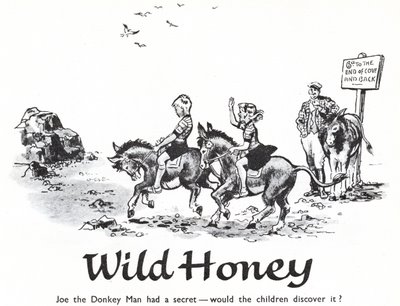
From these, it seems that Frank moved down to Cornwall in the early 1930s; he toured the UK as an actor in the 1940s, later working for the Player's Theatre for 18 months before returning to Cornwall in around 1944/45. The setting makes me wonder if his contribution to Swift Annual 3 was the short story 'Wild Honey' which is set in Cornwall and concerns donkey rides on the beach. The donkey-man, Joe, has a secret: "Joe goes along that way every evening to gather wild honey... No one knows where Joe gets it. He keeps the place a secret -- and then sells the honey to holiday-makers for a lot of money."
The story has Joe talking in local dialect ("I seed you and Master Larry last night," chuckled Joe. "I seed you, and I laughed to meself as I hid with Timothy in the scrub. I was in no hurry. I sez to meself, I sez, 'Timothy and me'll wait here till morning, if need be, till them young scamps give up looking."). And the place where he gets his wild honey would have stayed a secret if it hadn't been for those darn kids...
Cornish setting, local (at least I presume it's meant to be local) dialect... could this be Frank Baker's story?
Novels
The Twisted Tree. London, Peter Davies, 1935.
The Birds. London, Peter Davies, 1936.
Miss Hargreaves. A fantasy. London, Eyre & Spottiswoode, 1940.
Allanayr. London, Eyre & Spottiswoode, 1941.
Sweet Chariot. London, Eyre & Spottiswoode, 1942.
Before I Go Hence. Fantasia on a novel. London, Andrew Dakers, 1946.
Mr. Allenby Loses the Way. London & New York, T. V. Boardman & Co., 1946.
Embers. A winter tale. New York, Coward-McCann, 1946; London, Andrew Dakers, 1947.
The Downs So Free. London, Andrew Dakers, 1948.
My Friend the Enemy. London, T. V. Boardman & Co., 1948.
Lease of Life. London, Angus & Robertson, 1954.
Talk of the Devil. London, Angus & Robertson, 1956.
Teresa. London, Peter Davies, 1960.
Collections
Blessed Are They. Eight stories. London, Society of St. Pauls, 1953.
Stories of the Strange & Sinister. London, Kimber, 1983.
Plays
Playing With Punch. A new play, accompanied by Payne Collier's transcription of the immortal drama of Punch & Judy, etc., illus. Reginald Woolley and Douglas Campbell. London, T. V. Boardman, 1944.
Non-fiction
The Road Was Free. London, T. V. Boardman & Co., 1948.
I Follow But Myself. London, Peter Davies, 1968.
The Call of Cornwall, with photos by David Pitt and others. London, R. Hale, 1976.
Frank Baker contributed anonymously to Swift Annual 3 (1956). No idea what he wrote but maybe someone will be able to fill in that gap some time.
Frank Edgar Baker is one of the few Swift Annual authors listed in the Author's and Writer's Who's Who (4th edition, 1960) which reveals he was born in 1908 in Hornsey, London. He was educated at Winchester Cathedral School, married Kathleen Lloyd and had 2 sons and 1 daughter. At the time he lived in West Cornwall.
Baker contributed to the Radio Times, News Chronicle, Manchester Guardian, English Review, etc.
The Birds and Miss Hargreaves were reprinted in the mid-1960s by Panther Books and the latter, his most successful, was recently republished by Tartarus Press. It was adapted twice for the radio, once in the 1950s and later in an adaptation by Brian Sibley in 1989. The Birds had a very similar theme to the later story by Daphne Du Maurier which was subsequently filmed by Alfred Hitchcock.
There is a web site dedicated to his work with a good biographical essay which reveals that he died at his home in Porthleven in 1983. Another good article on Baker's work can be found here.
From these, it seems that Frank moved down to Cornwall in the early 1930s; he toured the UK as an actor in the 1940s, later working for the Player's Theatre for 18 months before returning to Cornwall in around 1944/45. The setting makes me wonder if his contribution to Swift Annual 3 was the short story 'Wild Honey' which is set in Cornwall and concerns donkey rides on the beach. The donkey-man, Joe, has a secret: "Joe goes along that way every evening to gather wild honey... No one knows where Joe gets it. He keeps the place a secret -- and then sells the honey to holiday-makers for a lot of money."
The story has Joe talking in local dialect ("I seed you and Master Larry last night," chuckled Joe. "I seed you, and I laughed to meself as I hid with Timothy in the scrub. I was in no hurry. I sez to meself, I sez, 'Timothy and me'll wait here till morning, if need be, till them young scamps give up looking."). And the place where he gets his wild honey would have stayed a secret if it hadn't been for those darn kids...
Cornish setting, local (at least I presume it's meant to be local) dialect... could this be Frank Baker's story?

Novels
The Twisted Tree. London, Peter Davies, 1935.
The Birds. London, Peter Davies, 1936.
Miss Hargreaves. A fantasy. London, Eyre & Spottiswoode, 1940.
Allanayr. London, Eyre & Spottiswoode, 1941.
Sweet Chariot. London, Eyre & Spottiswoode, 1942.
Before I Go Hence. Fantasia on a novel. London, Andrew Dakers, 1946.
Mr. Allenby Loses the Way. London & New York, T. V. Boardman & Co., 1946.
Embers. A winter tale. New York, Coward-McCann, 1946; London, Andrew Dakers, 1947.
The Downs So Free. London, Andrew Dakers, 1948.
My Friend the Enemy. London, T. V. Boardman & Co., 1948.
Lease of Life. London, Angus & Robertson, 1954.
Talk of the Devil. London, Angus & Robertson, 1956.
Teresa. London, Peter Davies, 1960.
Collections
Blessed Are They. Eight stories. London, Society of St. Pauls, 1953.
Stories of the Strange & Sinister. London, Kimber, 1983.
Plays
Playing With Punch. A new play, accompanied by Payne Collier's transcription of the immortal drama of Punch & Judy, etc., illus. Reginald Woolley and Douglas Campbell. London, T. V. Boardman, 1944.
Non-fiction
The Road Was Free. London, T. V. Boardman & Co., 1948.
I Follow But Myself. London, Peter Davies, 1968.
The Call of Cornwall, with photos by David Pitt and others. London, R. Hale, 1976.
Rowan Ayers
 Another contributor to Swift Annual 1 (1954). No idea what he might have written but I have dug up a small heap of information. Ayers was the author of Aspects in Adolescence. Being the moods of a young man (London, A. H. Stockwell, 1940), a slim book of wartime poetry. He was living in London (Kensington and Chelsea) during the 1950s-1970s. He also wrote a couple of stories for Argosy around the same time as his contribution to Swift Annual.
Ayers went on the produce Line-Up for the opening night of BBC2 on 20 April 1964, the programme described thus in the following article, 'Presentation Presents' by David Brockman:
Line-up was one of its [the BBC's Presentation (Programmes) Dept.] first major successes, transmitted as it was across the week, in various formats, over seven days. The programme covered a wide range of topics including books, theatre, cinema, music and all manner of cultural topics. A key figure behind Line-up was Rowan Ayers, who later was a founding creator of the BBC's innovative Community Programme Unit.Ayers was the producer of the Late Night Line-Up, which took over from Line-Up in September 1964. The show lasted until 1972, although whether Ayers was involved all the way through I don't know. It seems likely as he was there to launch the Beatles album Abbey Road in September 1969 (this according to a Beatles memorabilia site). Ayers has various other credits with the BBC ranging from Carry on Forever (1970) to articles in the Radio Times (an example of which can be found here).
According to a brief entry on Wikipedia, Ayers subsequently moved to Australia where he wrote and narrated a TV documentary The Riddle of the Dead Sea Scrolls. He also co-authored two books, Australian Film, Television & Radio School Guide to Video Production (Allen & Unwin, Jun 1990) and Guide to Video Production (Allen & Unwin, Feb 1992).
Apparently he is the father of Kevin Ayers, one of the founders of Soft Machine, the British psychedelic band. Again, Wikipedia provides a few clues, mentioning in its entry for Kevin Ayers that his parents split and he spent much of his childhood in Malaysia (this would put the split somewhere around 1950). This site (and many others drawing, presumably, from the same source) gives Kevin's father's occupation as a British District Officer but this is at odds with an article in The Guardian which says that it was Ayers' stepfather who worked in Malaysia.
Australian broadcaster ABC's website also provides some background on Ayers: he started out as a journalist in Fleet Street and then went into TV, working with David Attenborough and helping revolutionise British television with shows like Points of View and The Old Grey Whistle Test before moving to Australia where he worked at Channel 9. According to the site, "Rowan now lives on the Sunshine Coast." The site relates to a radio interview with Ayers (20 February 2006). The photograph above also comes from the site.
(* I didn't intend writing this up tonight but, while digging around, I found an interview with Neil Gaiman (22 May 2006) which I'm waiting to finish downloading... hence the slightly random nature of this entry. But it gives you an idea of how these things can be built up from scratch.)
Monday, October 09, 2006
Jack Borg
More delvings into the Swift Annual...
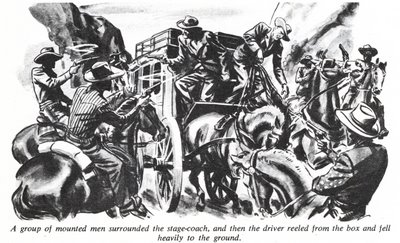
Jack Borg is credited with writing material for the first two Swift Annuals and, although all the stories and strips are published anonymously, I suspect his contributions were the stories 'Bail Up!' (Swift Annual 1, 1954) and 'Arizona Hold-Up' (Swift Annual 2, 1955). Borg was a prolific writer of westerns and these are both tales of the wild west and the most likely thing for him to have written.
 Jack Borg was the pen-name of Philip Antony Borg, born in King's Norton on 4 March 1910. Nothing is known about his life although a bit of genealogical digging reveals that he was the eldest son of Philip Anthony Borg (born in King's Norton in 1886, the son of Italian-born Philip Antone Borg (c.1840-1891) and his wife Edith (nee Hatfield). He had three younger siblings, Neville (1912- ), Gerard (1914- ) and Barry Denzil (1916- ).
Philip Antony Borg published his first novels as Jack Borg in 1954 (the same year as his appearance in Swift Annual) and went on to write over 60 novels, 34 as Jack Borg, 15 as Phil Bexar and 14 as John Q. Pickard, averaging three novels a year. Two of his novels were for children, published by Collins (Children's Press) and he also published a number of short stories for children and adults.
His last novel appeared in 1975 and Borg died a year later, his death registered in Ludlow.
Novels as Jack Borg (series: Hogleg Bailey)
Hellbent Trail. London, Herbert Jenkins, 1954.
Sheriff of Clinton. London, Herbert Jenkins, 1954.
Big Cherokee. London, Herbert Jenkins, 1955.
The Cannon Kid. London, Herbert Jenkins, 1955.
Bushwack Canyon. London, Herbert Jenkins, 1956.
Sheriff's Deputy. London, Herbert Jenkins, 1956.
Bronco Justice. London, Herbert Jenkins, 1957.
Gunsmoke Feud. London, Herbert Jenkins, 1957.
The Cherokee Trail. London & Glasgow, Children's Press, 1958.
Kansas Trail (Hogleg Bailey). London, Herbert Jenkins, 1958.
Rawhide Tenderfoot. London, Herbert Jenkins, 1958.
Badlands Fury (Hogleg Bailey). London, Herbert Jenkins, 1959.
Rustlers' Range. London, Herbert Jenkins, 1959.
Range Wolves (Hogleg Bailey). London, Herbert Jenkins, 1960.
Saddle Tramp (Hogleg Bailey). London, Herbert Jenkins, 1960.
Horsethieves Hang High (Hogleg Bailey). London, Herbert Jenkins, 1961.
Kid With a Colt (Hogleg Bailey). London, Herbert Jenkins, 1961.
Guns of the Lawless (Hogleg Bailey). London, Herbert Jenkins, 1962.
Cast a Wide Loop (Hogleg Bailey). London, Herbert Jenkins, 1963.
Texas Wolves (Hogleg Bailey). London, Herbert Jenkins, 1963.
The Trail Drivers. London & Glasgow, Children's Press, 1963.
Gun Feud at Sun Creek (Hogleg Bailey). London, Herbert Jenkins, 1964.
Rope for a Rustler (Hogleg Bailey). London, Herbert Jenkins, 1965.
Stagecoach to Concho. London, Herbert Jenkins, 1966.
Dry Valley War. London, Herbert Jenkins, 1968.
The Owlhooter. London, Herbert Jenkins, 1968.
The Long-Ropers. London, Herbert Jenkins, 1969.
Badman's Shadow. London, Hale, 1972.
The Man from San Antonio. London, Hale, 1972.
Tumbleweed Man. London, Hale, 1972.
Badman Headed North. London, Hale, 1974.
The Calico Kid. London, Hale, 1974.
Showdown at Sweet Springs. London, Herbert Jenkins, 1975.
Trail of Dead Men. London, Herbert Jenkins, 1975.
Novels as Phil Bexar (series: Billy Dupree)
Law of the Six-Gun. London, Herbert Jenkins, 1957.
Storm in the Saddle. London, Herbert Jenkins, 1957.
Guns Over Texas. London, Herbert Jenkins, 1958.
Showdown in Gunsmoke. London, Herbert Jenkins, 1958.
Outlaw Marshal. London, Herbert Jenkins, 1959.
Six-Gun Fury. London, Herbert Jenkins, 1959.
The Lone Prairie (Billy Dupree). London, Herbert Jenkins, 1960.
Cowtown Fury. London, Herbert Jenkins, 1961.
Trail to Slaughter Creek (Billy Dupree). London, Herbert Jenkins, 1961.
Cowtown Marshal (Billy Dupree). London, Herbert Jenkins, 1962.
Texas Terror (Billy Dupree). London, Herbert Jenkins, 1962.
Maverick Gunfighter (Billy Dupree). London, Herbert Jenkins, 1963.
Rustler Guns (Billy Dupree). London, Herbert Jenkins, 1964.
The Banks of the Sacramento. London, Herbert Jenkins, 1968.
Hardcase Prodigal. London, Herbert Jenkins, 1969.
Novels as John Q. Pickard
Medicine Pony. London, Ward Lock, 1962.
Trail of Fury. London, Ward Lock, 1962.
Sixgun for Sale. London, Ward Lock, 1963.
Gone to Texas. London & Melbourne, Ward Lock, 1963.
Black Hawk. London & Melbourne, Ward Lock, 1964.
Cactus Maverick. London & Melbourne, Ward Lock, 1964.
The Gringo. London & Melbourne, Ward Lock, 1965.
Whistling Bone Creek. London & Melbourne, Ward Lock, 1965.
Pistol Wages. London, Ward Lock, 1966.
Richer Than Tombstone. London, Ward Lock, 1966.
Blood Creek. London, Ward Lock, 1967.
The Horsethieves. London, Ward Lock, 1967.
Buzzard Bait. London, Ward Lock, 1968.
Comanche Crossing. London, Ward Lock, 1968.
Short Stories as Jack Borg
Broken Spur! (in Western Library 108, Sep 1954)
? Bail Up! (Swift Annual 1, 1954)
? Arizona Hold-Up (Swift Annual 2, 1955)
Sino-Japanese Incident (Combat, Dec 1956)
The Silver Bullet (Combat, Mar 1957)
Line and Sinker (Combat, Apr 1957)
Jackpot (Evening News, 5 Dec 1960)
Shake (Evening News, 21 Jan 1961)
Note
The illustration is from Swift Annual 2's story 'Arizona Hold-Up' and is © Look and Learn Magazine Ltd.
(* My thanks to Jane Borg, a relation of Jack's, who has been a great help in adding some details to the bare branches of Jack's family tree.)
Jack Borg is credited with writing material for the first two Swift Annuals and, although all the stories and strips are published anonymously, I suspect his contributions were the stories 'Bail Up!' (Swift Annual 1, 1954) and 'Arizona Hold-Up' (Swift Annual 2, 1955). Borg was a prolific writer of westerns and these are both tales of the wild west and the most likely thing for him to have written.
 Jack Borg was the pen-name of Philip Antony Borg, born in King's Norton on 4 March 1910. Nothing is known about his life although a bit of genealogical digging reveals that he was the eldest son of Philip Anthony Borg (born in King's Norton in 1886, the son of Italian-born Philip Antone Borg (c.1840-1891) and his wife Edith (nee Hatfield). He had three younger siblings, Neville (1912- ), Gerard (1914- ) and Barry Denzil (1916- ).
Philip Antony Borg published his first novels as Jack Borg in 1954 (the same year as his appearance in Swift Annual) and went on to write over 60 novels, 34 as Jack Borg, 15 as Phil Bexar and 14 as John Q. Pickard, averaging three novels a year. Two of his novels were for children, published by Collins (Children's Press) and he also published a number of short stories for children and adults.
His last novel appeared in 1975 and Borg died a year later, his death registered in Ludlow.
Novels as Jack Borg (series: Hogleg Bailey)
Hellbent Trail. London, Herbert Jenkins, 1954.
Sheriff of Clinton. London, Herbert Jenkins, 1954.
Big Cherokee. London, Herbert Jenkins, 1955.
The Cannon Kid. London, Herbert Jenkins, 1955.
Bushwack Canyon. London, Herbert Jenkins, 1956.
Sheriff's Deputy. London, Herbert Jenkins, 1956.
Bronco Justice. London, Herbert Jenkins, 1957.
Gunsmoke Feud. London, Herbert Jenkins, 1957.
The Cherokee Trail. London & Glasgow, Children's Press, 1958.
Kansas Trail (Hogleg Bailey). London, Herbert Jenkins, 1958.
Rawhide Tenderfoot. London, Herbert Jenkins, 1958.
Badlands Fury (Hogleg Bailey). London, Herbert Jenkins, 1959.
Rustlers' Range. London, Herbert Jenkins, 1959.
Range Wolves (Hogleg Bailey). London, Herbert Jenkins, 1960.
Saddle Tramp (Hogleg Bailey). London, Herbert Jenkins, 1960.
Horsethieves Hang High (Hogleg Bailey). London, Herbert Jenkins, 1961.
Kid With a Colt (Hogleg Bailey). London, Herbert Jenkins, 1961.
Guns of the Lawless (Hogleg Bailey). London, Herbert Jenkins, 1962.
Cast a Wide Loop (Hogleg Bailey). London, Herbert Jenkins, 1963.
Texas Wolves (Hogleg Bailey). London, Herbert Jenkins, 1963.
The Trail Drivers. London & Glasgow, Children's Press, 1963.
Gun Feud at Sun Creek (Hogleg Bailey). London, Herbert Jenkins, 1964.
Rope for a Rustler (Hogleg Bailey). London, Herbert Jenkins, 1965.
Stagecoach to Concho. London, Herbert Jenkins, 1966.
Dry Valley War. London, Herbert Jenkins, 1968.
The Owlhooter. London, Herbert Jenkins, 1968.
The Long-Ropers. London, Herbert Jenkins, 1969.
Badman's Shadow. London, Hale, 1972.
The Man from San Antonio. London, Hale, 1972.
Tumbleweed Man. London, Hale, 1972.
Badman Headed North. London, Hale, 1974.
The Calico Kid. London, Hale, 1974.
Showdown at Sweet Springs. London, Herbert Jenkins, 1975.
Trail of Dead Men. London, Herbert Jenkins, 1975.
Novels as Phil Bexar (series: Billy Dupree)
Law of the Six-Gun. London, Herbert Jenkins, 1957.
Storm in the Saddle. London, Herbert Jenkins, 1957.
Guns Over Texas. London, Herbert Jenkins, 1958.
Showdown in Gunsmoke. London, Herbert Jenkins, 1958.
Outlaw Marshal. London, Herbert Jenkins, 1959.
Six-Gun Fury. London, Herbert Jenkins, 1959.
The Lone Prairie (Billy Dupree). London, Herbert Jenkins, 1960.
Cowtown Fury. London, Herbert Jenkins, 1961.
Trail to Slaughter Creek (Billy Dupree). London, Herbert Jenkins, 1961.
Cowtown Marshal (Billy Dupree). London, Herbert Jenkins, 1962.
Texas Terror (Billy Dupree). London, Herbert Jenkins, 1962.
Maverick Gunfighter (Billy Dupree). London, Herbert Jenkins, 1963.
Rustler Guns (Billy Dupree). London, Herbert Jenkins, 1964.
The Banks of the Sacramento. London, Herbert Jenkins, 1968.
Hardcase Prodigal. London, Herbert Jenkins, 1969.
Novels as John Q. Pickard
Medicine Pony. London, Ward Lock, 1962.
Trail of Fury. London, Ward Lock, 1962.
Sixgun for Sale. London, Ward Lock, 1963.
Gone to Texas. London & Melbourne, Ward Lock, 1963.
Black Hawk. London & Melbourne, Ward Lock, 1964.
Cactus Maverick. London & Melbourne, Ward Lock, 1964.
The Gringo. London & Melbourne, Ward Lock, 1965.
Whistling Bone Creek. London & Melbourne, Ward Lock, 1965.
Pistol Wages. London, Ward Lock, 1966.
Richer Than Tombstone. London, Ward Lock, 1966.
Blood Creek. London, Ward Lock, 1967.
The Horsethieves. London, Ward Lock, 1967.
Buzzard Bait. London, Ward Lock, 1968.
Comanche Crossing. London, Ward Lock, 1968.
Short Stories as Jack Borg
Broken Spur! (in Western Library 108, Sep 1954)
? Bail Up! (Swift Annual 1, 1954)
? Arizona Hold-Up (Swift Annual 2, 1955)
Sino-Japanese Incident (Combat, Dec 1956)
The Silver Bullet (Combat, Mar 1957)
Line and Sinker (Combat, Apr 1957)
Jackpot (Evening News, 5 Dec 1960)
Shake (Evening News, 21 Jan 1961)
Note
The illustration is from Swift Annual 2's story 'Arizona Hold-Up' and is © Look and Learn Magazine Ltd.
(* My thanks to Jane Borg, a relation of Jack's, who has been a great help in adding some details to the bare branches of Jack's family tree.)
Sunday, October 08, 2006
Comic Clippings - 8 October
Just a few brief notes tonight as I've spent all day in front of the computer and it's about time I switched screens and watched the TV instead... or maybe read a book. Anything but sitting here in the office!
I've spent most of the day writing an introduction to the Fleetway War Libraries book I'm doing with David Roach which is now pretty much as complete as it's going to get. My attitude has always been to get lists out into the public domain as soon as they're reasonably complete; we could waste years trying to dot every 'i' and cross every 't', during which time the mass of information we've been able to compile will sit on my computer, of no use to anyone but ourselves. The beauty of producing the book now is that, in these days of the internet, if we do have any corrections or additions to make, we can very easily distribute them... maybe via this very blog or a dedicated site or whatever.
So, that's what I've been up to. What about everyone else?
(* And that's me done for the evening...)
I've spent most of the day writing an introduction to the Fleetway War Libraries book I'm doing with David Roach which is now pretty much as complete as it's going to get. My attitude has always been to get lists out into the public domain as soon as they're reasonably complete; we could waste years trying to dot every 'i' and cross every 't', during which time the mass of information we've been able to compile will sit on my computer, of no use to anyone but ourselves. The beauty of producing the book now is that, in these days of the internet, if we do have any corrections or additions to make, we can very easily distribute them... maybe via this very blog or a dedicated site or whatever.
So, that's what I've been up to. What about everyone else?
- Having mentioned Massimo Belardinelli a couple of weeks ago, a Yahoo group dedicated to his work briefly appeared a couple of days ago under the name themassimobellandinelligroup which introduced itself thus: "Massimo Bellardinelli is a GENIUS! And a vastly under-rated genius." The link worked on Friday but, having accrued 35 members, now seems to have disappeared despite still appearing in the groups listings if you do a search for Bellardinelli (note misspelling). No idea what's going on.
- UPDATE: Richard Sheaf (Comments below) informs me that the group is now back up and running and can be found here.
- A memorial tribute to the late Tom Frame appears in the centre pages of the latest issue of 2000AD. If you've not picked up a copy yet, the picture can be found at the 2000AD web site.


- The superlative Gerry Anderson Complete Comic History web site has just uploaded a Thunderbirds Extra with a ton of fascinating features. Of all the sites dedicated to British comics in one way or another, this is by far the best. Fabulous interviews with Alan Willow and Brian Woodford and lots, lots, more.
- Last Sunday's Sunday Times (1 October 2006) opened a review of Janet Street-Porter's book Fall Out with the words "Janet Street-Porter had the great good fortune to be born with looks that were exactly right for her era. When she left home in 1967, her resemblance to Plug in The Beano's Bash Street Kids was, for the first time ever, enormously fashionable."
- The 24 Hour Comics Day (Friday/Saturday/Sunday due to different time zones around the world) was a great success as far as I can tell. I wasn't able to follow events very closely but I have just spotted some photographs from ComICA and there is an ongoing commentary of events as they happened throughout the day at the 24 Hour Comics Day blog.
- Another David Lloyd interview, this time at the Fractal Matter blog (2 October 2006).
(* And that's me done for the evening...)
Ronald Welch (Ronald Oliver Felton)
The digging I've been doing over the past couple of days has rammed home once again the fact that here, in the UK, we seem to have had a dismissive attitude to our writers and artists who fall into the 'popular' category. Finding information on 99% of the artists who worked for Look and Learn has been a case of piecing together data one line at a time. You won't find their names in reference books yet, time and again, I hear comments from visitors to the Look and Learn web site -- and I've said it myself more than once -- that the artists working on Look and Learn were some of the finest artists Britain has ever produced. The same with comic strips: I got my start researching comic strip creators simply because I couldn't find anything about them (same story for paperbacks and, to a degree, old story papers).
Looking through the lists of authors who had contributed to Swift Annual the other day led me to compile a list (most things do!) and, of the 134 named authors who contributed across the nine annuals (1954-62, numbered 1-6 on covers then 1961, 1962 and 1963) only a dozen managed entries in The Author's and Writer's Who's Who, some little more than an abbreviated list of published titles, and I've found less than a handful in Contemporary Authors (admittedly this is an American series but it is supposed to encompass authors from around the globe).
And then, sometimes, information just arrives out of the blue. I was looking blankly at my list, wondering when I'd find time to research another 134 authors, when some information on one dropped into my e-mail inbox. A friend of mine, John Tipper (who knows well that I have an interest in biographical information on children's authors), had forwarded a note he'd received from Tom McGlynn on Friday, the very same day I'd bought a run of Swift Annual. The synchronicity is too perfect for me not to write about it.
Let's start with a picture from Swift Annual 1963 (1962)...
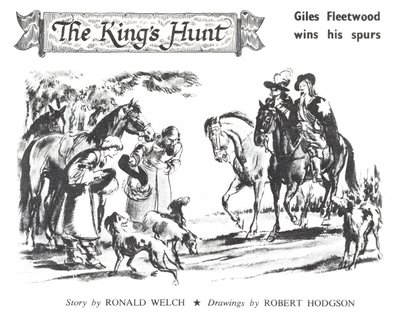 Ronald Welch was the pseudonym of Ronald Oliver Felton, born 14 December 1909, the son of accountant Oliver Felton and his wife Alice (nee Thomas). After attending Berkhamsted School (1922-28), he earned a place at Clare College, Cambridge, where he studied history (M.A., 1931). Welch then went on to work as an assistant history master at Berkhamsted before moving to Bedford Modern School as a senior teacher in 1933. That same year, Felton joined the Territorial Army and, during World War II, Welch became a major and served in Normandy and Germany.
In 1947, he became headmaster of Okehampton Grammar School, Devonshire, where he remained until 1964. He also began writing novels, publishing The Black Car Mystery under the pen-name Ronald Welch in 1950; others quickly followed: The Clock Stood Still (1951), and The Gauntlet (1951), the latter linking Welch with the Oxford University Press, who were to publish the majority of his books. The Gauntlet was also his first historical novel -- actually a science fiction timeslip novel in which a modern day boy finds himself in the 14th century sharing adventures with a distant ancestor.
The best of Welch's early novels was Knight Crusader (1954), his first fully-fledged historical novel, set in teh 12the century as its protagonist, a crusading knight named Philip d'Aubigny, battles his way through the Holy Land and, at the end, returns to Wales to found what was to become the Carey family in later novels. In June 1955, Knight Crusader won the Library Association's Carnegie Medal for the most outstanding children's book of 1954 (and the identity if 'Ronald Welch' became an open secret).
Over the next twenty-five years, Felton wrote a further 17 books, including a biography of Ferdinand Magellan (1955) and a single novel, Sker House (1954) under his own name. Many of his 'Ronald Welch' historical novels followed the exploits of various generations of the Carey family, starting with Captain of Dragoons (1956) which followed Charles Carey at the time of Marlborough's army at the Battle of Blenheim; Alan Carey joined Wolfe at Quebec in Mohawk Valley (1958), Christopher Carey serves under Wellington in the Peninsular in Captain of Foot (1959), the family's French roots are explored in Escape from France (1960) as Richard Carey helps his relatives escape the Revolution, For the King (1961), follows the adventures of Royalist soldier Neil Carey, Nicholas Carey (1963) is a soldier at the time of the Crimean War, Harry Carey takes to the sea in Elizabethan times in The Hawk (1967), Tank Commander (1972) was the most up-to-date of his historical novels, set during the grim days of the Great War, Zulu Warrior (1974) was set during the Zulu Wars whilst Ensign Carey (1976) was set during the days of the the Indian Mutiny.
Of the latter, one reviewer recorded, "Mr. Welch makes it clear that the English officers were often both ignorant and arrogant and that for many of them the mutiny was no more than they deserved" (The Times, 26 November 1976). This was a strength of Felton's work: he would spend six months researching the backgrounds of each of his novels and made sure that each was historically accurate. He did not shy away from grim details and, as Pamela Cleaver says in Twentieth-Century Children's Writers "he never glorified war, but made it quite clear that mud and discomfort, wounds and death were part of soldiering as well as comradeship and adventure." His accuracy sometimes made uncomfortable reading, especially in Zulu Warrior which "expresses the Jingoistic sentiments of the characters which are right for the times portrayed but out of mesh with today's attitudes both to Africa and the war."
So much for Ronald Welch, the author. Ronald Felton in person was an imposing character and Tom McGlynn writes:
Notes
Biographical details are derived from Twentieth-Century Children's Writers and Author's and Writer's Who's Who. The Ronald Welch page at Collecting Books and Magazines includes a number of book cover images (and is the source for an entry for 'Ronald Welch' on Wikipedia). As you will see from the above picture (©
The year that Felton departed Okehampton School is uncertain: 1963 in Twentieth-Century Children's Writers, 1964 in Contemporary Authors online and 1965 according to Author's and Writer's Who's Who (6th edition, 1971). I've plumped for 1964 as the average date.
(* Many thanks to Tom McGlynn and to John Tipper. John runs a very good web site, Collecting Books and Magazines, which has a wide coverage of children's authors and is well worth visiting regularly.)
Looking through the lists of authors who had contributed to Swift Annual the other day led me to compile a list (most things do!) and, of the 134 named authors who contributed across the nine annuals (1954-62, numbered 1-6 on covers then 1961, 1962 and 1963) only a dozen managed entries in The Author's and Writer's Who's Who, some little more than an abbreviated list of published titles, and I've found less than a handful in Contemporary Authors (admittedly this is an American series but it is supposed to encompass authors from around the globe).
And then, sometimes, information just arrives out of the blue. I was looking blankly at my list, wondering when I'd find time to research another 134 authors, when some information on one dropped into my e-mail inbox. A friend of mine, John Tipper (who knows well that I have an interest in biographical information on children's authors), had forwarded a note he'd received from Tom McGlynn on Friday, the very same day I'd bought a run of Swift Annual. The synchronicity is too perfect for me not to write about it.
Let's start with a picture from Swift Annual 1963 (1962)...
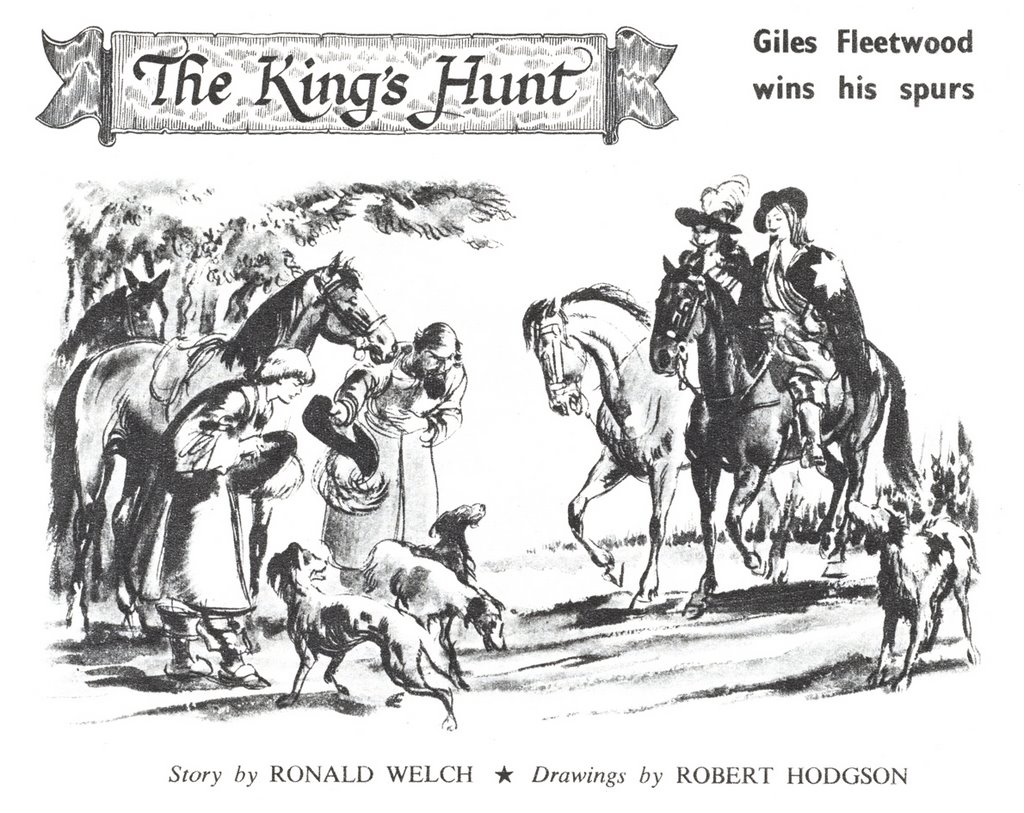 Ronald Welch was the pseudonym of Ronald Oliver Felton, born 14 December 1909, the son of accountant Oliver Felton and his wife Alice (nee Thomas). After attending Berkhamsted School (1922-28), he earned a place at Clare College, Cambridge, where he studied history (M.A., 1931). Welch then went on to work as an assistant history master at Berkhamsted before moving to Bedford Modern School as a senior teacher in 1933. That same year, Felton joined the Territorial Army and, during World War II, Welch became a major and served in Normandy and Germany.
In 1947, he became headmaster of Okehampton Grammar School, Devonshire, where he remained until 1964. He also began writing novels, publishing The Black Car Mystery under the pen-name Ronald Welch in 1950; others quickly followed: The Clock Stood Still (1951), and The Gauntlet (1951), the latter linking Welch with the Oxford University Press, who were to publish the majority of his books. The Gauntlet was also his first historical novel -- actually a science fiction timeslip novel in which a modern day boy finds himself in the 14th century sharing adventures with a distant ancestor.
The best of Welch's early novels was Knight Crusader (1954), his first fully-fledged historical novel, set in teh 12the century as its protagonist, a crusading knight named Philip d'Aubigny, battles his way through the Holy Land and, at the end, returns to Wales to found what was to become the Carey family in later novels. In June 1955, Knight Crusader won the Library Association's Carnegie Medal for the most outstanding children's book of 1954 (and the identity if 'Ronald Welch' became an open secret).
Over the next twenty-five years, Felton wrote a further 17 books, including a biography of Ferdinand Magellan (1955) and a single novel, Sker House (1954) under his own name. Many of his 'Ronald Welch' historical novels followed the exploits of various generations of the Carey family, starting with Captain of Dragoons (1956) which followed Charles Carey at the time of Marlborough's army at the Battle of Blenheim; Alan Carey joined Wolfe at Quebec in Mohawk Valley (1958), Christopher Carey serves under Wellington in the Peninsular in Captain of Foot (1959), the family's French roots are explored in Escape from France (1960) as Richard Carey helps his relatives escape the Revolution, For the King (1961), follows the adventures of Royalist soldier Neil Carey, Nicholas Carey (1963) is a soldier at the time of the Crimean War, Harry Carey takes to the sea in Elizabethan times in The Hawk (1967), Tank Commander (1972) was the most up-to-date of his historical novels, set during the grim days of the Great War, Zulu Warrior (1974) was set during the Zulu Wars whilst Ensign Carey (1976) was set during the days of the the Indian Mutiny.
Of the latter, one reviewer recorded, "Mr. Welch makes it clear that the English officers were often both ignorant and arrogant and that for many of them the mutiny was no more than they deserved" (The Times, 26 November 1976). This was a strength of Felton's work: he would spend six months researching the backgrounds of each of his novels and made sure that each was historically accurate. He did not shy away from grim details and, as Pamela Cleaver says in Twentieth-Century Children's Writers "he never glorified war, but made it quite clear that mud and discomfort, wounds and death were part of soldiering as well as comradeship and adventure." His accuracy sometimes made uncomfortable reading, especially in Zulu Warrior which "expresses the Jingoistic sentiments of the characters which are right for the times portrayed but out of mesh with today's attitudes both to Africa and the war."
So much for Ronald Welch, the author. Ronald Felton in person was an imposing character and Tom McGlynn writes:
Few attending Okehampton Grammar School knew that 'Felix' had written even one historical novel -- fewer still that he'd published several and continued to do so into the mid-1970s. Our ignorance of his writing was mainly due to the fact that Felix rarely referred to his books, despite the fact that the thousands he had taught over several decades represented a large potential readership. Only now, 50+ years later (and a retired history teacher myself) have I discovered that Felix wrote more than a dozen historical novels for young people -- all set in diverse periods and widely scattered locations.
Felix read history at Cambridge in the 1930s and was a Tank Corps officer in World War II. Because of that background he was in appearance, accent, dress, etc., a typical upper class Englishman. Yet he was a Welsh patriot, not least because of his firm grasp on the often tragic history of 'The land of his Fathers'.
He taught only 'A' level history -- in my day "Europe 1780-1920". But to the majority [most Grammar School boys left school after 'O' levels, aged 16], 'The Boss' was a remote figure who presided at morning assemblies and fulfilled the 1944 Butler Education Act's requirements on religious instruction (R.I.). I recall that Felix seemed to find his own R.I. lessons just as tedious as we did. The Butler Act's compulsory R.I. clause, I suspect, had been backfiring ever since -- achieving more since 1944 "to promote secularism via boredom" than the efforts of all British atheists and communists combined.
Ronald Felton was a big man, maybe 6' 4" and 220 lbs. He was 43 when I met him but seemed much older -- maybe because of the massive domed head and thinning, grey, swept-back hair. As my 6th Form history teacher he came across as a very different man from the impassive presenter of Middle Eastern fairy tales of my earlier years at OGS. Lessons on George the 3rd and 4th, Chatham, Charles James Fox, William Pitt, Napoleon (& Josephine!), Wellington, Goya, Brougham, Peel, Canning, Queen Victoria, Melbourne, Cardigan, Napoleon III, Disraeli, Gladstone, Kaiser Franz-Josef, Archduke Franz-Ferdinand, Parnell, Chamberlain, the last three German Kaisers, Balfour, Lloyd-George and many others, were always enlivened with personal anecdotes.
I recall Felix expounding on Bismarck: in his student days lying in winter on a giant stove as a way of concentrating on his studies; how he took the measure of Russia as a diplomat in Sankt Peterburg; how he reacted to the news of the death in 1888 of Kaiser Frederick III (of throat cancer after an English surgeon failed to cure him) by saying with a shrug, "the young fool will soon destroy the Empire;" and how, in his last years, he warned his successors that "Germany and Europe must grasp that in the coming century the Americans will play a major role in all our affairs."
Felix added that if only the Anglophile Frederick III had died at 80 -- in 1911 -- rather than at 57, the entire 20th century would be unimaginably different. "No World War I. No Russian Revolution! But what instead?"
Notes
Biographical details are derived from Twentieth-Century Children's Writers and Author's and Writer's Who's Who. The Ronald Welch page at Collecting Books and Magazines includes a number of book cover images (and is the source for an entry for 'Ronald Welch' on Wikipedia). As you will see from the above picture (©
The year that Felton departed Okehampton School is uncertain: 1963 in Twentieth-Century Children's Writers, 1964 in Contemporary Authors online and 1965 according to Author's and Writer's Who's Who (6th edition, 1971). I've plumped for 1964 as the average date.
(* Many thanks to Tom McGlynn and to John Tipper. John runs a very good web site, Collecting Books and Magazines, which has a wide coverage of children's authors and is well worth visiting regularly.)
Random Notes on Look & Learn Artists 2
More artists who contributed to Look and Learn and related titles about whom I know very little.
Leonard (G.) Appleby (1929- ). Born in Kingston-on-Thames, Appleby was the author and illustrator of two books on snakes, British Snakes (1971) and Snakes (1983). Contributed to The Countryside.
Gordon (C.) Arnold (1910- ). Artist who contributed to Treasure. Arnold studied at the City School of Art in Liverpool and was noted for his architectural illustration and engraving. He exhibited in Liverpool and at the Royal Academy. He lived in Bromborough, Wirrall.
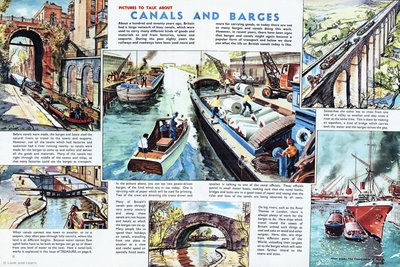
John J. Arnold (?- ). Contributed to Look and Learn and Speed & Power. Specialised in diagramatical illustrations of cars.
P. J. Ashmore (?- ). Contributed to Look and Learn.
John Barber (1932- ). Contributed to Ranger. Illustrated numerous books, including volumes of the 'How and Why Wonder Book' series from Transworld, the 'Nature Trail' series for Usborne and 'The Young Scientist Investigates' series for Oxford University Press.
Stefan Barany (?- ). Contributed to Treasure. Barany was an irregular cover artist for Fleetway's war libaries and the Sexton Blake Library (for who he produced almost two dozen covers between 1961 and 1963).
John Beswick (?- ). Contributed to Look and Learn via Greystock and Marsh agency. Illustrated various titles for Hamlyn, including Mammals of the World (1970), Undersea Exploration (1971), Fortune Telling (1972), Spotlight on Wild Animals (1973) and, for Blackwells, Submarines (1973).
P. J. Bird (?- ). Contributed cut-away drawings to Speed & Power.
Janet Blakely (?- ). Contributed to Look and Learn.
Robert Brook (?- ). Produced dozens of covers Look and Learn from around 1967 and notably illustrated the series 'Dancing Round the World' in 1968. We have many examples of his artwork up on the Look and Learn web site.

Ralph Bruce (?- ). Contributed to The Children's Newspaper and Look and Learn. Bruce was a cover artist for paperbacks, including Digit Books. Later contributed illustrations to a number of books published by Beckenham-based Patterson Blick, including Ancient Egypt (1970) and Football (1970). Some examples of his artwork can be found here.
Jeff Burn (?- ). Contributed to Look and Learn.
Any help or information would be very welcome.
Leonard (G.) Appleby (1929- ). Born in Kingston-on-Thames, Appleby was the author and illustrator of two books on snakes, British Snakes (1971) and Snakes (1983). Contributed to The Countryside.
Gordon (C.) Arnold (1910- ). Artist who contributed to Treasure. Arnold studied at the City School of Art in Liverpool and was noted for his architectural illustration and engraving. He exhibited in Liverpool and at the Royal Academy. He lived in Bromborough, Wirrall.
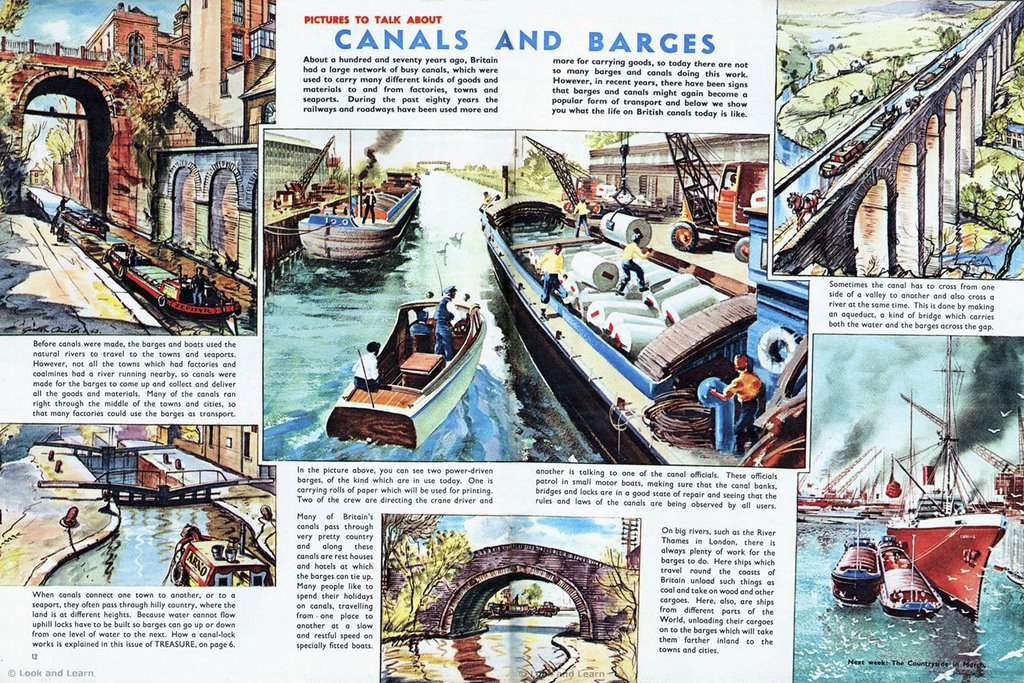
John J. Arnold (?- ). Contributed to Look and Learn and Speed & Power. Specialised in diagramatical illustrations of cars.
P. J. Ashmore (?- ). Contributed to Look and Learn.
John Barber (1932- ). Contributed to Ranger. Illustrated numerous books, including volumes of the 'How and Why Wonder Book' series from Transworld, the 'Nature Trail' series for Usborne and 'The Young Scientist Investigates' series for Oxford University Press.
Stefan Barany (?- ). Contributed to Treasure. Barany was an irregular cover artist for Fleetway's war libaries and the Sexton Blake Library (for who he produced almost two dozen covers between 1961 and 1963).
John Beswick (?- ). Contributed to Look and Learn via Greystock and Marsh agency. Illustrated various titles for Hamlyn, including Mammals of the World (1970), Undersea Exploration (1971), Fortune Telling (1972), Spotlight on Wild Animals (1973) and, for Blackwells, Submarines (1973).
P. J. Bird (?- ). Contributed cut-away drawings to Speed & Power.
Janet Blakely (?- ). Contributed to Look and Learn.
Robert Brook (?- ). Produced dozens of covers Look and Learn from around 1967 and notably illustrated the series 'Dancing Round the World' in 1968. We have many examples of his artwork up on the Look and Learn web site.

Ralph Bruce (?- ). Contributed to The Children's Newspaper and Look and Learn. Bruce was a cover artist for paperbacks, including Digit Books. Later contributed illustrations to a number of books published by Beckenham-based Patterson Blick, including Ancient Egypt (1970) and Football (1970). Some examples of his artwork can be found here.
Jeff Burn (?- ). Contributed to Look and Learn.
Any help or information would be very welcome.
Friday, October 06, 2006
Barbara Wace
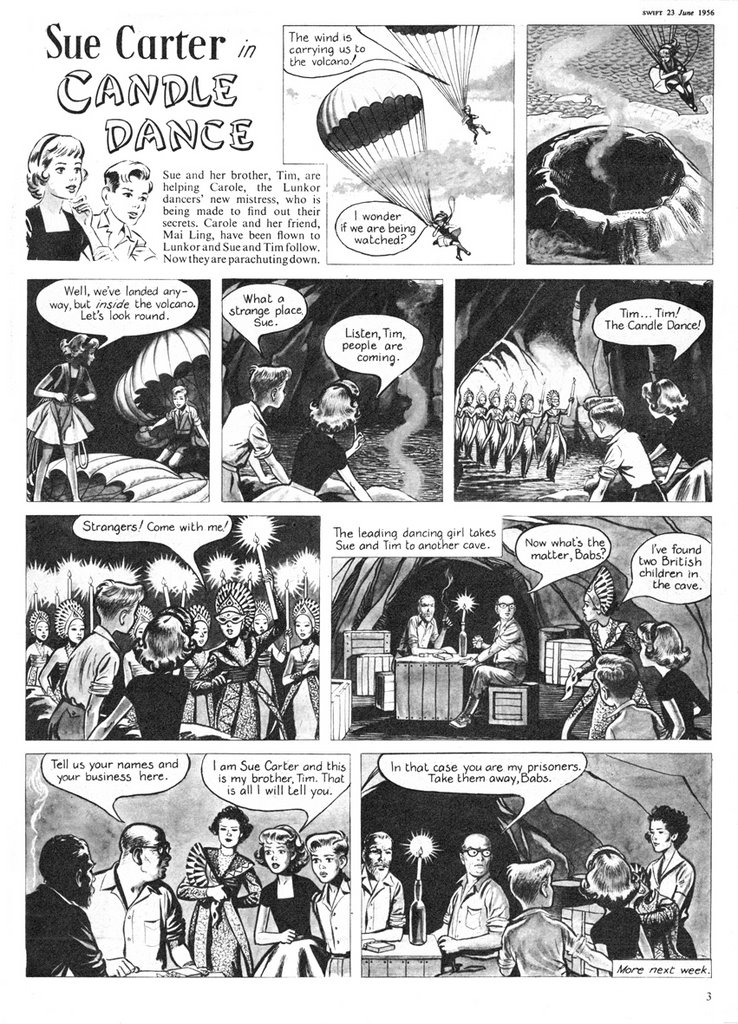 A couple of weeks ago I mentioned a strip about a lass called 'Sue Carter' as possibly being written by Betty Roland.
I now think that's wrong. I've just picked up a run of Swift Annual which had three Sue Carter yarns. Although it didn't credit individual stories, Swift Annual did run a list of contributors on the contents page and Betty Roland's name is not included. This, of course, presumes that the annual strips were written by the same author as the weekly comic strip. I think that's a reasonably safe assumption as other known credits tie in.
So, if Betty Roland didn't write the strip, who did? Well, if we presume the strips were all written and drawn by the same people, the author will appear in all three of the contributors lists. Excluding one or two names I know to be associated with other strips that leaves four strong suspects, namely Maud Miller, Margaret Thomas, Barbara Wace and Roger Wilkinson.
I don't have much information on any of them. Maud (Mary) Miller edited film books just after the war and was editor of the Girl Television and Film Annual (1962) -- she was probably editoress of all six editions (the first five, published in 1957-61, were entitled Girl Film and Television Annual, indicating how important TV was becoming by the early 1960s).
I know nothing about Roger Wilkinson or Margaret Thomas (apart from the fact that Margaret Thomas contributed a couple of stories to Girl) but Barbara Wace would appear to be a very likely suspect.
Wace was born in Gillingham, Kent, on 4 September 1907, into an Army family and was educated at the Royal High School, Bath. She spent much of her childhood in Germany where her father, Brigadier E. C. Wace, was serving with the British occupying forces and, in 1920-21, was British Commissioner of the Saar Boundary Delimitation Committee. She trained as a secretary and her knowledge of German helped her get a job with the British Embassy in Berlin where she was working at the time of the 1936 Olympic Games.
In 1940 she transferred to Washington and then New York and San Francisco, helping to set up the British information service which fed material to the American press. In 1942, she returned to the UK and applied for a job with the Ministry of Labour. Because of her travels to America she was offered a post with the news agency Associated Press (AP) which allowed her to become accredited to US forces. In 1944, she became the first British woman to report on the Allied invasion of Normandy, sent to France to cover the arrival of the Women's Army Corps four weeks after D-Day. Wace, who could speak French, travelled around some of the devestated villages interviewing some of the villagers about their devestated lives.
Wace was sent to cover the siege at Brest where the German army was holding out. However, a male reporter was sent to cover the last days of the siege and she received no byline. When her belongings were stolen, she sent a telegram to AP's London office which read: "Lost skirt, Brest fallen".
After the war she travelled extensively, travelling extensively in America and, on the strength of selling several travel articles to Reader's Digest, went freelance as a writer and photographer. She broadcast on the BBC World Service and wrote for the Manchester Guardian and New York Times. She visited at least 60 countries, often the first to report from little known parts of the world such as on her 1957 trip to Albania. Wace wrote extensively about the Middle East.
She continued to make a living as a journalist until well into her 80s. For forty years she lived in an attic flat in Fleet Street, until 1988 when climbing the 96 stairs became too much. She moved to a flat in the Barbican and, later, to a residential home in Blackheath where she died on 16 January 2003, aged 95.
Her travels around the middle and far east make her a very strong suspect as the possible author of Sue Carter, whose adventures took her to the Middle East, Egypt and elsewhere.
By similar logic, I've narrowed down the name of the artist to a handful of suspects: Ursula Blau, John Brinkley Ann Parker, D. H. Ralphs, Eric Winter, Bill White and John Woods. A little more research is needed before I take a stab at who drew the strip but, for now, Barbara Wace is my top suspect as scriptwriter.
Tuesday, October 03, 2006
Comic Clippings - 3 October 2006
Monday was radio day for me as I was doing interviews with Radio Newcastle, Radio Cumbria, Radio Swindon and Radio Wiltshire and, nearly, Radio Manchester. I say nearly because when they dialed up to get a line they contacted BBC Essex's main studio in Chelmsford only to be told I wasn't there... which is true because I was at BBC Essex in Colchester. Hopefully we can reschedule. It wasn't as terrifying as expected thanks to the friendly, chatty first interview with BBC Radio Newcastle's Paul Wappat and Ian Robinson, who was out with the Big Blue Bus. If you've ever done any radio you'll know that you get about 30 seconds warning before you're live so learning that you're about to talk to someone on a Big Blue Bus was... interesting! Turns out The Blue Bus is the name of the show. But with that first one under my belt and a regular supply of coffee, the whole day went pretty well. Kudos to Paul & Ian, Paul Braithwaite, Graham Seaman and Gavin McCoy.
Between that and other work for Look and Learn, I've not had a chance to write anything for a few days. So here's a round-up of odds and ends spied on the web this evening.
(* Bringing things full circle, the Oh Boy! office was next door to Look and Learn at King's Reach. Small world, eh?)
Between that and other work for Look and Learn, I've not had a chance to write anything for a few days. So here's a round-up of odds and ends spied on the web this evening.
- Paul Gravett had a lengthy interview with Alan Moore in the Independent on Sunday (1 October 2006). A DVD, The Mindscape of Alan Moore, is due out on 18 November from Shadowsnake Films after screening up the upcoming Comica Festival at the ICA. The whole thing kicks off on the 6th with a 24 Hour Comics Day. For a full rundown of events, see here.
- D. C. Thomson have an area of their site where you can find their latest Annuals and calendars which, this year, includes an Art of Commando Calendar.
- Robinson are due to publish The Mammoth Book of Best New Manga on 26 October. Over 500 pages of all-new stories edited by Ilya (Ed Hillyer) for a mere £7.99.
- The Forbidden Planet blog is reporting that cartoonist Ralph Steadman has been involved in a car accident. He was to have been a guest on the Phil Jupitus breakfast show on BBC Radio 6.
- The band The Gorillaz are publishing an autobiography, Rise of the Ogre, on 2 November. Over 300 pages with lots of colour illustrations by Jamie Hewlett.
- Books just out: The Best of Girl (which, incidentally, doesn't show up if you do a search on Amazon.co.uk... but it's there!), True Brit, and Jackie: Dear Cathy & Claire. The best of your favourite problems page, all from Prion Books.
- Just noticed that Robson Books Ltd. have just published The Best of My Guy (28 September). OK, not comics, but one of the iconic girls' papers of the 1980s (it actually ran from 1978-95) that killed off the traditional girls' comics. The original editor was ex-Oh Boy! assistant Brigid Callaghan who later worked for The Sun and now, I believe, works for The Times Online. I remember Gaythorne Silvester (who was managing ed. of the girls' magazines) telling me a couple of years ago that some of the staff had gone on to better things. Seems he was right.
(* Bringing things full circle, the Oh Boy! office was next door to Look and Learn at King's Reach. Small world, eh?)
Subscribe to:
Posts (Atom)
BEAR ALLEY BOOKS

Click on the above pic to visit our sister site Bear Alley Books