If last week was the 30th anniversary of
2000AD, that means this week is the anniversary of Judge Dredd, who made his debut appearance in the second issue. Back in 1994, I was briefly involved in my own Judge Dredd adventure which came about through my contact with Phil Duckett of P & J Promotions who had just picked up the license to do a set of Judge Dredd B.T. phonecards. The whole story was written up for a magazine called
TeleCard Collector International (August 1995), so this is probably the first time anyone has read it... if anyone is actually reading this...
PUTTING THE LAW IN ORDER
It’s always nice to face a new challenge, but this one was going to stretch my meagre talents to their limit. A phone call from Phil Duckett had fired my enthusiasm to boiling point; you see, Phil had just picked up the license to produce Judge Dredd Telecards and I am -- to say the very least -- a fan of Dredd. I’ve followed the comic book character since his debut in 1977 and know my way around the soaring skyscrapers of Mega-City One better than any Yellow Cab driver knows his way around New York - upon whose foundations Mega-City One will one day stand; as the population grows and tower blocks give way to the Starscrapers of the future, the huge conglomerate of cities down America’s Eastern seaboard will merge into one vast mega-city containing eight hundred million inhabitants. Every one, as Dredd would say, a potential perp (perpetrator of crime).
To combat the crime menace that seems to grow as any city grows, the police-force was first augmented by highly trained Judges - empowered to dispense instant, on-the-spot justice. Later the Judge system took over completely, a harsh, emotionless rule where littering the walkways could earn you a year in the iso-cubes (prison). The size and population of the city caused its own problems - with unemployment rife thanks to robot-run automated factories, the announcement of an position opening often led to job riots where thousands of bored citizens would converge on a factory to fight for one place. That boredom could escalate into full-scale block wars - battles between neighbouring towers which stretched the judges to their limits.
The toughest Judge of all is Dredd who follows the law like a bible. No-one is innocent in Dredd’s eyes, and it’s his job to bust each and every one. Thanks to accelerated-sleep chambers, he can patrol the streets on his Lawmaster Bike almost 24 hours a day. Dressed in the black leather and emblems of the Judge, Dredd’s face is forever hidden behind a tinted helmet - in the comic strip his face has never been seen, although the forthcoming movie will reveal Dredd’s face as that of Sylvester Stallone - Stallone’s visage is, after all, pretty well known anyway, and when the fee is $11 million, you expect to see as much of your star actor as possible.
The movie will bring Dredd to a much wider audience for the first time, although the character has appeared around the world in comics, books and newspapers -- probably the most widely read British comic character since Dan Dare, and his big screen debut will help his fame grow even wider this summer.
Here, then, was the problem: to bring the larger than life Judge Dredd to the relatively small space available on a telecard and make this unique opportunity... well, unique!
Phil Duckett had previously handled plenty of high-profile characters, producing Captain Scarlet and Thunderbirds telecards, for instance, in 1994. The limited edition cards he envisaged for Dredd had to retain the character of the comic book, yet had to offer something more.
The solution was both simple and intriguing: to produce a story told over a series of 18 telecards that could be both easily followed by fans and offer single, dynamic images of Dredd and his future world for collectors. No-one had ever tried to tell a story before yet for a comic character -- whose adventures appear in a series of sequential images anyway -- it seemed the obvious thing to do, adding a massive bonus to collectors who followed the whole series as they were issued.
One artist whose work I felt would transfer to telecards sprang to mind -- Kev Walker. Not only was he familiar with Dredd’s future, having painted stories for the Judge Dredd Megazine, he had been invited to Los Angeles a year before to assist in the design of the Dredd movie. Many of his conceptual drawings helped shape what you will eventually see on the screen. A phone-call to Kev piqued his interest, although he wanted to see a script before committing himself.
 Who could write such a script? In any line of work, you should always aim for the top - and who better than the writer who had created the character in the first place? John Wagner has been a professional full-time comic strip writer for twenty-five years, has penned hundreds of Dredd’s adventures for eighteen of them and is considered the best in the business by editors and fans alike. One important aspect of Dredd that had to be brought out was the line of black humour that ran through his stories. Without the storyline and dialogue, Dredd was nothing more than a black-leather bedecked biker with a vicious streak.
The phone-lines hummed again. By November 1994, Wagner had completed the script which not only explored Dredd’s world, but brought in many of the other characters to be found in Mega-City: the beautiful Psi-Judge Cassie Anderson, Mean Machine Angel, whose emotions are controlled by a surgically implanted dial that on 1 makes him surly -- on 4 he’s completely insane. The other star of the script was Judge Death, Dredd’s most dangerous foe, the spirit of judgement who had taken Dredd’s maxim that every citizen was a potential criminal to its extreme limit; Death’s warped logic said that as all crime was committed by the living, life itself was a crime - and there was only one sentence.
The script was sent to Walker who turned Wagner’s concepts into visual reality. To give you a taste of what’s to come, here’s John’s instructions for the opening frame, written as you would a film script, with descriptions of the scene, of angles and the dialogue that was to appear on the ‘strip’ version of the card in the folder:
PIC 1
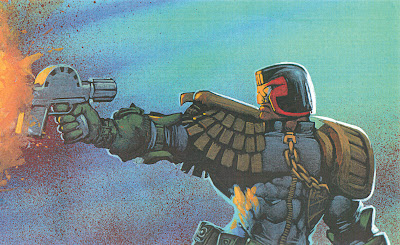
Dredd on bike, riding towards us. Angle from below and in front, so that we get Dredd's arms and bike handle bars using the full width of the pic. the angle condensing things so we can see his badge and head above. He has lawgiver in hand in close fg. firing at us at unseen perps.
CAPTION: JUDGE DREDD - IN THE NIGHTMARE FUTURE WHERE HE PATROLS, HE IS THE LAW.
DREDD: DROP DEAD, CREEP!
 The accompanying illustration will show how Kev Walker translated this scene, making full use of the width of the card’s artwork space to empower Dredd with menace as he grimly fires his Lawgiver handgun at out-of-frame criminals. That single illustration has a dynamic tension unlikely to be found in most telecards, making them a unique experiment. As Wagner said, "Telling a smooth story featuring a totally different aspect of Dredd and his world in each picture was an impossible task, though I think I got fairly close. The first priority had to be to make every picture both varied and highly visual. This would seem to be the key factor in their collectability, when coupled with Kev Walker’s artwork."
Where Walker’s artwork alone would make the card a 'must have' for most fans, the especially created folders, reprinting the card art with the captions and dialogue in place to tell the story, means that the Judge Dredd Telecard will enter the telecard history books as the first ever storycard set.
END
Below: A bit of a bonus -- the first page of John Wagner's script and cards 2 and 3 to show how Kevin Walker interpreted it.


 Actually, the story doesn't quite end there. The cards, which were strictly limited to 2,000 copies worldwide were issued in a folded card; where the phonecards were simply images, the folders had the captions and dialogue that made up the story. So, apart from making the connection between Phil, John Wagner and Kev Walker, I was also involved in putting together the folder that the cards came in along with Alex Baldock, who I'd worked with on Comic World (his dad, Graham, was our fantastic designer).
The cards were issued monthly, so the complete set of 18 were issued over 1995-97 and, in 1997, we began the whole process again with a second series.
 (* Judge Dredd is © Rebellion A/S.)