Showing posts with label Jeremy Briggs. Show all posts

Wednesday, May 13, 2015

Space Captain Jim Stalwart: Foreign Reprints

SPACE CAPTAIN JIM STALWART: 
FOREIGN REPRINTS
by Jeremy Briggs

Surprisingly, for a little known British comic strip in a short run children’s newspaper, Space Captain Jim Stalwart was sold abroad and was printed in at least three other countries - Portugal, France and Spain.

Jim Stalwart was published in Portugal in the weekly comic Titã which ran for 42 issues between 12 October 1954 and 10 August 1955. Edited by José da Costa Pessoa and published by P&B, Titã translated and reprinted many well known comic strips including Eagle's Dan Dare and Jeff Arnold, Tintin comic's Blake and Mortimer and the American newspaper strip Terry and the Pirates.


The comic only published the first Jim Stalwart story, The Fantastic Adventures Of The Missing S.200, which ran for 25 weeks from issue 7, 23 November 1954, to issue 31, 25 May 1955, under the title "O Satélite S 200". The British publication of the first story was still ongoing when Titã began publishing it at the same rate as the UK, one page per week, almost three months after their British publication. For Titã the landscape layout of the newspaper strip was changed to a portrait layout to better fit the more traditional shape of the comic.


France began publication of the strip after the Junior Mirror had been cancelled in the UK. Jim Stalwart, Captain De L’Espace was published in the French monthly magazine Pierrot. Both Stalwart adventures that had been completed in the United Kingdom, The Fantastic Adventures Of The Missing S.200 and The Green Star, were published over six issues – numbers 5 to 10, December 1956 to May 1957, and the two stories were printed under close translations of their British titles, “La Disparition Du Satellite S-200” and “L’Etoile Verte”. This second run of Pierrot magazine, “Nouvelle Serie”, itself lasted only 17 issues from August 1956 to December 1957. 


Meanwhile, also in 1957, Stalwart was also published in the Spanish science fiction bi-monthly comic Futuro. The first two issues of Futuro in 1957 ran colour covers featuring Stalwart with the first issue featuring the Beta 1 spaceship approaching the S-200 space station for their version of the story “La Desaparicion Del Satellite S-200”.


(At the time that this article was first published, in Eagle Times v23 #2 in Summer 2010, there was next to nothing on the internet about the Space Captain Jim Stalwart strip. Since that time the National Library of Australia has digitised a selection of newspapers on its Trove website and these include the Melbourne Argus which reprinted Jim Stalwart in its children’s section The Junior Argus. The Argus began publishing the first Stalwart story, The Fantastic Adventures Of The Missing S.200, on 15 October 1954 some six weeks after it began in the UK but does not appear to have completed it.)

Tuesday, May 12, 2015

Jim Stalwart Stripography

SPACE CAPTAIN JIM STALWART STRIPGRAPHY
by Jeremy Briggs


The tabloid sized Junior Mirror was published by Pictorial Publications beginning with the issue dated 1 September 1954. Edited by Donald Zec, it sold for an initial cover price of 2d, rising later to 3d, and was based on the long running weekly Children's Newspaper which had begun in 1929.  It used the newspaper format of its adult namesake, the Daily Mirror, and featured a few cartoon strips amongst its text articles. For the publication’s young readers the humorous Pip, Squeak and Wilfred strip would have been familiar as it had been running in the Daily Mirror since 1919 while the science fiction Space Captain Jim Stalwart, the canine Flash The Wonder Dog and the western Fighting Tomahawks were new.

The paper was an initial success with sales in the region of 500,000 despite industrial action which halted publication for four weeks for the issues that would have been dated 30 March and 6, 13 and 20 April 1955. However the publication came to an end with issue 75 dated 29 February 1956. With a strike expected in March of that year, which did affect the publication of such comics as Knockout, Lion and Tiger, the decision was made to close the title rather than attempt to ride out what would have been the second strike in the Junior Mirror's relatively short life and its anticipated detrimental effect on the title's sales figures. Jim Stalwart artist Bruce Cornwell received “a curt letter from the editor that a printers strike was going to kill the project stone dead. I can’t say that I was upset. I had plenty of other work at hand and I must say cartooning was somewhat limiting for a trained illustrator like myself.”

The Junior Mirror published three Space Captain Jim Stalwart stories, The Fantastic Adventures Of The Missing S.200, The Green Star, and the incomplete Pirates Of The Spaceways!


The Fantastic Adventures Of The Missing S.200

26 episodes
1 September 1954 (A1) to 23 Feb 1955 (B26)


Space Captain Jim Stalwart is ordered to return to the E.24 base from London by the Space Marshall to investigate why the Genamica fuel powering the new C.12 space freighters is solidifying as they return from the Moon to the S.200 space station in Earth orbit. To make matters worse E.24’s observatory reports that the S.200 has disappeared although the radio room is still receiving the S.200’s signal. Jim and his co-pilot Flight Sergeant Archie Harbottle take the Beta 1 spaceship to investigate not knowing that Jim’s younger brother Space Cadet Tony Stalwart has stowed away. In orbit they find that the S.200 has gone but a small radio transmitting satellite has been left in its place.

An asteroid storm damages the Beta 1 but also pushes it to the same location that the S.200 has ended up. Finding their stowaway, the two men and the boy board the S.200 and talk to its commanding officer Major Borman who tells them of his problems with storm damage and an ill crew however as Tony explores the station he discovers an alien Satik from Saturn. Jim and Archie don’t believe Tony but on discovering that they have been locked in their cabin, the men escape and while Archie repairs the Beta 1 Jim disappears into a ballast tank. When they realise Jim is missing, Archie and Tony search the station and discover Jim being held as a Satik prisoner.


On telling Borman of their discovery, Borman pulls a hand gun on them and reveals the truth as the Satiks bring Jim to the room. On an inspection trip to the Moon, Borman had discovered a new metal with amazing properties which he smuggled on board the S.200 where crewmen were bribed into refining it. He was selling the new metal to the Satiks for a vast profit however the refining process gave off radiation which caused the fuel to solidify and Borman decided to move the station to Saturn’s orbit before he was found out. Unfortunately the asteroid storm had damaged the station. Now, obsessed by power and referring to himself as The Great Borman, he gives them 10 hours to decide between death or joining him.

Escaping from their cell, Jim, Archie and Tony send a mayday from the radio room before neutralising the radiation so that they can escape in the unarmed Beta 1. As they launch, they see armed Satik ships approaching but are saved by E.24’s G Squadron who drive off the Satik vessels and then take control of the S.200. A search of the station shows that Borman has escaped justice but his new metal, called Balite, will revolutionise spaceship construction. Safely back on Earth Jim Archie and Tony are all awarded the Space Legion Medal Of Merit and Tony is promoted to Chief Cadet First Class.


The Green Star

34 episodes
2 March 1955 (B27) to 16 November 1955 (B60)

Note: this story was advertised in B26 as “Next Week – The Mystery Of The Green Star” however the title panel of B27 refers to it simply as The Green Star.


Jim Stalwart is ordered to take command of Moon Base 1 with Archie Harbottle assigned with him and Tony Stalwart is included as part of his cadet training. With Beta 1 under repair they take an X.71 to the moon. The moon base is sealed under a transparent dome and after landing they are walking to the headquarters building when Tony saves the elderly Professor Erkintoss from being knocked down by a vehicle. To show his appreciation the Professor offers Tony a place on his expedition to the dark side of the Moon using Super Land Trucks, half tracked lunar rovers. Jim agrees and assigns Archie to the expedition as well. Setting out from Moon Base 1 the expedition sights the Green Star, a moving celestial phenomenon that has recently appeared in the solar system.


While driving over the flat Cara Plateau, one of the vehicles breaks the surface crust and partially sinks. While the other expedition trucks pull it free, Tony ventures away from the site and discovers a piece of alien equipment. As he attempts to free it he falls through the crust into a chamber. Discovering that he has disappeared, Archie informs Jim at Moon Base 1 and launches a search. Jim flies to the site in a Scooter Jet, and discovers Tony by falling into the same chamber which they realise contains an alien space craft. Once they are rescued from the chamber, alien craft appear in the sky and, with two circling, one lands. As the rest watch from a distance, Jim investigates the craft alone and is suddenly surrounded by the craft’s alien crew. Attempting to rescue him, Archie and Tony are also captured and when they are taken inside the craft, the Professor orders the Super Land Trucks to be parked around the spacecraft to prevent it taking off.


Inside the craft the aliens force Jim into a machine which allows them to learn English. The friendly Tukanan leader Socha warns Jim that the Moon is in great danger from the Green Star which destroyed their home world, Tuka. With time running short and the Green Star causing radio interference, the Tukanas agree to transport the expedition crew back to Moon Base 1. There Jim orders the entire base to be evacuated into space on ships and he decides to use the X.71 packed with the high explosive Tritureum to destroy the Green Star. Jim and Archie pilot the X.71 onto a collision course with the Green Star and escape in life pod as the explosion destroys the Green Star. With everyone safely back on Moon Base 1, the Tukanas are allowed to settle on the Moon by way of thanking them for their help.


Pirates Of The Spaceways!

15 episodes
23 November 1955 (B61) to 29 February 1956 (C75)

Note: this story was advertised in B60 as “Next Week – Pirates Of The Spaceways!” however none of the actual episodes include a story name in their title panels


After their near death encounter with the Green Star, Jim Stalwart and Archie Harbottle have been assigned to rest duties in the control tower of Moon Base 1 where they are growing bored. Tony Stalwart is on his way to Mars on the Martian 1 freighter commanded by Space Captain Jock MacKenzie when the Space Marshal orders the two men to fly Police Commissioner Higgins to Mars to investigate a security leak. They lift off the next day in the Martian 2 freighter along with the Commissioner, his bumbling secretary Augustus Potts and six large canisters of Eukalium fuel.


While in space they come across seven men floating in their spacesuits and on bringing the barely conscious men on board, discover that they are Jock MacKenzie and the crew of the Martian 1 but Tony is not with them. Jock warns them of the Black Raider, a spaceship that suddenly appeared from behind a radiation cloaking shield and attacked them. Now a prisoner on board the Black Raider, Tony is taken to see its commander Major Borman who now styles himself as an Admiral. Borman uses the Black Raider to attack Jim’s Martian 2 with a freezing ray but Tony is able to switch off the ray before the crew of the Martian 2 are overcome and Jim prevents Archie from firing on the Raider as Tony remains on board. With Tony restrained, the Black Raider attacks the Martian 2 a second time and successfully freezes the crew. Borman’s deputy, Leffman, boards the Martian 2 with alien Satiks to get the cargo of Eukalium but Jim is able to move enough to fire at the Raider and destroys its freezing weapon. As the Satiks escape, Leffman is left trapped on the ship.


Borman now offers his hostage, Tony, for the Eukalium cargo but Jim refuses and Borman makes his escape with the captive Tony in the now invisible Raider. Interrogating Leffman, Jim discovers that Borman’s base is in the Asteroid Belt and the Space Marshal assigns him a squadron of fast Gamma spaceships to hunt Borman down. Jim follows a trail of wreckage from the Raider towards the Asteroid Belt.

Note: This is where the strip concluded in the final issue of Junior Mirror. However the conclusion of the story was printed in text form below that week’s Stalwart strip under the heading “Now Read How Jim Stalwart’s Adventure Ended”, and included two panels from what would have been the next issue’s comic strip which would have been C76.


Tony refuses to give Borman any information on the Moon’s supply of Eukalium and Borman puts him in the captured Martian 1 on course for the Satiks on Saturn. Jim rendezvous’ with the Gamma squadron and leads them through the Asteroid Belt to recover Tony from the Martian 1. Tony has planted a tracking device on the Black Raider which means that Jim and the squadron are able to find and attack the ship. Borman uses a spacesuit to get to the Martian 2 before his ship explodes and he is arrested to stand trial for his crimes.


(* This article was first published in Eagle Times v23 #2 in Summer 2010.)

Monday, May 11, 2015

Bruce Cornwell's Forgotten Space Captain: Jim Stalwart

BRUCE CORNWELL'S FORGOTTEN SPACE CAPTAIN :
JIM STALWART
by Jeremy Briggs

Artist Bruce Cornwell joined the Hampson Studio in 1950 and so worked on Dan Dare from the very first issue of Eagle as well as working on the Tommy Walls advertising strip. His forte was the drawing of technology so while other team members concentrated on figure work, colours or backgrounds, Cornwell often produced panels that included spaceships and other vehicles. Leaving the Dan Dare fold several years later he would return twice to Dan Dare, first in the 1950s when the Hampson team had moved from Southport to Espom where his model making skills were used to create reference models of spaceships and again in the 1960s when he teamed up with Don Harley to illustrate the strip after Frank Bellamy moved from Dan Dare in Eagle to Thunderbirds in TV Century 21.

In those intervening years Cornwell worked on a number of different projects including illustrating the Kemlo and Tas science fiction children’s novels of EC Eliott, where he was credited as A Bruce Cornwell, as well as the Journey Into Space comic strip in Express Weekly based on the BBC radio series. However one of the first strips that he worked on after leaving Dan Dare was a black and white science-fiction comic strip in the short lived weekly newspaper aimed at children, the Junior Mirror. That strip was Space Captain Jim Stalwart.  

The Space Captain Jim Stalwart strip began in issue 1 of the Junior Mirror dated 1 September 1954 and continued in all 75 issues of the publication with Bruce Cornwell illustrating the strip throughout its run. He recalled, “My agent came up with the project. I wasn’t too keen but I must admit that the money had an influence”. The strip told three sequential stories, The Fantastic Adventures Of The Missing S.200, The Green Star, and Pirates Of The Spaceways! This third story was still running when the paper was cancelled and rather than leave it hanging the a brief text conclusion was printed in its final issue.

Set on Earth and in the inner solar system at an undefined point in the future, Jim Stalwart was a captain in the Space Legion and the officer in charge of Space Station E.24 which was actually a ground base near London. He was a commanding officer who flew his own spaceships and lead from the front. With him for the three stories were his co-pilot Flight Sergeant Archie Harbottle (above), “a handy chap to have in a tight squeeze” and his rather over enthusiastic younger brother Space Cadet Tony Stalwart (below) who was enrolled at the base school. The stories made use of spaceships, space stations, moon bases as well as aliens from both inside and outside the solar system with Tony Stalwart invariably being on hand to give a character for the strip’s young readers to identify with.

The art chores were split between Bruce Cornwell and C Bannerman with CE Webber providing the lettering. Cornwall remembered, “I did all the layout and all the finished artwork. I would do the artwork in pencil and then pass it to Bannerman who would put in the figures that I had drawn in rough form; on its return I would then finish the frame in ink.” While he never met Bannerman, Cornwell worked to his strengths on the strip with spaceships, cars and lunar rovers and the artwork is at its best when he gets to provide large panels featuring technical detail of his vehicles. “The fundamental reason for splitting the strip up this way was because of the time element. I had other work on board and couldn’t cope with the technical demands of the script and the figure work,” said Cornwell. He also never met Webber, “His job was to put the lettering in the balloons. The system worked logically in drawing the frame I would draw the balloon and dialogue and when finished would rub it out, knowing that he had room to do his bit.”

The format of the strip was black and white line art in three rows which would take up around half of page eleven of the sixteen page paper, the same page that the three rows of Pip, Squeak and Wilfred were printed on. Early episodes were fairly consistent in their layout and tended to be made up of a title panel with three small panels in the first row while the next two rows consisted of either three larger panels or four smaller panels. The original artwork was produced half size up – 50% bigger than the publication size.

The format remained fairly consistent until the 2 February 1955 issue when The Fighting Tomahawks, illustrated by Richard Jennings, was moved into the Pip, Squeak and Wilfred slot. It stayed there for seven weeks until it was moved away and with the May 4 1955 issue Jim Stalwart was increased in size to fill the full width of the page rather than the outside three quarters as before. This was done simply by increasing the size of the artwork reproduction as the lettering accompanying the art correspondingly increased in size. The beginning of the third story, Pirates of the Spaceways!, was heralded with a full length figure of Stalwart taking up the left hand side of the strip and four rows of panels before the art settled back the next week to three rows with the figure of Stalwart in the title panel becoming two rows tall. It remained this way with Stalwart in various poses until the title’s final issue.

Each episode was identified with a letter and number code, the letter indicating the calendar year beginning with A in 1954 and the number indicating the issue number of the paper that the art was appearing in. Therefore the numbering system ran from A1 in the first issue in 1954 to C75 in the final issue in 1956, with A18 on 29 December 1954 being followed by B19 on 5 January 1955 and B66 on 28 December 1955 being followed by C67 on 4 January 1956.

To eyes used to craft from 2001: A Space Odyssey and Star Wars, the designs of the spaceships and space stations now look as old fashioned as their better known Dan Dare equivalents, however Cornwell’s designs for both the earth based and the lunar vehicles remain remarkably fresh and the detail of the interiors still stand up to adult scrutiny over fifty years after they were drawn. Why have a simple doorbell when you could insert your hand into a “Foto Electric Bell Unit Mk 5” to announce your presence?

The figure work is generally good with the alien Tukanas (above) in the second story having a classy ancient Egyptian look to them. That said the Saturnian Satiks (below) who appear in the first and third stories look suspiciously like they could have come from an early episode of Doctor Who, created by actors in a radiation suits with metal claws for hands. Despite this the stories are surprisingly complex with plot points from earlier episodes only falling into place as the story progresses although the scripts do often rely heavily on meaningless technical terms to fill out the word balloons. “I don’t know who wrote the scripts and I must admit I never asked,” said Cornwell.

Yet it is hard to get away from the fact that the strip is a Dan Dare clone used by the Junior Mirror so that they would have a character similar to Eagle’s well known space pilot. While the fictional date of the Stalwart stories is never given, this is a world that has the same level of technology and a similar knowledge of alien cultures as the early Dare stories, with spaceships launching from ramps and space stations in orbit. Although at ten black and white panels per week it was never going to stand up to the two pages of full colour Dan Dare, in comparison to the early stories of that better known Dan Dare clone, Lion’s Captain Condor, the plotlines are more interesting and the artwork is considerably better.

The character was considered popular enough in 1955 for an actor dressed as him to open a space ship attraction in Hove near Brighton. The Junior Mirror dated 8 June of that year features a photo of the actor at the seaside resort surrounded by children and standing in the back of a three wheeled Bond Mark C Minicar (a predecessor of the better know Bond Bug) with prominent Junior Mirror advertising panels on it. “Free Taxi Rides For Readers” announced the photo’s blurb. “Junior Mirror taxi runabouts have made their debut for the summer season. Look out for them throughout the holidays. Use your Junior Mirror to flag them for free taxi rides.”

Indeed on the front page of issue 49 in August of that year the same Minicar from the photograph, registration 783 CML, was used for an advertising cartoon illustrated by Reg Smythe before he went on to create Andy Capp for the adult version of the Mirror.

Yet today the Junior Mirror is all but forgotten, along with its spaceman character, and even a search for “Space Captain Jim Stalwart” in google.com returns just one solitary hit, a passing mention in Steve Holland’s history of Look and Learn magazine. Perhaps because the strip was in a publication that was to all effective purposes a newspaper, there was no desire on the part of its original young readers to retain it as part of a collection that they would reread in the future.

This is a pity because it has deprived that future of an interesting period piece containing some lovely black and white artwork.

With thanks to Ray Carnes and Richard Sheaf, and especially Bruce Cornwell for his time and recollections.

(* At the time that this article was first published, in Eagle Times v23 #1 in Spring 2010, as the penultimate paragraph suggests there was next to nothing on the internet about the Space Captain Jim Stalwart strip. When I broke the news of Bruce Cornwell’s passing on downthetubes in March 2012 , I mentioned the strip amongst the others that he had worked on, while Steve Holland here on Bear Alley and Will Grenham on the Eagle Times blog also mentioned the strip in their obituaries for him. The details of those obituaries have since been included in various on-line bios of Bruce meaning that at least the title of the strip is now much more widely spread that it was when this article first appeared. Indeed you can now read some episodes of the strip from its publication in the Melbourne Argus newspaper on the National Library Of Australia’s Trove website. However rather than update the original article I have decided to leave that part of the text in its original form as it displays how little was available at that time.)

Monday, April 20, 2015

Same Again Next Week?

Same Again Next Week?
A Review of The Champion Issue 1471 – 65 Years Late
by Jeremy Briggs

Today there are few of what we would think of as traditional British comics left on the newsagent’s shelves. While Beano, Commando and 2000AD lead the charge of the surviving old favourites, most comics for today’s children are more like junior lifestyle magazines with their comic strips, or more commonly strip, appearing to be something of an afterthought.

We perhaps look down on these kind of modern comic magazines because we see them as being less than those we read as children with less stories, more colour pictures filling up the pages, and the titles somehow prostituting themselves with the lure of at least one gift every single issue. Yet what to us is the traditional British weekly comic, full of picture strips with speech balloons, really only gained its dominance after the Second World War and in particular with the lifting of the post-war paper rationing in the early Fifties, for in the Forties the typical boys adventure comic was the text-heavy and illustration-light style of the story papers. Amongst others DC Thomson had the long running Adventure, dating from 1921, while Amalgamated Press had The Champion, which began four months later in January 1922, created to compete against the DCT title. These weekly titles had pages upon pages of text stories with a few spot illustrations per story and, maybe, a couple of pages of comic strip to break up the monotony of the solid text. Even the more visual humour titles, the Beano and Dandy amongst them, had text stories included with their comic strips.


Issue 1471 of The Champion was dated for the week ending 8 April 1950 and the look of the publication had not changed in decades. Indeed, cover artist Ronald Simmons had been working on various AP and DCT publications since the early 1920s and as good as his red and blue painted covers for The Champion were, there were only so many variations of a theme that could be produced when the comic only had five or six stories based on similar themes. Yet in that first week of April 1950 The Champion had the rather unusual cover illustration of seals playing football while being watched by real footballers.

The internal text story that the cover referenced was Danny of the Dazzlers, the story of a professional footballer, while the other characters in that issue were pilot Rockfist Rogan, detective Colwyn Dane, schoolboy Ginger Nutt, and boxer Ruff Storm. These were all 3 or 4 page text stories with 1 or 2 black and white line illustrations in each story. The only main visual relief from the 3 columns of text were the centre pages which had a black and white 2 page comic strip of the American Indian character Johnny Fleetfoot, another footballer.


Danny Roberts is the centre-forward for North London United, the football club nicknamed the Dazzlers, and at this point in their season they are in the Cup Final and have a good chance of winning the Championship although team injuries are a worry for their manager John Nixon. When a circus van carrying performing seals breaks down in front of their Sunrays Park ground, Danny allows the animals to stay in the stadium overnight. The next morning they escape, to the delight of the team and the disbelief of the manager who thinks he is having a nervous breakdown and threatens to resign. While the sequence with the seals is farce, the football match, which the Dazzlers eventually win 5-2, is well described and shows just why Danny was one of the title’s favourite characters.


Ruff Storm: The Cyclone Heavyweight is a boxing sailor on the tramp steamer Saucy Lea along with his crew mates Shorty Sparks and Sobby Hobson. The Saucy Lea has berthed at the equatorial island of Dalong to take on a cargo of cocoa beans and for her Captain to deliver something to the island’s dictator who only allows ship’s captains on shore. Captain Roarer Hardy is asleep in his cabin, so Ruff steals his captain’s uniform to go ashore to set up a boxing match with the crooked Pug Milligan and his dangerous manager. While the main plot, of the difficulty in setting up the boxing match and its repercussions, is well handled, the idea that a tramp steamer captain would have a formal uniform and be taking a coded treasure map to the unnamed island dictator is more than a little far fetched.


Ginger Nutt: The Boy Who Takes The Biscuit and Jumbo Merlin are friends in the Fourth Form at St Jake’s College boarding school. Despite having saved enough money to buy tickets to the circus in the nearby village of Malbury they are not allowed to leave the school. They evade Sixth Formers Snake Bertall, Tasker Lynch and Senior Prefect Bagshawe-Smythe but on returning from the box-office run into the House Master, Mr Grimm, who rips up their tickets. This doesn’t prevent the two friends dressing up as trapeze act The Masked Marvels and making it to the big top where the ringmaster mistakes them for his opening act and gets them to climb up the ladder to the trapeze. While the rest is run-of-the-mill comic schoolboy antics, the idea of the two friends actually attempting to perform the trapeze act in front of the circus audience and surviving the experience does strain credibility somewhat.


The Early Adventures Of Johnny Fleetfoot: The Redskin Winger is a comic strip featuring the younger days of one of Champion’s other footballer characters and is set in America amongst his tribe, complete with wigwams and feathered head dresses. The ongoing story tells of Johnny teaching his tribe better football skills so that they can play against the team from the local Crow tribe. While the story is juvenile, the art is relatively detailed although, despite taking up the comic’s centrespread, the thirteen art panels are divided into two separate pages.


Rockfist Rogan had been a fighter pilot serving with the RAF during WWII and after the war had joined Star Airways as a pilot and general trouble shooter. With his colleagues Curly Harper, Archie Streatham and “scatter-brained odd-job man” Dizzy Dyall, they take a flying boat to Crossbones island in the Pacific to create a runway so that Star Airways can extend their passenger routes over that ocean. Needless to say the natives have to be won over from their cannibalistic and war-like ways but after barely three pages Rockfist is made their chief.


This is the first part of the Flying Boss Of Crossbones Island series of stories which presumably would have been reprinted in the planned fourth Rockfist Rogan novel, Rockfist King Of The Cannibals, if had it have been published by Stuart Pepper and Son. Despite the book reprints stopping after Rockfist At The North Pole, the character was deemed popular enough for the publishers to advertise a Rockfist Club on the dust wrapper of that third novel.


The Clue Of The Lion’s Paw is a Colwyn Dane ‘Tec Thriller in which the armed detective chief and his junior detective Slick Chester investigate the murders of African explorers Professor Malin and Sir George Galden who have apparently been mauled to death by a lion in Essex, despite the fact that there are no paw prints around either of their bodies. The story rattles along between a series of different locations and, remarkably, three fairly gory deaths before Colwyn Dane is able to piece the mystery together for the reader and show that while two different lions were involved both were innocent of the killings.


The authors’ names attributed to the stories, as with many of the story papers, are not necessarily genuine. Edward Hame-Gall writing Ruff Storm and Ted Cowan writing Ginger Nutt are indeed the writers’ given names while the other three are pseudonyms. Ted Cowan created Robot Archie for Lion as well as writing for Tiger and Eagle amongst others, while Edward Hame-Gall had created Colwyn Dane. However by this point in Champion’s history the generic pseudonym of Mark Grimshaw was used for any Colwyn Dane writers although the chances are high that the author of this story was Ernest McKeag. As for John Marshall and Hal Wilton, both were pseudonyms of Frank S Pepper who created Captain Condor under his own name for Lion and Roy Of The Rovers under the pseudonym of Stewart Colwyn for Tiger, and the publisher of the Rockfist Rogan novels, Stuart Pepper and Son, was therefore a family business. Indeed the writing connection between Danny Of The Dazzlers and Rockfist Rogan can be seen in this issue when Rockfist Rogan and Dizzy Dyall discuss the current state of the Dazzlers team as Dizzy fills in his Pools coupon.

At the time The Champion was published on newsprint, 24 pages long and was just less than A4 size, all for the cover price of 3d. While the format really hadn't changed in years, based on its longevity, it remained successful with its readership who would have bought it week in, week out. However when those same readers entered their newsagent's shop the next week with their thrupenny coin intending to buy issue 1472 of The Champion, they were confronted with a new tabloid sized comic with colour covers, a large colour centrespread, and comic strips virtually the whole way through.

Could it be that back then there were long standing readers of The Champion who looked at the new title appearing on their newsagent's racks and were unimpressed with this new picture strip format for boy's adventure titles? After all, a copy of The Champion with all its text stories would take quite some time to read through, while a copy of the larger picture strip comic would just not take as long. Time-wise, the story paper provided more entertainment for the same money. That said it the new comic must have been quite a temptation compared to the small, mainly black and white, text heavy Champion and its massive sales suggest that many boys were indeed tempted.


It was April 1950 and the Eagle had arrived.

(The original version of this article appeared in Eagle Times v23 #1, Spring 2010)

P.S. Steve here with a minor correction: the majority of the Colwyn Dane yarns in this era were written by Harry Belfield, but the story in issue 1471 was one of a handful of fill-in tales written by Ted Cowan.

Monday, April 06, 2015

Sammy Goes Dutch

SAMMY GOES DUTCH
by Jeremy Briggs

When Swift comic began in March 1954 one of the original comic strips in it was "Sammy And His Speedsub". This was a black and white half page adventure strip in which young Sammy used his one boy sized Speedsub to help people in trouble. These one off, modern day stories were popular enough to soon be expanded to a full page as well as running in the early Swift Annuals. They continued in Swift until February 1957 when Sammy was suddenly invited to go visit a moonbase and the strip mutated into the science fiction themed "Sammy In Space" which was set in the same universe as Eagle’s "Dan Dare" strip.

While fictionally Sammy made it to the moon, in the real world he got as far as the Netherlands appearing in Arend, the Dutch version of Eagle. Arend was published in Holland between 1955 and 1966 and reprinted strips from not just Eagle but from Girl and Swift comics as well including "Daan Durf" (Dan Dare), "De Drie Js" (The Three Js) and "Harrie Twiet" (Harris Tweed).

For Arend Sammy became Rob and his Speedsub became a Wonderboat. In addition, and unusually for a strip that was created in black and white wash, at least some of the "Rob En Zijn Wonderboot" episodes appeared in colour on the back cover of Arend in 1958.

The single page story above shows the simplicity of the Speedsub plots, aimed as they were at an age range of 7 to 9 year olds, as the flying Speedsub saves a train from potential derailment. The story was originally published in Swift v2 #17 (23 April 1955) in black and white and reprinted in Arend v3 #38 (21 June 1958) in colour.

By 1959 Arend was publishing the "Sammy In Space" strips as "Rob In De Ruimte" and while their lunar pet Flap retained his original name, cousin Jill was rechristened as Margreet.

Again as with the Speedsub stories, some of the early Space stories were coloured for their publication in Arend.


(The original versions of this article appeared in Eagle Times v24 #1, Spring 2011, and v24 #4, Winter 2011. With thanks to John Swan.)

Sunday, April 05, 2015

Sammy: Swift's Space Fleet Cadet - Stripography

SAMMY: SWIFT’S SPACE FLEET CADET - STRIPOGRAPHY
Compiled by Jeremy Briggs

SAMMY IN SPACE (STORY 1)           
16 pages: 9 February – 11 May 1957


Arriving on the Moon Colony, Sammy is shown around by his cousin Jill. Between them they fix Jill’s rocket car and take it outside for a test run. However they have installed a new more powerful engine in it and have to break the throttle control to make the engine stop. Floating in space to make the necessary repairs they see the distress signal of another spaceship which has been damaged by an astral storm. Boarding the ship they discover that it has been split in two by the storm and that while the pilot is alive in the nose section there is a passenger trapped in the separated stern. Sammy flies the rocket car to the stern to retrieve the passenger, Mr Rogers, and then attaches a tow line to the nose of the ship and tows it to a safe landing on the Moon’s surface where they discover that Mr Rogers is actually the Governor of the Moon Colony. As a reward he allows them to keep the new engine in the rocket car.


SAMMY IN SPACE (STORY 2)   
15 pages: 18 May – 24 August 1957


Taking their rocket car out of a run to the dark side of the Moon, Sammy and Jill discover that the vehicle is being drawn down into an underground cavern. Trying to find a tunnel to the surface, they discover a Moon animal that appears to be a cross between a cat and a sea-lion. Following it, they soon come across an alien boy called Dimple who lives in the underground City Of Moon Dimps. In the City they meet the Moon Dimps elders who show Sammy and Jill that there is air in their city and that they can remove their space helmets. Suddenly there is a flood warning and the Moon Dimps race for high ground while the cousins race back to their rocket car. The flood carries the rocket car back to the underground city where they discover that Dimple has been lost in the flood. Taking Dimple’s animal Flap with them, they fly the rocket car over the flood and as Flap dives into the water, they are just in time to save Dimple from a whirlpool and make it back to the Moon’s surface. There they take Dimple and Flap back to the Moon Colony to prove the existence of the underground city and the Moon Dimps to Governor Rogers.


SAMMY IN SPACE (STORY 3)
15 pages    : 31 August – 27 November 1957


Realising that the problems the Moon Colony has been having with their spaceship engines may be due to the power crystals in the Moon Dimps’ city, Governor Rogers leads a ground expedition to locate the underground city. Arriving in the city they find it deserted and as they look around they are caught by a moonquake which opens a chasm between the cousins and the rest of the group. The quake has also caused a herd of Moon Cattle to stampede towards the rest of the group but Sammy and Jill are able to scare them off by using the rocket car. Investigating further they discover that the Dimps have taken refuge from the quake in a smaller cave, the entrance to which has collapsed trapping them all. The cousins rescue the Dimps, but the Dimps will not help them search for the rest of their group who have fallen into a deep pit. Jill convinces them to help as Dimple is in the pit as well and everyone is rescued. As a reward for their bravery, Governor Rogers announces that they are to go to Space Cadet School at Earth Space Fleet Headquarters.


SAMMY AND THE MISSING TEST PILOT
10 pages    : 4 December 1957 – 15 February 1958


In the Space Cadet School on Earth, Sammy and Jill’s class is being taken by the famous test pilot Captain Ace Silver. Having left a book behind in the classroom, Sammy returns to discover Ace Silver unconscious and being kidnapped by two masked men who load him in a helijet and take off. They have no luck searching for the helijet in their rocket car so Sammy and Jill return to headquarters to report everything to the Duty Officer. There they are amazed to see Ace Silver acting as if nothing has happened, but Sammy soon realizes that it is not the real Ace Silver who is due to fly the new secret XL2 space ship the next day. The cousins confront the fake Silver who threatens the life of the real Silver if they give him away before he steals the space ship. Using a map that the fake Silver dropped, the cousins fly to the gang’s hideout and free the real Silver who returns in the helijet just in time to prevent the fake Silver taking off in the XL2. As a reward Captain Ace Silver invites Sammy and Jill to come with him on his tour of duty at the naval base.


SAMMY AND THE ESCAPED CONVICT   
10 pages    : 22 February – 26 April 1958


Arriving at the naval base in their rocket car, Sammy and Jill are in time to hear of a dangerous convict who has escaped from the nearby Black Rock prison. Using the rocket car, the cousins scout the area and stop to help a police man in a broken down police jepeet. He steels all their extra fuel and, as they try to stop him, he drives the jepeet into the rocket car. Realising that the police officer is actually the convict in disguise, they search for him but are both captured and tied up by him as he tries to make his getaway in a submarine. Escaping their bonds, they take the rocket car out over the water after the submarine but in their haste the canopy flies open, Jill falls into the water and is recaptured by the convict who pulls her into the submarine. Diving the rocket car into the sea after the submarine, they all realize that the submarine cannot get out to sea because of the anti-submarine nets and the convict surfaces giving Jill the chance to escape. Swimming after Jill in the water, the convict is captured by a net hanging from Ace Silver’s helijet and the convict is once again taken into custody.


SAMMY AND THE SPACE BANDITS
10 pages: 3 May – 5 July 1958


During a space test flight of their rocket car, the cousins see an explosion happen on a nearby spaceship and go aboard to investigate only to discover that it is empty. They are joined by Captain Ace Silver from the XL2 and unable to contact HQ he sends Sammy off in the rocket car to report to HQ while he takes Jill on the XL2 to search the area. Sammy is intercepted by a fleet of small black ships and is captured by them before the ships find the XL2 and capture it as well. Taking their prisoners to their base ship, the space bandits take Silver and the cousins at gun point to their chief who orders them to be locked up. Escaping from the brig, Silver goes to disable the bandits’ ships while the cousins head for XL2. Unable to get into the XL2 they steal one of the bandits’ black ships but are forced back to the base ship where they escape again using the rocket car as Silver escapes in the XL2. Using the XL2’s engines Silver sets the base ship on fire and forces the bandits to fly it to HQ where they are captured.


SAMMY AND THE RESEARCH STATION
10 pages: 12 July – 22 November 1958


The supplies officer of Space Fleet HQ asks Sammy and Jill to deliver a package to No2 Research Station, a space station on which Major Anson works alone testing equipment after the rocket fuel scientist Professor Summers had died. Arriving on the station they find no sign of Major Anson but see an unknown alien just as he escapes in a spaceship. Major Anson then lands on the station and when they tell him of the alien, he tells them that he will report it to HQ. In the meantime Sammy realizes that the alien was an Urano from Uranus but when he goes to tell Major Anson he discovers that the Major has taken off in his spaceship and rendezvoused with the Urano ship. Before he returns, the cousins discover a laboratory on the station and realize that the Major has been manufacturing the Professor’s new rocket fuel for the Uranos in return for gold. The Major discovers the children and locks them up with the intention of imprisoning them on Uranus. However they escape and make it to the station’s radio room where they radio Space Fleet HQ who send a rescue squadron to detain the Major.


SAMMY ON CERES
10 pages    : 20 September – 22 November 1958


It is Sammy’s birthday and Dimple on the Moon has sent him his pet Flap as a present. The children are introduced to a new cadet Tony Brent who’s father has disappeared on a Space Fleet expedition to the planet Ceres. To cheer Tony up they have a race around HQ in their spaceships but Tony takes his S.3 ship and flies to Ceres with Sammy, Jill and Flap in the rocket car following him. Landing on the planet they find that it has lush swampy vegetation and pteradon-like birds. Tony finds a carved stick with his father’s initials on it but while they sleep Flap gets lost on an island in the swamp. The next morning Sammy makes it to the island and discovers the injured Captain Brent who has been awaiting a rescue party. Making it back to dry land, Sammy flies the rocket car to the island where he rescues Captain Brent and they all return safely to Earth.


SAMMY AND THE SPACE RACE
12 pages: 29 November 1958 – 14 February 1959


Captain Ace Silver has entered the International Space Race but on the way to the starting satellite the engine of his racing ship fails. Sammy and Jill rescue him using the rocket car and when they land on the satellite they are met by the arrogant Speer Milano who intends to win the race. Returning to Earth for a spare part to fix Silver’s ship, the cousins go to the rescue of Milano whom they think has crashed. However it is actually a plot to disable their rocket car and stop them getting the spare part to fix Silver’s ship. Repairing the rocket car they discover that the factory that has the part is on fire but Sammy is able to retrieve the part they need. However as they take off they are again harassed by Milano in his ship as he tries to make them crash but they make it safely to the satellite where Milano chases them to get the part. During the melee Milano falls overboard and has to be rescued by Sammy after which he confesses his actions to Ace Silver. However the spare part cannot be used as Silver’s racing ship has been damaged by a meteorite and Silver then decides that Sammy should take his place in the race using the rocket car. Sammy wins the race and the cup for Space Fleet Headquarters.


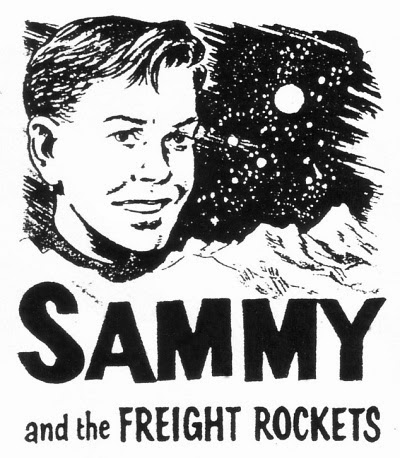
SAMMY AND THE FREIGHT ROCKETS
13 pages: 21 February – 16 May 1959


Sammy and Jill are fishing with Flap from the floating rocket car when they see a fright rocket crash into the sea. Sammy dives into the sea but is unable to locate the wreck so they return to headquarters where they report the crash location to the Duty Officer. He tells them that there have been technical problems with the new rockets. In the plotting room Sammy discovers that all the crashed rockets have been on the same route and so the cousins take the rocket car up to rendezvous with the next rocket traveling along that route. They board the rocket before it crashes into the sea and watch from a porthole as the rocket maneuvers into an undersea cavern. In the cavern the cousins hide as men unload the freight from the rocket and soon discover that the men have a remote system for controlling the unmanned rockets. The cousins’ escape from the cavern in the rocket car but the men use the remote control on the rocket car and Sammy and Jill are forced to land at an old smelting works. There they discover that the stolen rockets are being melted down by Mr Brennor of the Space Metal Company. They escape in the rocket car having gotten word to Space Fleet Headquarters but the remote control forces them back into the cavern where the men hold Sammy and Jill at gun point until Space Fleet police arrive and free them.


SAMMY AND THE DINOR MYSTERY
8 pages: 23 May – 29 August 1959


Sammy and Jill decide to take their school holiday on the Mediterranean island of Dinor. Landing at the Dinor spaceport, Flap runs off and causes a taxiing spaceship to crash just as President Mikard of Dinor arrives for an inspection. He orders the children to his office where he forgives them and asks them to help him find a boy called Greego. Greego’s uncle was killed in an accident that he blames the President for and is forming the island’s children into rebel gangs. As the cousins leave for their hotel the president has them followed, however a boy called Ferdi has also been watching them and he gets a gang of children to attack them. Recovering from the attack in their hotel that night, they find a message telling them to leave before it is too late.  Searching the hotel they discover Ferdi stealing food and, as he leaves, they see one of the President’s men about to kill him. They knock out the man and help Ferdi escape with them in the rocket car as the man comes around again and shoots at the flying car. Ferdi turns out to be Greego and he tells them that it was the President who shot his uncle in an argument over the gold mine that Greego takes them to. The President and armed guards appear at the mine and begin shooting at the children who are rescued by locals after which the President is imprisoned and the gold mine turned over to the people of Dinor.


SWIFT ANNUALS

In addition to the weekly comic there were 9 Swift annuals which included three Sammy And His Speedsub stories in the second, third and fourth annuals and three Sammy In Space stories, each of which lasted four pages, in the fifth, sixth and seventh annuals.


In the Sammy In Space story in Swift annual 5 (published in 1958 and hence the annual for 1959) Sammy and Jill discover during their visit to the partially complete Satellite B, that the damage to the station was being caused by escaped monkeys which were been used to test new space suit designs.

In Sammy And The Secret Explosive in Swift Annual 6 (published in 1959) Space Fleet HQ is evacuated when explosive primed to go off in 30 minutes goes missing. Jill is trapped in an out of control rocket but when Sammy reaches it they discover the explosive just in time to deactivate it. Returning to HQ they discover the men who stole the explosive and force them to surrender to the authorities.

In Sammy And The Turret Light in Swift Annual 7 (published in 1960) Sammy and Jill visit Sammy’s friend Tommy Hunting who wants to join the Space Cadets. At the Hunting’s farm they notice a light in the turret of the farm’s ruined castle. When they investigate they discover that the man who has been trying to buy the castle has been excavating in the tower and discovered forgotten jewels. The cousins trap him before he can buy the castle.

(The original version of this article appeared in Eagle Times, Volume 24 Number 1, Spring 2011 and Volume 24 Number 2, Summer 2011.)

BEAR ALLEY BOOKS

BEAR ALLEY BOOKS
Click on the above pic to visit our sister site Bear Alley Books