Neuromancer (New York, Ace Books, 1984)
Grafton 0586-06645-4, 1986, 317pp.
HarperCollins 0486-06645-4, 1993, 317pp.
Voyager 0006-48041-1, 1995, 320pp.
Voyager 0007-11958-5, 2001, 317pp.
Burning Chrome (New York, Arbor House, 1986)
Grafton 0586-07461-9, 1988, 220pp.
Voyager 0006-48043-8, 1995, 220pp.
Voyager 0586-07461-9, 224pp.
Count Zero (London, Victor Gollancz, 1986)
Grafton 0586-07121-0, 1987, 335pp.
Voyager 0006-48042-X, 1995, 335pp, £5.99. Cover by Gary Marsh
Mona Lisa Overdrive (London, Victor Gollancz, 1988)
Grafton 0586-20747-3, 1989, 316pp.
Voyager 0006-48044-6, 1995.
Voyager 0586-20747-3, 2000, 320pp.
Gollancz 978-1473-21742-3, 2016, 314pp, £8.99. Cover by Daniel Brown
The Difference Engine, with Bruce Sterling (London, Victor Gollancz, 1990)
VGSF 0575-05073-X, 1991, 256pp.
Vista 0575-60029-2, 1996, 383pp.
Gollancz (SF Masterworks) 978-0575-09940-1, 2011, 383pp.
---- [2nd imp.] n.d., 383pp, £7.99. Cover based on an image by Christopher Gibbs/Arena
Virtual Light (New York, Bantam Spectra, 1993)
Penguin 0140-15772-7, 1994, 295pp, £5.99. Cover photo
---- [9th imp.] n.d., £6.99.
Idoru (New York, G. P. Putnam's Sons, 1996)
Penguin 978-00140-24107-5, 1997, 292pp, £6.99. Cover by Gary Marsh
All Tomorrow's Parties (New York, G. P. Putnam's Sons, 1999)
Penguin 0140-26613-5, 2000, 277pp, £6.99. Cover photo by Martine Mouchy/Stone
Penguin 978-0241-95351-8, 2011, 277pp.
Pattern Recognition (New York, G. P. Putnam's Sons, 2003)
Penguin 0140-26614-3, 2004, 356pp.
Penguin 978-0241-95353-2, 2011, 356pp.
Spook Country (New York, G. P. Putnam's Sons, 2007)
Penguin 978-0141-01671-9, 2008, 369pp, £7.99. Cover photo by Steve Harries
Penguin 978-0241-95354-9, 2011.
Zero History (New York, G. P. Putnam's Sons, 2010)
Penguin 978-0670-91955-0, 2011, 404pp.
The Peripheral (New York, G. P. Putnam's Sons, 2014)
Penguin 978-0241-96100-1, 2015, 484pp, £8.99. Cover design by gray318
Agency (2020)
X
Saturday, December 17, 2016
Friday, December 16, 2016
Comic Cuts - 16 December 2016
On Monday, I started work on the next issue of Hotel Business, and have spent the remainder of the week keeping a lid on e-mail related to the title. Normally I would have started with a couple of hundred outstanding messages, but I've been keeping an eye on things and the number never went over 105 and dropped over the next couple of days to 64 then 34.
I seem to sped most of my day reading press releases. It's very different to my days on Comic World. Putting aside the idea that it was so long ago we didn't have e-mail (!), on Comic World I was able to build up a small team of reliable writers, whose names you would see in issue after issue. The unreliable ones were quickly dropped. It's the system I prefer and the one I used on all other magazines I've been involved with... until now.
As there's no budget, we rely on agencies for written material and instead of five or six articles of between 1,600 and 3,200 words by five or six authors, I'm dealing with 50 or 60 150-300 word pieces by 50 or 60 agencies. As themes change in each issue, and agency staff changes almost as quickly, I'm rarely dealing with the same people from one issue to the next. Building a relationship is impossible and every newcomer seems to have their own way of getting things wrong. Actually that's a bit of an exaggeration because they all make one mistake in common: I always ask for high res. pictures to use as illustrations, and they're either missing or what they've sent is way too small. We're a glossy broadsheet paper: your Google mail profile picture is waaaaay too small... and, no, we can't just "grab something off the website" because even if you don't mind illustrating your bylined article with shitty product shots, I do mind having them in a paper that has my name on it as editor.
(But you don't say that, of course. You try to explain the meaning of "pixel resolution" and "dots per inch" and why something that looks good on an HD TV – which is essentially what your computer screen is – won't look so good when it's blown up to four or five times the original size and printed on paper.)
Wednesday was interrupted by the arrival of a police officer who was going door-to-door asking about a shooting incident in nearby Stanley Road. I'd walked past a police van and noticed the crime-scene tape that had been used to close down the road. Apparently, police had responded to a neighbour's call that a house was being broken into. When they arrived a few minutes later, the would-be thief fired a gun at them and escaped while they were calling for back-up. This occurred at around 9.30pm on Tuesday night.
Police began searching Stanley Road and surrounding roads, including ours, which Stanley Road branches off and runs parallel to. A near neighbour's house on the opposite side of the road backs onto the property that was broken into, yet we knew nothing about it... although any other Tuesday, Mel would have been caught right in the middle of it. Visiting friends, she's usually not back until gone ten in the evening. However, this Tuesday, she was back at nine because our friend's daughter wanted to borrow something for a cookery project; so our friend, who had driven Mel back, left with her daughter around half-an-hour before the break-in and gun-shot. A later report identified the weapon as a gas-powered BB gun that was taken from the burgled house.
As you'd expect, most of the stories about the incident quote people talking about how quiet the town is, although we've had a drug-related stabbing and the guy who ran the local fish & chip shop is now serving time for almost dismembering his landlord. And some ducks have gone missing recently. This place is a hot-bed of crime!
I was saddened to hear that Patricia Robins had died. Better known as Claire Lorrimer, she was a very prolific author, although she did not write 160 novels as was claimed by the Daily Mail. I think the claim stems from a Press Association obituary which mistook Patricia's output for that of her mum, Denise Robins. An online biography reads: "Born Patricia Robins, 1st Feb 1921, she was the second of three daughters of Denise Robins, the bestselling novelist also known as ‘the Queen of Romance’, author of 160 novels." Daughter Patricia was said to have just completed her 80th novel. Still a lot, but only half the output of her mother.
Patricia once commented on a piece I'd written here on Bear Alley! Back in 2007 I wrote a column about her grandmother, Kathleen Groom, who wrote under a variety of names. Patricia commented via one of her nieces.
On the same day we learned that E. R. Braithwaite, author of To Sir With Love died, aged 104. Patricia was 95, so it gives us all hope: some writers live to a ripe old age and don't just wither away over their keyboards. Patricia was still actively writing, having continued to write following a fall which hospitalised her earlier this year. Her first book was written when she was 12, which means her writing career lasted 83 years!
In honour of Patricia and E. R. Braithwaite, here are a few random scans.
Starting on Monday we have a new Paul Temple comic strip beginning, which I'll be running through Christmas and into the new year. Think of it as my present to you.
I seem to sped most of my day reading press releases. It's very different to my days on Comic World. Putting aside the idea that it was so long ago we didn't have e-mail (!), on Comic World I was able to build up a small team of reliable writers, whose names you would see in issue after issue. The unreliable ones were quickly dropped. It's the system I prefer and the one I used on all other magazines I've been involved with... until now.
As there's no budget, we rely on agencies for written material and instead of five or six articles of between 1,600 and 3,200 words by five or six authors, I'm dealing with 50 or 60 150-300 word pieces by 50 or 60 agencies. As themes change in each issue, and agency staff changes almost as quickly, I'm rarely dealing with the same people from one issue to the next. Building a relationship is impossible and every newcomer seems to have their own way of getting things wrong. Actually that's a bit of an exaggeration because they all make one mistake in common: I always ask for high res. pictures to use as illustrations, and they're either missing or what they've sent is way too small. We're a glossy broadsheet paper: your Google mail profile picture is waaaaay too small... and, no, we can't just "grab something off the website" because even if you don't mind illustrating your bylined article with shitty product shots, I do mind having them in a paper that has my name on it as editor.
(But you don't say that, of course. You try to explain the meaning of "pixel resolution" and "dots per inch" and why something that looks good on an HD TV – which is essentially what your computer screen is – won't look so good when it's blown up to four or five times the original size and printed on paper.)
Wednesday was interrupted by the arrival of a police officer who was going door-to-door asking about a shooting incident in nearby Stanley Road. I'd walked past a police van and noticed the crime-scene tape that had been used to close down the road. Apparently, police had responded to a neighbour's call that a house was being broken into. When they arrived a few minutes later, the would-be thief fired a gun at them and escaped while they were calling for back-up. This occurred at around 9.30pm on Tuesday night.
Police began searching Stanley Road and surrounding roads, including ours, which Stanley Road branches off and runs parallel to. A near neighbour's house on the opposite side of the road backs onto the property that was broken into, yet we knew nothing about it... although any other Tuesday, Mel would have been caught right in the middle of it. Visiting friends, she's usually not back until gone ten in the evening. However, this Tuesday, she was back at nine because our friend's daughter wanted to borrow something for a cookery project; so our friend, who had driven Mel back, left with her daughter around half-an-hour before the break-in and gun-shot. A later report identified the weapon as a gas-powered BB gun that was taken from the burgled house.
As you'd expect, most of the stories about the incident quote people talking about how quiet the town is, although we've had a drug-related stabbing and the guy who ran the local fish & chip shop is now serving time for almost dismembering his landlord. And some ducks have gone missing recently. This place is a hot-bed of crime!
I was saddened to hear that Patricia Robins had died. Better known as Claire Lorrimer, she was a very prolific author, although she did not write 160 novels as was claimed by the Daily Mail. I think the claim stems from a Press Association obituary which mistook Patricia's output for that of her mum, Denise Robins. An online biography reads: "Born Patricia Robins, 1st Feb 1921, she was the second of three daughters of Denise Robins, the bestselling novelist also known as ‘the Queen of Romance’, author of 160 novels." Daughter Patricia was said to have just completed her 80th novel. Still a lot, but only half the output of her mother.
Patricia once commented on a piece I'd written here on Bear Alley! Back in 2007 I wrote a column about her grandmother, Kathleen Groom, who wrote under a variety of names. Patricia commented via one of her nieces.
On the same day we learned that E. R. Braithwaite, author of To Sir With Love died, aged 104. Patricia was 95, so it gives us all hope: some writers live to a ripe old age and don't just wither away over their keyboards. Patricia was still actively writing, having continued to write following a fall which hospitalised her earlier this year. Her first book was written when she was 12, which means her writing career lasted 83 years!
In honour of Patricia and E. R. Braithwaite, here are a few random scans.
Starting on Monday we have a new Paul Temple comic strip beginning, which I'll be running through Christmas and into the new year. Think of it as my present to you.
Labels:
Comics News
Thursday, December 15, 2016
Commando issues 4975 - 4978
Commando issues on sale 15th December 2016.
Commando – 4975 – Flying Blind
Sergeant Owain Howell was too headstrong for the R.A.F. Charged with insubordination, he found himself consigned to the ground crew, servicing the planes he had once hoped to fly. Travelling with his crew to Africa, he was shot down and stranded in Italy.
Squadron leader Leonard Brinkley, on the other hand, was a cool and experienced pilot. However, after a raid went disastrously wrong, Leonard found himself a Prisoner of War; unable to see, and unable to escape.
Together, they embarked on an audacious plan to rescue their teammates and return to Britain. But escaping the enemy is no mean feat when you’re… Flying Blind.
Story: Alan Hebden
Art: Morhain
Cover: Janek Matysiak
Commando – 4976 – The Stolen Lanc
Tom Cornish flew Spitfires and had lightning reactions to match. His brother, Mike, flew a Lancaster bomber, and was safe and steady as a rock.
Too bad that Tom had a nasty habit of referring to “flying tramcars” and lumbering Lancs”, or saying fighter pilots needed twice the skill and courage of bomber crews. To him bombing was about as risky as delivering milk.
Mike was so made that he invited Tom aboard the Lanc for one of those “milk runs”.
Introduction
The introduction of the Lancaster bomber in World War Two would change the face of air warfare, bringing with it enduring competition between bomber crews and fighter pilots. Such attitudes are brilliantly explored in David Boutland’s epic tale of sibling rivalry, as he perfectly captures the frustration of fighting for recognition.
The story of Mike and Tom Cornish is brought to life by Domingo’s striking artwork, not only capturing the fast-paced action, but establishing a fraught relationship between the brothers with subtle looks and body language. Framed by Ken Barr’s stunning cover art, The Stolen Lanc recognises the importance of the Lancaster bomber crew and the incredible risks they took on each of their missions.—The Commando Team
Story: David Boutland
Art: Domingo
Cover: Ken Barr
The Stolen Lanc, originally Commando No 271 (July 1967), reissued as No 951 (July 1975).
Commando - 4977 – Strange Encounter
Cadogan Strange thought he’d heard the last of the arrogant Major von Hunsdorff after Russian troops had thwarted the Major’s attempt to flee across the Pamirs to the Turkish Front. But a Prisoner of War camp could not hold Hunsdorff for long, and his escape brought these two foes face to face once again.
Desperate to use Afghanistan’s forces against the British, Hunsdorff defies orders from Berlin and leads his men towards Heart in an effort to seize power. With a score to settle and peace to maintain, it is up to respected veteran Cadogan Strange and his newfound ally, Lieutenant Frank Gibson, to stop the rogue German troops from reaching their target – before it’s too late!
Story: Alan Hebden
Art: Morahin & Rezzonico
Cover: Ian Kennedy
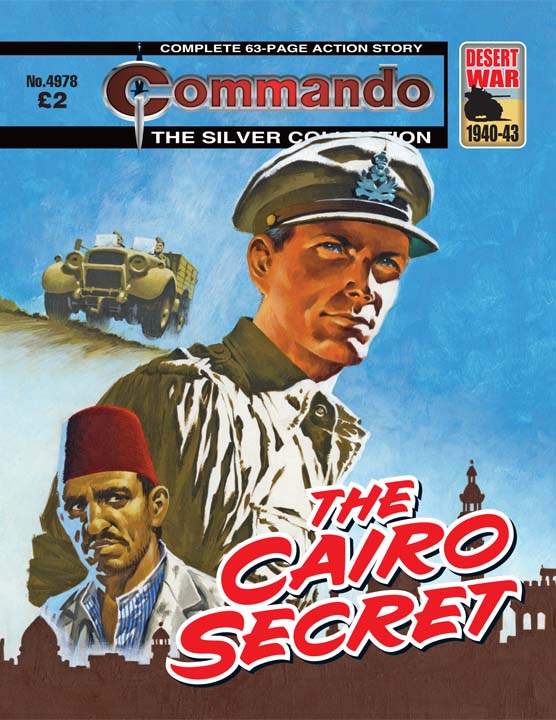
Commando - 4978 – The Cairo Secret
A vast city, teeming with millions of people of all nationalities. Here in Cairo were spies, informers, saboteurs, as well as crooks, thieves, and assassins. Here many a dangerous plot was hatched, here much money could be made, and quickly. Here too, sudden death lay waiting…
Introduction
When reluctant soldiers Len Potter and Tim Bates deserted the army to seek their fortune in Cairo, they could never have guessed that they would become central figures in sparking an uprising against the British. The Cairo Secret is a classic tale of twists and treachery, tapping into the revolutionary tensions in Egypt during the Second World War, and proving there was action – and danger – to be found far from the front lines.
Lomas’ cast of unpredictable characters teamed with Gordon C. Livingstone’s wonderful art creates an undercover story which throws us straight into the action, refusing to slow down until the very end.—The Commando Team
Story: Lomas
Art: Gordon C. Livingstone
Cover: Ian Kennedy
The Cairo Secret, originally Commando No 1130 (May 1977), reissued as No 2460 (April 1991)
Commando – 4975 – Flying Blind
Sergeant Owain Howell was too headstrong for the R.A.F. Charged with insubordination, he found himself consigned to the ground crew, servicing the planes he had once hoped to fly. Travelling with his crew to Africa, he was shot down and stranded in Italy.
Squadron leader Leonard Brinkley, on the other hand, was a cool and experienced pilot. However, after a raid went disastrously wrong, Leonard found himself a Prisoner of War; unable to see, and unable to escape.
Together, they embarked on an audacious plan to rescue their teammates and return to Britain. But escaping the enemy is no mean feat when you’re… Flying Blind.
Story: Alan Hebden
Art: Morhain
Cover: Janek Matysiak
Commando – 4976 – The Stolen Lanc
Tom Cornish flew Spitfires and had lightning reactions to match. His brother, Mike, flew a Lancaster bomber, and was safe and steady as a rock.
Too bad that Tom had a nasty habit of referring to “flying tramcars” and lumbering Lancs”, or saying fighter pilots needed twice the skill and courage of bomber crews. To him bombing was about as risky as delivering milk.
Mike was so made that he invited Tom aboard the Lanc for one of those “milk runs”.
Introduction
The introduction of the Lancaster bomber in World War Two would change the face of air warfare, bringing with it enduring competition between bomber crews and fighter pilots. Such attitudes are brilliantly explored in David Boutland’s epic tale of sibling rivalry, as he perfectly captures the frustration of fighting for recognition.
The story of Mike and Tom Cornish is brought to life by Domingo’s striking artwork, not only capturing the fast-paced action, but establishing a fraught relationship between the brothers with subtle looks and body language. Framed by Ken Barr’s stunning cover art, The Stolen Lanc recognises the importance of the Lancaster bomber crew and the incredible risks they took on each of their missions.—The Commando Team
Story: David Boutland
Art: Domingo
Cover: Ken Barr
The Stolen Lanc, originally Commando No 271 (July 1967), reissued as No 951 (July 1975).
Commando - 4977 – Strange Encounter
Cadogan Strange thought he’d heard the last of the arrogant Major von Hunsdorff after Russian troops had thwarted the Major’s attempt to flee across the Pamirs to the Turkish Front. But a Prisoner of War camp could not hold Hunsdorff for long, and his escape brought these two foes face to face once again.
Desperate to use Afghanistan’s forces against the British, Hunsdorff defies orders from Berlin and leads his men towards Heart in an effort to seize power. With a score to settle and peace to maintain, it is up to respected veteran Cadogan Strange and his newfound ally, Lieutenant Frank Gibson, to stop the rogue German troops from reaching their target – before it’s too late!
Story: Alan Hebden
Art: Morahin & Rezzonico
Cover: Ian Kennedy
Commando - 4978 – The Cairo Secret
A vast city, teeming with millions of people of all nationalities. Here in Cairo were spies, informers, saboteurs, as well as crooks, thieves, and assassins. Here many a dangerous plot was hatched, here much money could be made, and quickly. Here too, sudden death lay waiting…
Introduction
When reluctant soldiers Len Potter and Tim Bates deserted the army to seek their fortune in Cairo, they could never have guessed that they would become central figures in sparking an uprising against the British. The Cairo Secret is a classic tale of twists and treachery, tapping into the revolutionary tensions in Egypt during the Second World War, and proving there was action – and danger – to be found far from the front lines.
Lomas’ cast of unpredictable characters teamed with Gordon C. Livingstone’s wonderful art creates an undercover story which throws us straight into the action, refusing to slow down until the very end.—The Commando Team
Story: Lomas
Art: Gordon C. Livingstone
Cover: Ian Kennedy
The Cairo Secret, originally Commando No 1130 (May 1977), reissued as No 2460 (April 1991)
Wednesday, December 14, 2016
Rebellion releases (2000AD)
Rebellion releases 14 December 2016.
2000AD Prog 2011
Celebrate the festive season with another bumper 100-page end of year spectacular, featuring a stunning line of stories and creators! Justice Department has a novel method of reducing illegalities but Dredd's not happy in "Taking the Crime out of Christmas" by Rob Williams and Chris Weston; there's terror in the snow for a one-off Fall of Deadworld story by Kek-W and Dave Kendall; brand-new series Kingmaker welcomes you to a fantasy land with a twist, courtesy of Ian Edginton and Leigh Gallagher; Bulliet and his Grey Area team are back on Earth and facing a more terrestrial threat, by Dan Abnett and Mark Harrison; the legacy of Black Hawk lives on in Aquila: Mors in Venetia by Gordon Rennie and Paul Davidson; Ace Garp takes on the might of Euphrates, Inc in "The Festive Flipflop!" by Eddie Robson and Nigel Dobbyn; the fabric of time could be rent asunder in the third series of The Order by Kek-W and John Burns; and plunge into the dark underbelly of a very different 1940s Hollywood in new supernatural P.I. thriller Hope by Guy Adams and Jimmy Broxton!
Contents
Judge Dredd: Boxing Day by Rob Williams (w) Chris Weston (a) Annie Parkhouse (l)
The Fall of Deadworld: Winter Break by Kek-W (w) Dave Kendall (a) Annie Parkhouse (l)
Kingmaker by Ian Edginton (w) Leigh Gallagher (a) Ellie De Ville (l)
Aquila: Mors Venetiae by Gordon Rennie (w) Paul Davidson (a) Gary Caldwell (c) Simon Bowland (l)
Ace Trucking Co.: The Festive Flipflop by Eddie Robson (w) Nigel Dobbyn (a) Ellie De Ville (l)
Kingdom: As It Is In Heaven by Dan Abnett (w) Richard Elson (a) Ellie De Ville (l)
The Order: Wyrm War by Kek-W (w) John Burns (a) Annie Parkhouse (l)
Hope: ...For The Future by Guy Adams (w) Jimmy Broxton (a) Simon Bowland (l)
2000AD Prog 2011
Celebrate the festive season with another bumper 100-page end of year spectacular, featuring a stunning line of stories and creators! Justice Department has a novel method of reducing illegalities but Dredd's not happy in "Taking the Crime out of Christmas" by Rob Williams and Chris Weston; there's terror in the snow for a one-off Fall of Deadworld story by Kek-W and Dave Kendall; brand-new series Kingmaker welcomes you to a fantasy land with a twist, courtesy of Ian Edginton and Leigh Gallagher; Bulliet and his Grey Area team are back on Earth and facing a more terrestrial threat, by Dan Abnett and Mark Harrison; the legacy of Black Hawk lives on in Aquila: Mors in Venetia by Gordon Rennie and Paul Davidson; Ace Garp takes on the might of Euphrates, Inc in "The Festive Flipflop!" by Eddie Robson and Nigel Dobbyn; the fabric of time could be rent asunder in the third series of The Order by Kek-W and John Burns; and plunge into the dark underbelly of a very different 1940s Hollywood in new supernatural P.I. thriller Hope by Guy Adams and Jimmy Broxton!
Contents
Judge Dredd: Boxing Day by Rob Williams (w) Chris Weston (a) Annie Parkhouse (l)
The Fall of Deadworld: Winter Break by Kek-W (w) Dave Kendall (a) Annie Parkhouse (l)
Kingmaker by Ian Edginton (w) Leigh Gallagher (a) Ellie De Ville (l)
Aquila: Mors Venetiae by Gordon Rennie (w) Paul Davidson (a) Gary Caldwell (c) Simon Bowland (l)
Ace Trucking Co.: The Festive Flipflop by Eddie Robson (w) Nigel Dobbyn (a) Ellie De Ville (l)
Kingdom: As It Is In Heaven by Dan Abnett (w) Richard Elson (a) Ellie De Ville (l)
The Order: Wyrm War by Kek-W (w) John Burns (a) Annie Parkhouse (l)
Hope: ...For The Future by Guy Adams (w) Jimmy Broxton (a) Simon Bowland (l)
Sunday, December 11, 2016
John Gillatt (1929-2016)
For over sixeen years, John Gillatt charted the adventures of Billy Dane, whose extraordinary footballing talents were channelled from ‘Dead-Shot’ Keen through the soccer legend’s beaten-up pair of football books. As with any comic strip story, the real excitement came from the numerous ways scriptwriter Fred Baker separated Billy from his boots, forcing the horrified youngster to play using only his own meagre footballing skills.
Although he was not the first artist on the strip, Gillatt’s arrival on the strip in October 1971 in the pages of Scorcher and Score brought together the story’s perfect team. Gillatt and Baker went on to follow Billy’s soccer and cricketing adventures through the pages of Tiger, Eagle and Roy of the Rovers before Gillatt finally departed in January 1988.
Gillatt left the strip to take up the challenge of drawing Dan Dare in the pages of the revived Eagle, which he drew for almost a full year. This was a return to science fiction, which is where Gillatt had started his career thirty-one years earlier when he began drawing Jet-Ace Logan in April 1957. “Jet-Ace” was a pilot with the R.A.F. of the future, battling space pirates and aliens on the interstellar space lanes in the pages of Comet and Tiger. An excellent draughtsman, his work—drawn twice-up—received praise from many of the writers he worked with, including Frank Pepper, who took over writing Jet-Ace in Tiger, who considered him the best of the Jet-Ace artists.
Gillatt was born in Peterborough on 17 August 1929, the son of Oswald Belton Gillatt, a master mason, and his wife Hilda May (née Hooke), who were married in 1918. John was the youngest of four boys. Apart from his National Service and a period studying at Leicester College of Art, he lived in Peterborough his whole life.
Educated at Deacon’s School, he became a fan of comics whilst through reading American comic sections sent over by an American pen-friend during the Second World War, becoming a fan of Milton Caniff’s “Terry and the Pirates”; he was also a follower of Alex Raymond’s “Rip Kirby” when it appeared in the Daily Mail. However, his first employment was not in comics but as an illustrator with an advertising agency and as a draughtsman with the engineering firm of Perkins Diesel.
He was married to Josephine Wright in 1956 and their first child was born in 1957. To provide for his new family, Gillatt found work drawing comics and, thanks to his regular weekly output on “Jet-Ace Logan” he was able to give up his day job after only three months. He earned £1,000 in his first year.
His early work was meticulous, at first taking six days to produce the pages for Jet-Ace, although when Comet merged with Tiger in 1959, he simplified his style for the sporting paper’s larger pages. With only the occasional break, he continued to draw Jet-Ace serials until 1963
It was in Tiger that Gillatt first turned his hand to sporting strips, taking over (from Geoff Campion, as he had Jet-Ace Logan) the artwork for wrestling Native American “Johnny Cougar” in 1963. In 1966 he took a break from the strip to draw “The Forest Rangers”, based on the Canadian TV series broadcast on ITV, and “The Black Archer”, a caped crime-fighter with a crossbow. In the guise of the Archer, Delago City’s clumsiest young TV reporter, Clem Macey, was able to battle fabulous villains like The Remover, who could alter the size of objects, and The Weatherman, who could use weather phenomena to aid his criminal activities. After a brief spell drawing “The Great Thesbius” (a former stage actor and illusionist who turns to crime when his fame wanes), he returned to “Johnny Cougar” until 1969, when he took over the comedy-adventures of the Robinsons, who ran and played in a unique family-owned football club, Thatchem United. Gillatt produced “Football Family Robinson” in colour for three years before switching to line and wash.
During his time on “Football Family Robinson”, Gillatt added “Billy’s Boots” in Scorcher and Score to his weekly schedule, and kept both strips going until the latter merged with Tiger in 1974; further mergers saw Billy switch to Eagle in 1985 and Roy of the Rovers in 1986. Written by Fred Baker, who managed to find innumerable ways for ‘Dead-Shot’ Keen’s boots to be lost, damaged or stolen, it was the only strip to challenge Roy of the Rovers for the top spot in Tiger and became that paper’s unchallenged top story when Roy moved to his own title.
Although Billy Dane’s adventures came to an end in the early Nineties, reprints of Gillatt’s years on the strip remain popular in Holland where it was known as “De Wondersloffen van Sjakie”. In one instance, where Billy played a match in Holland, Gillatt had to redraw the strip for its appearance in Sjors and Dutch-born Sjackie hitch-hiked to the match in a lorry instead of arriving by ferry. 24 volumes of Sjackie’s adventures were reprinted featuring Gillatt’s artwork, with Gillatt providing new cover artwork.
Gillatt’s move to “Dan Dare” coincided with the merger between Eagle with Battle and an almost year-long adventure ensued for the pilot of the future as he battled the flesh-eating Drakken and a miniaturised Mekon in full colour. This was a rocky time for British comics, with many titles folding and merging: Gillatt found himself briefly drawing “Magic Man” for Hot-Shot! and “Ring Raiders”, based on the animated TV show, in an eponymously titled—and abruptly cancelled after only six issues—comic. The short-lived “My Pet Alien!” in Eagle in 1990 proved to be his last regular work on weekly comics, although he produced new covers for the Johnny Cougar’s Wrestling Monthly reprint magazine in 1992-93. Around the same time he produced a number of educational strips for Young Telegraph on subjects ranging from the Eifel Tower to Einstein.
Gillatt found a new market in the Daily Mirror where former Tiger editor Barrie Tomlinson was writing a daily football strip, “Scorer”. More adult-themed storylines required Gillatt to add elements that had never been aa requirement in his previous comics. “Johnʼs Scorer illustrations were, of course, brilliant,” Barrie Tomlinson has said. “The story needed an artist who could illustrate football action and also be able to draw beautiful women. John could do both those things and I felt honoured that my scripts could be turned into such excellent works of art which made the story so popular that it steadily increased in size on the Mirror cartoon page. When we later added photographic and computer effects, John adapted with ease and worked in close association with David Pugh, who did all the computer work. They were a great team. Johnʼs work was always delivered on time and always to the same high standard.
“Tall, bespectacled, articulate, softly-spoken and a man who could deal with any challenge, John was a pleasure to work with and to be with. He was a perfect gentleman.”
Gillatt suffered a stroke in 2003 and retired from “Scorer”. He lived in Eastfield Road, Peterborough, where he suffered another stroke in May which left him paralysed down one side and unable to speak. He was cared for at Philia Lodge Rest Home, where he died on Friday, 4 November, aged 87. He is survived by his three children, Simon, Matthew and Rachel.
Although he was not the first artist on the strip, Gillatt’s arrival on the strip in October 1971 in the pages of Scorcher and Score brought together the story’s perfect team. Gillatt and Baker went on to follow Billy’s soccer and cricketing adventures through the pages of Tiger, Eagle and Roy of the Rovers before Gillatt finally departed in January 1988.
Gillatt left the strip to take up the challenge of drawing Dan Dare in the pages of the revived Eagle, which he drew for almost a full year. This was a return to science fiction, which is where Gillatt had started his career thirty-one years earlier when he began drawing Jet-Ace Logan in April 1957. “Jet-Ace” was a pilot with the R.A.F. of the future, battling space pirates and aliens on the interstellar space lanes in the pages of Comet and Tiger. An excellent draughtsman, his work—drawn twice-up—received praise from many of the writers he worked with, including Frank Pepper, who took over writing Jet-Ace in Tiger, who considered him the best of the Jet-Ace artists.
Gillatt was born in Peterborough on 17 August 1929, the son of Oswald Belton Gillatt, a master mason, and his wife Hilda May (née Hooke), who were married in 1918. John was the youngest of four boys. Apart from his National Service and a period studying at Leicester College of Art, he lived in Peterborough his whole life.
Educated at Deacon’s School, he became a fan of comics whilst through reading American comic sections sent over by an American pen-friend during the Second World War, becoming a fan of Milton Caniff’s “Terry and the Pirates”; he was also a follower of Alex Raymond’s “Rip Kirby” when it appeared in the Daily Mail. However, his first employment was not in comics but as an illustrator with an advertising agency and as a draughtsman with the engineering firm of Perkins Diesel.
He was married to Josephine Wright in 1956 and their first child was born in 1957. To provide for his new family, Gillatt found work drawing comics and, thanks to his regular weekly output on “Jet-Ace Logan” he was able to give up his day job after only three months. He earned £1,000 in his first year.
His early work was meticulous, at first taking six days to produce the pages for Jet-Ace, although when Comet merged with Tiger in 1959, he simplified his style for the sporting paper’s larger pages. With only the occasional break, he continued to draw Jet-Ace serials until 1963
It was in Tiger that Gillatt first turned his hand to sporting strips, taking over (from Geoff Campion, as he had Jet-Ace Logan) the artwork for wrestling Native American “Johnny Cougar” in 1963. In 1966 he took a break from the strip to draw “The Forest Rangers”, based on the Canadian TV series broadcast on ITV, and “The Black Archer”, a caped crime-fighter with a crossbow. In the guise of the Archer, Delago City’s clumsiest young TV reporter, Clem Macey, was able to battle fabulous villains like The Remover, who could alter the size of objects, and The Weatherman, who could use weather phenomena to aid his criminal activities. After a brief spell drawing “The Great Thesbius” (a former stage actor and illusionist who turns to crime when his fame wanes), he returned to “Johnny Cougar” until 1969, when he took over the comedy-adventures of the Robinsons, who ran and played in a unique family-owned football club, Thatchem United. Gillatt produced “Football Family Robinson” in colour for three years before switching to line and wash.
During his time on “Football Family Robinson”, Gillatt added “Billy’s Boots” in Scorcher and Score to his weekly schedule, and kept both strips going until the latter merged with Tiger in 1974; further mergers saw Billy switch to Eagle in 1985 and Roy of the Rovers in 1986. Written by Fred Baker, who managed to find innumerable ways for ‘Dead-Shot’ Keen’s boots to be lost, damaged or stolen, it was the only strip to challenge Roy of the Rovers for the top spot in Tiger and became that paper’s unchallenged top story when Roy moved to his own title.
Although Billy Dane’s adventures came to an end in the early Nineties, reprints of Gillatt’s years on the strip remain popular in Holland where it was known as “De Wondersloffen van Sjakie”. In one instance, where Billy played a match in Holland, Gillatt had to redraw the strip for its appearance in Sjors and Dutch-born Sjackie hitch-hiked to the match in a lorry instead of arriving by ferry. 24 volumes of Sjackie’s adventures were reprinted featuring Gillatt’s artwork, with Gillatt providing new cover artwork.
Gillatt’s move to “Dan Dare” coincided with the merger between Eagle with Battle and an almost year-long adventure ensued for the pilot of the future as he battled the flesh-eating Drakken and a miniaturised Mekon in full colour. This was a rocky time for British comics, with many titles folding and merging: Gillatt found himself briefly drawing “Magic Man” for Hot-Shot! and “Ring Raiders”, based on the animated TV show, in an eponymously titled—and abruptly cancelled after only six issues—comic. The short-lived “My Pet Alien!” in Eagle in 1990 proved to be his last regular work on weekly comics, although he produced new covers for the Johnny Cougar’s Wrestling Monthly reprint magazine in 1992-93. Around the same time he produced a number of educational strips for Young Telegraph on subjects ranging from the Eifel Tower to Einstein.
Gillatt found a new market in the Daily Mirror where former Tiger editor Barrie Tomlinson was writing a daily football strip, “Scorer”. More adult-themed storylines required Gillatt to add elements that had never been aa requirement in his previous comics. “Johnʼs Scorer illustrations were, of course, brilliant,” Barrie Tomlinson has said. “The story needed an artist who could illustrate football action and also be able to draw beautiful women. John could do both those things and I felt honoured that my scripts could be turned into such excellent works of art which made the story so popular that it steadily increased in size on the Mirror cartoon page. When we later added photographic and computer effects, John adapted with ease and worked in close association with David Pugh, who did all the computer work. They were a great team. Johnʼs work was always delivered on time and always to the same high standard.
“Tall, bespectacled, articulate, softly-spoken and a man who could deal with any challenge, John was a pleasure to work with and to be with. He was a perfect gentleman.”
Gillatt suffered a stroke in 2003 and retired from “Scorer”. He lived in Eastfield Road, Peterborough, where he suffered another stroke in May which left him paralysed down one side and unable to speak. He was cared for at Philia Lodge Rest Home, where he died on Friday, 4 November, aged 87. He is survived by his three children, Simon, Matthew and Rachel.
Labels:
John Gillatt,
Obituary
Saturday, December 10, 2016
Sean M'Guire
In 1931, adverts for Sean M'Guire's third novel described it as "An enthralling romance by an author who is rapidly establishing for himself a reputation as an enterprising and original thinker."
M'Guire's previous two novels had been of interest to fans of lost race yarns as the first concerned a remote island inhabited by monsters and the second a feral child aiding a lost race in Africa. The latter, Beast or Man? was reprinted in 2009 by Ramble House, one of the first titles under their Dancing Tuatara Press imprint.
In Spider Island an ailing ex-service man, drudging as a clerk, takes a holiday at a remote place by the sea, and saves from drowning a golden-haired society girl, whose brother owns a yacht. The latter is the means by which the clerk plans to go adventuring after discovering the location of a strange treasure. The Scotsman (19 September 1929) offered the following description:
Both books, says Pelan, raised serious moral and ethical issues. "Both are far deeper than anything [H. Rider] Haggard attempted, though both operate easily enough as pure pulp adventures." In Beast or Man?, big-game hunter Dick Fearless questions the banality of his life and the morality of trapping intelligent creatures for exhibition. In later chapters, the half-human, half-gorilla progeny of a human boy raised by apes, is the inspiration for the title.
M'Guire published only one more novel, Paul Garroway, Priest, which again made little impact. The Aberdeen Press & Journal (15 April 1931) was one of the few papers to carry a review:
With Paul Garroway, Priest, M'Guire vanished as an author. In fact, he had never existed.
Sean M'Guire was a pen-name, but the clues to his real identity are almost non-existent. The sole source of information is a brief paragraph in "Town Talk and Gossip", compiled for The Sporting Times (9 November 1929) by "The Tramp".
Unpacked, the information contained in this paragraph is skimpy at best: a former R.A.F. officer, assisted by his friend, Major Gibson, has moved from London to Martham. He has published "several" books on ornithology and has a large collection of birds' eggs.
None of these clues have yet yielded a name for the author behind the Sean M'Guire novels, but they're a first step in the right direction.
M'Guire's previous two novels had been of interest to fans of lost race yarns as the first concerned a remote island inhabited by monsters and the second a feral child aiding a lost race in Africa. The latter, Beast or Man? was reprinted in 2009 by Ramble House, one of the first titles under their Dancing Tuatara Press imprint.
In Spider Island an ailing ex-service man, drudging as a clerk, takes a holiday at a remote place by the sea, and saves from drowning a golden-haired society girl, whose brother owns a yacht. The latter is the means by which the clerk plans to go adventuring after discovering the location of a strange treasure. The Scotsman (19 September 1929) offered the following description:
Strange things have been met with, in fact and in fiction, in the South Seas; but never anything resembling the discoveries made at and in the vicinity of Mr Sean M'Guire's Spider Island ... the key to the existence and locality of which was found in the familiar form of a manuscript contained in a sealed section of bamboo cast up on the shores of England within reach of the hands of a holiday-making clerk. Men who have been turned into rocks and yet continue to live through some kind of suction from the soil; slugs, fifteen feet long, that live in caves and absorb their human and other prey by enclosing and digesting them in sight of the spectators, carnivorous creepers, and the diabolical priests of a horrifying cult that, under the influence of a potent drug, can turn themselves into a fluent mass, more deadly than anything that moves on limbs, above all the "Spider" itself, are among the wonders revealed in a tale that reads in part like the outcome of nightmare. To enjoy it, one must put aside all thought of the probable and possible, and be content to follow the guidance of wild and unrestrained imagination.Spider Island does not appear to have been widely reviewed on its appearance in September 1929, and Beast or Man? was equally poorly reviewed the following February. John Pelan, introducing the latter, considered M'Guire's two novels "exceptional" and "a breath of fresh air".
Both books, says Pelan, raised serious moral and ethical issues. "Both are far deeper than anything [H. Rider] Haggard attempted, though both operate easily enough as pure pulp adventures." In Beast or Man?, big-game hunter Dick Fearless questions the banality of his life and the morality of trapping intelligent creatures for exhibition. In later chapters, the half-human, half-gorilla progeny of a human boy raised by apes, is the inspiration for the title.
M'Guire published only one more novel, Paul Garroway, Priest, which again made little impact. The Aberdeen Press & Journal (15 April 1931) was one of the few papers to carry a review:
Mr Sean M'Guire has given us a readable story of the war which, however, principally concerns Paul Garroway, who preferred the rural church living to sitting on an office stool. Paul married young. Shortly after the war broke out he was appointed a padre and posted to an infantry battalion. He was broad-minded and got on well with officers and men alike. he was respected by all ranks; he gave good advice and helped many in their troubles, and was altogether an influence for good in the battalion. In France he was awarded the V.C., was wounded, sent home, and then dispatched to Egypt, where his beliefs were rudely shaken as the result of discussions with Singleton, the scientist. He began to lose faith and hope and it was a nerve-racked Paul Garroway who returned to England. That briefly is the story, which winds up with an incident following the Armistice showing how he regained his faith. We get the happy ending, although it is not very satisfying. The story is well sprinkled with humour supplied by the irrepressible Bridgeworth, who is never daunted.Again, it appeared that M'Guire was attempting to write a novel which would ask serious questions about faith and religion in the same way that Beast or Man? questioned the belief that Europeans were inherently superior to African tribesmen.
With Paul Garroway, Priest, M'Guire vanished as an author. In fact, he had never existed.
Sean M'Guire was a pen-name, but the clues to his real identity are almost non-existent. The sole source of information is a brief paragraph in "Town Talk and Gossip", compiled for The Sporting Times (9 November 1929) by "The Tramp".
The first problem here is that Merstham is in Surrey, not Norfolk. However, the mention of ornithology makes me believe the author meant Martham, near the coast of Norfolk some 20 miles north-east of Norwich. The village falls within the Broads National Park and is home to the Martham Broad nature reserve."Moving" by Plane.THAT prolific writer of thrillers, Sean M'Guire, is nothing if not original. He was moving from London to Merstham, in Norfolk, and nothing would suit him but to go by air. He is an ex-R.A.F. officer, and was accompanied by another war-pilot, Major Gibson. His real name ("Sean M'Guire" being but a pseudonym) appears on the title-pages of several learned works of ornithology, so versatile is he. His collection of birds' eggs is unrivalled in this country.
Unpacked, the information contained in this paragraph is skimpy at best: a former R.A.F. officer, assisted by his friend, Major Gibson, has moved from London to Martham. He has published "several" books on ornithology and has a large collection of birds' eggs.
None of these clues have yet yielded a name for the author behind the Sean M'Guire novels, but they're a first step in the right direction.
Labels:
Author,
Sean M'Guire
Friday, December 09, 2016
Comic Cuts - 9 December 2016
Another issue of Hotel Business was signed off on Tuesday, although we went right up to the wire—the last paid-in feature arrived at 4:36pm and I signed off the last page at 5:26. Some poor sod still had to upload a high resolution PDF file to the printers, but I could sit back and relax.
What I actually did was watch Ghost in the Shell: The New Movie, which was pretty good; I also enjoyed the two episodes of the Arise series that I've managed to catch. I think the number of different versions it has gone through (movie, movie 2, Stand Alone Complex and movie, Arise and movie, PC games and even a theatre production) proves that Masamune Shirow's original comic strip was a fantastic base from which to jump off. And early... the original manga was serialised in 1989. Mind you, I read Neuromancer in 1985 and had read 'Johnny Mnemonic' when it originally appeared in Omni in 1981. Thirty-five years ago. Oh, boy. Where do the years go?
Anyway, Ghost in the Shell is the kind of cyber-thriller series I enjoy. I'm looking forward to the movie that's due out next March. It looks like it will be a good year for big-budget comics-based movies, with Valerian and the City of a Thousand Planets due in July, the Kingsman sequel due in June plus the usual plethora of DC and Marvel tie-ins.
I haven't been impressed with DC's recent crop (Batman vs Superman, Suicide Squad) but Wonder Woman – based on the trailer – could put them back on top. I'm definitely looking forward to Guardians of the Galaxy and Thor:Ragnarok and I'll give Logan and Spider-Man a look-in. The second Wolverine movie (the one set in Japan) was OK but I haven't been a huge fan of the X-Men franchise. At the end of next year there's the Justice League movie, but if it's as bad as Batman vs Superman (seriously: Martha?) and Suicide Squad...
And while we're about it, can movies please stop with the anti-gravity power beams? Why does every movie have to have electric blue beams shooting into the clouds, which darken and swirl around to make a hole, through which rubble and junk shoot. The Avengers, Iron Man, Fantastic Four, X-Men and even the Ninja Turtles have all used the same trope, as did Ghostbusters, Transformers, Independence Day: Resurgence and even Big Hero 6 (see some examples here). There might have been one in Warcraft, too. It was cool when the ground started breaking up and rising in Akira twenty-five years ago, but it's becoming tedious in the extreme now.
With blue power beams filling my thoughts, here are today's random scans on the theme of the colour blue.
Coming soon: With Christmas fast approaching, I thought it was time to share another Paul Temple adventure, so over Christmas and New Year, we will be featuring "Paul Temple and the Khanwada Conspiracy". The adventure will start on Monday, December 19.
.
What I actually did was watch Ghost in the Shell: The New Movie, which was pretty good; I also enjoyed the two episodes of the Arise series that I've managed to catch. I think the number of different versions it has gone through (movie, movie 2, Stand Alone Complex and movie, Arise and movie, PC games and even a theatre production) proves that Masamune Shirow's original comic strip was a fantastic base from which to jump off. And early... the original manga was serialised in 1989. Mind you, I read Neuromancer in 1985 and had read 'Johnny Mnemonic' when it originally appeared in Omni in 1981. Thirty-five years ago. Oh, boy. Where do the years go?
Anyway, Ghost in the Shell is the kind of cyber-thriller series I enjoy. I'm looking forward to the movie that's due out next March. It looks like it will be a good year for big-budget comics-based movies, with Valerian and the City of a Thousand Planets due in July, the Kingsman sequel due in June plus the usual plethora of DC and Marvel tie-ins.
I haven't been impressed with DC's recent crop (Batman vs Superman, Suicide Squad) but Wonder Woman – based on the trailer – could put them back on top. I'm definitely looking forward to Guardians of the Galaxy and Thor:Ragnarok and I'll give Logan and Spider-Man a look-in. The second Wolverine movie (the one set in Japan) was OK but I haven't been a huge fan of the X-Men franchise. At the end of next year there's the Justice League movie, but if it's as bad as Batman vs Superman (seriously: Martha?) and Suicide Squad...
And while we're about it, can movies please stop with the anti-gravity power beams? Why does every movie have to have electric blue beams shooting into the clouds, which darken and swirl around to make a hole, through which rubble and junk shoot. The Avengers, Iron Man, Fantastic Four, X-Men and even the Ninja Turtles have all used the same trope, as did Ghostbusters, Transformers, Independence Day: Resurgence and even Big Hero 6 (see some examples here). There might have been one in Warcraft, too. It was cool when the ground started breaking up and rising in Akira twenty-five years ago, but it's becoming tedious in the extreme now.
With blue power beams filling my thoughts, here are today's random scans on the theme of the colour blue.
Coming soon: With Christmas fast approaching, I thought it was time to share another Paul Temple adventure, so over Christmas and New Year, we will be featuring "Paul Temple and the Khanwada Conspiracy". The adventure will start on Monday, December 19.
.
Labels:
Comics News
Wednesday, December 07, 2016
Rebellion Releases (2000AD)
Rebellion releases for 7 December 2016.
2000AD Prog 2010
In this issue:
Judge Dredd: In Denial by Michael Carroll (w), Andrew Currie (a), Chris Blythe (c), Annie Parkhouse (l)
Savage: The Marze Murderer by Pat Mills (w), Patrick Goddard (a), Annie Parkhouse (l)
Counterfeit Girl by Peter Milligan (w), Rufus Dayglo (a), Dom Regan (c), Ellie De Ville (l)
Flesh: Gorehead by Pat Mills (w), Clint Langley (a), Ellie De Ville (l)
2000AD Prog 2010
In this issue:
Judge Dredd: In Denial by Michael Carroll (w), Andrew Currie (a), Chris Blythe (c), Annie Parkhouse (l)
Savage: The Marze Murderer by Pat Mills (w), Patrick Goddard (a), Annie Parkhouse (l)
Counterfeit Girl by Peter Milligan (w), Rufus Dayglo (a), Dom Regan (c), Ellie De Ville (l)
Flesh: Gorehead by Pat Mills (w), Clint Langley (a), Ellie De Ville (l)
Tuesday, December 06, 2016
Dan Dare audio release
The upcoming release of B7 Media's Dan Dare audio adventures has inspired the company to put together a brief video history of the character:
And here's a preview of the first story:
The first three stories can be ordered now from Big Finish. The first volume also contains a fourth disc of music by Imran Ahmad from Dan Dare and other B7 Media productions.
And here's a preview of the first story:
The first three stories can be ordered now from Big Finish. The first volume also contains a fourth disc of music by Imran Ahmad from Dan Dare and other B7 Media productions.
Saturday, December 03, 2016
Illustrators #16
The latest issue of Illustrators (Autumn 2016) thumped onto the doormat the other day, reassuringly hefty in these days of lightweight Toblerones.
It's a particularly colourful issue which leads off with a nice long appreciation of Neal Adams, whose memorable run on Deadman made his name in the late 1960s. Adams went on to draw X-Men and The Avengers, before returning to DC to revive Batman, team-up Green Lantern / Green Arrow, and Superman vs. Mohammad Ali before turning to book covers and independent comics, returning occasionally to the mainstream (e.g. Batman Odyssey, First X-Men).
Peter Stone covers his career in detail and the feature is accompanied with some great illustrations dating back to his early Sixties work on the "Ben Casey" newspaper strip and numerous comic covers. The only shame here is that the article doesn't cover much from the past 25 years.
Never mind. Here's Paul Slater to keep us amused with some of his wilful mischievousness. British-born but inspired by MAD Magazine, he is probably best known for his covers for The Listener and twenty years illustrating the "Eating Out" column for the Times Magazine and working on Saturday, the weekly Daily Express magazine, all of which has allowed him to draw and paint his absurdist illustrations in a wide variety of styles.
Canadian Will Davies worked for a wide range of America's top magazines, from The Saturday Evening Post and Ladies Home Journal to Good Housekeeping. He returned to Canada and was soon earning $500 a week (big bucks in the 1950s) and named "Canada's top illustrator".
Cecil Glossop was an English illustrator who contributed to boys' papers in the 1920s and 1930s, most notably to Chums where he was one of the paper's chief adventure story illustrators, favouring stories of pirates, highwaymen and foreign legionnaires, although he was versatile enough to draw everything from African adventure to aviation.
Little-known these days, this exploration of his work by David Ashford is especially welcome.
For more information on Illustrators and back issues, visit the Book Palace website, where you can also find details of their online editions, and news of upcoming issues. Issue 17 will feature Mort Kunsler, Gustave Dore, Zac Retz and Francisco Coching.
It's a particularly colourful issue which leads off with a nice long appreciation of Neal Adams, whose memorable run on Deadman made his name in the late 1960s. Adams went on to draw X-Men and The Avengers, before returning to DC to revive Batman, team-up Green Lantern / Green Arrow, and Superman vs. Mohammad Ali before turning to book covers and independent comics, returning occasionally to the mainstream (e.g. Batman Odyssey, First X-Men).
Peter Stone covers his career in detail and the feature is accompanied with some great illustrations dating back to his early Sixties work on the "Ben Casey" newspaper strip and numerous comic covers. The only shame here is that the article doesn't cover much from the past 25 years.
Never mind. Here's Paul Slater to keep us amused with some of his wilful mischievousness. British-born but inspired by MAD Magazine, he is probably best known for his covers for The Listener and twenty years illustrating the "Eating Out" column for the Times Magazine and working on Saturday, the weekly Daily Express magazine, all of which has allowed him to draw and paint his absurdist illustrations in a wide variety of styles.
Canadian Will Davies worked for a wide range of America's top magazines, from The Saturday Evening Post and Ladies Home Journal to Good Housekeeping. He returned to Canada and was soon earning $500 a week (big bucks in the 1950s) and named "Canada's top illustrator".
Cecil Glossop was an English illustrator who contributed to boys' papers in the 1920s and 1930s, most notably to Chums where he was one of the paper's chief adventure story illustrators, favouring stories of pirates, highwaymen and foreign legionnaires, although he was versatile enough to draw everything from African adventure to aviation.
Little-known these days, this exploration of his work by David Ashford is especially welcome.
For more information on Illustrators and back issues, visit the Book Palace website, where you can also find details of their online editions, and news of upcoming issues. Issue 17 will feature Mort Kunsler, Gustave Dore, Zac Retz and Francisco Coching.
Labels:
Illustrators,
Review
Friday, December 02, 2016
Comic Cuts - 2 December 2016
Having spent a little time working on the Valiant index, this week I've had to concentrate on the job that pays the rent. Hotel Business has taken up most of my work day and hasn't left time for much else. I did spend most of Saturday and all of Sunday working on another article about an obscure and long-forgotten author. And I would have gotten it finished if it hadn't been for those darn kids!
Actually there were no kids involved. Mel was away the weekend before last, so we've had a lot of TV to catch up with. As well as our usual weekly intake of humour (The Last Leg, Have I Got News For You, QI, Dave Gorman's Modern Life is Goodish), and documentaries (Planet Earth II, Who Do You Think You Are?), we've been catching up with the second series of Missing, which has been brilliant.
We treated ourselves to fish & chips on Monday and a double-helping of the latter thriller, with a desert of No Such Thing as the News to finish off the evening on a lighter note. I think this second serial is the equal to the first series, which was a huge hit in the papers. It doesn't seem to have generated the same high count of column inches, but it has been as nailbiting. Tchéky Karyo has been brilliant as dogged detective Julien Baptiste and I've been a fan of Keeley Hawes for years. She played Diana Dors in a 2-parter about twenty years ago and has since been responsible for some of the most dramatic moments on TV in shows like Spooks, Ashes to Ashes and Line of Duty as well as playing the mother in The Durrells. She's one of a small handful of actors whose choices seem to coincide with my tastes (Celia Imrie and Olivia Coleman are usually good rules of thumb, too, although the former did appear in a film called Dude, Where's My Donkey, so it isn't foolproof).
My lunchtime viewing has been Dune, the mini-series that appeared on the Sci-Fi Channel in 2000 starring Alex Newman, William Hurt and Saskia Reeves. I had the good fortune to pick up the sequel, Children of Dune (2003) recently and thought I'd reacquaint myself with the original series. It took a while, but I've finally ploughed through all three lengthy episodes. I remember it as being far better than the David Lynch movie – which I've also rewatched this year, but with no greater enthusiasm than I previously had for it – and it still holds up well. I'm looking forward to the sequel.
I was prompted by the news that there is to be another Dune movie. It's not an easy book to translate into a single film, as Jodorowski's failed early attempt and Lynch's butchered completed attempt proved. Maybe the producers are thinking of it as a two- or three-part epic story that will take more than one film to tell.
There hasn't been much time for anything else, so we'll go straight into our random scans... which are a few covers for comic strips that I've picked up recently. Three are old Private Eye strips, the first by "Monty Stubble" (the joint pen-name of PE editor Ian Hislop & artist Nick Newman, who later co-wrote the My Dad's the Prime Minister TV show). "Battle For Britain" originally ran in 1983-87. Nick Newman still draws the "Snipcock & Tweed" cartoon.
The Barry McKenzie series had an even greater pedigree as it was written by Barry Humphries (based on an idea by Peter Cook) and drawn by cartoonist Nicholas Garland. It inspired two films, The Adventures of Barry McKenzie and Barry McKenzie Holds His Own.
Lastly, The Amazing Remarkable Monsieur Leotard by Eddie Campbell and Dan Best, because if you see anything by Eddie Campbell, you pick it up. Right?
I should add that the column header is by Paul Lehr, another pair of scans that I've had sitting on the desktop of my computer for months. I have a feeling that I pasted the two pics together that way because the NEL version came out earlier than the Signet book. Not that it matters in the big scheme of things, but it does affect the way I list the art credit in my notes.
Actually there were no kids involved. Mel was away the weekend before last, so we've had a lot of TV to catch up with. As well as our usual weekly intake of humour (The Last Leg, Have I Got News For You, QI, Dave Gorman's Modern Life is Goodish), and documentaries (Planet Earth II, Who Do You Think You Are?), we've been catching up with the second series of Missing, which has been brilliant.
We treated ourselves to fish & chips on Monday and a double-helping of the latter thriller, with a desert of No Such Thing as the News to finish off the evening on a lighter note. I think this second serial is the equal to the first series, which was a huge hit in the papers. It doesn't seem to have generated the same high count of column inches, but it has been as nailbiting. Tchéky Karyo has been brilliant as dogged detective Julien Baptiste and I've been a fan of Keeley Hawes for years. She played Diana Dors in a 2-parter about twenty years ago and has since been responsible for some of the most dramatic moments on TV in shows like Spooks, Ashes to Ashes and Line of Duty as well as playing the mother in The Durrells. She's one of a small handful of actors whose choices seem to coincide with my tastes (Celia Imrie and Olivia Coleman are usually good rules of thumb, too, although the former did appear in a film called Dude, Where's My Donkey, so it isn't foolproof).
My lunchtime viewing has been Dune, the mini-series that appeared on the Sci-Fi Channel in 2000 starring Alex Newman, William Hurt and Saskia Reeves. I had the good fortune to pick up the sequel, Children of Dune (2003) recently and thought I'd reacquaint myself with the original series. It took a while, but I've finally ploughed through all three lengthy episodes. I remember it as being far better than the David Lynch movie – which I've also rewatched this year, but with no greater enthusiasm than I previously had for it – and it still holds up well. I'm looking forward to the sequel.
I was prompted by the news that there is to be another Dune movie. It's not an easy book to translate into a single film, as Jodorowski's failed early attempt and Lynch's butchered completed attempt proved. Maybe the producers are thinking of it as a two- or three-part epic story that will take more than one film to tell.
There hasn't been much time for anything else, so we'll go straight into our random scans... which are a few covers for comic strips that I've picked up recently. Three are old Private Eye strips, the first by "Monty Stubble" (the joint pen-name of PE editor Ian Hislop & artist Nick Newman, who later co-wrote the My Dad's the Prime Minister TV show). "Battle For Britain" originally ran in 1983-87. Nick Newman still draws the "Snipcock & Tweed" cartoon.
The Barry McKenzie series had an even greater pedigree as it was written by Barry Humphries (based on an idea by Peter Cook) and drawn by cartoonist Nicholas Garland. It inspired two films, The Adventures of Barry McKenzie and Barry McKenzie Holds His Own.
Lastly, The Amazing Remarkable Monsieur Leotard by Eddie Campbell and Dan Best, because if you see anything by Eddie Campbell, you pick it up. Right?
I should add that the column header is by Paul Lehr, another pair of scans that I've had sitting on the desktop of my computer for months. I have a feeling that I pasted the two pics together that way because the NEL version came out earlier than the Signet book. Not that it matters in the big scheme of things, but it does affect the way I list the art credit in my notes.
Labels:
Comics News
Thursday, December 01, 2016
Commando issues 4971 - 4974
Commando issues on sale 1st December 2016.
Commando – 4971 – Island of Last Hope
In 1938, Germany invaded Poland…but Poland did not give in without a fight.
Captain Micha Polanski and the Polish Air Force fought valiantly against the might of the Luftwaffe. But when his brother was slaughtered, Micha swore vengeance against the plane that cut him down, the plane that bore the symbol of a Black Eagle and Swastika.
Micha was sent to Britain to continue the fight against Nazis, but he still hoped he would see that plane again and avenge his brother. As for Micha and many other Poles, Britain was wyspa ostatniej nadziei… The Island of Last Hope.
Story: Shane Filer
Art: Muller
Cover: Ian Kennedy
Commando – 4972 – Stringbag Ace
They said H.M.S. Adventurer was a haunted ship; haunted by a shadowy figure bent on sending the carrier to the bottom with all her planes and crew.
Mystery lights flashed at night to guide enemy bombers to her. Men were struck down in shadowy corners and never knew what hit them. Guns jammed, planes blew up. Death, sudden and baffling, stalked by night along the quiet alleyways of the ship…
And a young flight lieutenant wanted to get his Spitfires and their pilots to Malta in one piece.
Introduction
If you’re searching for an outstanding adventure then look no further than this maritime gem. Tyson contrasts the claustrophobic confines of the H.M.S. Adventurer with the endless vistas of the skies to create a tense tale of ships, sabotage and Stringbags.
To top it all off, this issue boasts a truly dynamic cover, courtesy of iconic and greatly missed Commando artist, Ken Barr. Set at a dizzying angle, it’s a dramatic and exhilarating depiction of aerial action.—The Commando Team
Story: Tyson
Art: Peter Ford
Cover: Ken Barr
Stringbag Ace, originally Commando No 265 (June 1967), reissued as No 935 (May 1975)
Commando - 4973 – Mountie Hunter
Mounties Drew Fraser and Ross McKinley were partners and best friends. But when Drew enlisted in the Canadian Army, Ross was left behind.
However, Mountie life was far from quiet for Ross as the destruction of the war in Europe had extended its deathly claw all the way to Canada. Trains and supply lines were being targeted with ruthless precision, destroying vital supplies for the Allies. So ruthless in fact it spelled only one thing – sabotage!
Hunting the German spies would push Drew to the edge and force him to make the ultimate sacrifice. But a Mountie always gets his man…
Story: Alan Hebden
Art: Vincente Alcazar
Cover: Janek Matysiak
Commando - 4974 – Press Gang
Front-line action from the London blitz right through to the final American triumph against the Japanese in the Pacific. Not bad for a man invalided out of the R.A.F. in 1940 and not even in the fighting forces.
But then R.D. Jones was a press photographer and he and his mate Tommy Vidler were a two-man team of war correspondents, risking death to get the news to their readers at home.
Introduction
Alan Hemus’ celebration of wartime correspondence is a boyish adventure that runs the full length of the Second World War, from the London Blitz to the final days of the Pacific War.
There is a great array of characters and show stopping set pieces, all brought to life by the dynamic pen of artist, Manuel Benet. Benet is a true Commando comics veteran, still illustrating new issues to this day, so it’s a real joy to be able to share some of his earlier artwork – enjoy!—The Commando Team
Story: Alan Hemus
Art: Manuel Benet
Cover: Ian Kennedy
Press Gang, originally Commando No 2479 (June 1991)
Commando – 4971 – Island of Last Hope
In 1938, Germany invaded Poland…but Poland did not give in without a fight.
Captain Micha Polanski and the Polish Air Force fought valiantly against the might of the Luftwaffe. But when his brother was slaughtered, Micha swore vengeance against the plane that cut him down, the plane that bore the symbol of a Black Eagle and Swastika.
Micha was sent to Britain to continue the fight against Nazis, but he still hoped he would see that plane again and avenge his brother. As for Micha and many other Poles, Britain was wyspa ostatniej nadziei… The Island of Last Hope.
Story: Shane Filer
Art: Muller
Cover: Ian Kennedy
Commando – 4972 – Stringbag Ace
They said H.M.S. Adventurer was a haunted ship; haunted by a shadowy figure bent on sending the carrier to the bottom with all her planes and crew.
Mystery lights flashed at night to guide enemy bombers to her. Men were struck down in shadowy corners and never knew what hit them. Guns jammed, planes blew up. Death, sudden and baffling, stalked by night along the quiet alleyways of the ship…
And a young flight lieutenant wanted to get his Spitfires and their pilots to Malta in one piece.
Introduction
If you’re searching for an outstanding adventure then look no further than this maritime gem. Tyson contrasts the claustrophobic confines of the H.M.S. Adventurer with the endless vistas of the skies to create a tense tale of ships, sabotage and Stringbags.
To top it all off, this issue boasts a truly dynamic cover, courtesy of iconic and greatly missed Commando artist, Ken Barr. Set at a dizzying angle, it’s a dramatic and exhilarating depiction of aerial action.—The Commando Team
Story: Tyson
Art: Peter Ford
Cover: Ken Barr
Stringbag Ace, originally Commando No 265 (June 1967), reissued as No 935 (May 1975)
Commando - 4973 – Mountie Hunter
Mounties Drew Fraser and Ross McKinley were partners and best friends. But when Drew enlisted in the Canadian Army, Ross was left behind.
However, Mountie life was far from quiet for Ross as the destruction of the war in Europe had extended its deathly claw all the way to Canada. Trains and supply lines were being targeted with ruthless precision, destroying vital supplies for the Allies. So ruthless in fact it spelled only one thing – sabotage!
Hunting the German spies would push Drew to the edge and force him to make the ultimate sacrifice. But a Mountie always gets his man…
Story: Alan Hebden
Art: Vincente Alcazar
Cover: Janek Matysiak
Commando - 4974 – Press Gang
Front-line action from the London blitz right through to the final American triumph against the Japanese in the Pacific. Not bad for a man invalided out of the R.A.F. in 1940 and not even in the fighting forces.
But then R.D. Jones was a press photographer and he and his mate Tommy Vidler were a two-man team of war correspondents, risking death to get the news to their readers at home.
Introduction
Alan Hemus’ celebration of wartime correspondence is a boyish adventure that runs the full length of the Second World War, from the London Blitz to the final days of the Pacific War.
There is a great array of characters and show stopping set pieces, all brought to life by the dynamic pen of artist, Manuel Benet. Benet is a true Commando comics veteran, still illustrating new issues to this day, so it’s a real joy to be able to share some of his earlier artwork – enjoy!—The Commando Team
Story: Alan Hemus
Art: Manuel Benet
Cover: Ian Kennedy
Press Gang, originally Commando No 2479 (June 1991)
Subscribe to:
Posts (Atom)