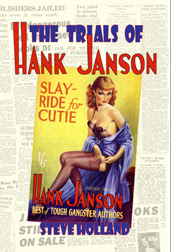
Horace McCoy is one of my favourite American authors. I don't read that many American writers these days as I seem to be going through a phase of reading/re-reading British thriller and spy writers (Henry Porter, Desmond Bagley, John Le Carre), although I did re-read a Clifford Simak novel prior to the Le Carre I've just finished and about four books ago I re-read Joe Poyer's North Cape, which is a superb thriller - and maybe the blueprint for the techno-thriller.
Anyway, I'm straying from the point. They Shoot Horses was probably the last book I read in a single sitting. It's not long and despite what sounds like an unpromising subject matter (a marathon dance) it's a real page turner. McCoy was snapped up by Hollywood to write film scripts and didn't write many novels. Over the years I've read five of the six he wrote and there's not a dud amongst them. His hard-boiled novels - Kiss Tomorrow Goodbye being the both the best and best known - are pitched somewhere between Dashiell Hammett and W. R. Burnett, which is a good position to be in. I Should Have Stayed Home is a look at the seamier side of Hollywood.
Sadly, McCoy was already dead by the time his last novel appeared, having suffered a third, fatal heart attack in 1955, aged 58. They Shoot Horses was filmed in 1969 with Jane Fonda, too late to benefit McCoy's literary standing in the US, although he has always been lauded in France. Even here in the UK, his novels have been briefly revived in the 1980s and 1990s. With only one of his title's still in print, it's about time Horace McCoy was reassessed... and some publisher really should take a look at putting some of his short stories between covers; there's a whole run of Black Mask yarns that I, for one, would be happy to have a chance to read.
They Shoot Horses, Don't They? (New York, Simon & Schuster, 1935; New York, Arthur Barker, 1935)
Wells Gardner, Darton, 1940, 187pp.
Penguin C2306, 1965, 123pp, 2/6. Cover by Massimo Vignelli
----, 1970
Serpent's Tail 1852-42401-X, 1995, 121pp, £6.99.
Serpent's Tail 1846-68739-X, 2010.
No Pockets in a Shroud (London, Arthur Barker, 1937; revised, New York, New American Library, 1948)
Penguin 1759, 1962, 171pp, 2/6. Cover by John Sewell
Serpent's Tail 1852-42434-6, 1998, 183pp. Cover by Rex Ray
I Should Have Stayed Home (New York, Knopf, 1938; London, Arthur Barker, 1938)
Penguin C2412, 1966, 141pp, 3/6. Cover by Harri Peccinotti
Serpent's Tail 1852-42402-8, 1996, 184pp. Cover by Rex Ray
Kiss Tomorrow Goodbye (New York, Random House, 1948; London, Arthur Barker, 1949)
Corgi GC769, 1960
Consul 1306, (Jun) 1964, 277pp, 5/-. Cover by John Rose/design by Sam Suliman
Serpent's Tail 1852-42433-8, 1996, 346pp. Cover by Rex Ray
Scalpel (New York, Appleton Century Crofts, 1952; London, Arthur Barker, 1953)
(no UK paperback edition)
Corruption City (New York, Dell, 1959; London, Consul, 1961)
Consul N1063, 1961, 2/6. Cover by Mitchell Hooks
4 Novels
Zomba 0946-39113-0, 1983, 574pp, £5.95. Cover by Robin Hass?
Sunday, October 09, 2011
Saturday, October 08, 2011
Ronald Brett
I originally attempted to put together some information on Ronald Brett back on 3 December 2006, at which time I wasn't able to find much at all. There was a note on the web relating to "the late Ronald Brett, a well-known local artist" judging a children's design competition in 1994 for the Lingfield Wildlife Area, a wildlife reserve set up that year by Tandridge District Council, Surrey. And there was also a death register entry for a Ronald William Brett, born 5 December 1921, died 1994, aged 72.
At the time I was uncertain whether these bore any relation to the artist who had contributed to Swift Annual 4 (1957, frustratingly unsigned so I'm not sure what his contribution was) and the book listed below. I did discover that there was a Ronald Brett who drew advertising posters as early as 1933 (further examples can be found here, in 1937, and here, in... er..., and here).

Subsequently I've heard from Tony Budd, who shared some recollections about Ronald Brett, whose wife was Tony's Godmother. Brett was a close friend of his parents and Tony described him as "a very versatile commercial artist and his main work was advertising artwork and posters. I think he did some work on the famous "My goodness - My Guinness" campaign and seems to be mainly connected now with posters for Southern Railway. I know that he did some work on comics because I can remember seeing rough comic designs in his studio. At that age I was very excited to see that he did that kind of work but was disappointed that he was not working for the Beano or Dandy which were my favourites. He also showed me a cereal packet he had designed which included something you had to cut out with scissors and glue together to make a model of a house."
Tony noted that Brett had emigrated to Canada when he retired to join his daughter, Frances, a childhood friend of Tony's some seventy years ago.
"One of my memories of childhood was a large oil-painting of a man-of-war in full sail that was hanging above the fireplace. The story goes that he was going on his honeymoon and arrived at the docks to find that he had forgotten his passport. He telephoned to my father who drove down with it at top speed and they just caught the boat. The painting was his "thank you" present which is still treasured in the family. The incident would have been in about 1930."
To step back briefly, Ronald Brett began his professional career in 1926 when he joined a lithographic printing firm, Lochend Printing Co., as a junior. Lochend merged with Sanders Philips and Co. (The Baynard Press) in 1930 and Brett became part of the Baynard Press Studio. Between 1933 and 1936, he spent much time "on the road" obtaining print orders for the company. In 1936 he took charge of the Studio, supplying the various representatives with ideas and finished artwork.
In late 1938, Brett teamed up with A. E. Callam (previously the director of Askew Younge Studios) to form Brett Callam Designers. They took over the studio at Baynard Press as their nucleus, still working with and for the printing company. The war devastated all forms of the print industry and in early 1940, Brett joined Service Advertising Co. as a visualiser.
Late in 1940 he joined the Army, rising to the rank of Major in the Tank Regiment, serving with the 8th Army. "He strongly disliked Field-Marshall Montgomery for some reason," says Tony. "Although he was not an official war artist he did portraits of the top Tank Regiment officers which are on display in the Tank Corps Museum at Bovington in Dorset. His daughter went to the museum during [her recent visit to the UK] and donated a book (presumably connected with the Tank Regiment) for which he had provided the illustrations and the design of the front cover."
Demobbed in 1946, Brett joined Publicity Arts Ltd. as Chief Designer, was elected M.S.I.A. in 1948 and elected a Member of the Advertising Creative Circle in 1949. In 1950 he resigned his position with Publicity Arts and turned freelance.
In a leaflet he produced in July 1950 to introduce himself to clients, Brett said: "I now intend to put all the experience I have gained, both in printing houses and advertising agencies and studios, to the fullest possible use, and it is clear that as free-lance consultant visualiser this can best be achieved."
Over the years his clients included J. Arthur Rank, British Iron and Steel Corporation, Central Office of Information, British Overseas Airways, Thorn Electrical Industries, Vickers Armstrong, Southern Railway, Legal & General Assurance, The Gas Council and dozens of others. He worked on the famous Toucan posters promotion for Guinness and advertising for Rinso as well as railway posters. His daughter also recalls him working for Eagle Annual and Swift.
Ronald A. Brett had married Irene C. Hawkins in Bromley in 1936, his daughter Frances being born in Orpington the following year. In the 1950s the family lived in Crowborough, Sussex. Following his retirement, Brett only lived in Canada for about five years before returning to England.
Illustrated Books
Back from the Front by Sam Browne. Edinburgh & London, Oliver & Boyd, 1946.
(* With many thanks to Tony Budd and to Ronald Brett's daughter, Frances Humphreys, for their generous help with compiling the above information.)
Labels:
Artist
Friday, October 07, 2011
Comic Cuts - 7 October 2011
The highlighted name is that of John Seymour Lucas and I was writing up his son Sydney for the Illustration Art Gallery blog when I stumbled across this advert for DeReszkes Cigarettes. The advert appeared on 8 December 1922. Seymour Lucas died five months later.
A little news about the next Bear Alley Books project. I managed to spend a whole day working on the upcoming The Black Pirate collection last weekend and now have all of the original artwork pages pieced together. Just to explain: the boards were too big to scan in one piece, so I had to do up to four scans (although usually two or three) per page, which I've then had to put together like a jigsaw puzzle - one of the reasons why this particular project is taking so long. Thirty pages of original artwork are being used in the book which meant some seventy-five scans in total.
The good news is that all thirty pages have now been reconstructed. That left ten missing pages across two stories, which have also now been scanned, and the third story - of twenty-five pages - has also been scanned. The third story, incidentally, will have some missing frames restored that didn't make the cut when it appeared in Look and Learn.
There's still quite a long way to go: I've cleaned up about a third of the pages, but some pages also need to be relettered and there's a fair amount of restoration required. I'm also mulling over the idea of adding a fourth story, which is probably a completely daft idea as it will add another twenty-four pages to my workload.
Another possible title that I'm not quite ready to announce yet also took a step towards reality this week. Hopefully I'll be starting on it before Christmas, by which time you'll know what it is.
Just to balance all this good news, I was knocked back on another book I wanted to do. The company in charge won't let me do it at this time, which is a bit disappointing. Maybe, one day...
Given the weird way the weather has been of late, today's random scans has a doomed world theme... except the one above. John Christopher is one of the big names of British science fiction who, ironically, is now almost forgotten. I think I'm right in saying that The Death of Grass is his only book still in print here in the UK, although others are available from the USA.
The first title here isn't a novel, it's a collection, but I couldn't resist putting it in here because (a) I had the book to hand; and (b) it has a fine cover.
Next up are our three global disaster novels, beginnig with the classic The Death of Grass, which Penguin published with a stark cover by John Griffiths in 1963. I did a little digging around the internet and found a later edition from Sphere for comparison. In fact, I found later Sphere editions of all three books, so my thanks to the original scanner. The 1964 Penguin edition of The World in Winter has a cover by Bruce Robertson. For the third title, A Wrinkle in the Skin, we actually have two different Sphere editions.
Next week, less doom and more Paul Temple... and we're approaching the end of the story. No breaks from hereon.
Labels:
Comics News
Thursday, October 06, 2011
Wednesday, October 05, 2011
Tuesday, October 04, 2011
Monday, October 03, 2011
Sunday, October 02, 2011
Eric Ambler
After a run of galleries for SF authors, I thought it would be a break to have something from a classic writers of thrillers and spy fiction. Eric Ambler was one of the first writers to try and bring a sense of reality to spy fiction, taking his cue from Somerset Maugham's Ashenden. From the very beginning, he wrote novels that eschewed the bravado of Sapper's Bulldog Drummond and Buchan's Richard Hanney; his heroes were ambiguous and sometimes uncertain and out of their depth, caught up in the machinations of international intrigue. John Le Carre, who had his own gallery here recently, is his natural successor.
Generally speaking The Mask of Dimitrios and Epitaph for a Spy are considered the classics from his early period (1930s); mid-period (1940s/50s), his best novel was probably The Schirmer Inheritance; and, of the later novels, the best are probably The Light of Day (filmed as Topkapi), its sequel, Dirty Story and The Levanter.
Novels
The Dark Frontier. London, Hodder and Stoughton, 1936; New York, Mysterious Press, 1990.
Hodder & Stoughton C346, 1959. Cover by Oliver Brabbins
Fontana Book 1497, 1967, 222pp, 3/6. Cover by unknown
----, [xth imp.] 1984
Uncommon Danger. London, Hodder and Stoughton, 1937; as Background to Danger, New York, Knopf, 1937.
Hodder & Stoughton C1, 1952, 255pp, 2/-. Cover by Mudge Marriott
Penguin Books 1467, 1960, 223pp, 2/6. Cover: desgn
Fontana Books 0006-15011-X, 1977, 220pp.
Penguin Books 0141-19034-5, 2009, xi+236pp.
Epitaph for a Spy. London, Hodder and Stoughton, 1938; New York, Knopf, 1952.
Pan Books 71, 1948 (Jan 1949), 224pp, 2/-.Cover by Pares
Hodder and Stoughton C431, (May) 1960
----, [xth imp.] 1966.
Coronet 0340-16852-8, 1973, 219pp.
Pan Books 0330-37244-0, 1999, x+244pp. [introduction by Robert Harris]
Penguin Books 0141-19031-0, 2009, vii+226pp. [introduction by James Fenton]
Cause for Alarm. London, Hodder and Stoughton, 1938; New York, Knopf, 1939.
Penguin Books 517, 1945, 285pp. Cover: design
----, [2nd imp.] 1947
Pan Books 305, (Oct) 1954, 223pp, 2/-. Cover by FVM
Penguin Books 517, [3rd imp.] 1961, 248pp, 2/6. Cover: design
Coronet 0340-16851-X, 1973, 248pp.
Pan Books 0330-39619-6, 2000, x+337pp. [introduction by Robert Goddard]
Penguin Books 0141-19032-9, 2009, viii+269pp. [introduction by John Preston]
The Mask of Dimitrios. London, Hodder and Stoughton, 1939; as A Coffin for Dimitrios, New York, Knopf, 1939.
Pan Books 114, (Nov) 1949, 255pp.
Pan Books G426, 1961, 220pp. Cover by S. R. Boldero
Fontana Books 0006-14206-0, 1966
----, [2nd imp.] 1969
Fontana Books 0006-16812-4, [xth imp.] 1983, 221pp.
Coronet 0340-55449-5, 1991, 272pp.
Pan Books 0330-37243-2, 1999, 304pp.
Penguin 0141-19033-7, 2009, vii+226pp, £9.99. [introduction by Mark Mazower]
Journey into Fear. London, Hodder and Stoughton, and New York, Knopf, 1940.
Hodder & Stoughton C38, 1952, 2/-.
Fontana Books 1321, 1966, 192pp. Cover by unknown
Fontana Books 0006-13916-7, [xth imp.] 1975, 192pp.
----, [4th imp.] 1979, 192pp.
----, [xth imp.] 1983, 192pp.
Pan Books 0330-37245-9, 1999, x+256pp. [introduction by Robert Harris]
Penguin Books 0141-19030-2, 2009, viii+210pp.
Four Square Book 5, 1957, 189pp.
Consul Books 1226, 1963, 191pp, 3/6. Cover by unknown
Fontana Books 1544, 1967, 189pp, 3/6. Cover by unknown
----, [2nd imp.] Jan 1969, 189pp.
----, [3rd imp.] 1971, 189pp.
Fontana Books 0006-14658-9, [xth imp.] 1977, 189pp.
----, [xth imp.] 1983, 189pp.
The Night-Comers. London, Heinemann, 1956; as State of Siege, New York, Knopf, 1956.
Pan Books G115, 1958, 186pp. Cover by S. R. Boldero
Fontana Books 1323, 1966, 158pp, 3/6. Cover by unknown
----, [2nd imp.] Apr 1967
----, [3rd imp.] Sep 1967. [given as 2nd imp.]
Fontana Books 2118, [4th imp.] Oct 1969, 158pp, 5/-. Cover: photo
----, [5th imp.] Nov 1969.
Fontana Books 0006-16907-4, [xth imp.] 1984, 158pp.
Passage of Arms. London, Heinemann, 1959; New York, Knopf, 1960.
Pan Books G496, (Oct) 1961, 201pp. Cover by Sam Peffer
Fontana Books 1390, 1967, 224pp.
----, [2nd imp.] 1969, 224pp.
Fontana Books 0006-15299-6, [xth imp.] 1979, 224pp.
Fontana Books 0006-17072-2, [xth imp.] 1985, 224pp.
Pan Books 0330-39620-X, 2000, 336pp. [introduction by Robert Goddard]
The Light of Day (Simpson). London, Heinemann, 1962; New York, Knopf, 1963; as Topkapi, New York, Bantam, 1964.
Four Square Books 1202, 1965, 190pp, 3/6. Cover by unknown
New English Library 0450-00118-0, [2nd imp.] Sep 1968, 1968, 190pp.
New English Library 2773, [3rd imp.] Dec 1969, 190pp, 5/-. Cover: photo. Movie tie-in.
Fontana Books 3034, 1972, 235pp. Cover: photo
Fontana Books 0006-15688-6, [xth imp.] 1979, 220pp.
No Exit Press 1842-43174-9, 2006, 287pp.
A Kind of Anger. London, Bodley Head, and New York, Atheneum, 1964.
Fontana Books 1338, 1966, 221pp.
----, [3rd imp.] 1969, 221pp.
Fontana Books 0006-16659-8, [xth imp.] 1983, 221pp.
Dirty Story (Simpson). London, Bodley Head, and New York, Atheneum, 1967.
Fontana Books 4207, 1969, 206pp.
Fontana Books 0006-16481-1, [xth imp.] 1982, 191pp.
The Intercom Conspiracy. New York, Atheneum, 1969; London, Weidenfeld and Nicolson, 1970.
[as A Quiet Conspiracy on cover] Fontana Books 0006-16687-3, 1971, 208pp.
Fontana Books 2765 [2nd imp.], Apr 1972, 188pp, 30p. Cover photo
Fontana Books 0006-12395-3, 1974, 188pp.
The Levanter. London, Weidenfeld and Nicolson, and New York, Atheneum, 1972.
Fontana Books 0006-13259-6, 1973, 222pp, 35p. Cover photo
Fontana Books 0006-17069-2, [xth imp.] 1985, 222pp.
No Exit Press 1842-43149-8, 2005, 311pp.
Doctor Frigo. London, Weidenfeld and Nicolson, and New York, Atheneum, 1974.
Fontana 0006-13996-5, 1975, 245pp, 60p. Cover photo [Continental Edition]
Fontana Press 0006-16569-9, 1976, 300pp.
----, [2nd imp.] Jan 1978
----, [3rd imp.]
----, [4th imp.] Feb 1986, 245pp, £2.75. Cover by unknown
Send No More Roses. London, Weidenfeld and Nicolson, 1977; as The Siege of the Villa Lipp, New York, Random House, 1977; London, Prior, 1978.
Fontana Books 0006-15161-2, 1979, 256pp.
Fontana Books 0006-16929-5, [xth imp.] 1988, 315pp.
The Care of Time. London, Weidenfeld and Nicolson, and New York, Farrar Straus, 1981.
Fontana Books 0006-16459-5, 1982, 299pp.
----, [3rd imp.] 1990, 299pp.
Novels as Eliot Reed (with Charles Rodda)
Skytip. New York, Doubleday, 1950; London, Hodder and Stoughton, 1951.
Tender to Danger. New York, Doubleday, 1951; as Tender to Moonlight, London, Hodder and Stoughton, 1952.
The Maras Affair. London, Collins, and New York, Doubleday, 1953.
Note: two further novels, Charter to Danger (London, Collins, 1954) and Passport to Panic (London, Collins, 1958) were by Rodda alone.
Collections
Waiting for Orders: The Complete Short Stories of Eric Ambler. New York, Mysterious Press, 1991; expanded as The Story So Far, London, Weidenfeld & Nicholson, 1993.
Generally speaking The Mask of Dimitrios and Epitaph for a Spy are considered the classics from his early period (1930s); mid-period (1940s/50s), his best novel was probably The Schirmer Inheritance; and, of the later novels, the best are probably The Light of Day (filmed as Topkapi), its sequel, Dirty Story and The Levanter.
Novels
The Dark Frontier. London, Hodder and Stoughton, 1936; New York, Mysterious Press, 1990.
Hodder & Stoughton C346, 1959. Cover by Oliver Brabbins
Fontana Book 1497, 1967, 222pp, 3/6. Cover by unknown
----, [xth imp.] 1984
Uncommon Danger. London, Hodder and Stoughton, 1937; as Background to Danger, New York, Knopf, 1937.
Hodder & Stoughton C1, 1952, 255pp, 2/-. Cover by Mudge Marriott
Penguin Books 1467, 1960, 223pp, 2/6. Cover: desgn
Fontana Books 0006-15011-X, 1977, 220pp.
Penguin Books 0141-19034-5, 2009, xi+236pp.
Epitaph for a Spy. London, Hodder and Stoughton, 1938; New York, Knopf, 1952.
Pan Books 71, 1948 (Jan 1949), 224pp, 2/-.Cover by Pares
Hodder and Stoughton C431, (May) 1960
----, [xth imp.] 1966.
Coronet 0340-16852-8, 1973, 219pp.
Pan Books 0330-37244-0, 1999, x+244pp. [introduction by Robert Harris]
Penguin Books 0141-19031-0, 2009, vii+226pp. [introduction by James Fenton]
Penguin Books 517, 1945, 285pp. Cover: design
----, [2nd imp.] 1947
Pan Books 305, (Oct) 1954, 223pp, 2/-. Cover by FVM
Penguin Books 517, [3rd imp.] 1961, 248pp, 2/6. Cover: design
Coronet 0340-16851-X, 1973, 248pp.
Pan Books 0330-39619-6, 2000, x+337pp. [introduction by Robert Goddard]
Penguin Books 0141-19032-9, 2009, viii+269pp. [introduction by John Preston]
The Mask of Dimitrios. London, Hodder and Stoughton, 1939; as A Coffin for Dimitrios, New York, Knopf, 1939.
Pan Books 114, (Nov) 1949, 255pp.
Pan Books G426, 1961, 220pp. Cover by S. R. Boldero
Fontana Books 0006-14206-0, 1966
----, [2nd imp.] 1969
Fontana Books 0006-16812-4, [xth imp.] 1983, 221pp.
Coronet 0340-55449-5, 1991, 272pp.
Pan Books 0330-37243-2, 1999, 304pp.
Penguin 0141-19033-7, 2009, vii+226pp, £9.99. [introduction by Mark Mazower]
Journey into Fear. London, Hodder and Stoughton, and New York, Knopf, 1940.
Hodder & Stoughton C38, 1952, 2/-.
Fontana Books 1321, 1966, 192pp. Cover by unknown
Fontana Books 0006-13916-7, [xth imp.] 1975, 192pp.
----, [4th imp.] 1979, 192pp.
----, [xth imp.] 1983, 192pp.
Pan Books 0330-37245-9, 1999, x+256pp. [introduction by Robert Harris]
Penguin Books 0141-19030-2, 2009, viii+210pp.
Judgment on Deltchev. London, Hodder and Stoughton, and New York, Knopf, 1951.
Pan Books G363, (Jan) 1961, 202pp, 2/6. Cover by S. R. Boldero
Fontana Books 1270, 1966, 192pp.
Fontana Books 2172, [2nd imp.] 1969, 192pp. Cover: photo
Fontana Books, [3rd imp.] Dec 1974
Fontana Books 5687, [4th imp.] Apr 1979, 192pp, 80p, Cover: photo.
*Copyright page lists this as 3rd imp.
Pan Books 0330-39618-8, 2000, x+275pp. [introduction by Robert Goddard]
Four Square Book 5, 1957, 189pp.
Consul Books 1226, 1963, 191pp, 3/6. Cover by unknown
Fontana Books 1544, 1967, 189pp, 3/6. Cover by unknown
----, [2nd imp.] Jan 1969, 189pp.
----, [3rd imp.] 1971, 189pp.
Fontana Books 0006-14658-9, [xth imp.] 1977, 189pp.
----, [xth imp.] 1983, 189pp.
The Night-Comers. London, Heinemann, 1956; as State of Siege, New York, Knopf, 1956.
Pan Books G115, 1958, 186pp. Cover by S. R. Boldero
Fontana Books 1323, 1966, 158pp, 3/6. Cover by unknown
----, [2nd imp.] Apr 1967
----, [3rd imp.] Sep 1967. [given as 2nd imp.]
Fontana Books 2118, [4th imp.] Oct 1969, 158pp, 5/-. Cover: photo
----, [5th imp.] Nov 1969.
Fontana Books 0006-16907-4, [xth imp.] 1984, 158pp.
Passage of Arms. London, Heinemann, 1959; New York, Knopf, 1960.
Pan Books G496, (Oct) 1961, 201pp. Cover by Sam Peffer
Fontana Books 1390, 1967, 224pp.
----, [2nd imp.] 1969, 224pp.
Fontana Books 0006-15299-6, [xth imp.] 1979, 224pp.
Fontana Books 0006-17072-2, [xth imp.] 1985, 224pp.
Pan Books 0330-39620-X, 2000, 336pp. [introduction by Robert Goddard]
The Light of Day (Simpson). London, Heinemann, 1962; New York, Knopf, 1963; as Topkapi, New York, Bantam, 1964.
Four Square Books 1202, 1965, 190pp, 3/6. Cover by unknown
New English Library 0450-00118-0, [2nd imp.] Sep 1968, 1968, 190pp.
New English Library 2773, [3rd imp.] Dec 1969, 190pp, 5/-. Cover: photo. Movie tie-in.
Fontana Books 3034, 1972, 235pp. Cover: photo
Fontana Books 0006-15688-6, [xth imp.] 1979, 220pp.
No Exit Press 1842-43174-9, 2006, 287pp.
A Kind of Anger. London, Bodley Head, and New York, Atheneum, 1964.
Fontana Books 1338, 1966, 221pp.
----, [3rd imp.] 1969, 221pp.
Fontana Books 0006-16659-8, [xth imp.] 1983, 221pp.
Dirty Story (Simpson). London, Bodley Head, and New York, Atheneum, 1967.
Fontana Books 4207, 1969, 206pp.
Fontana Books 0006-16481-1, [xth imp.] 1982, 191pp.
The Intercom Conspiracy. New York, Atheneum, 1969; London, Weidenfeld and Nicolson, 1970.
[as A Quiet Conspiracy on cover] Fontana Books 0006-16687-3, 1971, 208pp.
Fontana Books 2765 [2nd imp.], Apr 1972, 188pp, 30p. Cover photo
Fontana Books 0006-12395-3, 1974, 188pp.
The Levanter. London, Weidenfeld and Nicolson, and New York, Atheneum, 1972.
Fontana Books 0006-13259-6, 1973, 222pp, 35p. Cover photo
Fontana Books 0006-17069-2, [xth imp.] 1985, 222pp.
No Exit Press 1842-43149-8, 2005, 311pp.
Doctor Frigo. London, Weidenfeld and Nicolson, and New York, Atheneum, 1974.
Fontana 0006-13996-5, 1975, 245pp, 60p. Cover photo [Continental Edition]
Fontana Press 0006-16569-9, 1976, 300pp.
----, [2nd imp.] Jan 1978
----, [3rd imp.]
----, [4th imp.] Feb 1986, 245pp, £2.75. Cover by unknown
Send No More Roses. London, Weidenfeld and Nicolson, 1977; as The Siege of the Villa Lipp, New York, Random House, 1977; London, Prior, 1978.
Fontana Books 0006-15161-2, 1979, 256pp.
Fontana Books 0006-16929-5, [xth imp.] 1988, 315pp.
The Care of Time. London, Weidenfeld and Nicolson, and New York, Farrar Straus, 1981.
Fontana Books 0006-16459-5, 1982, 299pp.
----, [3rd imp.] 1990, 299pp.
Novels as Eliot Reed (with Charles Rodda)
Skytip. New York, Doubleday, 1950; London, Hodder and Stoughton, 1951.
Tender to Danger. New York, Doubleday, 1951; as Tender to Moonlight, London, Hodder and Stoughton, 1952.
The Maras Affair. London, Collins, and New York, Doubleday, 1953.
Note: two further novels, Charter to Danger (London, Collins, 1954) and Passport to Panic (London, Collins, 1958) were by Rodda alone.
Collections
Waiting for Orders: The Complete Short Stories of Eric Ambler. New York, Mysterious Press, 1991; expanded as The Story So Far, London, Weidenfeld & Nicholson, 1993.
Labels:
Author,
Cover Gallery
Saturday, October 01, 2011
F W Garnham
Doug Greene and I have been batting some correspondence back and forth across the Atlantic in relation to W. Stephens Hayward and the Anonyma books. There are some questions about the publication of the books, so I thought I'd do a little digging.
One novel, Mabel Gray; or, Cast on the Tide was published by F. W. Garnham. Garnham, it turns out, was Frederick William Garnham, a bookseller who was living in Henry Street, St Mary Newington, London, at the time of the 1871 census. He was born in Ipswich, Suffolk, in 1843, the son of William Garnham, a wine merchant and hotel keeper, and his wife Caroline (nee Sheldrake). He was christened in Ipswich on 27 April 1845, as were siblings, Charlotte Sheldrake Garnham (b.1842) and Alfred Henry Garnham (b. late 1844/early 1845).
He was working as a commercial traveller when he married 16-year-old Clara Fossey at St Philip, Clerkenwell, on 4 August 1861. Clara died in 1885, aged 41, and Garnham remarried the following year, on 19 October 1886 at St Pancras Church, to 29-year-old Elizabeth Lynam. At that time his occupation was described as "gentleman".
I've not traced Garnham beyond that second marriage. Nor have I managed to find out how long Garnham was based at his bookseller's address of 44 Ludgate Hill, although Mabel Gray was published in 1869.
(Incidentally, a Google search for F. W. Garnham turns up a number of references to a book entitled Legends of the Rhine from Basle to Rotterdam but the book itself reveals that the O.C.R. (presumably) has made an error: the book is by F. J. Kiefer, translated by L. W. Garnham, B.A.)
Subscribe to:
Posts (Atom)