Friday, June 19, 2009

Comic Cuts

Not much to add to what I covered on Monday. I've spent the bulk of this week cleaning artwork for the next book—the title of which I'll be announcing fairly soon—and talking to people. Lots of e-mail and telephone calls trying to sort out various plans for the future and get Bear Alley Books running on a professional basis.

For most of the 1990s I worked on various magazines and you think that you pick up quite a lot of skills along the way. I never really considered what half the other people working there did. Office manager, subscriptions department, post room... there was a whole support staff surrounding me and things got magically done that I never had to think about. Now I'm trying to do everything myself I'm starting to realise how protected and cossetted I was.

And we get used to certain things, like the speed of communication across the internet. So I was surprised to learn that it can take 4-6 weeks to register a book in a database. There's a form that you have to submit electronically to register an ISBN. Four to six weeks for someone to process a form? And do you know what the BIC guidelines are? They say you should try to submit information on a new title 20 weeks in advance. Welcome to the 21st century of book publishing.

No, I didn't know what BIC was before this week—it stands for Book Industry Communication. They issue a set of classification codes that are standard across the publishing trade, a bit like the old Dewey Decimal system you find in libraries. A graphic novel is classified as "AKLC1".

The old adage that you learn something new every day certainly applies to me this week.

Talking of BIC... BICS, the Birmingham International Comics Show in October. I'm hoping to be there this year to plug Bear Alley Books. Not that I've got anything organised yet, but that's the plan. My first comic convention since the last UKCAC in.... er... 1997?

"Potts' Progress" comes to an end today and next week should see Harry Hawkes back in action in another WW1 adventure. Tomorrow I'll have a little cover gallery of Titan's earlier James Bond series featuring artwork by Dave McKean, Kyle Baker and Paul Johnson. See you then.

(* Spotted this issue of Commando at a local charity shop and couldn't resist the Ian Kennedy cover. 49p well spent! © D. C. Thomson.)

Tuesday, June 16, 2009

Monday, June 15, 2009

Comic Cuts

I missed my regular Friday Comic Cuts column due to the announcement of Bear Alley Books, so I thought I'd squeeze one in today. I didn't have much time for anything last week outside of getting everything ready for Friday. There's still a lot of work to do before I've got everything sorted out but I'm hoping that I'll have all the ordering information and that kind of thing up and running soon. Cautiously I'll say by the end of the month but I don't know what unforeseen problem I might run into (that's why they're called unforeseen). I'm registering the first two titles today and have set the publication dates: Cursitor Doom is 1st August, Phantom Patrol is 15th August, but I'll say now that the books might be out plus or minus two weeks of those dates.

The week between announcing the announcement and actually making it was a weird one. Some days I was nice and calm and getting on with the job. Every now and then I'd wonder what the heck I was doing. And there was one moment of panic when a hard drive--the one with the scans for the two books--started having trouble booting up. Thankfully, it's a back-up, but I was up until four in the morning copying everything to another hard drive. Just in time: the next day it didn't boot up at all. It's a pain in the bum as it was a 1tb hard drive about half full, so I'm going to be struggling for space and nothing can be backed-up until I can afford to replace it. Which may be a while because the washing machine has gone kaput and we can't live without a washing machine.

Only two major panics in a week that chaotic... I'm counting myself lucky.

The new issue of Crikey! arrived (#10, June 2009) with the usual eclectic mixture of articles. Around half the issue is dedicated to some of comicdoms finest females: Jane, Axa, Carrie, Wicked Wanda and the George & Lynne strip, which existed pretty much just to show the latter topless. Interleaved are articles on Marvel UK, Zero-X, Rogue Trooper, Countdown, daredevils of the Evel Knievel variety from the pages of Tiger and Speed, plus an interview with sculptor Terry Curtis who worked on various Gerry Anderson shows.

The big news from Crikey! is that the next, September, issue will be a major relaunch with the title going bi-monthly and expanding to 84 full colour pages. And they're being distributed in Borders. And it's all for the same £4.99 price tag. Phew! You'll find subscription details at the Crikey! website.

William Rudling's Jeff Hawke's Cosmos hits vol.5 #3 (May 2009) and runs to a very substantial 90 pages, with three Jeff Hawke stories. "Out of Touch" from 1957-58 has a plot about a large alien artefact approaching the solar system, pre-dating Arthur C. Clarke's Rendezvous with Rama by fourteen years. The script was by Harry Harrison, who named his alien vessel that defies all attempts at communication the World of Rhamm. The other two stories are brilliant examples of Willie Patterson's complex but lighthearted plotting: "Made in Birmingham" (1965) is a time-travel story where nobody travels in time and "The Changeling" (1963) sees a drunken alien gamble himself into exile on Earth in a remodelled body. As always, there are detailed background notes by Duncan Lunan and a couple of additional articles, including Andrew Darlington's look at American newspaper strip hero Brick Bradford.

Jeff Hawke's Cosmos is published three times a year and subscriptions are a mere £18.50 (£28 overseas [Eur. 38] by air mail; for further details of rates and any other enquiries, contact william [AT] williamrudling.com.

Finally, I get a wee mention in a new Spanish book called Diario de Guerra (Panini Espana, 2009) which collects four tales from War Picture Library drawn by Hugo Pratt. The four stories, plus an introduction by Antoni Guiral, make this a solid collection, 270 pages of superb Pratt artwork in a neat little hardback which reproduces the artwork in a slightly enlarged format.

My knowledge of Spanish is zero but for those of you with better language skills than I, it's well worth 15 Euros. I'm looking forward to future volumes from Panini.

A couple of bits of stray news. Dave Jones passed on the news that his late uncle's very extensive collection of old British story papers and comics is being sold by Dominic Winter Book Auctions on June 18th. The Auction is the Children's Literature & Illustrated Books sale and the various lots are listed under the heading of the Joseph Harry Saunders M.B.E. Collection. "He took a real pride collecting these things from a young boy to an old man," says Dave. "Both my Mum and I want them to go to a good home."

If I'd known before I bought a washing machine, we might not have a washing machine.

Koki (whose Spanish is, I suspect, much better than mine) has passed on a link to a very good overview of the life and work of the late Pepe Gonzalez.

I'll be answering some of the questions that have come in over on the Bear Alley Books blog during the week so please drop by. Please keep the suggestions for strips you'd love to see reprinted rolling in.

Friday, June 12, 2009

Ron Smith cleared of abuse charges

Ron Smith, 80-year-old former D. C. Thomson and 2000AD artist, has been cleared of all charges relating to sexually abusing a 13-year-old girl following a 5-day trial at Guildford Crown Court. Smith maintained his innocence throughout, calling the charges ridiculous. "I never touched her in any way or at any point. I certainly never had sex with her and I did not rape her. I did not even go near her. It just did not happen ... There is not a shred of truth to these allegations, they are false through and through."

Smith was arrested last year when the woman, now 39, made a complaint to the police that she had been abused over a period of three years between the ages of 13 and 16.

The news of his release has been greeted with relief by fans of his work, although it was sad to learn, through the trial, that Smith has been suffering from skin cancer.

Ron Smith began his career as an artist after leaving the R.A.F., working for G-B Animation with such comics' luminaries as Mike Western, Eric Bradbury, Bill Holroyd, Harry Hargreaves and many others. He found work with the Amalgamated Press in 1950, first as a fill-in artists on humour strips before switching to adventure stories. Between 1952 and 1979 he worked almost exclusively for D. C. Thomson, drawing strips for Adventure, Hotspur, Topper, Dandy, Beezer, Bunty, Judy, Victor and Warlord. In 1979 he drew his first Judge Dredd episodes for the series "The Day the Law Died" and continued to draw the character for the next 15 years. He also drew for various other IPC titles, including MASK, Eagle, Wildcat and Toxic Crusaders before retiring in the 1990s.

Update (15 June 2009): An interesting commentary by Michael Molcher on how the case was reported can be found here.

Update #2 (5 August 2009): On 31 July 2009, John Freeman of Down the Tubes noted that the Sun newspaper website was still carrying its original report—with its leading headline ("Girl of 13 'abused by artist'")—on the Ron Smith trial but had not published a follow-up making it clear that the artist had been cleared of all charges.

2000AD fan "Van Dom" contacted the Sun and received a response from Jane Hamilton who works on the paper's newsdesk on 4 August stating that, "Having done some research this verdict was way back at the start of June and then only reported by a small number of local websites. I will need to find out why this is as no reputable news agency or freelancer has filed it to us. I will ask a reporter to check with the court."

The original story was subsequently removed from the Sun's website.

(* An early example of Ron Smith adventure story, "The Flame and the Arrow" © IPC Media.)

Monday, June 08, 2009

Aces High (Air Ace Picture Library collection 1)

Officially released on June 11, Aces High gathers together 10 of the best stories from the highly collectable Air Ace Picture Library. It is a companion to the recently released Up And At 'Em! collection and follows in the footsteps of four previous volumes collecting some of the best stories from War Picture Library and Battle Picture Library.

Contents

Flash Point (AAPL 35, Jan 1961) Art: Joe Colquhoun; Script: D. M. Garbutt
Fighter, Fighter! (AAPL 39, Feb 1961) Art: Ian Kennedy
No Survivors (AAPL 46, Apr 1961) Art: Mike Western; Script: G. W. Brunt
War Smoke (AAPL 50, May 1961) Art: Luis Bermejo
Dive Bomber (AAPL 51, May 1961) Art: Solano Lopez; Script: G. W. Brunt
Target Tirpitz (AAPL 54, Jun 1961) Art: Ferdinando Tacconi
Whirlwind in the Sky (AAPL 55, Jun 1961) Art: Juan Zanotto; Script: G. W. Brunt
Steel Bats (AAPL 65, Aug 1961) Art: Ian Kennedy
Teeth of Battle (AAPL 66, Sep 1961) Art: Leopoldo Ortiz; Script: Ken McOwan
Blast Bomb (AAPL 76, Nov 1961) Art: Kurt Caesar

Please note: the names of other scriptwriters remains unknown at the present time. The cover art is by Graham Coton.

Synopsis

When War Picture Library was launched in 1958 it quickly became apparent that many of the most popular stories with the readers featured the adventures of the warriors of the air, pilots who soared and swooped through the sky, cannons and machine guns blazing. The flyers were seen as the glamour boys of the Second World War, handling the most sophisticated and technically advanced combat machines ever invented and there was almost limitless scope to develop stories based around their exploits. The machines that they flew—fighters such as Spitfires, Hurricanes, Messerschmitts, Mustangs and Zeros—were lovingly recreated by the finest artists, in the brand new Air Ace Picture Library in 1960. Those images are reproduced here 25 per cent larger than in their original published form, pulling you into close formation in the thick of the action. The ten stories in "Aces High" take you from the flak-blasted night sky over Germany to the sweltering heat of the tropics, twisting and turning like a Typhoon with a Focke Wolf in its sights!

About the Author
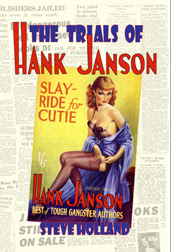
Steve Holland is the author of over 1,000 articles and a dozen books relating to comics and pulp culture, including The Trials of Hank Janson, nominated for the Silver Dagger Award by the Crime Writers Association. His latest book, The War Libraries Index charts the extraordinary history of Fleetway's war picture libraries.

Reviews

(none yet)

Sunday, June 07, 2009

Malcolm Douglas [J. T. Dogg] (1954-2009)

Malcolm Douglas, artist best known for his work for Oink!, died on Sunday, 22 March, aged 54. Douglas had been suffering from cancer and had been taken to Royal Hallamshire Hospital in December 2008, where the condition was diagnosed, although he had subsequently returned home.

Douglas was born on 10 August 1954 and raised in South London and educated at Trinity School of John Whitgift, Croydon, and Sheffield University, where he studied French and English. Drawing was one of his hobbies and he volunteered to illustrate the student union newspaper. He went on to draw "The Street-Hogs!" (written by Mark Rodgers) and "Ham Dare, Pig of the Future" (written by Lew Stringer) for Oink! His contributions, often across the colour centre spread and signed J. T. Dogg, were amongst the most popular in the paper.

When Oink! was merged with Buster, Douglas went on to draw for a number of adult comics, including Brain Damage, Gas, Comic Strip, Zit! and UT as well as adult magazines Knave and Fiesta. For five years, he also drew a regular strip for the Manchester United match programme featuring "Fred the Red", the Man U. mascot.

Aside from drawing, his passion was for folk music. A musician himself, playing fiddle, mandolin and cittern with various bands, he was a driving force in the English Folk Dance and Song Society and the South Riding Folk Arts Network and was responsible for republishing the songbooks English Classical Folk Songs (2003) and Marrow Bones (2007).

Some pages from an unpublished comic strip, "Night Falls on Jericho", appear on Douglas's website.

Further information: Website; The Guardian (15 April). Lew Stringer has written a tribute to Douglas on his Blimey! blog (6 June).

War Comics: A Graphic History

I'll confess up front that I wrote a couple of the articles for War Comics: A Graphic History, although my contributions account for 4 of the 192 pages, so I don't think it will bias my view of the book. Said view is that this is an excellent addition to any comics' reference library and sits very comfortably on my shelf alongside the two volumes of Tim Pilcher's history of Erotic Comics (Erotic Comics: A Graphic History, Volume 1: From Birth to the 1970s and Erotic Comics: A Graphic History, Volume 2: From the 1970s to the Present Day) and Dez Skinn's Comic Art Now.

The format is identical to my Sci-Fi Art: A Graphic History and, as with that, I'm hugely impressed by the look of the book. The design is colourful and clear and the images taken from a vast range of comics, all informatively captioned.

The text meanders across all theatres of war, from the days of Troy to the current "War on Terror". The two World Wars account for only around half the book, leaving plenty of space for conflicts as disparate as the American-Indian wars and the battle for the Falklands. The diversity saves the book from becoming unrelentingly one-sided. The coverage is primarily American and British, so expect depictions of Allied and Axis powers to be poles apart: the allies are impossibly heroic and gung-ho; their enemy are ugly and evil. Coverage of later comics is more interesting as the book turns to the likes of Keiji Nakazawa's Barefoot Gen, Joe Sacco (Palestine, Safe Area Gorazde), Joe Kubert's Fax From Sarajevo and the American comics' response to 9/11.

The selection of artwork shows a fantastic range of styles. As an unrepentant fan of British comics it's great to see Joe Colquhoun, Ian Kennedy and others celebrated alongside classic war artwork by the likes of Russ Heath, Jack Davis, Harvey Kurtzman and Joe Orlando. Although I don't collect American comics, I'm certainly aware of these fine artists; American readers, on the other hand, are less likely to have seen the British comics and should be in for a treat.

War Comics: A Graphic History, ed. Mike Conroy. Ilex ISBN 978-1905814473, 18 May 2009.

Saturday, June 06, 2009

Modesty Blaise cover gallery

I've been sorting through some duplicates of books with the notion of getting rid of them. One series I'm a bit loath to get rid of is Titan's first set of Modesty Blaise books even though they've been superceded by the latest series. The reason is mostly down to the covers by the wonderful John M. Burns, one of my favourite artists. But needs—mostly the desperate need for some shelf-space—must so I'm reluctantly going to let them go.

But not before I scan the covers and present them here as a cover gallery.

(* Modesty Blaise © Associated Newspapers/Solo Syndication.)

Friday, June 05, 2009

Comic Cuts

I've been dropping hints about publishing some books for some time without actually giving any details. Over the past couple of weeks I've promised news soon and I'm pleased to say that I've almost got my ducks in a row. So... next Friday I'll be announcing the first two titles that will be appearing under the Bear Alley Books imprint. That's Friday the 12th. There, I'm committed to it now. Can't go back. Big announcement. Next Friday.

Until then, 'fraid it's Project One and Project Two. I have a printer's proof in front of me for the former which looks pretty damn good. A few things to tweak before the book is printed but not far to go at all. Project Two... well, I received a cover sketch on Wednesday and it blew me away. I can't wait to see it in colour. I think you'll love it, too.

I've still got other commitments to work on. We're on the very final stages of finishing the Frank Bellamy's World War 1 book and I finished cleaning up the pages of 'Wells Fargo' on Tuesday. It's going to be a hell of a book: Don Lawrence's artwork is stunning. And it doesn't end there as I'm about to start on the second part of the book, 'Pony Express'. Between them they run to around 200 pages so it's going to be a bumper book when it appears. Unbelievable to think that the neither strip has been reprinted in full before now. In fact, I don't think 'Pony Express' has ever been reprinted in the UK at all.

My new book from Carlton (under their Prion imprint) is out next week. I received a copy earlier this week and I'll be posting some information on the contents in the next day or two. As a teaser, I thought you might like to see the original artwork clean of lettering—it's at the head of the column above. The artist was Graham Coton, one of the greats from the era of the War Picture Library. David Roach called him "The king of vehicles, machines and weaponry," in his book The Art of War, and I'd have to add that Coton was at his best with aircraft in aerial action. Dogfights never looked so exciting. Coton was still painting aircraft long after the closure of the war libraries and deserves to be more widely known as the fine artist he was.

The latest issue of Paperback Fanatic (#10, June 2009) arrived this week, and continues to improve with every issue. It's now designed by Glenn Fleming (whose name you might recognise from Crikey!) who provides good clear layouts. With a huge range of paperback covers providing the artwork it's a great-looking magazine. Central to this issue are interviews with author John Harvey and artist John Holmes plus articles on Barry Sadler's Casca series of mercenary novels, the occult novels of Gerald Suster, the Ballantine Adult Fantasy series (not that kind of adult!), German Frankenstein novels and British sex education paperbacks of the 1960s and 1970s. You can't get more diverse than that. Further information and how to obtain copies of the magazine can be found at the Paperback Fanatic website.

Last thing through the post this week, a copy of the latest Commando book, which I'll review below. The monthly Commando books are also celebrating D-Day with a run of themed issues in June. The first batch of four titles (#4203 The Jailbreak; #4204 Fight Fire With Fire; #4205 D-Day Plus; #4206 Beach-Head Battle) are on sale from the 11th and the second batch (#4207 To Lead the Way; #4208 Close Support!; #4209 Terror on the Battlefield; #4210 Dead Man's Boots) follow a fortnight later. "Had we not had the benefit of the selfless efforts of a huge number of soldiers, sailors and airmen involved on that day, history would have been much blacker," says editor Calum Laird. "Our eight stories, though fictional, are our way of saluting that generation while spreading the story of what they did and what we owe them."

Interesting side note: apparently, Commando had their best ever sales during the 1970s and sales peaked when, one month, they sold 750,000 copies (over 90,000 copies of each of the 8 issues that month). When you consider that both War Picture Library and Battle Picture Library were both still going (and producing 20 titles a month between them), Combat Picture Library was still going and various other pocket library titles were being published—romance and schoolgirls regularly, plus a variety of science fiction, horror, western and thrillers at various times—a regular sale of 1½ to 2 million of these pocket books a month isn't an outrageous guess. Ah, those were the days!

Well that's cleared the desk a bit! Next week we have a new "Eagles Over the Western Front" story for your entertainment, plus that announcement next Friday. And anything else I can squeeze in.

Commando: D-Day Fight or Die!

Another excellent Commando collection has hit the shelves recently. With over 4000 issues to select from, it's no surprise that the editors—I'm not sure if George Low (ex-Commando editor) or Calum Laird (current Commando editor) is now making the selections—can produce huge volumes on certain themes. In this instance... well, the title rather gives it away.

D-Day was probably the single most significant day of World War 2: on 6 June 1944, Allied forces landed on a 50-mile stretch of Normandy coastline in northern France and fought their way up the beaches and into Europe, four years after the British Expeditionary Force had been pushed back by the German advance and evacuated from Dunkirk.

Collecting twelve stories covering the same event risks repetition but, as they said of The Naked City, "There are eight million stories in the Naked City; this has been one of them." Of the 160,000 troops landed on D-Day, I doubt if any two shared exactly the same experiences and in the fictionalised world of Commando, that translates into hundreds of thousands of different viewpoints from which to view the events of the day. Scriptwriters from historian Eric Hebden to current Commando favourite Ferg Handley have all stepped up to the plate and found new ways to approach the same topic.

For many fans, the key issue will be the artwork and Denis McLoughlin will be the name that stands out. However, I'm a contrary bugger and I'm going to say that if you buy the book for its artwork, buy it for the two pairs of stories by Victor de la Fuente and Sanchis Cortes. De la Fuente was one of the best war artists to have worked in the UK and Cortes has long been a favourite of mine ever since I stumbled across his work in Tiger. He worked at one time for Luis Bermejo and the Bermejo/Ortiz style rubbed off. A fantastic, almost unknown artist.

Contents

Ambush at Dawn
(333, May 1968) Art: C. T. Rigby; Script: Staff
The Strongpoint (1807, Jun 1984) Art: Blasco; Script: David Motton
Normandy Drop (4011, Jun 2007) Art: Garijo; Script: Ferg Handley
Wrong Time, Wrong Place (2279, May 1989) Art: Ibanez; Script: Alan Hebden
Big Joe (203, Mar 1966) Art: Alfredo Sanchis Cortes; Script: Fitzsimmons
Blood of Heroes (259, May 1967) Art: Eustaquio Segrelles; Script: Eric Hebden
D-Day Drop (511, Nov 1970) Art: Victor de la Fuente; Script: Ken Gentry
Operation Bulldog (413, Jul 1969) Art: Victor de la Fuente; Script: A. Carney Allan
Wolf Pack (329, May 1968) Art: Alfredo Sanchis Cortes; Script: Crawcroft
Man of Iron (358, Sep 1968) Art: Eustaqio Segrelles; Script: Fitzsimmons
Big Guy (92, Nov 1963) Art: Castro; Script: Eric Hebden
The Footsloggers (2365, Apr 1990) Art: Denis McLoughlin; Script: Alan Hebden

(* artwork by Ian Kennedy, Victor de la Fuente, Sanchis Cortes respectively (c) D. C. Thomson.)

Gulliver's Adventures in Lilliput part 2

(* artwork © Look and Learn Ltd. Reprinted by permission.)

Wednesday, June 03, 2009

Comics Firsts: C. L. Doughty

Something a bit special today. C. L. Doughty has become one of my favourite comics artists and illustrators. I have to confess that I knew little about his work (beyond reassurances from David Ashford and Norman Wright that it was great) until I started working for Look and Learn. Studying the pages of Look and Learn, it seemed that Doughty illustrated every other feature and the more I saw of his work the more impressed I was. His colour covers and illustrations were gorgeous and his black & white comic strips for the paper were almost without peer.

Given the high quality of his work in the 1960s, it may seem a little odd to travel right back to the beginning of his career. In 1948, Doughty was already in his mid-thirties but fresh to comics. His first known comic strip was the following Buffalo Bill yarn published in Knockout Comic #489, dated 10 July 1948. Over the next two days we'll follow his next strip, an adaptation of part of Gulliver's Travels drawn for The Children's Newspaper and published in weekly parts in 24 July to 11 September 1948.

I'll be reprinting one of Doughty's later strips in the near future. But, to see how far he had come, I thought it useful to have something to compare it to and these early strips are almost impossible to find. And definitely of historical interest, being Doughty's first, so I hope you'll indulge me.

(* Buffalo Bill artwork © IPC Media; illustration at top © Look and Learn Ltd.)

Cora Minnett

I usually blame my mate John Herrington for getting me started on these wild goose chases. This time it was another John entirely, book dealer John Eggeling, and a simple request asking whether anyone knew anything about Cora Minnett.

Minnie Warren Jones was born in 1868 in New South Wales, Australia, the daughter of James Jones and his wife Eliza (nee Warren). She had at least one sister, Ruth Jones, who was an artist.

After leaving school at 19, and using the name Cora Minnett Vane (mis-reported in The Times as Baynes), she took to the stage in 1888. She was married to Adolphus J. Braggett (1864- ) in Sydney in 1892, whom she left a few years later. She returned to the stage as Cora Minnett and "took companies round in Australia". Her advance agent for her theatrical companies was a Mr. Cowell and he subsequently became her secretary and manager.

Cora came to England in January 1910 and was listed in the London telephone book as a Journalist and Author living at 117 St. George's Square. In England she began writing novels under the names Cora Minnett and Pellew Harker and articles for Answers, the Ladies' Home Journal and the Ladies' Home Companion.

A subsequent newspaper report during a court case in which Minnett was accused of receiving stolen money noted:
She had views with regard to emigration, and she conceived the idea of forming a company to buy land in Australia and induce people who had not much capital to settle out there. When she arrived in England she began writing about the subject. She took offices at 110, Strand, intending to take larger offices later. She got many eminent people interested in her schemes, some of whom found money for them.
When Miss Minnett came to England her profession was as a writer and society entertainer. She placed an advertisement in the Daily Telegraph as a clairvoyante. She had cards prepared which described her as a mystical and dramatic entertainer and an aurapathic delineator—an occult study involving the aura emanations from the human body.
In April 1911, she opened a banking account at the Bank of England. She was in Australia for seven months to take up land in anticipation of forming her companies. She arranged for options over sugar-cane lands in Queensland and oil concessions near the Blue Mountains. At that time she opened an account at the Sydney office of the plaintiff bank [Commercial Bank of Australia] in the name of Pellen (sic) Hawker. When she returned to England in May, 1912, she transferred that account to the London office of the plaintiff bank. She continued to write books and pamphlets on the subject of her schemes. In September, 1912, she went to Canada to compare the prospects in Canada and Australia.
(It was later revealed that she had travelled to Canada with an introduction from Lord Strathcona for, she said, the purpose of studying life in Canada and writing a novel about it.)

Minnett produced a pamphlet entitled Australia, the Land of Golden Opportunity, and had plans to set up a company to be called The Anglo-Australasian Development Company. However, eventually only one company appears to have been established, The Federated Mining Development Company (West Africa) Ltd., in September 1913, which owned a £25 option in West Africa. An advertisement stated "Full security offered in land, palm oil, and concessions." Minnett claimed she had received many replies when she advertised for financial assistance and for gentlemen with capital to invest. One advertisement said "north country men preferred." That was not, she would later say, because she found north country men more likely to part with their money. She also took advantage of the women's suffrage movement by inviting women to her house, talking about the vote and then turning the conversation to business and persuading them to put money into her companies.

She received £400 from a Miss Miles and £500 from a foreign countess. A Mrs. Dale paid £250 on the promise that she would be made a director of one of Minnett's companies. A further £700 came from the Hon. W. G. Spence, an Australian M.P., who was a friend of her father.

A Mr. White invested £373 and subsequently sued her for the return of his money. Letters from Minnett to White referred to him as "Dearest"and "Darling", although she denied having done so in court. Nor did she recall signing herself "your loving partner, Cora" nor writing "Yet, dearest, in the interest of our mutual business and actual future happiness, I must ask you for more money, and a considerable sum—at least £350."

Another investor was to prove Cora Minnett's downfall. Walter Robson was a cashier in the London office of the Commercial Bank of Australia. In 1912, Miss. Minnett loaned him one of her books and, as they later talked, she told him about her proposed company. In February 1913, Robson loaned her £500, expecting the money to be repaid in 1914 along with a share of the profits from her company; he then provided her with other sums of money in bank notes—£700, £1,000, £500, and £100.

What Cora Minnett was seemingly unaware of was that Robson was stealing the money and, despite Minnett and Herbert Cowell moving the money to various accounts, one in the name of Cora and Bertie Minnett, the money was tracked down. When confronted with the fact, Cora and Herbert, still presenting themselves as brother and sister, claimed that they had spent all but £100 (which Herbert wrote out a cheque for). The Commercial Bank of Australia took them to court in February 1914 in order to bring an injunction restraining the defendants from dealing with the accounts.

In deciding the case, Mr. Justice Pickford noted that Robson had been stealing from his employers before meeting Cora Minnett; however, she must have known that something was wrong but refrained from making any inquiry. When asked to attend a meeting by the Commercial Bank of Australia, the couple had immediately withdrawn £500 and deposited it in Herbert's name at another bank. The day after, they had withdrawn another £500 from another account and tried to set up an account in a company name, without success. The accounts were frozen.

The Judge also noted that it was not part of the case to decide whether the defendant's schemes were only intended to get money out of her friends, although Mr. Shearman, K.C., for the plaintiffs, was of the opinion that the whole of Minnett's career in England was on the borderland of criminal enterprise. Minnett subsequently went to the Court of Appeal but her application was turned down as she could not offer security for the costs of her appeal and a request for an extension of time was refused.

Cora Minnett was listed at her London address until 1918. What became of her after that I have no idea.

Books as Cora Minnett
The Haunted Selection and other verses (verse). Melbourne, Victoria, McCarron, Bird & Co., c.1900.
The Day After To-morrow. London, F. V. White & Co., 1911.
Lucky, with Pellew Hawker, illus. A. MacNeill-Barbour. London, F. V. White & Co., 1911.
The Model Millionaire. London, W. J. Ham-Smith, 1911.
Fortune-Telling by Numbers. London, C. Arthur Pearson, 1912.
The Girdle of Kaf (verse). London, W. J. Ham-Smith, 1912.

Books as Pellew Hawker
God Disposes. London, Stanley Paul & Co., 1911.
Lucky, with Cora Minnett. See above.

BEAR ALLEY BOOKS

BEAR ALLEY BOOKS
Click on the above pic to visit our sister site Bear Alley Books