Friday, November 20, 2009

Paperback Cover Cavalcade 7

The Lonely Ones by Samuel Selvon (Digit Books D249, Apr 1959)
West Indians invade Great Britain in their thousands. A medley of 'spades,' freezing in the fog, basking in the Cythera-summer, rackety and thrilled, lonely and getting nowhere... The author depicts them and their plight expertly.
Originally published as The Lonely Londoners (1956). Selvon (1923-1994) was a West Indian writer, originally a journalist on the Trinidad Guardian before moving to England where he worked as a civil servant before turning freelance, writing novels and radio plays. The Lonely Londoners concerns immigrant West Indians and the problems they face, from poor housing to racial discrimination.

Go, Man, Go! by Edward De Roo (Digit Books R357, May 1960)
Faster! Faster! Faster! It's real cool, man. When you're a kid in a hot-rod, you just wanta GO! And there ain't nothin' or nobody gonna stop you, 'cause behind that wheel you're the most.
__And if you're in with the gang—you ain't never gonna chicken out on 'em, 'cause you can't, you'd die first!
Reprints an Ace Books original (D-406, 1959), a classic amongst collectors of JD/hot-rodding novels. De Roo penned a handful of other youthsploitation novels, The Fires of Youth (Ace S-105, 1955), The Young Wolves (Ace D-343, 1959, reprinted by Digit in 1959), Rumble at the Housing Project (Ace D-417, 1960, reprinted by Digit as The Big Rumble, 1960) and Little Caesars (Ace D-486, 1961). The Web offers nothing on De Roo beyond book titles—and all I've found out myself (via Al Hubin's Crime Fiction Bibliography) is that his full name was Edward John De Roo, born 7 July 1922, died 20 June 1988.

The Ton Boys by Ken Leary (Digit Books R526, 1961) Cover by R. A. Osborne
They were smart young kids with souped up motor bikes, ornamented black leather jackets and skid-lids.
__They larked around and took big risks; but, in the main, they were harmless enough. Until, that is, crime came unbidden into their midst...
An original Digit novel, probably written by Digit regular Macgregor Urquhart.

Wednesday, November 18, 2009

Paperback Cover Cavalcade 6

A trio of Movie Tie-ins.

Five Golden Hours, based on the screenplay by Hans Wilhelm (Digit R469, Apr 1961)
'Mourners are lavish spenders. Most of those we lay to rest here sleep well above their means,' remarks Aldo Brondi (Ernie Kovacs), professional undertaker and pallbearer as he gazes fondly across the cemetery. And his words give the key to the most off beat—and one of the most pungent—comedies of the year.
__For "Five Golden Hours", Mario Zampi's Production for Columbia Pictures, starring Ernie Kovacs, Cyd Charisse, George Sanders and Kay Hammond, is the story of the lovable—but frankly crooked—Aldo, whose ambition is one day to operate his own funeral parlour. To this end he becomes comforter and friend to a number of recently bereaved widows, wealthy ones, of course. That he should profit from this is only natural, since he gives himself so wholeheartedly to his work and has such enormous success. But the artful pallbearer meets his match in the beautiful, unscrupulous Baronessa (Cyd Charisse) who has buried too many husbands to be taken in...
__And those 'five golden hours'? They represent the time difference between Rome and New York. 'Golden' because Aldo has convinced his wealthy widows that he can take advantage of the time difference to make their fortunes on the New York stock exchange!
Not much to add. This was an anonymous adaptation, probably by a Digit regular.

A Question of Adultery by Gordon Wellesley, adapted from the screenplay by Anne Edwards (Digit R189, 1958) Cover by R. A. Osborne
Adapted by Gordon Wellesley from the screenplay by Anne Edwards of the currently running Eros Films picture of the same title, starring Anthony Steel and Julie London.
__It poses the burning topic of the hour... Should a wife be denied Motherhood?
__So extremely topical and controversial is the theme of this highly dramatic story that no reader who wants to keep abreast of the contemporary scene will miss it. The plot of the film has been developed into literary form with great delicacy by a gifted writer. The result is a moving tale of a young couple who desperately try to save their marriage from going on the rocks in the face of almost insuperable difficulties.
Based on the play A Breach of Marriage by Dan Sutherland and produced in an era when divorce was not automatically granted on grounds of irreconcilable differences. Adultery usually had to be proved to obtain a decri nici.

The interesting thing here is author Gordon Wellesley. He was involved in British films as a writer and producer from the early 1930s, initially for a company called Associated Talking Pictures, where his credits included Lorna Doone (1934) and three comedies starring Gracie Fields. In 1936, Gordon Wellesley Productions produced The High Command, starring Lionel Atwill, Lucie Mannheim and James Mason; it seems to have been their only production. Wellesley wrote the original story which was adapted by Sidney Gilliat & Frank Launder for the Carol Reed-directed thriller Night Train to Munich (1940) and was nominated for an Oscar (Best Writing, Original Story) in 1942. The film starred Margaret Lockwood and Rex Harrison and re-introduced the characters Charters and Caldicott, who had appeared in the earlier Lockwood movie, The Lady Vanishes.

Wellesley wrote a number of films for Warner Bros.-First National Studios and Two Cities Films during the war and co-directed The Silver Fleet (1943), starring Ralph Richardson as a Dutch marine engineer who sabotages a U-Boat he is supposedly building, and Rhythm Serenade (1943), starring Vera Lynn. After the war he wrote mostly for television, including episodes of Douglas Fairbanks Presents, The Gay Cavalier, The White Hunter, The Edgar Wallace Mystery Theatre, International Detective, Sir Francis Drake and Beware the Dog. His occasional movie credits in the 1960s included Visa to Canton (1961) for Hammer Films.

From the 1930s on, Wellesley lived at Hammersmith Road, London, where he died in 1980. It's worth noting that, although the IMDB gives his birth as 8 December 1906 in Sydney, New South Wales, he was, in fact, born on 8 December 1894, possibly in China (or so says one 1930s movie magazine), the son of Florence Edith Wellesley (c.1869- ). His original name was Gordon Wellesley Wong, his surname reflecting the part-Chinese background of his father. He would appear to have been educated in England and spent his early years as a merchant, with business in Malaysia: he and his mother travelled to London in 1926, prior to which they had been living in the Federated Malay States in the Malay Peninsula; his mother continued to live there until at least 1933. It may be coincidence, but Wellesley is also a province of Malaysia (also known as Seberang Perai), named after Richard Wellesley, the 1st Marquess Wellesley (1760-1842). Gordon Wellesley Wong inverted his name to Gordon Wong Wellesley and, under that name, was contributing to the American pulp magazine Romance as early as 1929. One of his early credits, as co-adaptor of the movie Shanghai Madness (1933) was as Gordon Wong Wellesley. He was under contract in Hollywood in the early 1930s.

In 1935, and back in the UK, Wellesley married Katherine Hazel Strueby (1908-1988), an American-born scriptwriter who lived and worked in England. Wellesley was the scenario editor on Death Drives Through (1935) whch was based on one of her original stories.

How Wellesley came to novelise A Question of Adultery is unknown and his only other book credit is Sex and the Occult, a non-fiction study of occultism published by Souvenir Press in 1973. You have to wonder whether he wrote any other books pseudonymously in the intervening 15 years.

That Kind of Girl by Alastair Revie, based on the screenplay by Jan Reed (Digit R738, Aug 1963)
For the first time ever the screen has reflected with compelling frankness one of the great social evils facing the nation today. Now everyone can see in this dramatic story the facts, the truth and the danger of venereal disease.
__A subject that millions only dare whisper about has now been filmed for millions to see, read and shout about!
__That Kind of Girl has been described as '...having achieved the impossible.' IT HAS—and the producers believe—opened the eyes of a nation!
That Kind of Girl was Italian actress Margaret-Rose Keil as a free-loving baby-sitter in suburban Britain. Well, you expect that kind of thing from these continental dolly-birds, especially in an X-rated movie from 1963. Of course, there's a moral... a doctor warns viewers against having promiscuous sex because of sexually transmitted diseases, so it's no surprise that a young lad (David Weston) picks up a dose of VD from Eva (Keil), whom he picks up following an argument with his girlfriend (Linda Marlowe). Reconciled, he then passes the disease to her.

Adaptor Alastair Revie wrote a number of non-fiction books, including biographies This Is Liz Taylor (Consul Books, 1962), I Came Back From Hell (the story of Barry Ellis) (Digit, 1964) and The Last Englishman (about Alfred Wintle) (Michael Joseph, 1968). His other books include a history of WW2 Bomber Command, The Lost Command (David Bruce & Watson, Oct 1971; rev. 1972), Battle: A History of Conflict on Land, Sea and Air, with Thomas Foster & Graham Burton (Marshall Cavendish, 1974), The Pictorial History of Land Battles (Marshall Cavendish, 1974), plus two books on sports, All Roads Lead to Wembley (Pelham, 1971) and Wonderful Wimbledon (Pelham, 1972). I know little about Revie, other than that he was a journalist, and one of the first to learn of the Christine Keeler affair. He was possibly Alastair Shaw Revie (1919-1988), a Scot who later lived in Shropshire.

All I can add is that I once met Linda Marlowe at a screening of an absolute classic exploitation movie called The Swordsman in which she played a private-eye called Harriet Zapper (it was a sequel to Big Zapper) and she was a delightful speaker—and certainly not that kind of girl at all!

Tuesday, November 17, 2009

Paperback Cover Cavalcade 5

Today's Paperback Cover Cavalcade concentrates on Anthologies.

Butcher's Dozen by the Crime Writers Association (Digit R455, 1961)
This is the first anthology by members of the Crime Writers Association and all kinds of stories are to be found in it.
__The selection has been made by three members of the C.W.A., who are also contributors, to cover the widest possible range of styles and to cater for all tastes, and also to show the versatility and ingenuity of the modern crime writer. The editors have contributed an introduction explaining their aims, which also contains some original comments on crime writing in general.
  • 5 * Bell, Josephine, Gilbert Michael & Symons, Julian * Introduction
  • 7 * Alan, Marjorie * Portrait of Eleanor * r/p (D. C. Thomson)
  • 23 * Bell, Josephine * The Thimble River Mystery * Evening Standard,
  • 34 * Fitt, Mary * A Death in the Black-Out * pl * (originally broadcast on the BBC)
  • 48 * Gilbert, Michael * Money is Honey
  • 63 * Green, Janet * The Tallest Man in the World
  • 82 * Kennington, Alan * Remote Control * Esquire,
  • 85 * King, Frank * Strange Journey * Britannia & Eve,
  • 93 * Morland, Nigel * He Got What She Wanted * r/p (P. J. Coster Inc.)
  • 103 * Newman, Bernard * Death at the Wicket
  • 108 * Proctor, Maurice * Diamonds for the Million * Collier's Magazine,
  • 119 * Strong, L. A. G. * Rubber Gloves * Ellery Queen's Mystery Magazine,
  • 125 * Stuart, Vivian * The Killer
  • 129 * Symons, Julian * The Dupe
  • 139 * Vickers, Roy * Dinner for Two * Ellery Queen's Mystery Magazine, Jan 1949
  • 151 * Willa, Cecil M. * The Lost Village
The three editors mentioned were Josephine Bell, Michael Gilbert and Julian Symons. Originally published by William Heinemann in 1956.

Secret Agents edited by Kurt Singer (Digit R536, Oct 1961)
This exciting books tells of courage against Nazism, Communism, and other terrible forces. Some stories concern ordinary men and women, strange situations that might unexpectedly confront any one of us. Others tell of secret agents who made international headlines, such as the exclusive report on Francis G. Powers, pilot of the U-2 shot down by the Russians.
__Every page glows with the kind of courage described by the late Ernest Hemingway, winner of the Nobel and Pulitzer prizes.
  • 5 * Valtin, Jan * The Spy School in Leningrad
  • 21 * Ambler, Eric * Belgrade, 1926
  • 42 * Tytell, Martin * The $7,500 Typewriter I Built For Algeria
  • 62 * Molenkev, Serge (as told to Kurt Singer) * I Was a Red Spy in Korea
  • 71 * Buck, Pearl S. * A Man's Foes
  • 100 * Conrad, Joseph * The Informer
  • 125 * Wolff, Victoria * Guilty Without Trial
  • 147 * Singer, Kurt * Francis G. Powers: Modern Space Spy
  • 155 * Hemingway, Ernest * The Secret Agent's Badge of Courage
The original US edition by Belmont Books was published under the title The Secret Agent's Badge of Courage in 1961. See below for some comments on the origin of the book. Kurt Singer (1911-2005) was originally born Kurt Deutsch in Austria; he escaped the rise of the Nazis in Germany in 1933 by fleeing to Sweden and subsequently, in 1940, went to America where he became a naturalised citizen in 1951. He wrote dozens of books on spies and espionage, biographies of Charles Laughton, Danny Kaye and Ernest Hemingway and edited 20 or so anthologies of horror stories.

The World's Greatest Spy Stories edited by Kurt Singer (Digit R559, 1962)
The Israeli Secret Service was willing to call the chapter closed and to admit they were shadow-boxing.
__Tuvia Friedman was not convinced. With the acuteness of a bloodhound, he continued his search. The finances came from his wife, his doctor, friends, acquaintances, who believed a smoke screen was protecting Eichmann.
__"Eichmann is alive," Friedman said. "I know it!"
__The greatest espionage stories of all time, both fact and fiction, have been collected in this new paperback edition. Here are tales of detection, high adventure, and sudden violence. All are masterpieces.
  • 5 * Maugham, W. Somerset * The Traitor
  • 47 * Mueller, Edwin * The Man Who Did Business With Himmler
  • 54 * Bruckberger, R. L. * Death of a Collaborationist
  • 63 * Singer, Kurt * Eichmann: The Hunter and the Hunted
  • 78 * Von Rintelen, Franz * The Dark Invader
  • 114 * Wallace, Edgar * Code No. 2
  • 132 * Lawrence, T. E. * Blowing Up A Train
  • 143 * Anon. [?Singer, Kurt] * The Frogman
Published in the USA by Belmont Books according to the copyright page, but the book actually dates back to 1954 when it was published as The World's Best Spy Stories in the US by Wilfred Funk and in the UK as The World's Greatest Spy Stories by W. H. Allen. The hardcover edition (US) had 342 pages, so it is possible this is an abridged version, the second half made up from the contents of Secret Agents (above).

They Got Back. The best escape stories from the "RAF Flying Review" (Digit R733, Jul 1963)
These are the authentic escape-stories of R.A.F. aces of the last war who achieved the seemingly impossible—they got back from behind enemy lines. From Germany, from the desert, from the freezing wastes of the Arctic, they made their break for freedom, often after suffering torture in the hands of the enemy.
__These are thrilling, legendary stories of epic courage and determination, of men who would never admit defeat.
  • 9 * Clifton, Paul * Escape from Siam
  • 23 * Young, 'Scottie' (as told to Gordon Thomas) * Missing—Believed Killed
  • 34 * McSweyn, A. F. (as told to Paul Clifton) * Escape!
  • 65 * Hunt, Leslie * Escape to Death
  • 76 * Hunt, Leslie * Desert Flight
  • 84 * Clarke, D. H. * Desert Rescue
  • 94 * Hunt, Leslie * Window to Freedom
  • 105 * Wharton, Bill * We Die Tonight
  • 119 * Norris, Geoffrey * Pimpernels of the Air
  • 148 * Feast, A. M. * They Captured Their Captors
A reprint anthology (originally published by Herbert Jenkins in 1961). Of the authors, I recognise Bill Wharton as a regular contributor of war and adventure features to men's magazines, Gordon Thomas as a thriller writer and Donald Henderson Clarke as an American novelist whose work dates back to the 1930s. Leslie C. Hunt would appear to be the author of The Prisoners' Progress. An illustrated diary of the march into captivity of the last of the British Army in FranceJune 1940 (Hutchinson & Co., 1941), who was himself a Lieut. in the East Surrey Regiment who was a P.O.W. at Oflag Vllc. in Germany. Paul Clifton was the author of The Fastest Men on Earth (Herbert Jenkins, 1964) and Geoffrey Norris wrote Jet Adventure. Airmen today and tomorrow (Phoenix House, 1962) leaving A. M. Feast as the only complete unknown.

Update: 18 November: Jamie Sturgeon passes on the speculation that A. M. Feast is a Canadian feature writer called Arnold M. Feast, who contributed to Flying magazine. Further investigation shows that Flying Officer A. M. Feast was a Beaufort pilot with 39 Squadron during WW2, shot down off the coast of Sicily in March 1943; he became a P.O.W. in Germany for the rest of the war. He died in 1988. Feast contributed to Pioneering Aviation in the West which was published posthumously by Hancock House in 1992.

Lesbian Love in Literature edited by Stella Fox (Digit R827, Feb 1964) Cover by R. A. Osborne
The varieties of Lesbian experience...
__A dissatisfied wife learns that she and her husband love the same woman—
__A young girl falls in love with her father's mistress—
__A college girl initiates her roommate—
__A French lady dressed in man's clothes looks for her lovers—
__A student learns love from her teacher—
__Here is an anthology of superb stories and selections from distinguished novels that presents many variations on the theme of Lesbian love.
  • 9 * Boyle, Kay * from Monday Night
  • 19 * De Maupassant, Guy * Paul's Mistress
  • 39 * Mallet, Francoise * from The Illusionist * ex
  • 65 * Lewis, Sinclair * from Ann Vickers * ex
  • 77 * Gautier, Theophile * from Mademoiselle de Maupin * ex
  • 115 * Willingham, Calder * The Sum of Two Angles
  • 125 * Lawrence, D. H. * from The Rainbow * ex
  • 145 * Mansfield, Katherine * Bliss
This one sold pretty well, not surprisingly, and went through at least three editions (Feb 1964, Sep 1964, Oct 1964), which may have been a first for Digit as they usually gave new editions a whole new number and it was often years between editions. Originally published in the US by Avon (1962), I can't find any other reference to Stella Fox (well, not this Stella Fox), so I presume it is a pseudonym. The original version seems to have included some poems, which may explain why Sappho, an ancient Greek poet from whom the term sapphic is derived, is mentioned on the cover although none of her work appears inside.

Monday, November 16, 2009

W. L. Martin

I mentioned a couple of weeks ago that I was thinking about writing some posts relating to mysteries my research into old paperbacks has yet to resolve. Most are niggling bibliographical problems, some relate to authors that I simply can't find any information on, yet others concern authors relatively well known—and by relatively I mean authors known within certain circles, usually SF collectors or collectors of the more pulpy end of the British paperback market, both of which categories I fall into.

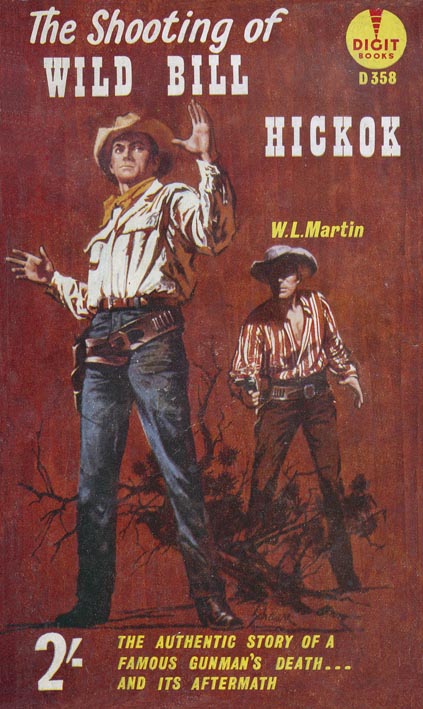
Here's an example: W. L. Martin was the author of The Shooting of Wild Bill Hickok, a paperback original published by Digit Books in 1960. Here's the blurb:
Many books, both fact and fiction, have been written about the hectic life of the famous Western lawman and gunfighter, Wild Bill Hickok. Little, however, has ever been written about the infamous murder of this bizarre figure of the West by a drifter and penny-ante gun rannie by the name of Jack McCall.
     That killing, like the cowardly murder of Jesse James, touched off a series of startling and historical events.
     This Digit Original factual Western presents for the first time the true story behind the murder, and the consequences. As may be expected, murder abduction, rape, love and hate resulted.
Most Western originals published by Digit were published in their Longloop Westerns or Wagon Wheel Westerns series. The Shooting of Wild Bill Hickok just happened to be published after the former folded and before the latter was launched; a handful of Westerns appeared under the Digit imprint in 1960 but only one or two were originals.

The oddity here is that the book lists a number of other titles "by the same author"...
  • Night Riders of Tonopah by Bill Martin. London: T.V. Boardman, 1951.
  • Guns Along the Columbia by Bill Martin. Sydney: Invincible Press (Invincible Westerns #37), Dec 1949.
  • Indian Agent.
  • Silverado by Bill Martin. Sydney: Invincible Press (Invincible Westerns #28), Jul 1949.
  • Arrowhead Justice by Bill Martin. Sydney: Invincible Press (Invincible Westerns #23), May 1949.
  • Johnny LasherGunman.
  • Red-River Riders. — actually Raiders of Red River by Bill Martin. Sydney: Invincible Press (Invincible Westerns #45), Mar 1950.
Of these, the British Library records Night Riders of Tonopah by Bill Martin as being published by T. V. Boardman in 1951. Curiously, Bill Martin is also given a year of birth, 1919. But none of the other titles have been traced. All, presumably, published between 1951 and 1960... but where? Are they short stories included to bulk up Martin's literary CV? Comic strips?

What of William L. Martin? Apart from the fact that he was born in 1919, nothing else is known. The Shooting of Wild Bill Hickok contains a brief dedication "to Jane and Vic Rose" but no other clues.

One final mystery. The cover is by American artist Harry J. Schaare and, presumably, originally appeared on an American paperback. Can anyone identify the original book?

More "mysteries that continue to mystify" soon...

Sunday, November 15, 2009

Frank Jennens

(* Reposted from 7 April 2009. As you can see, I've just received some photographs of Jennens, so I've taken this opportunity to slightly revamp the piece. Initially there was some question about his full name, which led to various bits of speculation on my part; as I was subsequently able to confirm some of the details, I've been able to tidy things up a bit, although I've tried to retain the flavour of the original post.)

I recently heard from someone looking for information on Frank Jennens and, as he was a comic strip artist as well as an illustrator, I thought it might make an interesting subject for a column. I was told he "was a children's books and annuals illustrator from about 1917 until the 1950s." He also wrote a couple of books, which he illustrated, which seem to be particularly scarce and sought after: Brown Mouse and its sequel Brown and White.

I have no knowledge of these titles, although I believe they were identified by someone on the Collecting Books and Magazines list some while ago where the first book was described thus: "It was a delightful story of a very plain little girl who had 2 beautiful sisters named Muriel and Marina. She was overlooked in her family but the story tells how with the help of friends she eventually wins her family over to love and accept her and ends with her saving her sister's life."

A dig around the web via Google turns up very little, although two lots of Jennens' original paintings have come up fairly recently. One lot was 3 watercolours of 'Young Girls', painted in the 1940s; another was 'Portrait of a young Man Reading', oil on canvas, signed and dated 1909.

Jennens was also a writer, contributing to Hulton's Girls' Annual 1927 with a story "The Scarlet Signal". Around that period, he was also contributing to the Bruin Boys Annual and to the Amalgamated Press's nursery comics, starting with "Little Snowdrop" in Tiny Tots (1927) and various contributions to Sunbeam ("Lily of the Valley", 1929; "Grandfather's Secret", 1930; and "The Miser's Secret", 1934). Unfortunately, I couldn't come up with any images, although Alan Clark believed him "an accomplished artist [who] produced excellent pen and ink drawings. His painting for book frontispieces and plates were always to a high standard."

Frank Douglas Beaufoy Jennens was born in 1893 at St. Pancras, London. The 1901 census locates him at 17 Camden Square, Camden Town, St. Pancras, living with his widowed mother and various siblings (I've added some further notes I jotted down as I dug around):
  • Isabella (b. Birmingham, 3Q 1855)
  • Isabel Ruth (b. Islington, 1Q 1879) m. in 1901
  • Lilian May (b. St. Pancras, 3Q 1883) m. in 1905
  • Maud Ethel (b. St. Pancras, 4Q 1884) m. in 1908
  • Lily Gertrude (b. St. Pancras, 3Q 1886)
  • Alfred Edward F. (b. St. Pancras, 1Q 1889)
  • Frank Douglas B. (b. St. Pancras, 2Q 1893)
  • Lawrence Ewart (b. St. Pancras, 3Q 1895)
Between 1895 and 1901, Isabella Jennens was widowed. Turning to the death records we find a likely suspect in Joseph Jennens, who died at St. Pancras on 27 May 1900, aged 44. This turns out to be correct: Joseph Jennens, born 1 November 1855 in Hockley, Birmingham, the son of William Jennens and his wife Martha (nee Beaufoy), married Isabella Venners, the Birmingham-born daughter of silversmith Charles Venners and his wife Ruth, at the New Christian Church, Argyle Street, St. Pancras on 4 June 1876. Joseph and Isabella were living at 14 Cantlowes Road, Kentish Town at the time of the 1881 census, erroneously listed under the name Jennins. Joseph was then a 25-year-old clock manufacturer. In 1891 (as Jemmons) they were living at 38 St. Augustine's Road, St. Pancras district and had now been joined by Joseph's mother and sister, plus a servant. Joseph's clocks seem to be highly desirable nowadays.

The 1911 census shows Jennens living at Avoncourt, Loom Lane, Radlett, Hertfordshire, with his mother, Isabella, brothers Alfred and Lawrence and sister Gertrude. 17-year-old Frank's occupation is given as artist. If it is correct that he was painting portraits in oil in 1909, it would appear that Frank was quite a precocious talent as he would have been only 15 or 16 at the time.

As a comic strip artist he was active in the 1920s and 1930s, but this was not his only occupation. A clipping from volume 15 of Drama: The Quarterly Theatre Review (British Theatre Association, 1936) includes brief reports from local dramatic societies. One from the Baldock Dramatic Society reads:
Formed in April 1935 only, our infant Society already feels itself to be an integral part of the communal life of this small Hertfordshire town. Favoured indeed were we at the outset to make the chance discovery that a Mr. Frank Jennens, who had but recently relinquished his professional stage career as actor and producer, was actually living in our midst and—what is more—freely placed his expert services and the fine old Manor House at our disposal! Molly Booth, ER Bingham Harriss and he respectively produced "The Man Who Wouldn't Go To Heaven", "Security" and "Playgoers" (three one-act plays) to be followed last April by "Lucky Dip" under Frank Jennens' producership.
This is the same Frank D. B. Jennens as he is listed in the phone book for 1935 at The Manor, Baldock. Indeed, he was listed at various addresses in Kent over the years: phone records show that he resided at Manor House, Baldock [1935], 4 Royal York Mansions, Margate [1937], Palmerston Lodge, Palmerston Avenue, Broadstairs [1938/39], 1 Royal York Mansions, Margate [1941/46], East Northdown House, Margate [1948/50], Elmwood, Broadstairs [1953] and 5 Albion Road, Broadstairs [1954/57]. Frank Jennens' death was registered in Thanet in 3Q 1957, aged 64.

I recently heard from Julie Older and her sister Carol, who remember Frank Jennens from their childhood in Broadstairs. That's Carol and her older sister, Myrna, in the photograph above, reading one of Frank's comics.

Julie and her sisters were befriended by Jennens, whom they knew as Mr. Broadstairs, and Carol had her portrait painted by the artist. Frank lived for many years with his sister, Gertrude, and their ward, Eva Shackleton. The sisters were recently sent some of the annuals that Jennens contributed illustrations to, including the Rainbow Annual 1927 and Tiny Tots Annual 1931.

The above photo, featuring Carol, Arthur Shackleton (Eva's brother), Gertrude, Eva, Frank and Myrna, was taken at Frank's house during a Christmas get-together in 1947.

The following was taken from a book on Broadstairs, the photo originally published in the Broadstairs Guide for 1950. As can be seen from the caption, Jennens (using the stage name Frank Douglas) was still actively involved in repertory.

PUBLICATIONS

Novels (illustrated by the author)
Brown Mouse. London, P. R. Gawthorn, 1947.
Brown and White. London, P. R. Gawthorn, 1947.

Illustrated Books
The Bruin Boys' Annual 1927, illus. with others. London, Amalgamated Press, 1926.
The Bruin Boys' Annual 1929, illus. with others. London, Amalgamated Press, 1928.
Tiny Tots. A picture story book for little people, illus. with others. London, Amalgamated Press, c.1930.
What Katy Did and What Katy Did at School by Susan Coolidge. London, P. R. Gawthorn, 1947.
Anytime Tales by Herbert J. Brandon. Watford, Bruce Publishing Co., 1948.
Fun and Frolic Stories by Berta Lawrence. Watford, Bruce Publishing Co., 1948.
Gulliver's Travels by Jonathan Swift. Watford, Bruce Publishing Co., n.d.
The Life and Strange Adventures of Robinson Crusoe. Watford, Bruce Publishing Co., n.d.
The Pilgrim's Progress by John Bunyan. Watford, Bruce Publishing Co., n.d.
Bevis by Richard Jefferies. London, P. R. Gawthorn, 1949.
The Swiss Family Robinson by Johann R. Wyss. London, P. R. Gawthorn, 1951.
Good Wives by Louisa M. Alcott. London, P. R. Gawthorn, n.d.
The Last of the Mohicans by James Fenimore Cooper. London, P. R. Gawthorn, n.d.
Masterman Ready by Captain Marryat. London, P. R. Gawthorn, n.d.
Mr Midshipman Easy by Captain Marryat. London, P. R. Gawthorn, n.d.
Peter the Whaler by W. H. G. Kingston. London, P. R. Gawthorn, n.d.
Tom Brown's Schooldays by Thomas Hughes. London, P. R. Gawthorn, n.d.
Robin Hood and His Merry Men. London, Hampster Books (Early Reader Series 28), 1961?
The Twelve Dancing Princesses and other stories from Grimm's fairy tales. London, Hampster Books (Early Reader Series 31), 1961?

Note: Some of Jennens' illustrations appeared in a series of Early Reader books published around 1961/62, some years after his death. It should be noted that Hamster Books was an imprint of Spring Books who reprinted and recycled material endlessly, so it is possible that these were reprints from earlier titles.

(* My thanks firstly to Jamie Sturgeon who initially confirmed my identification of Frank D. B. Jennens as the artist and first spotted his connections to acting. A huge thanks to Julie and Carol for sending me the photos and clipping.)

S R Boldero

A prolific artist whose career has been something of a mystery until now. I believe I have managed to track down at least some information on his life, although it is scant and doesn't reveal much about the artist himself.

Stephen Richard Boldero is the only person with the correct initials that I've been able to track down who was around at the right time. He was born Stephen Richard Hamel-Wedekind in 1898, the son of merchant Richard Christian Benedictus Hamel-Wedekind (who was, in turn, the son of Rudolph Hamel, a manufacturer), and his wife Tempe Stanley Browne (the youngest daughter of Camillo di Montebello Drew, an officer in the Ceylon police), who married in 1897.

R. Hamel Wedekind would appear to be the author of Some Notes Extracted From A Diary To Give An Idea Of The State Of Morocco In 1889, a 48-page book(let?) describing the social life and customs in Morocco.

Tempe Hamel-Wedekind had previously married (in 1893 to Harold Montagu Browne), and already had one son, Harold Browne, born in India in c.1895. Richard and Tempe had two children, Stephen Richard (born on 3 April 1898 in Caterham, Surrey, and John Christian (born 28 December 1899 in Caterham, Surrey). It would then seem that Richard died suddenly. In 1901, when the census describes Tempe as a widow, the family were living at 5 Sinclair Gardens, Hammersmith, the household including four servants (a cook, nurse, parlourmaid and housemaid).

By the time of the 1911, the family were living in Battle, Sussex, and Tempe Stanley Hamel-Wedekind had reverted to her family name of Boldero, although it was not her maiden name. The Boldero name had originated in Suffolk but Tempe's family had strong links much further east. Her grandfather, John Stephen Boldero (1790-1858), was in the civil service of the East India Company in India. He and his wife Louisa (nee Templeton) had six children, all born in India between 1818-1830, the last being Tempe Stanley Boldero, born in Moradabad, on 11 October 1830. She married Captain Camillo di Montebello Drew on 7 May 1850 and had six children. Again, the last was Tempe Stanley Drew, born in Galle, Ceylon, in 1867.

Her mother died that same year, and Tempe was raised in the UK by her uncle Edward J. Boldero (formerly of the Bengal Civil Service) and aunt, Sibella Shedden Boldero (1832-1910). Sibella, incidentally, is a variant form of Greek sibylla, meaning prophetess or oracle; Tempe is derived from the Vale of Tempe, in Ancient Greek the favourite haunt of the Muses. Sibella was a witness at Tempe's first marriage in 1893.


Educated at St. Lawrence College, Ramsgate (1914-15), the now Stephen Richard Boldero trained at the Royal Military Academy and joined the Royal Regiment of Artillery in 1916 before transferring on a short service commission to the Royal Air Force, making Pilot Officer in 1921 and Flying Officer in 1922. He served part of his time in India, from whence he returned in 1924, relinquishing his commission in April 1925 due to ill-health. By then he seems to have been twice married, firstly to Nellie P. Woodley in 2Q 1916 in Steyning, Sussex, with whom he had a son, Alistair J. Boldero, in 1917, and secondly to Eleanor Winifred Wise in 4Q 1926 in Chelsea, Middlesex. The latter marriage ended in divorce in 1934.

Whether he had an artistic bent earlier in life is unknown, but he certainly turned to painting in the 1930s. The earliest trace of his artistic talents I have been able to find relates to the introduction of mobile recruiting offices, via which the R.A.F. hoped to recruit 31,000 men ahead of the (increasingly inevitable) war. A report in The Times (15 July 1938) describes them thus:
The outside decoration of the new type of van has been carried out in two contrasting shades of blue, with the R.A.F. concardes of red, white and blue in the lower panelling on either side of the body. Two chromium-plated show windows display, in colour, representations of life in the R.A.F. at home and abroad. They have been carried out, in cut-out form, by Mr. S. R. Boldero, who has served with the R.A.F. The inside of the van is equipped as an office.
Boldero's cover artwork appeared regularly in the 1950s and 1960s, published by most of the leading paperback firms (Corgi, Digit, Arrow, Pan, Panther, Four Square, Consul). He also had a long association with Souvenir Press, producing numerous dust jackets.

Stephen Richard Boldero lived for many years (at least from 1957-82) at 39 Ranelagh Gardens, London W.6. He died in London in the summer of 1987, aged 89.
PAPERBACK COVERS

Arrow Books

481 * Wallace, Edgar * When the Gangs Came to London (Oct 1957)
499 * Firmin, Stanley * Murderers in Our Midst (May 1958)
547 * Wallace, Edgar * The Gunner (Jan 1960)
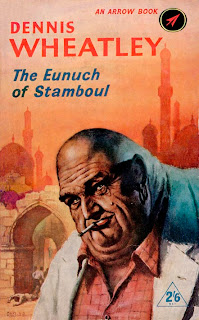
556 * Wheatley, Dennis * The Eunuch of Stamboul (Feb 1960)
560 * Wheatley, Dennis * Black August (Mar 1960)
580 * Wheatley, Dennis * Uncharted Seas (Aug 1960)
608 * Thomson, Christine Campbell * More Not At Night (1961)
??? * Proctor, Maurice * The Midnight Plumber (1966?)

Consul Books (World Distributors)

1107 * Shelley John C. * Cavalry Sergeant (Jan 1962)
1153 * Bonham, Frank * Defiance Mountain (Jun 1962)

Corgi Books

1031 * Roe, Vingie * West of Abiline (Jun 1955)
1115 * Haycox, Ernest * The Wild Bunch (Jul 1956)
T103 * Foster, Bennett * The Mustangers (1955)
T635 * Holmes, L. P. * The Plunderers (1959)

Digit Books (Brown Watson)

nn * "Blake" * Readiness at Dawn (Apr 1957)
nn * Foote, Alexander * Handbook for Spies (Nov 1956); reissued, R542 (Nov 1961)
nn * Hardy, Russ * Pack Train (Aug 1957)
nn * Howe, George * Decision Before Dawn (May 1957)
nn * Reynolds, Quentin * Seventy Thousand to One (Feb 1957)
nn * Schrire, I. * Stalag Doctor (Mar 1957)
nn * Vestal, Stanley * Send for Wyatt Earp (Mar 1957)
nn * Waldo, Dave * The Man from Thunder River (Jul 1957)

Four Square

328 Valentine, Victor * Cure For Death (1961)

Pan Books

415 Lustgarten, Edgar * Defender's Triumph (May 1957)
427 Tey, Josephine * Miss Pym Disposes (Jul 1957)
GP70 * Denti Di Parajno, Alberto * A Cure for Serpents (Jul 1957)
GP94 * Wheeler, Sir Mortimer * Still Digging (Jan 1958)
G109 * Marric, J. J. * Gideon's Day (Mar 1958)
G115 * Ambler, Eric * The Night-Comers (Apr 1958)
G146 * Macdonald, John Ross * Find a Victim (Aug 1958)
G309 * Carr, John Dickson * The Seat of the Scornful (Jan 1960)
? G330 * Hilton, James * Lost Horizon * (1960)
G363 * Ambler, Eric * Judgement on Deltchev (Jan 1961)
G403 * Lewis, C. S. * Out of the Silent Planet (1960)
G404 * Lewis, C. S. * Voyage to Venus (1961)
G421 * Lewis, C. S. * That Hideous Strength (1960)

G425 * Hogg, Garry * Cannibalism and Human Sacrifice (Jan 1961)
G463 * Clarke, Arthur C. * Childhood's End (1961)
G476 * Wallace, Edgar * Again Sanders (Jul 1961)
G495 * Upfield, Arthur * Bony and the Mouses (Sep 1961)
X12 * Queen, Ellery (Ed.) * Ellery Queen's Book of Mystery Stories (Jun 1957)
X26 * Smith, J. L. B. * Old Fourlegs (Sep 1958)
X27 * Phillips, Wendell * Sheba's Buried City (Sep 1958)
X67 * Van Thal, Herbert (Ed.) * The Second Pan Book of Horror Stories (Nov 1960)
X71 * Hitchcock, Alfred (Ed.) * Stories They Wouldn't Let Me Do On TV (Dec 1960)

Panther Books

512 Clifton, George C. * The Happy Hunted * (reissue)
648 Neave, Airey * Little Cyclone * (Mar 1957)

Pedigree Books

? nn * Michelet, Jules * Satanism and Witchcraft (May 1959)
nn * Gardner, Gerald B. * Witchcraft Today (1960)
nn * Verner, Gerald (Ed.) * Prince of Darkness (1960)

DUSTJACKETS

Hodder & Stoughton

nn * Oliver, Chad * The Wolf Is My Brother (1968)

Souvenir Press

nn * Derleth, August (Ed.) * When Evil Wakes (1963)
nn * Russell, Ray * The Case Against Satan (1963)
nn * Soubiran, Andre * The Good Dr Guillotin and His Strange Device (1964)
nn * Baker, Peter Gorton * The Antibodies (1969)
nn * Seymour, Alan * The Coming Self-Destruction of the United States of America (1969)
nn * O'Donnell, Peter * The Impossible Virgin (1971)
nn * Neely, Richard * The Walter Syndrome (1971)
nn * Michaels, Barbara * Greygallows (1974)

Cresselles Publishing, Henley-on-Thames

nn * Campbell, James * Bomber Stream Broken (1976)

Illustrations

Broxton's Silver Spur. A school story by Michael Poole. London, George Newnes, 1953. [as G. R. Boldero]
The Children's Jolly Book, with others. London, Odhams Press, c.1954.
The Treatment of Man by William Wiegand. London, Frederick Muller, 1960.

Saturday, November 14, 2009

Comic Cuts - 14 November

I've spent most of the week on Eagles Over The Western Front and as of this moment I've about twenty or so pages to go, plus most of the original artwork. It's a slow process: I wouldn't call what I'm doing "restoration" as I'm not redrawing anything, but there are a lot of print errors that need to be fixed—ink splashes and smears, ghosting from over-inked images on the reverse of pages, poor lettering and a few etceteras that I'm tidying up.

A quick bit of news relevant to Bear Alley. There is now an official Peter Elson website, featuring some 300 pieces by one of my favourite cover artists. I've featured a couple of pieces of Peter's work in past galleries. Now you can see a great many of his best covers scanned directly from the original artwork. Go visit. You won't regret it.

Next week, more "Ben-Hur", more work on Eagles, more book cover scanning and hopefully a couple of extra posts as I've been cobbling together some bits 'n' bobs while I've been going through a couple of shelves of old Digit paperbacks (you may have noticed quite a few Digit titles appearing here the last week or two) and having a bit of a tidy up. I'm also working on the next batch of comic novelisations and tie-ins, so it's going to be a busy week.

(* Original artwork for The Power of Blackness by Jack Williamson by Peter Elson. I remember buying this when it came out in 1978, published by Sphere. The book disappeared years ago, probably borrowed by someone and not returned, but I still remember that cover. Artwork © Estate of Peter Elson.)

Paperback Cover Cavalcade 4

Calling Scotland Yard. Being the casebook of Chief Superintendent Arthur Thorpe, presented by A. Noyes Thomas (Digit Books, Feb 1956)
Thorp's casebook contains enough material for a whole library of volumes, but in this book the reader will find a concentrated choice of the most varied and remarkable crimes which have been committed over the last thirty-five years. Here, for instance, are the Coventry Cyanide Case, in which the lady who was going to administer a dose to her husband in his whisky ended by drinking it herself; the Red Oil Case, which involved the shadowing and melodramatic chase through London of a Russian agent who was trying to obtain information from an employer of one of the world's largest oil corporations; the Babe Mancini Murder, set against a background of garish nightclub gambling hells.
A reprint of the hardback originally published by Allan Wingate in 1954. Alfred Noyes Thomas wrote a number of biographical books, including I Defy! The story of Lieutenant D. Lankford (1954), The Queen's Sister. An intimate portrait of Princess Margaret (1955) and Doctor Courageous. The story of Dr. Grantly Dick Read (1957). I believe he was related to Alfred Noyes (1880-1958), the poet who wrote "The Highwayman" (1906). A little biographical note I found on the web claimed that Noyes' sister married David William Thomas of Brynhawk, Maescrugiau, Carmathenshire, who was the archdeacon of St. David's and Skenfrith, Monmouth. They had one son, Alfred Noyes Thomas, who lived at Hazlemere, Surrey. From my own research I've found that his birth was registered in Llandilofawr, Carmathenshire, in 1915. He seems to have lived in Hindhead, Guildford, from the mid-1950s until the 1980s.

Recoil by Brien How (Digit R736, Jul 1963)
When Nora Parrington misses the 5.30 back to Somerset, she has to wait two and a half hours at Paddington and during this time Edward Griggs, well-known Taunton bookmaker, meets an untimely end.
__Diligent investigation leads the police to Nora. Though they fail to find a loophole in her defence, Nora's solicitor husband knows something the police do not. As he is having an affair with another woman, he sees his way clear to rid himself of Nora and puts into operation a diabolically ingenious plan.
__With its exciting twists and authentic legal background, this story hallmarks Brien How as a new novelist of considerable skill.
Originally published by Robert Hale in 1962, this was the debut and, as far as I can tell, only novel by Brien How, the abbreviated name used by barrister at law Herbert Henry Brien How. How is still something of a mystery himself. His book was submitted via an agent and even his publishers know nothing of him. However, it would seem that he was born in Richmond, Surrey, on 4 April 1913, and was called to the bar of the Inner Temple in 1936; at that time he was living in London but spent at least part of his subsequent career in Hong Kong. He served in the Intelligence Corps during the War and was married at least twice, firstly to Margaret J. Thorburne in 1947 and then to Joan Purdue (formerly Lea) in 1953. He is last known to have been living in Malaga. Given the positive reviews his first novel received ("accomplished", "ingenious", "an exciting novel", according to the Eastern Daily Express, Birmingham Post and Alec Waugh respectively) it seems a shame he did not continue writing.

A Sudden Loneliness by Dinah Lawrence (Digit R619, Sep 1962)
David Carew is a young man raised in a gritty, down-to-earth working class town in the North of England. Frustrated with the possessiveness of his mother, and the pettiness of the people around him, he strives to enter the glossy, material world of the middle-classes.
__This is a novel about love and ambition, about frustration and ultimate tragedy. Written with vigour, with courage and with sincerity, it is typical of our day and age.
Like Brien How above, Dinah Lawrence appears to be a one-off novelist, although she made some contributions to Swift Annual in 1958-60. Since I previously mentioned her two years ago, I've discovered very little. She contributed to Girl Annual 1964 (1963) and I think she may have been a feature writer for various magazines over the years, but that's only a guess.

Sunday, November 08, 2009

Luan Ranzetta

The oddly named Luan Ranzetta was a pen-name used on a series of four science fiction novels published by Digit Books in 1962-64, all uniformly bad as SF and not especially good as novels. The SF Encyclopedia sums them up as "routine sf adventures, which focus on alien invasions and great disasters".

The author behind the name—Luan perhaps an anagram of Luna, which was thought to be suitably science fictional when coupled with the guttural Ranzetta, which harks back to the days of ghastly SF pen-names Vektis Brack, Volsted Gridban and Vector Magroonhas never been revealed (but see the update below). The Ranzetta nameas V. Ranzettahad been used previously on another Digit original, The Uncharted Planet (1961), which I don't have.

I picked up one of Ranzetta's books at the recent ABC Show and, discovering I now had all four, thought it might make for an entertaining cover gallery. As someone who is masochistically entertained by bad science fiction, I even started reading one of them. The Yellow Peril has come in for some stick elsewhere, notably in Neil Gaiman & Kim Newman's Ghastly Beyond Belief, which extracts a number of passages for mocking. One of my favourites occurs early in the novel where top space-ship pilots Barry and Paul are discussing the latest scientific discovery: the met boffins are, apparently "quite upset by the earth's behaviour". Barry "sobered instantly":
"... but you're right about the boffins. They say the earth is shrinking at the poles. That makes it feasible that it will bulge in the middle, doesn't it? I can't visualise how that affects us, but I do understand that it slows up the earth's revolutions. That could be important."
__Paul Duffy grinned. "Just shows you how much we depend on the Sun, doesn't it? Though last summer he must have taken his holidays the same time as I had mine!" He closed his eyes thoughtfully. "God! That camping business!"
From scientists (sorry, boffins) predicting the destruction of Earth to memories of a miserable camping trip in one easy paragraph. But even this kind of bad writing has a certain charm to it (well, I think it has charm) and makes you wonder if the author hasn't misremembered something he's heard about global warming and shrinking ice caps (and this way back in 1962).

All four books are as bad. The Maru Invasion, for instance, begins with two pilots struggling to get their rocket back to earth. We learn that they, Don Winters and Gavin Carter, have been involved in a secret project to drop off 100 men on an uncharted planet, Maru; now, returning to their home planet, the rocket 's systems have died. Despite promises from the boffins back home that nothing can go wrong, Don is worried that the rocket could continue its journey until the "super-fuel" runs out or the rocket's walls deteriorate and allow cosmic rays to penetrate. His solution to the problem:
"Gavin, old man. What about trying another look-see out of the window? Might be something new."
They reach Earth, parachuting out of the rocket to land on an atoll that appears to have suffered the effects of an atomic bomb blast. Eventually, Don discovers that the Maruans have invaded for that time-honoured reason: they need to steal some women:
"The Maruan women, for some time, had been given all the privileges of men. They were equal, they had the same rights. Of course they bore that children; that was the catch ... The women rebelled against what they called 'the servility of child-bearing'. It was a farcical situation, and executing them had not made matters any better..."
__"That's where you made you mistake, old boy! We've never let our women know that they were our equals!"
...says Don.
Before we descend completely into misogynistic claptrap, I will say that the paperbacks of the era were full of this kind of casual sexism, although few go quite as far as executing feminists. Actually, the book has lost its charm long before that point and starts to drag after the first 20 or so pages. But it does have a surprisingly down-beat ending for this kind of pulp writing; the books usually end with the hero and his girl looking forward to a bright future. In The Maru Invasion, it's as if the author suddenly remembered the cover and thought he'd better write in an explanation for it. Thus we have a silver alien spaceship approaching the hiding place of a small group of earthmen on the nuclear blasted surface of an atoll and Don's final words are: "Well, here they come, the bastards!"

Here are the covers and blurbs for all four of Luan Ranzetta's novels:

The Maru Invasion by Luan Ranzetta (Digit Books R606, Jul 1962)
He leapt back as a wide jet of crimson flame scorched forth from the blunt barrel, hitting Argos full in the face. There was a loud, inhuman scream. The others were transfixed with terror, but Don could take no chances and turned the gun on them as they stood there, eyes stark with fear. Flame belched again and they fell to the ground, their hands clawing at their faces and throats...
The World in Reverse by Luan Ranzetta (Digit Books R618, Sep 1962)
Lanny stood still, his eyes glued on that crumpled form by his feet. He wanted to run back downstairs, to safety and sanity, but he had to know what it was. He stopped to examine the upturned face and gasped, in horror, as the ghastly picture fixed itself in his mind...
__It was a woman. A woman with blonde, wavy, luxuriant hair. Hair that was matted with dark, red, glistening substance. Blood. Across the face which had once been beautiful, there ran a gaping wound, filled with congealed blood.
He put his hand out to turn the poor bruised head towards him, and, as he did so, the whole face seemed to slide sideways, as it it were some dreadful, artificial mask.
The Night of the Death Rain by Luan Ranzetta (Digit Books R717, Jun 1963)
The ominous, leaden sky brooded threateningly over the earth: the sultry heat became daily more stifling. What was the cause of these oppressive clouds which came ever closer and for which the scientists could hazard no explanation? Then it came, a blinding, havoc-wreaking death storm: relentless, tearing rain and the earth's surface gouged with craters, shattered beyond recognition...
__A small party of survivors find themsel
ves on an alien planet, hurled there by the cosmic force of the earth's upheaval. Can they ever escape from this bleak world with its stern silent inhabitants? Their plans are dependent on a second even more violent nuclear storm, and they are flung once more into a hostile universeto safety? or total destruction?
Yellow Inferno by Luan Ranzetta (Digit Book R836, Mar 1964)
A party of scientists have been sent on a mysterious journey to Tibet. None of them knows why.
__As they step from their space-ship none of them could be aware of the terrifying dangers that lay ahead.
__They must prevent the sinister Doctor Chung-Yin from carrying out his threat to destroy the entire Western World. Either they are successful, or they die a horrible death themselves.
Update: 29 November 2009
As I mentioned above,
the author behind the Luan Ranzetta pen-name has remained unidentified for many years. I'm pleased to say that this post, and a follow-up which covered the V. Ranzetta novel, resulted in a message from Matt Ranzetta, who tells me that V. Ranzetta was indeed the same author as Luan Ranzetta. "However, the V stands for Valerie and Ranzetta is indeed her real surname."

So my original guess that Luan Ranzetta might have been one of the pen-names used by T. C. P. Webb turns out to be wrong. Hopefully some more information on Valerie Ranzetta will be forthcoming.

BEAR ALLEY BOOKS

BEAR ALLEY BOOKS
Click on the above pic to visit our sister site Bear Alley Books