Commando issues on sale 20th June 2013.
Commando No 4611 — See Paris And Die!
By Summer 1944, the Allies had broken out of the Normandy beach head and the race for Paris was on. The Convict Commandos were at the head of the advance — sent in to make sure the city wasn’t levelled.
For once, Jelly Jakes was pleased with their mission; he’d always wanted to see Paris. Mind you, he hadn’t banked on seeing it as he hurtled earthwards from the top of the Eiffel Tower!
Story: Alan Hebden
Art: Benet
Cover: Benet
Commando No 4612 – Run To Freedom
In 1968, a series of reforms known as The Prague Spring loosened the iron grip of communism on Czechoslovakia. Looking forward to this new beginning, Marek Kaldova — an RAF avionics expert — returned to his native Czechoslovakia after twenty years in exile.
Things didn’t go smoothly, though. The Russians invaded and Marek found himself on the run from the KGB who were desperate to uncover his priceless secrets.
Help was at hand, in the form of British Secret Service operative Sergeant Bob Carter, but even he would have his work cut out on the Run To Freedom.
Story: Alan Hebden
Art: Rezzonico
Cover: Janek Matysiak
Commando No 4613 — Spy In Battledress
The Commandos were tough, dedicated men who had risen from the funeral pyre of Dunkirk to hit back at the Nazis with blazing tommy guns and a brand of courage that was unique. Their motto…United We Conquer!
But there was one man who mocked that brave motto when he crept ashore on raids with his Commando mates. They all knew him as “Mitch” Mitchell, but German High Command knew him better as Leutnant Hans Reister of the SS.
And what the Commandos didn’t guess was that each time he was leading them straight into a German ambush…
Introduction
A traitor amongst Commandos? Not only would the man himself have to be bold, but the author of his tale would have to be similarly brave. Sustaining a story of treachery amongst a series of raids where the spy would have to avoid shooting his countrymen takes a lot of ingenuity. Fortunately for us, Eric Hebden succeeds admirably. And he manages to confound our expectations, too.
Alvaro, who did a score or more of the early Commando covers, sets the scene for the story and between his covers, Amador does a fine job of carrying the tale along with strong black and white work — even when he’s supposed to be drawing a red hat.
All in all a surprising yarn…for all the right reasons.
Calum Laird, Editor
Story: Eric Hebden
Art: Amador
Cover: Alvaro
Originally Commando No 89 (October 1963).
Commando No 4614 — A Pack Of Wolves
The three men were part of a band of Italian bandits, a pack of wolves who roamed through the mountains to make a fat profit while their war-torn country crumbled about them. There were other similar groups in the area too, but this lot had by far the strangest leader of all…an eccentric history lecturer from England!
Introduction
Some people might think that they know exactly what to expect from the pages of Commando. But every now and then comes a story that plays with those expectations and ultimately turns them around.
A Pack Of Wolves is a case in point. Instead of a fearless Tommy we have an utterly despicable one. Expecting a villainous German? Well, here’s a noble and honourable one. And when we meet the characters who we think might be the eponymous Pack Of Wolves — we meet another pack of them soon after. Nothing is quite what it seems here. And this memorable tale is all the better for it.
Scott Montgomery, Deputy Editor
Story: Allan Chalmers
Art: Gordon Livingstone
Cover: Jeff Bevan
Originally Commando No 2192 (June 1988), re-issued as Commando No 3660 (September 2003).
Thursday, June 20, 2013
Friday, June 14, 2013
Comic Cuts - 14 June 2013
I shall try to keep vaguely to topic for a few minutes. I've spent the whole week reading through and making notes about the strips appearing in Boys' World. It's a long-winded job, which means that other than saying my notes currently run to about 18,000 words, I haven't anything to say that I won't be saying in the book.
I do, on the other hand, need some help with Boys' World Annual. I have listings for the contents but I'm missing some cover scans and a few examples of pages from inside for the following: 1966, 1967, 1968, 1970, 1971, 1972. For some reason unknown, I only have three volumes (1964, 1965, 1969) to hand and I'm sure I had more.
If you think you can help, drop me a line at the address below the photo (top left) and I'll try to spread the workload.
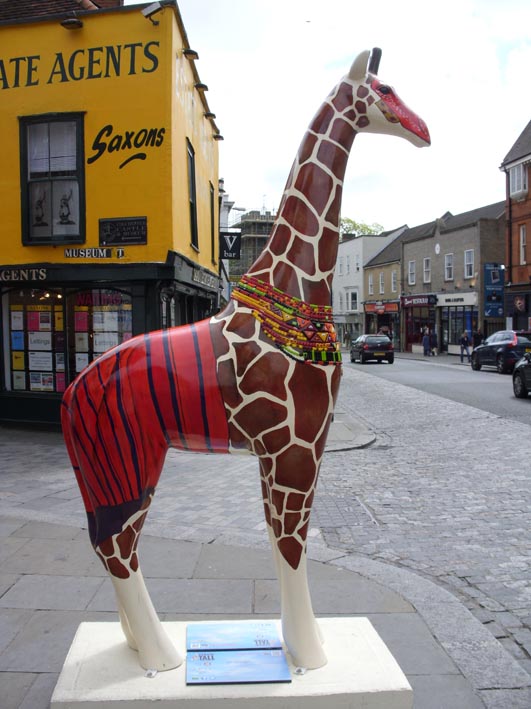
With that "news" out of the way I'm going to talk about giraffes. Yes, giraffes. These giraffes...
Colchester has been celebrating the 50th anniversary of its zoo and to promote the event a number of 7-foot high giraffes have turned up around town and other locations in Essex. Smaller giraffes have found their way into shops, but the larger ones, dotted around the High Street, the Castle, a few retail parks and elsewhere, have become quite a talking point. Grown ups are having as much fun as their kids trying to track them down. And, being as childish as the next person – especially when that next person is Melissa – I was scooting around town trying to find as many as I could last Saturday.
To be honest, I'd forgotten all about the promotion and spotted my first giraffe and was filled with wonder at this startling random act of art. Even when I realised it was a promotion and I was buying into what was in essence an advertising campaign, I was still overjoyed with each new discovery.
Some of them are brash and colourful, some beautiful and serene, others thought-provoking but mostly they are 7-foot high giraffes brightening up our otherwise dull summer. We've spotted eleven so far and I'm hoping to track down one or two more tomorrow. I'll let you know if I do.
Ulysses continues his voyages over the weekend and into next week.
I do, on the other hand, need some help with Boys' World Annual. I have listings for the contents but I'm missing some cover scans and a few examples of pages from inside for the following: 1966, 1967, 1968, 1970, 1971, 1972. For some reason unknown, I only have three volumes (1964, 1965, 1969) to hand and I'm sure I had more.
If you think you can help, drop me a line at the address below the photo (top left) and I'll try to spread the workload.
With that "news" out of the way I'm going to talk about giraffes. Yes, giraffes. These giraffes...
Colchester has been celebrating the 50th anniversary of its zoo and to promote the event a number of 7-foot high giraffes have turned up around town and other locations in Essex. Smaller giraffes have found their way into shops, but the larger ones, dotted around the High Street, the Castle, a few retail parks and elsewhere, have become quite a talking point. Grown ups are having as much fun as their kids trying to track them down. And, being as childish as the next person – especially when that next person is Melissa – I was scooting around town trying to find as many as I could last Saturday.
To be honest, I'd forgotten all about the promotion and spotted my first giraffe and was filled with wonder at this startling random act of art. Even when I realised it was a promotion and I was buying into what was in essence an advertising campaign, I was still overjoyed with each new discovery.
Some of them are brash and colourful, some beautiful and serene, others thought-provoking but mostly they are 7-foot high giraffes brightening up our otherwise dull summer. We've spotted eleven so far and I'm hoping to track down one or two more tomorrow. I'll let you know if I do.
Labels:
Comics News
Saturday, June 08, 2013
Dan Dare Space Fleet Operations Manual
SPACE FLEET OPERATIONS MANUAL
Steve Winders reviews the new Haynes’ Manual by Rod Barzilay and Graham Bleathman
After the U.S.S. Enterprise, the Millenium Falcon and Thunderbirds, Dan Dare’s spaceships have become the latest iconic space vehicles to receive the Haynes treatment. There are more than thirty highly detailed cutaway illustrations by Graham Bleathman, with fourteen in colour. These are supported by a large amount of background information from Rod Barzilay, about Dan Dare’s adventures from the famous Eagle weekly of the 1950s and 60s, the aliens he encountered, the principal characters and the Spacefleet organization. Rod’s informative and well researched pages are supported by illustrations from the original Eagle and almost all the cutaways are accompanied by small pictures of them from the strip.
Graham’s accurate cutaways are well up to the standards he set in his popular Thunderbirds illustrations and in quality, echo those of real vehicles which adorned the centre pages of the 1950s Eagle, when Dan Dare appeared on the front cover. All the principal cutaways are printed across two pages however and consequently a little detail is lost in the guttering between the pages. Clearly considerable effort has been made to minimise this issue, because the problem is not nearly as noticeable as in Daniel Tatarsky’s 2008 Eagle Annual of the Cutaways.
Although a few of the spaceships have been featured previously in cutaways in Rod Barzilay’s Spaceship Away! magazine, the cutaways in the book are all new. Spaceship Away! is a periodical originally devised to carry new Dan Dare strips in the original style and in the case of Rod’s own Phoenix Mission and Green Nemesis stories, predominantly drawn by Don Harley, who worked on the strip in the 1950s Eagle. Two episodes of Green Nemesis are featured on the endpapers of the book and Dan’s new spaceship from these adventures, the Marco Polo, is also included as a cutaway. The stories in Spaceship Away were also set during the period of Dan’s original adventures in the 1950s and 60s Eagle and the Spacefleet Operations Manual restricts itself to this time, avoiding the 2000AD comic’s version of Dan Dare and the adventures of his great great grandson in the 1980s Eagle.
In examining the technical aspects of Dan Dare in detail, this book explores an aspect of the saga that no previous book has covered and in quality and presentation it maintains the high standards that have established Haynes as a leading technical publisher. It is an essential work for fans of Dan Dare and will also interest more general science fiction enthusiasts. It contains 128 pages and is good value for £16.99.
Dan Dare: Space Fleet Operation Manual by Rod Barzilay & Graham Bleathman. J. H. Haynes & Co., 6 June 2013, 128pp, £16.99.
Labels:
Comics Review
Friday, June 07, 2013
Comic Cuts - 7 June 2013
I feel like I've time-jumped back to January. After finishing the Lion book, I wanted to do something that would be comparatively quick and looked to Boys' World and Ranger. I spent most of January trying to hustle Boys' World into some semblance of historical accuracy and update my contents lists. At the end of the month there was a minor glitch that persuaded me that Ranger would be the better option to work on and, as most of you will be aware, that book came out in April.
So now that the paying work has again dried up, I'm back on Boys' World and having a fine time reading stories that I haven't read for some years. Some that didn't grab my attention back then I'm reading for the first time and discovering one or two real gems. It's a shame we didn't have the European model when it came to comics whereby strips were gathered into albums after they had run in the weekly titles. The bizarre thing is that the idea of getting a second sale out of text stories dates back over one hundred years when the Amalgamated Press launched the Jack, Sam and Pete Library in 1906, reprinting stories by S. Clarke Hook from the pages of The Marvel. Thousands of these libraries appeared over the years – 1,488 issues of Boy's Friend Library, 1,310 issues of Girl's Friend Library, 411 issues of Schoolboys' Own Library, 274 issues of the Champion Library, just to name a few.
Although the paper shortage caused by the Second World War caused most of them to fold, the notion continued after the war with titles like Cowboy Comics and Thriller Comics reusing previously available material. Annuals recycled old strips and features endlessly and many comics would enter a phase of using reprints as they tried to save money. So reprinting wasn't an idea beyond the realms of publishers' imaginations; they just didn't gather together stories for reprinting in albums.
Shame.
Regular readers will know that I'm not only the lead writer at Bear Alley Books but also head cook and bottle washer. And one of the tasks I have to do is put together a cover for each of the titles I produce. In the case of the comic histories/indexes I try to reflect the comics themselves, hence the wraparound cover on the Hurricane and Champion index and the iconic full-page space-suited youngster on the Ranger book. The Lion was based on one of the annuals. I've played around with a couple of images for the Boys' World cover and have chosen my own favourite. However, I hate to see effort go to waste, so here's a sneak peak at one of the cover roughs that didn't make it. The final cover I'll reveal in a couple of week's time.
Domestic news... I'm still managing to walk a couple of miles a day. I'm trying to put a positive spin on this but after the first week's efforts seemed to make an impact I haven't noticed any improvement. I don't know whether it's doing anything to my weight or whether I have achieved some sort of new balance – the additional exercise I'm doing is just enough to stop my weight increasing, perhaps, or at the very least has slowed it down. I'm slowly increasing the daily distance so I'm now doing a half mile extra compared to week one and maybe that will make a difference.
As both Mel and I have said, it took twenty years to put the weight on so it's not going to disappear overnight. I'm aiming to change to a (slightly) healthier lifestyle and it takes a while for that to become ingrained. Once I've rebuilt some stamina, I might be able to consider something a bit more active than walking.
Bird watchers amongst you will be pleased to hear that we seem to have had some successful fledging this year: I'm sure the blackbirds have bred twice and at least one male and one female chick have survived; the robins I'm not 100% sure about but I believe they managed to raise a couple of chicks. We caught one cat attempting to sneak up to the nesting area but managed to divert its attention.
We spotted a sixth cat prowling around, a tortoiseshell now named Scaredy, for the rather obvious reason that he scarpers every time he sees us. Apologies for the blurry photo. Scatterpuss and Fluffybum, who only ever turn up during the summer, are both OK; Blingy we haven't seen for some while, although Mel is convinced she saw him walking down the road a couple of weeks ago; Ninja... well, you wouldn't expect to see him!; and Socks has not been around for a couple of weeks. Maybe he realises that there's no food on offer or caught sight of next door's dog.
Random scans for today... As I was writing, I heard the news that Tom Sharpe had died. Although best known for the Wilt series I always preferred his debut novels Riotous Assembly and Indecent Exposure, both set in South Africa, where Sharpe worked for a decade. They were the only two that I kept when I had a clear-out a few years ago – I may not have read them for a couple of decades but I still couldn't bring myself to get rid of this particular pair, bought in about 1982. Probably the only books apart from Anthony Buckeridge's Jennings that made me laugh out loud. Cover art is, I believe, by Paul Sample.
Over the weekend we have a review of the latest Haynes Manual for the Dan Dare Space Fleet and a piece on Joy Laurey, who was famous in the 1950s as the creator of Mr. Turnip and the puppets for Gerry Anderson's Adventures of Twizzle, but who disappeared after that. What happened to her? Find out on Sunday.
So now that the paying work has again dried up, I'm back on Boys' World and having a fine time reading stories that I haven't read for some years. Some that didn't grab my attention back then I'm reading for the first time and discovering one or two real gems. It's a shame we didn't have the European model when it came to comics whereby strips were gathered into albums after they had run in the weekly titles. The bizarre thing is that the idea of getting a second sale out of text stories dates back over one hundred years when the Amalgamated Press launched the Jack, Sam and Pete Library in 1906, reprinting stories by S. Clarke Hook from the pages of The Marvel. Thousands of these libraries appeared over the years – 1,488 issues of Boy's Friend Library, 1,310 issues of Girl's Friend Library, 411 issues of Schoolboys' Own Library, 274 issues of the Champion Library, just to name a few.
Although the paper shortage caused by the Second World War caused most of them to fold, the notion continued after the war with titles like Cowboy Comics and Thriller Comics reusing previously available material. Annuals recycled old strips and features endlessly and many comics would enter a phase of using reprints as they tried to save money. So reprinting wasn't an idea beyond the realms of publishers' imaginations; they just didn't gather together stories for reprinting in albums.
Shame.
Regular readers will know that I'm not only the lead writer at Bear Alley Books but also head cook and bottle washer. And one of the tasks I have to do is put together a cover for each of the titles I produce. In the case of the comic histories/indexes I try to reflect the comics themselves, hence the wraparound cover on the Hurricane and Champion index and the iconic full-page space-suited youngster on the Ranger book. The Lion was based on one of the annuals. I've played around with a couple of images for the Boys' World cover and have chosen my own favourite. However, I hate to see effort go to waste, so here's a sneak peak at one of the cover roughs that didn't make it. The final cover I'll reveal in a couple of week's time.
Domestic news... I'm still managing to walk a couple of miles a day. I'm trying to put a positive spin on this but after the first week's efforts seemed to make an impact I haven't noticed any improvement. I don't know whether it's doing anything to my weight or whether I have achieved some sort of new balance – the additional exercise I'm doing is just enough to stop my weight increasing, perhaps, or at the very least has slowed it down. I'm slowly increasing the daily distance so I'm now doing a half mile extra compared to week one and maybe that will make a difference.
As both Mel and I have said, it took twenty years to put the weight on so it's not going to disappear overnight. I'm aiming to change to a (slightly) healthier lifestyle and it takes a while for that to become ingrained. Once I've rebuilt some stamina, I might be able to consider something a bit more active than walking.
Bird watchers amongst you will be pleased to hear that we seem to have had some successful fledging this year: I'm sure the blackbirds have bred twice and at least one male and one female chick have survived; the robins I'm not 100% sure about but I believe they managed to raise a couple of chicks. We caught one cat attempting to sneak up to the nesting area but managed to divert its attention.
We spotted a sixth cat prowling around, a tortoiseshell now named Scaredy, for the rather obvious reason that he scarpers every time he sees us. Apologies for the blurry photo. Scatterpuss and Fluffybum, who only ever turn up during the summer, are both OK; Blingy we haven't seen for some while, although Mel is convinced she saw him walking down the road a couple of weeks ago; Ninja... well, you wouldn't expect to see him!; and Socks has not been around for a couple of weeks. Maybe he realises that there's no food on offer or caught sight of next door's dog.
Random scans for today... As I was writing, I heard the news that Tom Sharpe had died. Although best known for the Wilt series I always preferred his debut novels Riotous Assembly and Indecent Exposure, both set in South Africa, where Sharpe worked for a decade. They were the only two that I kept when I had a clear-out a few years ago – I may not have read them for a couple of decades but I still couldn't bring myself to get rid of this particular pair, bought in about 1982. Probably the only books apart from Anthony Buckeridge's Jennings that made me laugh out loud. Cover art is, I believe, by Paul Sample.
Over the weekend we have a review of the latest Haynes Manual for the Dan Dare Space Fleet and a piece on Joy Laurey, who was famous in the 1950s as the creator of Mr. Turnip and the puppets for Gerry Anderson's Adventures of Twizzle, but who disappeared after that. What happened to her? Find out on Sunday.
Labels:
Comics News
Thursday, June 06, 2013
Commando Issues 4507-4610
Commando editor Calum Laird has just announced a new innovation that will debut with today's Commando releases:
Commando 4607 – S For Sniper
Sniper. The very word struck fear into the hearts of many an infantryman. The thought that a calculating killer could be lying in wait, hidden from view and able to snuff out a life with a single shot, kept men awake at night.
Corporal Alec Knight was a sniper, a man of few words and a crack shot. But was he a cold-hearted killing machine? Between these covers is his story.
Story: Mac MacDonald
Art: Keith Page
Cover: Keith Page
Commando 4608 – The Talisman
Private Bill Watkins was one of the men who survived the retreat to Dunkirk. He put it down to one unusual incident — the sight of a young French lad spurring him on to reach the safety of an escaping ship when he had all-but given up.
Bill decided this youngster was his “Talisman” — his lucky mascot. But was it wise for him to think that a lucky mascot could get him safely through the war? Probably not…especially when he joined the SAS!
Story: Mike Knowles
Art: Jaume Forns
Cover: Janek Matysiak
Commando 4609 – Big Guy
“Powerhouse” Jenkins was a born fighter. His only trouble was he didn’t care who he fought. Germans and British alike crumpled before his massive fists, and this got him into a lot of hot water with the MPs.
When his regiment stormed up the French beaches on D-Day there was a song in Powerhouse’s heart. For this was the biggest fight he’d ever been in and he was going to enjoy every minute of it.
But as things turned out Powerhouse was promoted to corporal for bravery on the field of battle. And according to his sergeant that meant he was a King’s Corporal and couldn’t be disciplined ever again…So it was that Powerhouse set out to enjoy himself in his own tough way.
What a guy!
Introduction
The earliest Commando stories are peppered with two-fisted characters whose answer to every problem was to wade in with punches flying in all directions. This story from Eric Hebden is no exception but there’s a twist. A twist based around something only an old soldier would know about. A soldier like Major Hebden. His touch of authenticity lifts the story right up.
He’s ably abetted by Castro whose strong black and white work captures the action beautifully. And what about Chaco’s cover? Would you mess with that man?
All in all, a lovely little package from the 1963 Commando team.
Calum Laird, Editor
Story: Eric Hebden
Art: Castro
Cover: Chaco
Originally Commando No 92 (November 1963).
Commando 4610 – After D-Day
Sergeant Jack Potter had been in the war from the start. A brave bloke, full of courage and common sense. His men knew they could trust him to see them right as they pushed their way forward into France.
Then suddenly all that changed. Jack seemed to have something on his mind, something that was more important than anything else — the safety of a man who was no use to anybody!
Introduction
Here is a solid tale of honour, betrayal and redemption from author Ken Gentry, illustrated to the usual high standard by one of Commando’s most prolific interior artists —Gordon Livingstone. As a young reader many years ago, I’d always admired Gordon’s distinctive linework. Yet I never even knew his name until I joined the Commando staff decades later!
Though retired, this superb artist still keeps in touch. When we opened the Gordon (what a coincidence!) Highlanders’ wonderful Commando exhibition in summer 2012, Mr Livingstone was a guest of honour alongside fellow illustrator and good friend, Ian Kennedy.
Scott Montgomery, Deputy Editor
Story: Ken Gentry
Art: Gordon Livingstone
Cover: Jeff Bevan
Originally Commando No 2170 (March 1988), re-issued as Commando No 3628 (June 2003).
Over the last two years we've been listening to our readers' thoughts about Commando and working to make the comic the best we can for them.Commando issues on sale 6th June 2013
We started the Gold and Silver Collections, digging deep into our archive for the very best classic stories – because they asked us to – and these have proved to be winners.
We started our By Special Request series to give all readers, even lapsed ones, a chance to nominate titles they wanted to see again – because they asked us to. Judging by the number of requests we get every week, they like this idea.
We moved to better, cleaner, heavier papers to show off our artwork better – because they asked us to. Okay, they take up more space on the bookshelf but that better quality is worth the extra footage.
Now we've managed to go a step further with the first major change to the Commando format since 1961.
The issues released this week (in the UK – sorry, overseas readers, you'll have to wait a little longer) we've added a bit extra to the back covers so that we can display our cover art just as in left the illustrators' drawing boards. No lettering, no badges, no Commando label. Why? Because all the readers who have attended our recent exhibitions told us they really wanted to see it like that.
There are more changes to come in the near future, ones that we know will go down well (because the readers have already told us that they will) and that will give you more reasons to keep Commando at the top of your reading list.
Don't worry, though, Commando will be staying the same 68-page pocket-size helping of action and adventure.
So prepare yourself to get down to the newsstand on the 6th of June (Commando's very own D-Day) and look out for the new issues with their yellow cover flashes. We think you'll like what you find.
Calum Laird, Editor
Commando 4607 – S For Sniper
Sniper. The very word struck fear into the hearts of many an infantryman. The thought that a calculating killer could be lying in wait, hidden from view and able to snuff out a life with a single shot, kept men awake at night.
Corporal Alec Knight was a sniper, a man of few words and a crack shot. But was he a cold-hearted killing machine? Between these covers is his story.
Story: Mac MacDonald
Art: Keith Page
Cover: Keith Page
Commando 4608 – The Talisman
Private Bill Watkins was one of the men who survived the retreat to Dunkirk. He put it down to one unusual incident — the sight of a young French lad spurring him on to reach the safety of an escaping ship when he had all-but given up.
Bill decided this youngster was his “Talisman” — his lucky mascot. But was it wise for him to think that a lucky mascot could get him safely through the war? Probably not…especially when he joined the SAS!
Story: Mike Knowles
Art: Jaume Forns
Cover: Janek Matysiak
Commando 4609 – Big Guy
“Powerhouse” Jenkins was a born fighter. His only trouble was he didn’t care who he fought. Germans and British alike crumpled before his massive fists, and this got him into a lot of hot water with the MPs.
When his regiment stormed up the French beaches on D-Day there was a song in Powerhouse’s heart. For this was the biggest fight he’d ever been in and he was going to enjoy every minute of it.
But as things turned out Powerhouse was promoted to corporal for bravery on the field of battle. And according to his sergeant that meant he was a King’s Corporal and couldn’t be disciplined ever again…So it was that Powerhouse set out to enjoy himself in his own tough way.
What a guy!
Introduction
The earliest Commando stories are peppered with two-fisted characters whose answer to every problem was to wade in with punches flying in all directions. This story from Eric Hebden is no exception but there’s a twist. A twist based around something only an old soldier would know about. A soldier like Major Hebden. His touch of authenticity lifts the story right up.
He’s ably abetted by Castro whose strong black and white work captures the action beautifully. And what about Chaco’s cover? Would you mess with that man?
All in all, a lovely little package from the 1963 Commando team.
Calum Laird, Editor
Story: Eric Hebden
Art: Castro
Cover: Chaco
Originally Commando No 92 (November 1963).
Commando 4610 – After D-Day
Sergeant Jack Potter had been in the war from the start. A brave bloke, full of courage and common sense. His men knew they could trust him to see them right as they pushed their way forward into France.
Then suddenly all that changed. Jack seemed to have something on his mind, something that was more important than anything else — the safety of a man who was no use to anybody!
Introduction
Here is a solid tale of honour, betrayal and redemption from author Ken Gentry, illustrated to the usual high standard by one of Commando’s most prolific interior artists —Gordon Livingstone. As a young reader many years ago, I’d always admired Gordon’s distinctive linework. Yet I never even knew his name until I joined the Commando staff decades later!
Though retired, this superb artist still keeps in touch. When we opened the Gordon (what a coincidence!) Highlanders’ wonderful Commando exhibition in summer 2012, Mr Livingstone was a guest of honour alongside fellow illustrator and good friend, Ian Kennedy.
Scott Montgomery, Deputy Editor
Story: Ken Gentry
Art: Gordon Livingstone
Cover: Jeff Bevan
Originally Commando No 2170 (March 1988), re-issued as Commando No 3628 (June 2003).
Wednesday, June 05, 2013
Tuesday, June 04, 2013
Monday, June 03, 2013
Sunday, June 02, 2013
Jack Vance (1916-2013)
The above cover gallery celebrates the late Jack Vance, who died last Sunday (26 May 2013). There's plenty of information to be found about Vance at his official website, at Wikipedia and at the Science Fiction Encyclopedia. Below is a list of his books that I compiled as an aide memoire to help me put together the cover gallery.
PUBLICATIONS
Novels (series: Big Planet; Demon Princes (Keith Gersen); Durdane; Dying Earth; Lyonesse; Tschai (Planet of Adventure))
The Space Pirate. New York, Toby Press, 1953; as The Five Gold Bands, New York, Ace, 1963; London, Granada, 1980.
Vandals of the Void (for children). Philadelphia, Winston, 1953.
To Live Forever. New York, Ballantine, 1956; London, Sphere, 1976.
Big Planet (Big Planet) New York, Avalon, 1957; London, Coronet, 1977.
The Languages of Pao. New York, Avalon, 1958; St. Albans, Hertfordshire, Mayflower, 1974.
Slaves of the Klau. New York, Ace, 1958; Sevenoakes, Kent, Coronet, 1980; revised as Gold and Iron (Slaves of the Klau), San Francisco and Columbia, Pennsylvania, Underwood-Miller, 1982.
The Dragon Masters. New York, Ace, 1963; London, Dobson, 1965.
The Houses of Iszm. New York, Ace, 1964; London, Mayflower, 1974.
Son of the Tree. New York, Ace, 1964; London, Mayflower, 1974.
The Star King (Demon Princes). New York, Berkley, 1964; London, Dobson, 1966.
The Killing Machine (Demon Princes). New York, Berkley, 1964; London, Dobson, 1967.
Monsters in Orbit. New York, Ace, 1965; London, Dobson, 1977.
Space Opera. New York, Pyramid, 1965; Sevenoaks, Kent, Coronet, 1982.
The Blue World. New York, Ballantine, 1966; St. Albans, Hertfordshire, Mayflower, 1976.
The Brains of Earth. New York, Ace, 1966; London, Dobson, 1976; as Nopalgarth in Nopalgarth: Three Complete Novels, New York, DAW, 1980.
The Palace of Love (Demon Princes). New York, Berkley, 1967; London, Dobson, 1968.
City of the Chasch (Tschai). New York, Ace, 1968; St. Albans, Hertfordshire, Mayflower, 1974.
Emphyrio. New York, Doubleday, 1969; London, Coronet, 1980.
Servants of the Wankh (Tschai). New York, Ace, 1969; St. Albans, Hertfordshire, Mayflower, 1975; as Wankh, New York, Bluejay, 1986.
The Dirdir (Tschai). New York, Ace, 1969; London, Dobson, 1975.
The Pnume (Tschai). New York, Ace, 1970; London, Dobson, 1975.
The Anome (Durdane). New York, Dell, 1973; London, Coronet, 1975; as The Faceless Man, New York, Ace, 1978; London, Gollancz, 1987.
The Brave Free Men (Durdane). New York, Dell, 1973; London, Coronet, 1975.
Trullion: Alastor 2262 (Alastor Cluster). New York, Ballantine, 1973; London, Mayflower, 1979.
The Asutra (Durdane). New York, Dell, 1974; London, Coronet, 1975.
The Gray Prince. Indianapolis, Bobbs Merrill, 1974; London, Coronet, 1976; as The Grey Prince, London, Coronet, 1982.
Showboat World (Big Planet). New York, Pyramid, 1975; Sevenoaks, Kent, Coronet, 1977; as The Magnificent Showboats of the Lower Vissel River, Lune XXIII South, Big Planet, San Francisco, Underwood-Miller, 1983.
Marune: Alastor 993 (Alastor Cluster). New York, Ballantine, 1975; London, Coronet, 1978.
Maske: Thaery. New York, Berkley, 1976; London, Fontana, 1978.
Wyst: Alastor 1716 (Alastor Cluster). New York, DAW, 1978; Sevenoaks, Kent, Coronet, 1980.
The Face (Demon Princes). New York, DAW, 1979; London, Dobson, 1980.
Nopalgarth. New York, DAW, 1980; London, Panther, 1984.
The Book of Dreams (Demon Princes). New York, DAW, 1981; Sevenoaks, Kent, Coronet, 1982.
Lyonesse. I: Suldrum's Garden (Lyonesse). New York, Berkley, 1983; as Lyonesse, London, Granada, 1984.
Cugel's Saga (Dying Earth). New York, Pocket Books, 1983; London, Panther, 1985.
Rhialto the Marvellous. New York, Baen, 1984; London, Panther, 1984.
Lyonesse II: The Green Pearl (Lyonesse). Lancaster, Pennsylvania, Underwood-Miller, 1985; London, Grafton, 1986.
Strange Notions. San Francisco and Columbia, Pennsylvania, Underwood-Miller, 1985.
The Dark Ocean. San Francisco and Columbia, Pennsylvania, Underwood-Miller, 1985.
The Cadwal Chronicles Book 1: Araminta Station (Cadwal). New York, Tor, 1988; London, New English Library, 1988.
Lyonesse III: Madouc (Lyonesse) Lancaster, Pennsylvania, Underwood-Miller, 1989; London, Grafton, 1990.
Cadwal II: Ecce and Old Earth (Cadwal). Novato, California, and Lancaster, Pennsylvania, Underwood-Miller, 1991; London, New English Library, 1992.
Cadwal III: Throy (Cadwal). Novato, California, and Lancaster, Pennsylvania, Underwood-Miller, 1992; London, New English Library, 1993.
Night Lamp. New York, Tor, 1996.
Omnibus
Durdane (includes The Anome, The Brave Free Men, The Asutra). London, Gollancz, 1989.
Alastor (includes Trullion: Alastor 2262, Marune: Alastor 993, Wyst: Alastor 1716). New York, Tor, 1995.
Collections (series: Dying Earth)
The Dying Earth. New York, Curl, 1950; London, Mayflower, 1972.
Future Tense. New York, Ballantine, 1964; as Dust of Far Suns, New York, DAW, 1981.
Monsters in Orbit. New York, Ace, 1965; London, Dobson, 1977.
The World Between and Other Stories. New York, Ace, 1965; as The Moon Moth and Other Stories, London, Dobson, 1975.
The Eyes of the Overworld (Dying Earth). New York, Ace, 1966; London, Mayflower, 1972.
The Many Worlds of Magnus Ridolph. New York, Ace, 1966; London, Dobson, 1977; expanded, New York, DAW, 1980; further expanded as The Complete Magnus Ridolph, San Francisco, Underwood-Miller, 1985.
The Last Castle. New York, Ace, 1967.
Eight Fantasms and Magics. New York, Macmillan, 1969; as Fantasms and Magics, London, Mayflower, 1978.
The Worlds of Jack Vance. New York, Ace, 1973.
The Best of Jack Vance. New York, Pocket Books, 1976.
Green Magic. San Francisco, Underwood-Miller, 1979; with other stories as Green Magic: The Fantasy Realms of Jack Vance, 1979.
The Bagful of Dreams. San Francisco, Underwood-Miller, 1979.
The Seventeen Virgins. San Francisco and Columbia, Pennsylvania, Underwood-Miller, 1979.
Morreion: A Tale of the Dying Earth (Dying Earth). San Francisco and Columbia, Pennsylvania, Underwood-Miller, 1992.
Galactic Effectuator. Columbia, Pennsylvania, Underwood-Miller, 1980; Sevenoaks, Kent, Coronet, 1983.
Dust of Far Suns. New York, DAW, 1981.
The Narrow Land. New York, DAW, 1982; Sevenoaks, Kent, Coronet, 1984.
Lost Moons. San Francisco and Columbia, Pennsylvania, Underwood-Miller, 1982
Rhialto the Marvellous (Dying Earth). San Francisco and Columbia, Pennsylvania, Brandywyne, 1984; London, Grafton, 1985.
Light from a Lone Star. Cambridge, Massachusetts, NEFSA Press, 1985.
The Augmented Agent, edited by Steven Owen Godersky. San Francisco and Columbia, Pennsylvania, Underwood-Miller, 1986; London, New English Library, 1989.
The Dark Side of the Moon: Stories of the Future. San Francisco and Columbia, Pennsylvania, Underwood-Miller, 1986; London, New English Library, 1989.
Chateau d'If and Other Stories. Novato, California, and Lancaster, Pennsylvania, Underwood-Miller, 1990.
When the Five Moons Rise. Novato, California, and Lancaster, Pennsylvania, Underwood-Miller, 1992.
Novels as Peter Held
Take My Face. New York, Mystery House, 1957; as Jack Vance, Los Angeles, Underwood-Miller, 1988.
Novels as Ellery Queen
The Four Johns. New York, Pocket Books, 1964; as Four Men Called John, London, Gollancz, 1976.
A Room to Die In. New York, Pocket Books, 1965.
The Madman Theory. New York, Pocket Books, 1966; North Harrow, Middlesex, Kinnell, 1986 .
Novels as John Holbrook Vance
The Man in the Cage. New York, Random House, 1960; London, Boardman, 1961.
The Fox Valley Murders (Bain). Indianapolis, Bobbs Merrill, 1966; London, Hale, 1967.
The Pleasant Grove Murders (Bain). Indianapolis, Bobbs Merrill, 1967; London, Hale, 1968.
The Deadly Isles. Indianapolis, Bobbs Merrill, 1969; London, Hale, 1970.
Bad Ronald. New York, Ballantine, 1973.
The House on Lily Street. San Francisco and Columbia, Pennsylvania, Underwood-Miller, 1979.
The View from Chickweed's Window. San Francisco and Columbia, Pennsylvania, Underwood-Miller, 1979.
Novels as Alan Wade
Isle of Peril. New York, Mystery House, 1957; as Bird Isle by Jack Vance, Los Angeles, Underwood-Miller, 1988.
PLAYS
Television Plays
Captain Video (6 episodes), 1952 -53.
PUBLICATIONS
Novels (series: Big Planet; Demon Princes (Keith Gersen); Durdane; Dying Earth; Lyonesse; Tschai (Planet of Adventure))
The Space Pirate. New York, Toby Press, 1953; as The Five Gold Bands, New York, Ace, 1963; London, Granada, 1980.
Vandals of the Void (for children). Philadelphia, Winston, 1953.
To Live Forever. New York, Ballantine, 1956; London, Sphere, 1976.
Big Planet (Big Planet) New York, Avalon, 1957; London, Coronet, 1977.
The Languages of Pao. New York, Avalon, 1958; St. Albans, Hertfordshire, Mayflower, 1974.
Slaves of the Klau. New York, Ace, 1958; Sevenoakes, Kent, Coronet, 1980; revised as Gold and Iron (Slaves of the Klau), San Francisco and Columbia, Pennsylvania, Underwood-Miller, 1982.
The Dragon Masters. New York, Ace, 1963; London, Dobson, 1965.
The Houses of Iszm. New York, Ace, 1964; London, Mayflower, 1974.
Son of the Tree. New York, Ace, 1964; London, Mayflower, 1974.
The Star King (Demon Princes). New York, Berkley, 1964; London, Dobson, 1966.
The Killing Machine (Demon Princes). New York, Berkley, 1964; London, Dobson, 1967.
Monsters in Orbit. New York, Ace, 1965; London, Dobson, 1977.
Space Opera. New York, Pyramid, 1965; Sevenoaks, Kent, Coronet, 1982.
The Blue World. New York, Ballantine, 1966; St. Albans, Hertfordshire, Mayflower, 1976.
The Brains of Earth. New York, Ace, 1966; London, Dobson, 1976; as Nopalgarth in Nopalgarth: Three Complete Novels, New York, DAW, 1980.
The Palace of Love (Demon Princes). New York, Berkley, 1967; London, Dobson, 1968.
City of the Chasch (Tschai). New York, Ace, 1968; St. Albans, Hertfordshire, Mayflower, 1974.
Emphyrio. New York, Doubleday, 1969; London, Coronet, 1980.
Servants of the Wankh (Tschai). New York, Ace, 1969; St. Albans, Hertfordshire, Mayflower, 1975; as Wankh, New York, Bluejay, 1986.
The Dirdir (Tschai). New York, Ace, 1969; London, Dobson, 1975.
The Pnume (Tschai). New York, Ace, 1970; London, Dobson, 1975.
The Anome (Durdane). New York, Dell, 1973; London, Coronet, 1975; as The Faceless Man, New York, Ace, 1978; London, Gollancz, 1987.
The Brave Free Men (Durdane). New York, Dell, 1973; London, Coronet, 1975.
Trullion: Alastor 2262 (Alastor Cluster). New York, Ballantine, 1973; London, Mayflower, 1979.
The Asutra (Durdane). New York, Dell, 1974; London, Coronet, 1975.
The Gray Prince. Indianapolis, Bobbs Merrill, 1974; London, Coronet, 1976; as The Grey Prince, London, Coronet, 1982.
Showboat World (Big Planet). New York, Pyramid, 1975; Sevenoaks, Kent, Coronet, 1977; as The Magnificent Showboats of the Lower Vissel River, Lune XXIII South, Big Planet, San Francisco, Underwood-Miller, 1983.
Marune: Alastor 993 (Alastor Cluster). New York, Ballantine, 1975; London, Coronet, 1978.
Maske: Thaery. New York, Berkley, 1976; London, Fontana, 1978.
Wyst: Alastor 1716 (Alastor Cluster). New York, DAW, 1978; Sevenoaks, Kent, Coronet, 1980.
The Face (Demon Princes). New York, DAW, 1979; London, Dobson, 1980.
Nopalgarth. New York, DAW, 1980; London, Panther, 1984.
The Book of Dreams (Demon Princes). New York, DAW, 1981; Sevenoaks, Kent, Coronet, 1982.
Lyonesse. I: Suldrum's Garden (Lyonesse). New York, Berkley, 1983; as Lyonesse, London, Granada, 1984.
Cugel's Saga (Dying Earth). New York, Pocket Books, 1983; London, Panther, 1985.
Rhialto the Marvellous. New York, Baen, 1984; London, Panther, 1984.
Lyonesse II: The Green Pearl (Lyonesse). Lancaster, Pennsylvania, Underwood-Miller, 1985; London, Grafton, 1986.
Strange Notions. San Francisco and Columbia, Pennsylvania, Underwood-Miller, 1985.
The Dark Ocean. San Francisco and Columbia, Pennsylvania, Underwood-Miller, 1985.
The Cadwal Chronicles Book 1: Araminta Station (Cadwal). New York, Tor, 1988; London, New English Library, 1988.
Lyonesse III: Madouc (Lyonesse) Lancaster, Pennsylvania, Underwood-Miller, 1989; London, Grafton, 1990.
Cadwal II: Ecce and Old Earth (Cadwal). Novato, California, and Lancaster, Pennsylvania, Underwood-Miller, 1991; London, New English Library, 1992.
Cadwal III: Throy (Cadwal). Novato, California, and Lancaster, Pennsylvania, Underwood-Miller, 1992; London, New English Library, 1993.
Night Lamp. New York, Tor, 1996.
Omnibus
Durdane (includes The Anome, The Brave Free Men, The Asutra). London, Gollancz, 1989.
Alastor (includes Trullion: Alastor 2262, Marune: Alastor 993, Wyst: Alastor 1716). New York, Tor, 1995.
Collections (series: Dying Earth)
The Dying Earth. New York, Curl, 1950; London, Mayflower, 1972.
Future Tense. New York, Ballantine, 1964; as Dust of Far Suns, New York, DAW, 1981.
Monsters in Orbit. New York, Ace, 1965; London, Dobson, 1977.
The World Between and Other Stories. New York, Ace, 1965; as The Moon Moth and Other Stories, London, Dobson, 1975.
The Eyes of the Overworld (Dying Earth). New York, Ace, 1966; London, Mayflower, 1972.
The Many Worlds of Magnus Ridolph. New York, Ace, 1966; London, Dobson, 1977; expanded, New York, DAW, 1980; further expanded as The Complete Magnus Ridolph, San Francisco, Underwood-Miller, 1985.
The Last Castle. New York, Ace, 1967.
Eight Fantasms and Magics. New York, Macmillan, 1969; as Fantasms and Magics, London, Mayflower, 1978.
The Worlds of Jack Vance. New York, Ace, 1973.
The Best of Jack Vance. New York, Pocket Books, 1976.
Green Magic. San Francisco, Underwood-Miller, 1979; with other stories as Green Magic: The Fantasy Realms of Jack Vance, 1979.
The Bagful of Dreams. San Francisco, Underwood-Miller, 1979.
The Seventeen Virgins. San Francisco and Columbia, Pennsylvania, Underwood-Miller, 1979.
Morreion: A Tale of the Dying Earth (Dying Earth). San Francisco and Columbia, Pennsylvania, Underwood-Miller, 1992.
Galactic Effectuator. Columbia, Pennsylvania, Underwood-Miller, 1980; Sevenoaks, Kent, Coronet, 1983.
Dust of Far Suns. New York, DAW, 1981.
The Narrow Land. New York, DAW, 1982; Sevenoaks, Kent, Coronet, 1984.
Lost Moons. San Francisco and Columbia, Pennsylvania, Underwood-Miller, 1982
Rhialto the Marvellous (Dying Earth). San Francisco and Columbia, Pennsylvania, Brandywyne, 1984; London, Grafton, 1985.
Light from a Lone Star. Cambridge, Massachusetts, NEFSA Press, 1985.
The Augmented Agent, edited by Steven Owen Godersky. San Francisco and Columbia, Pennsylvania, Underwood-Miller, 1986; London, New English Library, 1989.
The Dark Side of the Moon: Stories of the Future. San Francisco and Columbia, Pennsylvania, Underwood-Miller, 1986; London, New English Library, 1989.
Chateau d'If and Other Stories. Novato, California, and Lancaster, Pennsylvania, Underwood-Miller, 1990.
When the Five Moons Rise. Novato, California, and Lancaster, Pennsylvania, Underwood-Miller, 1992.
Novels as Peter Held
Take My Face. New York, Mystery House, 1957; as Jack Vance, Los Angeles, Underwood-Miller, 1988.
Novels as Ellery Queen
The Four Johns. New York, Pocket Books, 1964; as Four Men Called John, London, Gollancz, 1976.
A Room to Die In. New York, Pocket Books, 1965.
The Madman Theory. New York, Pocket Books, 1966; North Harrow, Middlesex, Kinnell, 1986 .
Novels as John Holbrook Vance
The Man in the Cage. New York, Random House, 1960; London, Boardman, 1961.
The Fox Valley Murders (Bain). Indianapolis, Bobbs Merrill, 1966; London, Hale, 1967.
The Pleasant Grove Murders (Bain). Indianapolis, Bobbs Merrill, 1967; London, Hale, 1968.
The Deadly Isles. Indianapolis, Bobbs Merrill, 1969; London, Hale, 1970.
Bad Ronald. New York, Ballantine, 1973.
The House on Lily Street. San Francisco and Columbia, Pennsylvania, Underwood-Miller, 1979.
The View from Chickweed's Window. San Francisco and Columbia, Pennsylvania, Underwood-Miller, 1979.
Novels as Alan Wade
Isle of Peril. New York, Mystery House, 1957; as Bird Isle by Jack Vance, Los Angeles, Underwood-Miller, 1988.
PLAYS
Television Plays
Captain Video (6 episodes), 1952 -53.
Labels:
Author
Saturday, June 01, 2013
Dave Wallis
I've had an enquiry recently about whether I could track down any information on Dave Wallis, which reminded me of a piece written by Nick Jones a couple of years ago in which he also tried tracking down information. Nobody seems to have any details about his career, although a link provided by Nick led to a discussion in the early 2000s which contained some useful snippets.
There's also a quite astonishing coincidence that I wasn't expecting.
First, I have to correct a mistake I've perpetuated. The Bodleian Library lists Dave Wallis as David W. Wallis; I took this as gospel and sent it over as a addition to the Science Fiction Encyclopedia entry. Not true. The error may originate in the Bodleian mixing up two authors as the Library of Congress Catalogue has two authors named Dave Wallis: the Dave Wallis concerned here and a second whom the LOC identifies as David W. Wallis, an author of three books from an Arkansas-based publisher in the US.
Digging around US copyright records turns up the author's full name: David Capadose Wallis. And given his full name led very quickly to his year of death, 1990.
Wallis is best known for his novel Only Lovers Left Alive, which was well-received in many quarters. Irving Wardle, in "The day of the teenagers" (Observer, 21 June 1964, p.27), claimed that "If the Rank studios ever decide to put out a commercial counterpart to Peter Brook's version of "Lord of the Flies," they will find all they need in Dave Wallis's Only Lovers Left Alive—a fable of England taken over by teenagers which, from its title and cover photograph of a ton-up gang besieging a suburban street with sten guns, already looks like a Rank product." Wardle's isn't a wholly positive review as he has mixed feelings about how the novel progresses:
Perhaps it was these mixed reviews, which seemed fullsome in their praise before pulling away the rug, that caused Wallis to stop writing – his next novel did not appear for another seven years. Perhaps it was disappointment that Only Lovers Left Alive failed to get off the ground as a movie.
In 1965 Nicholas Ray was attached to direct a film based on the book. In March 1966 it was announced that the Rolling Stones would receive the astronomical sum of $1 million to make their film debuts in said movie, with the Stones' business manager Allen Klein co-producing with their music producer Andrew Loog Oldham. At the time they were negotiating with a screenwriter, director and distributor and were planning to shoot in black-and-white and colour on location in the UK. And then, nothing...
David Capadose Wallis was born in Marylebone, London, on 27 November 1917. His father, Ferdinand Howship Wallis, had run away from home as a boy with the intention of serving as a drummer boy during the Boer War. Although he failed to reach South Africa, as soon as he came of age he joined the 1/5th London Regiment (London Rifle Brigade) and was a Sergeant Major with that regiment at the outbreak of the Great War. After receiving three awards for bravery, he was eventually invalided out as a Lieutenant-Colonel in 1919.
He married Gertrude Ethel Vera Money in 1916 and took his young family to Canada where he worked as a stockbroker in Montreal. The family prospered until the stock market crash of 1929 and Ferdinand and his family returned to England in 1933, when David was 15.
David Capadose Wallis worked for the Automobile Association Foreign Touring Department in London during the 1930s. He was a member of the Young Communist League, which estranged him from his father. He married Cecily V. Fearn in 1940, shortly after being called up for training at Catterick Camp. He trained for the Royal Signals and was posted to Egypt in March 1941. He was wounded in 1942 and hospitalized in Cairo, but for the most part was posted in Maadi, under canvas. Towards the end of the war, Wallis was posted to Germany.
An extensive and candid interview (by Julian Putkowski, Revolutionary History, Vol. 8 No. 2. Summer 2002) by Wallis about his wartime experiences as a Communist sympathizer in the ranks can be found online here.
After being demobbed in 1946, Wallis turned away from Communism and eventually joined the Labour Party. He began working as a teacher – according to his younger brother, Jim, he "taught English in French schools and French in English schools." He was teaching in North London in the 1960s and in 1971-75 taught English and French at Earls Colne Grammar School in north Essex. At that time he was living near Pebmarsh, Braintree, Essex. Julian Putkowski noted that his interview with Wallis occurred in June 1983 in Wivenhoe, which presumably was where Wallis was living at the time and – here's the coincidence I mentioned earlier – where I'm sitting right now, typing this.
Wallis published his first novel in 1958, using his experiences in Egypt to pen Tram-stop by the Nile, a story set in Cairo. His second novel was set in London and was more widely reviewed.
The American rights for Paved in Gold were sold to America (where it appeared as A Girl with Class), but it was not successful enough for Heinemann, who declined his next book because "we didn't think it showed any marked advance on his previous work." Tom Maschler, the editorial director of Jonathan Cape, turned it down because "I don't think the book is a terribly good idea." The book was sold to Anthony Blond who risked a 10,000 first printing, which was considerable for a little-known author in his late forties then working as a supply teacher.
Blond's faith in the novel immediately paid off. Before publication, Blond had sold the paperback rights to Pan for £1,750, the US hardback rights for $3,000 and the US paperback rights for $25,000. A film company optioned the novel for £1,500. (I should add that before we snigger at Tom Maschler's lousy foresight, he did take what was thought a considerable risk in publishing John Lennon In His Own Write, which one of his rivals bet him would be a "dead duck" from a commercial point of view. It was a considerable best-seller.)
The financial success of the novel far outweighed its critical success:
PUBLICATIONS
Novels
Tram-stop by the Nile. London, Heinemann, 1958.
Paved with Gold. London, Heinemann, 1959; as A Girl with Class, New York, Coward-McCann, 1960.
Only Lovers Left Alive. London, Anthony Blond, 1964; New York, Dutton, 1964.
The Bad Luck Girl. London, Macmillan, 1971.
(* Background on Wallis from The Education of Jim Wallis by Jim Wallis, Brunswick, Maine, Camden Writers, 2010; information about sales of and quotes regarding Only Lovers Left Alive from "The New Men" by Paul Ferris, The Observer, 7 June 1964, p.23)
There's also a quite astonishing coincidence that I wasn't expecting.
First, I have to correct a mistake I've perpetuated. The Bodleian Library lists Dave Wallis as David W. Wallis; I took this as gospel and sent it over as a addition to the Science Fiction Encyclopedia entry. Not true. The error may originate in the Bodleian mixing up two authors as the Library of Congress Catalogue has two authors named Dave Wallis: the Dave Wallis concerned here and a second whom the LOC identifies as David W. Wallis, an author of three books from an Arkansas-based publisher in the US.
Digging around US copyright records turns up the author's full name: David Capadose Wallis. And given his full name led very quickly to his year of death, 1990.
Wallis is best known for his novel Only Lovers Left Alive, which was well-received in many quarters. Irving Wardle, in "The day of the teenagers" (Observer, 21 June 1964, p.27), claimed that "If the Rank studios ever decide to put out a commercial counterpart to Peter Brook's version of "Lord of the Flies," they will find all they need in Dave Wallis's Only Lovers Left Alive—a fable of England taken over by teenagers which, from its title and cover photograph of a ton-up gang besieging a suburban street with sten guns, already looks like a Rank product." Wardle's isn't a wholly positive review as he has mixed feelings about how the novel progresses:
The surprising thing is that no one has tackled the subject before: novels like "The Custard Boys" and "A Clockwork Orange" have cut into it from an oblique angle, but Mr. Wallis seems to be the first writer to have put the direct question, "What would happen if all the adults committed suicide tomorrow?", and taken it from there. And if one can swallow the bare-faced implausibility of the premise, the development is quite logical. Society splits into warring gangs who raid one another's manors with increasing ferocity as the stock of consumer goods dwindles away: when the last show-room motor-bike has been stolen and the final pop record has ground to a halt, the gangs quit the typhoid-infested ruins of London and move north, bartering their fast-vanishing hoards of cigarettes and nylons for meat until, finally cleansed of urban habits, they come to terms with the land.Daniel Stern in the New York Times (18 October 1964) praised the book, describing the premise as "irresistible", but he too had misgivings, saying, "It is only when one has finished the book that a certain dissatisfaction takes hold. There is, in spite of the excitement, a failure of vision. In the beginning we are shown the nihilism of a society without inner or outer centre. In the last third of the novel we witness a shift from such bitter truths to a kind of bucolic readjustment. Desperation (and acute shortages) have forced the gang to the herding of sheep. The cold-blooded psycopath, Ernie, is now a shepherd, and the devoted father of Kathy's child. Family life has been recreated; the bourgeois world is once again a possibility. All the holocaust has taught us is: plus ca change, etc."
Mr. Wallis is on his strongest ground in the first half of the book where he shows the brutal destructiveness of the gangs as a reflection of the wasteful civilisation they have inherited: Windsor Castle, for instance, is occupied by a mob called the Kings who put into practice all they have learnt from war films and stories of the Gestapo. Following the pattern of Shakespeare's "Richard III," they demonstrate the governing impulses of their elders stripped of cam and self-deception.
What muffles the effect is the author's habit of joining in the excitement on the teenagers' own level: instead of coolly showing how horror grows out of normal life (as a writer like Giles Cooper might have done) he treats it in the style of an adventure tale. Culminating in a petrol blaze that wipes out most of the Kings and a castration parade for the survivors, this part of the book is blurred by sensational writing. Thereafter Mr. Wallis has some success in tracing the growth of teenage subculture into tribal custom (though never gets round to giving them a god), but he takes a nose-dive into cliche by allowing his chosen gang the salvation of a return to nature. Thurber took the human cycle further in a single strip cartoon.
Perhaps it was these mixed reviews, which seemed fullsome in their praise before pulling away the rug, that caused Wallis to stop writing – his next novel did not appear for another seven years. Perhaps it was disappointment that Only Lovers Left Alive failed to get off the ground as a movie.
In 1965 Nicholas Ray was attached to direct a film based on the book. In March 1966 it was announced that the Rolling Stones would receive the astronomical sum of $1 million to make their film debuts in said movie, with the Stones' business manager Allen Klein co-producing with their music producer Andrew Loog Oldham. At the time they were negotiating with a screenwriter, director and distributor and were planning to shoot in black-and-white and colour on location in the UK. And then, nothing...
David Capadose Wallis was born in Marylebone, London, on 27 November 1917. His father, Ferdinand Howship Wallis, had run away from home as a boy with the intention of serving as a drummer boy during the Boer War. Although he failed to reach South Africa, as soon as he came of age he joined the 1/5th London Regiment (London Rifle Brigade) and was a Sergeant Major with that regiment at the outbreak of the Great War. After receiving three awards for bravery, he was eventually invalided out as a Lieutenant-Colonel in 1919.
He married Gertrude Ethel Vera Money in 1916 and took his young family to Canada where he worked as a stockbroker in Montreal. The family prospered until the stock market crash of 1929 and Ferdinand and his family returned to England in 1933, when David was 15.
David Capadose Wallis worked for the Automobile Association Foreign Touring Department in London during the 1930s. He was a member of the Young Communist League, which estranged him from his father. He married Cecily V. Fearn in 1940, shortly after being called up for training at Catterick Camp. He trained for the Royal Signals and was posted to Egypt in March 1941. He was wounded in 1942 and hospitalized in Cairo, but for the most part was posted in Maadi, under canvas. Towards the end of the war, Wallis was posted to Germany.
An extensive and candid interview (by Julian Putkowski, Revolutionary History, Vol. 8 No. 2. Summer 2002) by Wallis about his wartime experiences as a Communist sympathizer in the ranks can be found online here.
After being demobbed in 1946, Wallis turned away from Communism and eventually joined the Labour Party. He began working as a teacher – according to his younger brother, Jim, he "taught English in French schools and French in English schools." He was teaching in North London in the 1960s and in 1971-75 taught English and French at Earls Colne Grammar School in north Essex. At that time he was living near Pebmarsh, Braintree, Essex. Julian Putkowski noted that his interview with Wallis occurred in June 1983 in Wivenhoe, which presumably was where Wallis was living at the time and – here's the coincidence I mentioned earlier – where I'm sitting right now, typing this.
Wallis published his first novel in 1958, using his experiences in Egypt to pen Tram-stop by the Nile, a story set in Cairo. His second novel was set in London and was more widely reviewed.
The satirical title, Paved in Gold, is, perhaps, a little ambitious to be applied to Mr. Wallis's competent account of shady goings on in the City, coupled with a sad little love story which leaves Carole Brockett stranded almost as sadly in her bed-sitter as was her employer Sir Henry after the disastrous "take-over" of his interests by the unscrupulous Thorpley. It may be thought that the pattern of the story is rather too regular and contrived to be altogether probable, but there is little doubt that Mr. Wallis knows what he is writing about. The shabby business deals he describes are as unattractive as they are realistic. ("New Fiction", The Times, 4 February 1960, p.13)Philip Oakes found the book "Shrewd, funny and absorbing and absorbing story of young lovers—both hauling themselves up the social ladder by way of big business—whose affair is mangled by a takeover bid. Clearly written by someone in love with London (including the City) and whose ear is keen enough to catch the whimpers beneath the post-war boom." (The Observer, 7 February 1960, p.21)
The American rights for Paved in Gold were sold to America (where it appeared as A Girl with Class), but it was not successful enough for Heinemann, who declined his next book because "we didn't think it showed any marked advance on his previous work." Tom Maschler, the editorial director of Jonathan Cape, turned it down because "I don't think the book is a terribly good idea." The book was sold to Anthony Blond who risked a 10,000 first printing, which was considerable for a little-known author in his late forties then working as a supply teacher.
Blond's faith in the novel immediately paid off. Before publication, Blond had sold the paperback rights to Pan for £1,750, the US hardback rights for $3,000 and the US paperback rights for $25,000. A film company optioned the novel for £1,500. (I should add that before we snigger at Tom Maschler's lousy foresight, he did take what was thought a considerable risk in publishing John Lennon In His Own Write, which one of his rivals bet him would be a "dead duck" from a commercial point of view. It was a considerable best-seller.)
The financial success of the novel far outweighed its critical success:
In Mr. Dave Wallis's Only Lovers Left Alive the plot depends on all the "oldies" committing suicide and the teenagers taking over. This is a vigorous tale, with a central idea a little overworked, but it maintains a good narrative pace. The anti-social helmeted figures on the motorcycles, riding on their quests to plunder and attacking one another's strongholds, one of which is Windsor Castle, have a quality oddly like Malory's, and Mr. Wallis obviously enjoys drawing the parallel between his youngsters thrown on their own resources, learning how to live in the ruins of the sophisticated adult world, and the story of mankind settling down in the west after the barbarian invasions of the dark ages. The reader may regret that Mr. Wallis found it necessary to employ such a grotesque premise for his novel; his excellent knowledge and understanding of young people today might have been convincingly brought to bear in more realistic form. ("New Fiction", The Times, 9 July 1964, p.15)Wallis published only one further novel, The Bad Luck Girl, published by Macmillan in 1971 and reprinted in paperback by Mayflower in 1973. It would seem that Wallis eventually retired to Clifton Terrace, Wivenhoe, Essex, in the late 1970s and continued to live in the area for the rest of his life, later moving to Freda Gunton Lodge, Balkerne Gardens, Colchester. He died on 12 June 1990, aged 72.
8 Clifton Terrace, Wivenhoe
PUBLICATIONS
Novels
Tram-stop by the Nile. London, Heinemann, 1958.
Paved with Gold. London, Heinemann, 1959; as A Girl with Class, New York, Coward-McCann, 1960.
Only Lovers Left Alive. London, Anthony Blond, 1964; New York, Dutton, 1964.
The Bad Luck Girl. London, Macmillan, 1971.
(* Background on Wallis from The Education of Jim Wallis by Jim Wallis, Brunswick, Maine, Camden Writers, 2010; information about sales of and quotes regarding Only Lovers Left Alive from "The New Men" by Paul Ferris, The Observer, 7 June 1964, p.23)
Labels:
Author,
Wivenhoe Author
Subscribe to:
Posts (Atom)