

Prosecuting the case
for the County Solicitor, Mr. P. Prideaux stated by Ronald Gomer was
the ringleader of the three men charged. He held the post of organist
and choirmaster at a church and had been in the habit of befriending
other members of that church and bringing them to his house in Wimborne.
The
earliest acquaintance was Harold Miller, who he befriended as far back
as 1929. Gomer used to stay at Miller's parents' house in Winton when he
went over to perform church duties at the weekend. Gomer also struck up
acquaintance with three choir boys, befriended them, and asked them to
come to his house.
Having no desire to see others get
into trouble, Gomer made a statement in which he explained very fully
his mode of life—how he came to commit the acts and the circumstances in
which photographs were taken and letters written. Det.-Sgt. Fudge, of
Wimborne, gave evidence that a search of Gomer's house had resulted in
the discovery of 17 negatives, which were subsequently developed.
Gomer,
later described as a man of artistic temperament, had been the organist
and choirmaster at a Bournemouth church for 26 years. An only child, he
had developed an early interest in music and he later earned a living
teaching music and as an organist at local churches. He attributed his
behaviour chiefly to "a sense of loneliness"—following the death of his
parents in 1932 he had "more or less" lived alone and devoted himself to
his interests in music, poetry and art. He had produced a masque at
Wimborne in 1934 and published some small books of poetry.
He
had known Francis (Frank) Hart for some years and they had taken their
holidays together. Hart was born in Wimborne and had been employed as an
assistant teacher to a local school where he remained for 15 years.
Early in 1941, he became headmaster of a school in Dorchester and had
given every satisfaction in his employment and spent many hours in work
of national importance. Since boyhood he had been a member of the church
choir and had been very active in matters connected with the church.
For 15 years he held the position of a Scoutmaster.
Hart
and Gomer visited each other's homes, playing cards. During the trial,
Gomer was described as having done excellent work in connection with
church matters, having been vestry clerk at a Wimborne church, chairman
of a Scout troop at the Bournemouth church, and honorary secretary of
the Wimburnians Association. Everyone spoke very highly of his energies
in these directions.
However, at his trial, Mr. Justice
Lawrence said that "I have no doubt that you, Gomer, were principally
responsible," when passing sentence. Gomer, for his part, had said that
when taking the photographs, that it was all treated as a joke. At the
time of the acts, he said, their seriousness did not register in his
mind and, of the 81 letters he had written to Harold Miller, he admitted
that quite a number were indecent, but they were intended to be read
only by Miller.
Miller, a native of Oldham, had worked
as a clerk before joining the R.A.F. in 1940. He was an energetic worker
connected with a Bournemouth church, being sacristan and Scoutmaster
for the church troop. He had first met Gomer at the age of 17 but
nothing had happened between them until 1938. Gomer had shown a keen
interest in his welfare and, whilst unemployed for short periods, had
received financial assistance from his friend. Commenting on the
letters, Miller said he believed they were a "mere fabrication of a
lonely mind."
Mr. J. B. Carson, for Gomer, described
how the latter believed he suffered a "medical kink" and that he had
expressed a desire to try and undergo some treatment to stop these
tendencies. Carson asked for leniency in view of the fact that this was
so much a medical case.
Mr. Justice Lawrence clearly
disagreed and on 19 January 1942 sentenced Gomer to three years penal
serviture. Hart and Miller each received six months imprisonment in the
second division. At trial, all three had pleaded guilty.
Showing posts with label indecent photographs. Show all posts
Showing posts with label indecent photographs. Show all posts
Wednesday, July 22, 2015

Tuesday, July 21, 2015
Caught in the Act: Gomer and others (1942) part 1
Despite the passage of seventy years, some of the details below might be strong for some. I'm posting this because it details the second and final case from 1942 involving obscene publications that resulted in a conviction and imprisonment in excess of 18 months. It helps chart the rise in prosecutions for indecent photos, although in many cases this was a secondary charge.
On Saturday, 19 December 1942, Francis John Thomas Hart (38), a schoolmaster of Blind Lane, Wimborne, was charged at a special Police Court at Wimborne with having committed an act of indecency.
On the same day, Ronald Gomer (52), a musician of 60 West Borough, Wimborne, was charged at Bournemouth Police Court with procuring a boy for the purpose of committing acts of indecency. According to Detective-Sergeant Jones, Gomer said, "I can't get away from it can I? It is right. It has only happened two or three times at the most. I should say several times. I don't want to tell lies about it."
Gomer was remanded as Inspector Fisher gave details of a second arrest in Wimborne and said it seemed desirable that Gomer should be handed over to the Wimborne police as both men lived in Wimborne. The Bench agreed. Following a second appearance at Bournemouth on Monday morning, Gomer was arrested by Detective-Sergeant C. Fudge at noon at Bournemouth Police Station and was brought up at the Police Court at Wimborne before Major Eric T. H. Hanbury-Tracy, OBE, that same afternoon.
Superintendent J. Dark, when applying for a remand in police custody until Thursday, said that he hoped by then to have arrested others involved. He also said that it was almost certain that other charges would be preferred. When the Magistrates' Clerk (Mr. M. J. Raymond) granted the remand, Gomer said: "I don't think I wish to make an application for bail."
Meanwhile, Hart, who had been arrested on the Friday evening, was also remanded until Thursday and his bail extended. A hearing was scheduled on that day for New Year's Day and whilst Hart's bail was renewed, Gomer remained in custody at Dorchester Gaol.
A third man was arrested on Boxing Day morning. Harold Miller (31), an aircraftman and native of Oldham who was living Edgehill Road, Windon, was arrested at Cleethorpe, Lincolnshire, and charged with having committed gross indecency with Gomer at Wimborne.
All three were brought before a special court on New Year's Day and again remanded, although Supt. Dark said that the charge against Gomer of gross indecency with Miller would not be proceeded with; instead they would be charged jointly. Bail was extended for Hart and Miller and Gomer was returned to Dorchester Gaol. The following Monday, all three were committed for trial at Dorset Assizes (at Dorchester).
The case against the three involved twelve charges. Ronald Gomer was charged with acts of indecency with Harold Miller; Francis Hart was charged with two acts of gross indecency with a boy, two indecent assaults on another boy, one indecent assault on a third boy, and three offences under the Post Office Act, namely the sending of indecent photographs, articles and an indecent communication in the form of a poem through the post. Both Miller and Hart were charged with gross indecency with Gomer.
At the close of the prosecution's case, Gomer pleaded guilty to the ten charges against him; Miller and Hart pleaded not guilty and reserved their defence.
Continued in our next.
On Saturday, 19 December 1942, Francis John Thomas Hart (38), a schoolmaster of Blind Lane, Wimborne, was charged at a special Police Court at Wimborne with having committed an act of indecency.
On the same day, Ronald Gomer (52), a musician of 60 West Borough, Wimborne, was charged at Bournemouth Police Court with procuring a boy for the purpose of committing acts of indecency. According to Detective-Sergeant Jones, Gomer said, "I can't get away from it can I? It is right. It has only happened two or three times at the most. I should say several times. I don't want to tell lies about it."
Gomer was remanded as Inspector Fisher gave details of a second arrest in Wimborne and said it seemed desirable that Gomer should be handed over to the Wimborne police as both men lived in Wimborne. The Bench agreed. Following a second appearance at Bournemouth on Monday morning, Gomer was arrested by Detective-Sergeant C. Fudge at noon at Bournemouth Police Station and was brought up at the Police Court at Wimborne before Major Eric T. H. Hanbury-Tracy, OBE, that same afternoon.
Superintendent J. Dark, when applying for a remand in police custody until Thursday, said that he hoped by then to have arrested others involved. He also said that it was almost certain that other charges would be preferred. When the Magistrates' Clerk (Mr. M. J. Raymond) granted the remand, Gomer said: "I don't think I wish to make an application for bail."
Meanwhile, Hart, who had been arrested on the Friday evening, was also remanded until Thursday and his bail extended. A hearing was scheduled on that day for New Year's Day and whilst Hart's bail was renewed, Gomer remained in custody at Dorchester Gaol.
A third man was arrested on Boxing Day morning. Harold Miller (31), an aircraftman and native of Oldham who was living Edgehill Road, Windon, was arrested at Cleethorpe, Lincolnshire, and charged with having committed gross indecency with Gomer at Wimborne.
All three were brought before a special court on New Year's Day and again remanded, although Supt. Dark said that the charge against Gomer of gross indecency with Miller would not be proceeded with; instead they would be charged jointly. Bail was extended for Hart and Miller and Gomer was returned to Dorchester Gaol. The following Monday, all three were committed for trial at Dorset Assizes (at Dorchester).
The case against the three involved twelve charges. Ronald Gomer was charged with acts of indecency with Harold Miller; Francis Hart was charged with two acts of gross indecency with a boy, two indecent assaults on another boy, one indecent assault on a third boy, and three offences under the Post Office Act, namely the sending of indecent photographs, articles and an indecent communication in the form of a poem through the post. Both Miller and Hart were charged with gross indecency with Gomer.
At the close of the prosecution's case, Gomer pleaded guilty to the ten charges against him; Miller and Hart pleaded not guilty and reserved their defence.
Continued in our next.
Thursday, July 16, 2015
Caught In The Act: Godfray & others (1942) part 2
On 5 March 1942, the Judge at Hampshire Assizes at Winchester passed down sentences on three men accused of a number of charges relating to indecent photographs. Capt. Herbert Terence Dillon Godfray, employed in a Civil Service department in Bath, Geoffrey Noel Fabb, an engineering student, and Thomas Borrows, a fitter, all pleaded guilty to a number of charges: Borrows to publishing indecent photographs and obtaining with intent to publish; Godfray to two charges of sending indecent photographs through the post; and Fabb to two similar charges and one of publishing.
However, they pleaded not guilty to a number of charges, Godfrey to a charge of conspiring with the other two to do "certain acts injurious to public morals" whilst Fabb and Borrows pleaded not guilty to a number of other charges against them, although they admitted the conspiracy charge. Mr. N. R. Fox-Andrews, prosecuting, accepted the not guilty pleas and did not proceed on those counts.
Mr. Justice Wrottesley, the judge, sent all three to prison, Godfray for 20 months, Borrows for 18 months and Fabb for two years.
Sentencing Borrows, who, at an early age, had been involved in a flying accident that had left him crippled, the judge commented:
Some time after the war, Godfray was in a motoring accident which resulted in the loss of an arm. It was while he was in hospital that he developed an interest in sun-bathing. Married in 1929, he had three children, two of whom died.
In 1939 he contracted a duodenal ulcer, which was cured at a sun-bathing camp in North Devon. It was here that he took photographs of a model named Hylda.
It was suggested by Godfray's lawyer (Mr. J. D. Casswell, K.C.) that Godfray's case was different to the two others in that he had not made a habit of collecting photographs of an indecent nature and, when a quantity of such photos were sent to him by others, he burnt most of them. In July 1941 he had made the mistake of sending some of them on.
Of Fabb the judge observed:
However, they pleaded not guilty to a number of charges, Godfrey to a charge of conspiring with the other two to do "certain acts injurious to public morals" whilst Fabb and Borrows pleaded not guilty to a number of other charges against them, although they admitted the conspiracy charge. Mr. N. R. Fox-Andrews, prosecuting, accepted the not guilty pleas and did not proceed on those counts.
Mr. Justice Wrottesley, the judge, sent all three to prison, Godfray for 20 months, Borrows for 18 months and Fabb for two years.
Sentencing Borrows, who, at an early age, had been involved in a flying accident that had left him crippled, the judge commented:
I am not punishing you for having a rather abnormal and indecent and dirty outlook and habit of mind. What you must be punished for is trying to spread that to people who are not guilty of that habit of thought. The only good mark in your case is that you did not try to make money out of it.More ire was reserved for Godfrey and Fabb. To Godfrey, Wrottesley said:
You played with dirt and you got dirty. No man who has held a commission in his Majesty's Forces can feel anything, I imagine, but shame in having not merely photographed girls in the way you photographed those girls, but in sending that stuff about in the post, and sending it to try and make a little money out of it.Godfrey, the son of a former Colonel in the Indian Army, had indeed been commissioned: after being educated at a public school in England and captaining the Rugby XV, boats and joined the Officer Training Corps., rising to 2nd Lieutenant in 1914. He obtained a commission in the 2nd Gloucesters and served with distinction in France for three and a half years. He was made a Captain in 1919.
The only good thing about you is that you did not, as a habit, handle the same filthy material that was handled by Borrows or the other man.
Some time after the war, Godfray was in a motoring accident which resulted in the loss of an arm. It was while he was in hospital that he developed an interest in sun-bathing. Married in 1929, he had three children, two of whom died.
In 1939 he contracted a duodenal ulcer, which was cured at a sun-bathing camp in North Devon. It was here that he took photographs of a model named Hylda.
It was suggested by Godfray's lawyer (Mr. J. D. Casswell, K.C.) that Godfray's case was different to the two others in that he had not made a habit of collecting photographs of an indecent nature and, when a quantity of such photos were sent to him by others, he burnt most of them. In July 1941 he had made the mistake of sending some of them on.
Of Fabb the judge observed:
You are not old, but yours is the worst case of the three.Fabb had been interested in photography from a young age and had even won a competition as a young man. After his release from jail he married but I'm unaware of any children. He died in 2010, aged 93. Godfray had died almost a half century earlier in 1951, aged 57, and Borrows followed in 1968, aged 69.
The material you handled and the letters you wrote are disgusting, and it does not need a person to be a prude to say that.
Wednesday, July 15, 2015
Caught In The Act: Godfray & others (1942) part 1
The bulk of obscene publications trials involved photographs, so it is interesting to take a closer look at one of the bigger cases of the time.
In early January 1942, newspaper reports began appearing relating to three men who had been accused of conspiring together to do "certain unlawful acts injurious to the public morals by tending to corrupt the mind and destroy the love of decency, morality, and good order." This involved the publication and distribution of photographs and prints of an alleged indecent character and the prosecution was brought by the Director of Public Prosecutions.
The three accused were Captain Herbert Terence Dillon Godfray (47), an Admiralty employee formerly of Rosemary Cottage, Kingdown, Box, who later lived at Weston, Bath; Geoffrey Noel Fabb (23), an engineering student of Coldharbour Road, Redland, Bristol; and Thomas Borrows (43), a fitter of Dennis Road, Coventry. They were remanded at Chippenham, Wiltshire, although allowed bail.
A two-day hearing in late January was held before magistrates in Chippenham at which much evidence was heard. The three men were variously accused of a number offences, the main one being that they were jointly charged of conspiring against public morals. Godfrey was also committed on five charges of sending indecent photographs; two charges of publishing such photographs to Fabb and Borrows; and two of procuring indecent photographs.
There were two additional charges against Fabb of sending postal packets, two of publishing and two of procuring indecent photographs; and Borrow additionally faced two charges of publishing and two of procuring indecent photographs.
The three all pleaded not guilty and reserved their defence.
During the hearing, which occupied nearly ten hours, more than 1,000 photographs were produced, although it was not claimed by the prosecution that they were all indecent, Mr. G. R. Paling (prosecuting), saying that they might be merely artistic poses.
Paling revealed the background of the case: on 25 October 1941, police officers used a justices' warrant to search Godfray's house where they discovered a considerable number of photographic negatives and prints, many of which would be produced that the prosecution believed were clearly indecent. There were 1,000 prints and 62 negatives of models known as Hilda, Joan, Joyce, Marjorie and Eileen.
Godfray would advertise in the pages of The Naturist. The October 1941 issue had carried an advert for "Un-retouched nude studies, by sale or exchange; confidential." His contacts were stored on a card-index and a register which contained the names of 258 customers. There was a considerable quantity of correspondence, which indicated that his method of sending his wares was by post. Both Fabb and Borrows were amongst his correspondents.
In one of two letters, Fabb asked Godfray:
A day after the search, Godfray is reported to have told Det.-Sgt. Johnson at Chippenham:
The raid on Borrows' house uncovered 403 prints and 92 letters from customers. Borrows told the police:
Godfray and Fabb, on the other hand, were actively seeking models. One at least was not yet 17 years of age, and other models were obviously young women and whilst it might be argued (argued Mr. Paling) that the young women who posed were such that their morals could not be corrupted, to induce them to pose in the positions in the photographs was clearly an act injurious to public morals.
Amongst the numerous witnesses called was Joyce Moore, a 22-year-pold clerk of Croydon Road, Beddington, who was one of Fabb's models. Outdoor pictures of her were taken in September and October 1939 at Crockham Hill, Surrey, and indoor photos were taken in South Croydon where Fabb was living at the time. The two were going out together once a week and it was only later that Fabb asked if he could sell the prints. She agreed.
A 16-year-old clerk, Yvonne Chase, of Chiswick Road, London, told the court that on four occasions she had been photographed by Godfray at a studio in Fulham Palace Road. Asked who had arranged the poses, she replied: "Nobody arranged the positions, I fell into my own poses." Godfray told her that her face would not be seen in "close-ups" and whilst she was paid, it was not by Godfray.
Mrs. Joan Hilda Greet, 21, of Kensington, London, also said that she had posed twice for some photographs taken by Godfray before she was married and working as a professional model. These were taken at a studio in Fulham Palace Road, for which she was paid a fee.
Godfrey, who was arrested at Lansdown on 3 January 1942, had three charges against him withdrawn as a witness was not available to give evidence. All three were committed for trial to be heard at Winchester Assize on 21 February 1942.
To be continued in our next.
In early January 1942, newspaper reports began appearing relating to three men who had been accused of conspiring together to do "certain unlawful acts injurious to the public morals by tending to corrupt the mind and destroy the love of decency, morality, and good order." This involved the publication and distribution of photographs and prints of an alleged indecent character and the prosecution was brought by the Director of Public Prosecutions.
The three accused were Captain Herbert Terence Dillon Godfray (47), an Admiralty employee formerly of Rosemary Cottage, Kingdown, Box, who later lived at Weston, Bath; Geoffrey Noel Fabb (23), an engineering student of Coldharbour Road, Redland, Bristol; and Thomas Borrows (43), a fitter of Dennis Road, Coventry. They were remanded at Chippenham, Wiltshire, although allowed bail.
A two-day hearing in late January was held before magistrates in Chippenham at which much evidence was heard. The three men were variously accused of a number offences, the main one being that they were jointly charged of conspiring against public morals. Godfrey was also committed on five charges of sending indecent photographs; two charges of publishing such photographs to Fabb and Borrows; and two of procuring indecent photographs.
There were two additional charges against Fabb of sending postal packets, two of publishing and two of procuring indecent photographs; and Borrow additionally faced two charges of publishing and two of procuring indecent photographs.
The three all pleaded not guilty and reserved their defence.
During the hearing, which occupied nearly ten hours, more than 1,000 photographs were produced, although it was not claimed by the prosecution that they were all indecent, Mr. G. R. Paling (prosecuting), saying that they might be merely artistic poses.
Paling revealed the background of the case: on 25 October 1941, police officers used a justices' warrant to search Godfray's house where they discovered a considerable number of photographic negatives and prints, many of which would be produced that the prosecution believed were clearly indecent. There were 1,000 prints and 62 negatives of models known as Hilda, Joan, Joyce, Marjorie and Eileen.
Godfray would advertise in the pages of The Naturist. The October 1941 issue had carried an advert for "Un-retouched nude studies, by sale or exchange; confidential." His contacts were stored on a card-index and a register which contained the names of 258 customers. There was a considerable quantity of correspondence, which indicated that his method of sending his wares was by post. Both Fabb and Borrows were amongst his correspondents.
In one of two letters, Fabb asked Godfray:
Have you any facilities for indoor photography at Bath? I have only a bedroom on the top floor as a dark-room, and it would not be much good as a studio. Also, I don't think my mother would like it if I had various models up there. I am enclosing one or two of my own photos of Joyce ... I hope we shall be able to co-operate with our photography, so that our separate collections are known to each other.In another letter, Fabb said:
I think your idea of 6d. postcards is good ... Between us we might be able to produce quite a useful market.These letters, submitted Paling, disclosed quite clearly that there was an endeavour to make an arrangement for Fabb and Godfray to work together to get models to pose for them and to sell their wares.
A day after the search, Godfray is reported to have told Det.-Sgt. Johnson at Chippenham:
I am an ardent nudist and sun-bather, and I began by taking artistic figures in the usual way. I aspired to better work in that particular field, and I have been taking such photographs for 17 years.Police searched Fabb's house at Bristol on 30 October 1941 and found a book containing his record of sales of prints to customers including Godfray, who wrote to Fabb bemoaning the situation in Bath: "Although there are many girls in Bath, it does not seem possible to get into touch with them."
The raid on Borrows' house uncovered 403 prints and 92 letters from customers. Borrows told the police:
I never sold any of the photographs, but I admit I have distributed them to other people. I thought it was in order if they were not for public exhibition.Indeed, there was no evidence that Borrows was selling photographs; rather, he was exchanging photographs of his wife for pictures of other women, men or women and men together.
Godfray and Fabb, on the other hand, were actively seeking models. One at least was not yet 17 years of age, and other models were obviously young women and whilst it might be argued (argued Mr. Paling) that the young women who posed were such that their morals could not be corrupted, to induce them to pose in the positions in the photographs was clearly an act injurious to public morals.
Amongst the numerous witnesses called was Joyce Moore, a 22-year-pold clerk of Croydon Road, Beddington, who was one of Fabb's models. Outdoor pictures of her were taken in September and October 1939 at Crockham Hill, Surrey, and indoor photos were taken in South Croydon where Fabb was living at the time. The two were going out together once a week and it was only later that Fabb asked if he could sell the prints. She agreed.
A 16-year-old clerk, Yvonne Chase, of Chiswick Road, London, told the court that on four occasions she had been photographed by Godfray at a studio in Fulham Palace Road. Asked who had arranged the poses, she replied: "Nobody arranged the positions, I fell into my own poses." Godfray told her that her face would not be seen in "close-ups" and whilst she was paid, it was not by Godfray.
Mrs. Joan Hilda Greet, 21, of Kensington, London, also said that she had posed twice for some photographs taken by Godfray before she was married and working as a professional model. These were taken at a studio in Fulham Palace Road, for which she was paid a fee.
Godfrey, who was arrested at Lansdown on 3 January 1942, had three charges against him withdrawn as a witness was not available to give evidence. All three were committed for trial to be heard at Winchester Assize on 21 February 1942.
To be continued in our next.
Tuesday, July 14, 2015
Caught in the Act: various trials, 1942
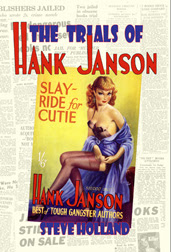
If you've read either The Mushroom Jungle or The Trials of Hank Janson, you'll perhaps recall that the earliest prosecutions against Americanised "gangster" fiction occurred in 1942 when authors Rene Raymond (James Hadley Chase) and Harold Kelly (Darcy Glinto) were both fined for novels published in the early years of the Second World War.
It's interesting to see the context in which these cases took place and worth quoting a paragraph from The Trials of Hank Janson which relates to prosecutions that took place in 1938-39.
A few months earlier, on 6 October 1941, the New Picture Press Ltd. of Arundel Street, Strand, were fined £200 with £21 costs at Reading for publishing improper issues of the magazine London Life.
The push against obscene material may have been the result of this case and two prosecutions in late 1941 which resulted in jail sentences. At West Riding Assizes, a 53-year-old man pleaded guilty to the indecent assault of four girls and three charges of sending indecent photographs through the post. He was sentenced to three years. It was noted during the case that the guilty man had a developed his obscene photographic business by contacting customers through a publication readily available on bookstalls.
A case was heard a week later at Sussex Assizes about a case of attempted buggery and indecent assault and of sending obscene prints through the post. This case resulted in a sentence of four years.
These two cases followed almost immediately the appearance of a League of Nations Annual Report published in Geneva on 14 November 1941 on activity relating to obscene publications. As mentioned above, almost all the instances of trafficking stopped by the Post Office involved material coming into the UK from abroad, mostly France but also America, Finland, Denmark and Sweden.
It seems plausible that this "perfect storm" of activity led to increased activity in 1942 and fines being issued against Road Floozie and Miss Callaghan Comes to Grief in March and May 1942, followed by the prosecution of authors and publishers at the Central Criminal Court in May.
An interesting coda to the above case involved Detective-sergeant Sidney Norman who said that "all books of this type would in future be seized by the police, wherever found." In fact, only a handful of court cases against booksellers followed that year, at least two involving the continued sale of the two prosecuted books.
It's interesting to see the context in which these cases took place and worth quoting a paragraph from The Trials of Hank Janson which relates to prosecutions that took place in 1938-39.
In the year ending June 30, 1939, only 40 offences of obscene publications were recorded in the United Kingdom, mostly destruction orders issued against magazines and photographs originating in the United States or France; in only 9 cases did the offending material originate in the UK. Between July 1939 and December 1940, the number of cases was down to 47, mostly (36 cases) involving publications from abroad.I've always thought that one of the reasons those particular novels—Miss Callaghan Comes to Grief by Chase and Road Floozie by Glinto—were targeted was their American settings; it seems likely that police constables gathering up American magazines for possible prosecution would have grabbed everything that looked similar.
A few months earlier, on 6 October 1941, the New Picture Press Ltd. of Arundel Street, Strand, were fined £200 with £21 costs at Reading for publishing improper issues of the magazine London Life.
The push against obscene material may have been the result of this case and two prosecutions in late 1941 which resulted in jail sentences. At West Riding Assizes, a 53-year-old man pleaded guilty to the indecent assault of four girls and three charges of sending indecent photographs through the post. He was sentenced to three years. It was noted during the case that the guilty man had a developed his obscene photographic business by contacting customers through a publication readily available on bookstalls.
A case was heard a week later at Sussex Assizes about a case of attempted buggery and indecent assault and of sending obscene prints through the post. This case resulted in a sentence of four years.
These two cases followed almost immediately the appearance of a League of Nations Annual Report published in Geneva on 14 November 1941 on activity relating to obscene publications. As mentioned above, almost all the instances of trafficking stopped by the Post Office involved material coming into the UK from abroad, mostly France but also America, Finland, Denmark and Sweden.
It seems plausible that this "perfect storm" of activity led to increased activity in 1942 and fines being issued against Road Floozie and Miss Callaghan Comes to Grief in March and May 1942, followed by the prosecution of authors and publishers at the Central Criminal Court in May.
An interesting coda to the above case involved Detective-sergeant Sidney Norman who said that "all books of this type would in future be seized by the police, wherever found." In fact, only a handful of court cases against booksellers followed that year, at least two involving the continued sale of the two prosecuted books.
Monday, July 13, 2015
Caught in the Act: convictions & imprisonment in the 1930s
An official government document on obscene publications reveals that there were a dozen cases between 1936 and 1957 where a conviction of imprisonment in excess of 18 months was awarded. Most of these were, as far as I'm aware, for obscene magazines and photographs, rather than books, but I'm planning to check out all twelve to see what information I can gather.
None made any great impact with the broadsheets, and only a couple caused more than a ripple in local papers, as far as I can find so far. This first, dating from 1936, generated only a single mention in one newspaper (The Citizen in Gloucester, 10 March 1936, which recorded a case heard on 7 March 1936 at Birmingham Quarter Sessions.
The same caveat applied to this second report from the 1930s which is brief and frustratingly lacking in detail.
None made any great impact with the broadsheets, and only a couple caused more than a ripple in local papers, as far as I can find so far. This first, dating from 1936, generated only a single mention in one newspaper (The Citizen in Gloucester, 10 March 1936, which recorded a case heard on 7 March 1936 at Birmingham Quarter Sessions.
I've found no further information on Moore, but Richard Conrad Kernick continued to live in the Bristol area and died in 1985. I haven't been able to find anything about the nature of the photographs and it's worth mentioning that something considered "grossly obscene" back in the mid-1930s may not be considered terribly "hard" today.CONSPIRACY UNMASKED
Sentence of nine months' hard labour was passed at Birmingham Sessions on Conrad Kernick (35), of Redland, Bristol, when he pleaded guilty to conspiracy in selling and publishing indecent photographs and books.
Kernick was charged jointly with a man named Howard Moore (41), of Sand Pits, Birmingham, who was sentenced to two years' hard labour.
Detective-Supt. Baguley, head of the Birmingham C.I.D., told the Recorder: "There can be no doubt that the arrest of these two men has brought to light one of the most extensive organisations for the manufacturing and circulating of grossly obscene photographs and books in this country; the master mind of the conspiracy being Moore."
The superintendent added that upwards of 210 persons whose names and addresses were found in the books of Moore and Kernick had been interviewed by the police. They were resident in all parts of England, Ireland, Wales and Scotland, and they included every walk of life—ministers of religion, schoolmasters, solicitors, librarians and civil servants.
"From many of these people," he said, "grossly obscene photographs and books have been recovered, all of which they obtained upon application to Moore, and they could have formed the subjects of many further charges."
The same caveat applied to this second report from the 1930s which is brief and frustratingly lacking in detail.
Pleading guilty at the Central Criminal Court yesterday to a charge of selling obscene literature, Edwin Henry Turvey (36), a salesman, was sentenced to two years' imprisonment.Notes from elsewhere reveal that Turvey was a wholesale bookseller and was sentenced "for publishing and selling an obscene book and photos". Turvey would later have a central role in the boom of paperbacks in the late 1940s.
Subscribe to:
Posts (Atom)
BEAR ALLEY BOOKS

Click on the above pic to visit our sister site Bear Alley Books