

Ron Turner was a private man—and his agent, Greg Hall, made sure nobody got to talk to him—and little was known about him for the decades that he was active—the 1950s through the 1970s—and it wasn't until John became his agent in the mid-1980s that snippets of information began to sneak out. For some years it was thought that his name was Roland Turner, which is how he signed one of his early book covers (Denis Gifford listed him as Rowland Turner in his British Comic Catalogue, just to confuse matters further).
Turner's life was at times joyful, at times tragic. He was born in Norwich but grew up in Southend-on-Sea, showing an early talent for drawing, stimulated by reading science fiction. His mother arranged an interview at Odhams, who took him on as a junior, which meant making tea, delivering art, and running errands. Eventually he was allowed to produce spot illustrations for Modern World and received his first commission for a spread featuring German aircraft in 1941. Unfortunately, one of the planes he depicted dropped a bomb on Odhams, destroying the building. Miraculously, the artwork survived the bombing, only to be turned into papier-mâché by rain.
After his own close call with German weaponry (he was shot in the leg whilst serving in Italy) led to him being "excused boots", Turner spent some time in the Far East, returning to Odhams in 1947. In 1948, he began drawing comic strips for Scion, which led to producing dozens of covers for that company's paperbacks, quickly establishing himself as the best SF cover artist of the paperbacks.
His technical background and interest in hardware meant that his covers had an authenticity to them that most lacked, even if it all came from Turner's imagination. Whether it was a comic strip drawn for the Tit-Bits Science Fiction Comics series, or the latest Vargo Statten or Volsted Gridban novel, Turner threw himself into creating futuristic images that dazzled the reader.
Success meant Turner could buy his dream car (a Jowett Jupiter Sports) and move out of the family home in Romford. Working on 'Space Ace' and 'Rick Random' kept him busy, as did marriage and a growing family in the late 1950s. However, Rick's adventures came to an end in 1959 and Turner turned to war strips to keep his career on track and even produced a sample SF strip for Buster which only now sees the light of day.
In the early 1960s, Turner was employed drawing paint-by-numbers guides for Craft Master, to the detriment of his comic strip output. That changed in 1965 when he began drawing Gerry Anderson tie-in strips and was then offered 'The Daleks'. He returned to Fleetway for 'The Robot Builders' but this lasted only six months and Turner found himself filling his time drawing for annuals and dot-to-dot books.

He was rescued from this drudgery by Bob Paynter, editor of Whizzer & Chips, who hired Ron to draw 'Wonder-Car'. Commissions for annuals and fill-ins kept Turner going until Tiger again came to the rescue with 'The Tigers', that ran for three years (1971-74). Whizzer & Chips and war libraries kept him busy until the call came from Pat Mills to draw 'The Robot Wars', a classic early Judge Dredd yarn. While Turner was able to adapt to the open panel style of 2000 AD (something he had developed in 'The Daleks', using bodies and machinery as panel borders and having Daleks burst out of the page), his was the gleaming utopian future he dreamt of in the years after WW2, not the grimy, grungy, overcrowded dystopian future of punk-era 2000 AD.
Thankfully he was offered 'The Spinball Slaves' in Action, which survived the transition to Battle-Action as 'The Spinball Wars'. Meanwhile, an attempt to revive 'Rick Random' at 2000 AD came to a grinding halt as Turner let the deadline for the final episode slip past and the editor had to turn to Carlos Ezquerra to draw the last few pages. Similarly, a potential line of work with Dr Who Weekly was lost when Turner chose 'Journey to the Stars' in Speed, letting down the editor of Who at the very last minute. The editors of Britain's two longest-running science fiction titles chose to never employ him again. DC Thomson took a similar attitude when Turner's agent prevaricated over Turner's brief work for Scoop, and decided not to offer him more work.
The arrival of 'New' Eagle in 1982 might have been perfect for Turner had his agent not nixed any notion of editor Barrie Tomlinson meeting with Turner in order to explain what precisely he wanted for the new Dan Dare strip. Gerry Embleton was hired instead. It was around this same time that Turner was divorced from his wife and moved to a small house on the Thames and then to a dilapidated houseboat on the river.
He was cajoled into accepting work on 'Action Force'. He argued that he would not be able to keep up the supply of four pages a week but was persuaded to take it on... and suffered an attack of angina as a result. Hall, too, was not well, and a stroke left him incapacitated and Turner, completely cut off from the industry, with no work. Not that Hall was solely to blame.... Turner himself could be temperamental and unpredictable, ignoring commissions where he didn't like the script and stopping work on a war story when he discovered that it had been written by a woman (probably Mary Feldwick).
Thankfully, by then John Lawrence had tracked down Turner to his houseboat and managed to introduce himself. This led to the final phase of Turner's career as John and Phil Harbottle kept Turner busy with their own stories (Nick Hazard, Kalgan the Golden), colour recreations of Turner's earlier book covers and a number of new commissions. There were also many disappointments over the next few years, many false starts and let downs; even Turner's houseboat was condemned as unsafe and he was forced back onto land.

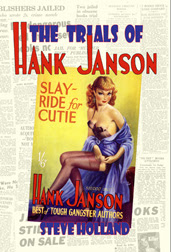
For a few years, Turner was the cover artist for dozens of reprint sf and crime novels published in America by Gary Lovesi's Gryphon Book (I arranged and introduced a couple of crime reprints for him and was very happy when copies turned up with Turner's fabulous covers). His finest work, however, was perhaps his return after thirty odd years to drawing a new Daleks strip for Doctor Who Magazine in 1997.
Turner was hospitalised after suffering a stroke the following year and a second stroke shortly after returning home proved fatal.
The book, of course, goes into far greater detail over its 384 pages. You'll learn the background of names like Vargo Statten and Rick Random, what Turner's reaction was to saving the life of a child, the blame game battle between artist and agent, and what he really thought of some of the strips he worked on. It's an astonishingly honest portrait of all involved. This is not a hagiography, but nor is it a a knife to the back. It honestly portrays the highs and lows of Turner's career and how the artist, as flawed a human as we all are, reacted to each turn of events. Forewords by his four children offer some deeply personal views and stories that help reveal Turner's character.
Like most, I'm also here for the art and you won't be disappointed. Having designed a book or two myself, I know it isn't always easy as you want to use the best quality artwork for your full-page pictures. This means they tend to be Turner's recreations of covers rather than the original covers themselves. That said, the cover reproductions are never more than four to a page, which means that they are still great to look at.
Comic strips, on the other hand, suffer a little depending on the size of the original. A Rick Random has legible text, but you might strain to read a page reproduced from Tiger.
I should add that the book covers are amazing. A lot of my Vargo Statten's have old tape marks and other defects which are beyond my Photoshopping skills. It speaks to the quality of the books that they have been read and re-read over a period of 75 years. To finally have the covers all in mint condition is a joy. In fact, the whole book is a joy from first page to last.
The Fantastic Art of Ron Turner by John Lawrence.
Telos Publishing ISBN 978-184583235-3, 15 March 2025, 384pp, £49.99. Available via Amazon.