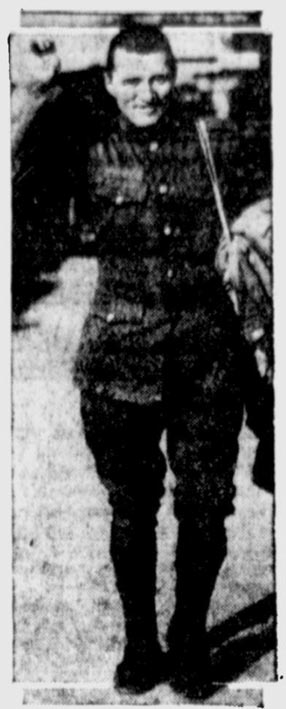


Across the border was the village of El Umtaiye. Between lay wheat-fields. The country was occupied by Syrians and Bedouins. They were all busy harvesting their crops. As we prest toward the frontier we attracted more and more attention from the Bedouins. They seemed friendly enough, and about 10 o'clock we stopt to talk to a group of them.John Harvey, Gilbert Clare (Bennett Jeffries Doty) and two others were deserting from the Foreign Legion and trying to reach British territory. They had only a single rifle between them and it was not long before they ran into trouble. Bedouin bandits. Doty's account above (from 'Doty's Wild Adventures in the Legion', The Literary Digest, 21 January 1928) reveals how the shooting awakens the local Caid of El Umtaiye who, accompanied by three young Bedouins, approach the deserters. Explaining that he was an English subject, he offers to take them with him to the village. Doty continues:
I had a premonition this was unwise. But as we hadn't had anything to eat since the night before, 1 was glad to stop and eat. They offered us food. While we were eating, Harvey questioned them about the best place to cross the border. We were told it was easier to get across at El Umtaiye than farther east, near the village of El Deir, which they said was occupied by a bad tribe.
Suddenly a mounted Bedouin carrying a Mauser rifle and loaded down with cartridge belts dashed up. John Harvey covered him with the carbine. The Bedouin reined in his horse, declaring he was a Christian and our friend. He dismounted and joined us. He talked friendly enough, but he was getting closer to Harvey's carbine. I was about to warn Harvey when the Bedouin snatched at tho gun with both hands, and wrested it away.
I jumped at him and wrenched the carbine from his hands. I leapt back, throwing the bolt to get a cartridge into the chamber. As I did so my foot struck a rock and I fell backward. At the same minute the Bedouin drew up his Mauser and let go at me. The fall saved my life.
I scrambled to my feet and fired at him, but he was zig-zagging across the field, shouting to the others as he ran. Rifles appeared from beneath the wheat sheaves, and the peaceful-appearing farmers opened upon us. We were hopelessly outnumbered, so we cut down the road toward the town as fast as we could go.
The Bedouins converged on us through the field, firing as they came. Down the road was another group of Bedouins shooting and gesticulating. They seemed to want to help us get away. When we came abreast of them they edged in, all talking at the same time and making signs to show their friendliness.
But they seemed too much interested in our rifle, so Harvey ordered them back. At that they drew their knives and attempted to rush us. Harvey slung the carbine to his shoulder and let one of them have it, catching him between the eyes. He fired again and hit the second in the midriff, and he fell kicking to the ground. This stopt the rush. We ran on toward El Umtaiye.
The next thing I knew, the Caid had Harvey's carbine. Harvey realizing we were trapt, fell upon him, and took the gun from him. At the same time, Bedouins appeared from every direction with rifles, knives, spears, and swords. I fought two who tackled me with knives. I used large stones for weapons. Lass and Weisser, the others in our party of deserters, had enough to do to take care of themselves.In Damascus in August 1926, Harvey and the others were court-martialed. Harvey and Doty were both given eight years in prison; the Germans (perhaps because they had not been armed) received sentences of only five years. The prisoners were dispatched from Damascus via Beirut and Marseilles to the prison at Clairvaux.
Harvey got the carbine clear and shot the Caid through the leg. We ran toward a village which lay on the railroad line, bullets singing around our ears. We were cut off from the right, the I left, and the rear. There was only one thing to do, go forward.
We retreated Legion fashion. Harvey kept them off with the rifle, while the rest of us ran. Then, when Harvey had caught up with us, another of us took the gun and covered the Bodouins while the others retreated. We held them off until we were almost outside the village walls, when our pursuers halted.
We were all in. We stopt by a tank, drank and rested. We decided to make another try for the border, going along the rail-road line. About 3 o'clock we started again and had gone 100 feet or so when out rode a Syrian gendarme and fired his pistol in the air. I knew then we were caught.
Harvey dropt the carbine and threw up his hands. The gendarme was very decent. He rode up to us. Behind him were a dozen Syrian gendarmes who had been in ambush behind the walls. The corporal rode up. Harvey gave him the gun, and our break for liberty was over.
Doty's account tallies with other accounts of the incidents surrounding the desertion and capture of John Harvey. In other accounts, Doty was in a company in the column of General Andreas on its way to Soueida [Al-Suwayda] when he had an altercation with a sergeant. Rather than accept the punishment that would be due, he decided to flee into the mountains. Their hiding place was spotted by airplanes as they attempted to head south towards Palestine and Jordan.
After fifteen months, Doty was released thanks to the efforts of his family and pressure from Washington. Back in Biloxi, he wrote an account of his adventures: The Legion of the Damned: The Adventures of Bennett J. Doty in the French Foreign Legion (New York, Century Co., 1928). He spent some time at university and passed the Mississippi bar in 1936. He disappeared in March 1938, supposedly heading off to fight in the Spanish Civil War.
Following Doty's release, questions were asked in the UK about the imprisonment of a British subject. Captain Arthur Evans, M.P., asked the Secretary of State for Foreign Affairs whether he would make any representations to the French authorities to effect a release. Mr. Locker-Lampson, in a statement in the House of Commons on 14 December 1927, responded that the French Government had given orders for Harvey's release as soon as the matter was brought to their notice.
Sir Eric Phipps, Minister to the British Embassy, presented a note to the French Minister of Foreign Affairs from the British Government thanking him for the actions of the French government the following day. After a few days, further questions were being asked in the House: was Harvey to be discharged completely or simply released from prison in order to resume his military service with the Legion? If it was a complete discharge, was there to be a payment of £500 to the French Government? Would he be returned to Africa?
At first it seemed that Harvey was to be transferred to the barracks at Troyes where he would learn which regiment of the Legion he would finish the terms of his service. He arrived on the evening of the 16th and was ordered to Marseilles; almost immediately – while Harvey was on the train – he was ordered back to Troyes and telephone messages sent down the line intercepted him at Dijon where he was held at the barracks of the 27th Infantry Regiment until his papers arrived.
Whilst in Dijon, a payment was made to have Harvey released, the payment representing a portion of the premium that soldiers were paid upon joining the Legion; it was paid back as Harvey had not completed his five years. Once this payment was made by a representative of the British Embassy, Harvey was released on 29 December 1927.
Harvey did not have his freedom for long. On 26 January 1928 he was arrested in London and charged the following day with deserting his wife and children. Harvey pleaded guilty and was ordered to repay the sum of £177 12s. 4d. to the Bedwellty Union. Since his return to the UK, Harvey had been writing a series of articles for a London newspaper which, he claimed, he shared the proceeds with another man who had fought his case for him, and had obtained an engagement at the Victoria Palace which paid him the considerable sum of £15 a week.
Sentenced to three months in prison, the sentence was suspended as long as he paid off the debt. He was allowed to pay in installments of £10 down and £7. 10s. a week, plus 10s. for the three children and £2 costs.
Harvey's book With the French Foreign Legion in Syria was published later that year and one suspects that Harvey was able to parley his notoriety into a steady income over the next few years. However, it would not last forever and, in 1932, a new series of books began appearing as by Ex-Legionnaire 1384. Copyright records establish that the ex-Legionnaire in question was John Henry Harvey, under which name Jones was now most commonly known. It was under this name that he married his second wife, Ellen Ada Carpenter, in 4Q 1932.
Harvey's life then appears to be relatively stable. Books appeared under the names Ex-Legionnaire 1384 and Operator 1384 – 21 books over the next eight years leading up to the Second World War. Many of them were co-written in collaboration with – or more likely entirely ghosted by – William James Blackledge, an author who seems to have specialised in ghosting Foreign Legion adventures and occasionally writing about the North-West frontier for variety. At least one of the Operator 1384 novels would appear to have been ghosted by Alfred Whatoff Allen (1888-1970), who also wrote a novel under his own name for Sampson Low.
It was not all plain sailing. John Henry Harvey once again made the papers in June 1937 when it was revealed at the Old Bailey that he had been living a bigamous life with his second wife. Married for five years, the couple had argued and Harvey had disclosed that he was already a married man. On 23 June 1937, he was sentenced to 12 months hard labour.
It seems likely that the two were divorced – The Times (23 January 1940) notes the decree nici between E. B. Jones (sic) and D. H. J. Jones was made absolute at the High Court of Justice.
Following his release from jail, on 29 August 1938, David Harvey John Jones legally changed his name by deed to David Harvey John Barrington. At the time he was living at 78 Sutherland Avenue, Maida Vale. He subsequently married (as David H. J. Barrington) Miss Betty I. Blair in Paddington, London, in 2Q 1942.
The last few books by Operator 1384, as Barrington now bylined himself for his books, appeared in the early years of the Second World War, the last in 1941. In December 1940, the recently renamed Barrington, of Howley Place, Paddington, then working as a billeting officer for the St. Pancras Borough Council, was remanded on bail at Clerkenwell Police Court for obtaining £15 by means of a forged billeting notice that he had cashed at a Post Office. Unfortunately, no further press reports of the case have been found.
It is easy to forget that, with such an adventurous life behind him, Barrington had still only just entered his forties. What happened to him following his marriage in 1942 is unknown. It is possible that the marriage did not last as the only records traced for Betty I. Blair are a birth (in 1919) and a second marriage, to Edward R. Day, in 4Q 1947. It is possible that a typo has crept into records and she is Betty Joan Blair (1919-1981).
Following his change of name and the potential embarrassment of police charging him with forgery, it may be that David Harvey John Barrington adopted yet another name in order to continue his career, although quite which career we may never know.
PUBLICATIONS
Books as John Harvey
With the French Foreign Legion in Syria. London, Hutchinson & Co., 1928. Greenhill, 1995
Books as Ex-Legionnaire 1384
Hell Hounds of France, in collaboration with W. J. Blackledge. London, 1932.
Zillah: Child of the Desert, with W. J. Blackledge. London, Sampson Low & Co., 1932.
With the Secret Service in Morocco, as told to W. J. Blackledge. London, 1934.
Legion of the Lost, in collaboration with Anton Lind. London, Sampson Low & Co., 1934.
The Soulless Legion, in collaboration with W. J. Blackledge. London, Denis Archer, 1934.
The Arab Patrol. London, Sampson Low & Co., 1935.
The Desert Patrol. London & Dublin, Mellifont Press, 1935.
Spies of the Sahara. London, Sampson Low & Co., 1936.
The Son of Allah. London, Rich & Cowan, Jan 1937.
The Mutiny of Fort Saada. London, Sampson Low & Co., 1937.
Eater of Women by W. J. Blackledge, in collaboration with Ex-Legionnaire 1384. London, T. Werner Laurie, 1938.
Books as Operator 1384
The Devil's Diplomats. London, Hutchinson & Co., Jun 1935.
The Catacombs of Death [ghosted by A. Whatoff Allen]. London, Hutchinson & Co., Jan 1936.
The White Tuareg, London, Rich & Cowan, Feb 1936.
The Scourge of the Desert. London, Rich & Cowan, Sep 1936.
Queen of the Riffs. London, John Long, 1937.
The Black Arab. London, Rich & Cowan, 1937.
Jackals of the Secret Service. London, Rich & Cowan, 1938.
The Last Outpost. London, Rich & Cowan, 1938.
Spies and Rebels. London, Rich & Cowan, 1939.
McCann of the Legion, London, Cassell & Co., Sep 1939.
McCann the Spy. London, Cassell & Co., Feb 1940.
McCann the Fighter. London, Cassell & Co., 1941.
McCann the Rebel. London, Cassell & Co., 1941.
Novels as John Barrington (series: Ken Williams in all)
Murder in White Pit. London, John Langdon, 1947.
The Moving Finger. London, John Langdon, 1947.