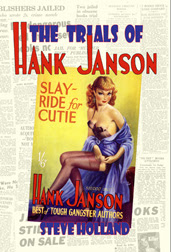
Clair Walter Huffaker was born in Magna, Utah, on 24 September 1926, the son of Clair Huffaker (1908-1960) and his wife Orlean Bird (1907-1965). Huffaker grew up in Salt Lake City He served in the Navy during World War II in the South Pacific and after the war became an Honours student at Princetown and then at Columbia University in New York. Before going on to study at several continental universities, Huffaker joined Time, Inc. and wrote for both Time and Life. After his return to New York he edited several magazines at one time before becoming a freelance writer.
Author of over 200 stories, numerous feature and magazine articles in pulp and men's adventure magazines. No less than seven of his novels were made into major motion pictures: Seven Ways from Sundown (1960 starring Audie Murphy), Flaming Star (1960 starring Elvis Presley), Posse from Hell (1960 starring Audie Murphy), Rio Conchos (1964 starring Stuart Whitman) and The War Wagon (1967), starring John Wayne. Huffaker also wrote two further John Wayne movies: The Comancheros (1961) and Hellfighters (1968); he also wrote the original screenplay Tarzan and the Valley of Gold (1966). Huffaker's later screenplays include One Hundred Rifles (1969), Flap (1970 starring Anthony Quinn), adapted from his later novel Nobody Loves a Drunken Indian (1967), The Deserter (1971) and Chino (1976).
Huffaker also wrote for television series such as Rawhide, The Virginian and Bonanza.
Clair was married twice: first to Winifred Dutton Moore in 1951, with whom he had a son, Lance Clark Huffaker (1952-1980); and secondly to Joyce Lousin Rainboldt in 1959. He died of an aneurysm in Los Angeles, California, on 2 April 1990, aged 63.
PUBLICATIONS
Rider from Thunder Mountain (Greenwich, Conn., Fawcett Publications/Crest Books 193, Nov 1957)
Frederick Muller/Gold Medal Books 358, 1959, 140pp.
Badge for a Gunfighter (Greenwich, Conn., Fawcett Publications, 1957)
Gold Medal Books 223, 1957, 126pp.
Futura 0860-07040-9, 1974, 126pp.
Badman (Greenwich, Conn., Fawcett Publications, 1957)
Gold Medal Books 225, 1958, 128pp.
as The War Wagon, Futura 0860-07037-9, 1975, 128pp, 30p.
Guns of Rio Conchos (Greenwich, Conn., Fawcett Publications/Gold Medal Books 733, Jan 1958)
Frederick Muller/Gold Medal Books 337, 1959, 142pp.
as Rio Conchos, Futura 0860-07038-7, 1975, 126pp.
Cowboy (adapted from the screenplay by Edmund H. North and Reminiscences of a Cowboy by Frank Harris, Greenwich, Conn., Fawcett Publications/Gold Medal Books 736, Jan 1958)
Gold Medal Books 271, 1958, 143pp.
Posse from Hell (Greenwich, Conn., Fawcett Publications, 1958)
Gold Medal Books 362, 1959, 137pp.
Futura 0860-07168-5, 1975, 124pp, 35p.
Flaming Lance (New York, Simon & Schuster, 1958; Greenwich, Conn., Fawcett Publications/Crest Books s421, 1960)
as Flaming Star, Futura 0860-07039-5, 1975, 126pp, 30p.
Seven Ways from Sundown (Greenwich, Conn., Fawcett Publications/Crest Books 398, 1960)
Futura 0860-07105-7, 1974, 124pp.
Sunday, May 19, 2013
Saturday, May 18, 2013
Norman Lee
Norman Lee was a popular writer of American style thrillers in the 1950s, whose work owed elements to Marlowe and – as the popularity of Fleming's character grew – James Bond. "Norman Lee’s style never varied from the loosely constructed homage he paid to the American writers," writes David Latta (in Sand on the Gumshoe). "While Lee was a lightweight novelist who now has little appeal, there was a crisp action and pace in his work that was refreshing for its time."
Norman Harold Lee was born in South Norwood, 1898, the son of John James Lee, a gardner, and Mary Lee. Lee grew up in Leatherhead, and served as a private with the East Surrey Royal Engineers during the latter months of the Great War, having joined for duty in June 1918. A keen writer, he had his first story published at the age of 12.
His date of birth is given as 10 October 1898 at the BFI website, which notes "Checked birth and dead (sic) at Family Records Centre, London." A check of birth records would reveal only the quarter/year of birth and where the birth was registered. On the latter subject, the entry says "Born in Croydon", but then lists the birthplace as Sutton, Surrey, whilst the birth was registered in Croydon, 3Q 1898. South Norwood, given as his place of birth in the 1911 census and in the Author's and Writer's Who's Who, is an urban district in the Borough of Croydon. The IMDb also lists his birth as 10 October 1898 in Sutton, Surrey.
Lee's military enlistment record gives Lee's date of birth as 2 September 1899 and that his occupation was Inspector. He was, at the time (1918) living in Main Street, Marathon, New York, and was single at the time. That this is the same Norman H. Lee is proven by the listed next of kin: his mother Mrs Mary Lee of Church Walk, Leatherhead, England. His medical report, which gives his age on 4 June 1918 as 19 years and 254 days, indicates that he was born in around 23 September 1898 (not 1899). Elsewhere, his age was given as 19 years 8 months when he enlisted, which encompasses both September and October 1898.
Lee reputedly spent most of the 1920s in South Africa where he became involved in the film industry. A preface in one of his books refers to travelling to Africa twice. "On the first time I went with a filming party to make De Vere Stacpoole's The Blue Lagoon." Hal Erickson's All Movie Guide notes: "Lee also kept busy in the theatre as a director and revue writer until his permanent return to England in 1928, when he signed with Elstree Studios."
Lee began writing and directing silent movies. One of his earliest films - uncredited - was as a writer on Alfred Hitchcock's The Farmer's Wife (1928). Lee then wrote and directed various documentaries – The Lure of the Atlantic (1929), The Streets of London (1929), The Night Patrol (1930), The Song of London (1930) – mostly concerned with life in London. It is mentioned in one of his later books that Lee also wrote pseudonymous articles in Daily Chronicle, Film Weekly and London Opinion in this (1929-30) period.
Lee founded one of the earliest independent companies to capitalise on sound in the cinema, although Lees Novelty Sound Films Ltd. produced only one film, The Lady of the Camellias Big Moments from Big Books (1930).
Lee then became involved in writing a number of comedies for British International, including My Wife's Family (1931), Money Talks (1932), Strip! Strip! Hooray!!! (a.k.a. Fun with the Sunbathers, 1932), The Pride of the Force (1933), Doctor's Orders (1934) and A Political Party (1934). Lee was also involved in writing and directing films featuring Jimmy Josser, a character created by actor Ernie Lotinga, including Dr. Josser K.C. (1931), Josser in the Army (1932), Josser Joins the Navy (1932) and Josser on the River (1932).
Lee directed comedies for the Fred Karno Film Company, Argyle Talking Pictures and others in the late 1930s – mostly comedies but also including the occasional thriller such as Bulldog Drummond at Bay (1937), Mr. Reeder in Room 13 (1938, based on Edgar Wallace), Murder in Soho (1939), Wanted by Scotland Yard (1939), The Door with Seven Locks (1940). During the war he was involved in a number of films featuring George Formby: Wouth American George (1941), He Snoops to Conquer (1944) and I Didn't Do It (1945).
After the war, Lee was less prolific, his directing/writing credits including The Monkey's Paw (1948), co-written with Barbara Toy, with whom he had earlier collaborated on the play Lifeline (1943, both employing the pen-name Norman Armstrong) and The Case of Charles Peace (1949). His last known movie credit was The Girl Who Couldn't Quite (1950), about a girl tought to smile by a tramp (played by Bill Owen).
In the war and immediate post-war years, with the film industry in a much reduced state, Lee took up the suggestion of his agent and turned to writing books for boys, his titles including Action on the Rolling Road and The Hoodoo Ship. His entry in 1948-49 edition of Author's and Writer's Who's Who notes that he has written "thrillers and adventure stories" and contributed to Theatre & Cinema and The Screen Writer (USA).
Lee turned to writing thrillers for adults after writing fiction for boys and non-fiction books about sailing and film directing. He adopted the names Raymond Armstrong and Mark Corrigan, the latter in particular becoming hugely popular with readers of crime thrillers. Corrigan was a private eye based in Philadelphia who took on assignments for the American Secret Service; he later worked for them regularly until the last three books in the 30-book series [in addition Corrigan was also credited with a children's book, The Green Chateau, and a non-fiction book] where he becomes a troubleshooter for a television corporation. For most of his career, Corrigan has a regular assistant in the shape of the small, delectable Tucker Mclean.
His assignments, both private and for U.S. Intelligence, take him around the world with adventures taking place in England, north Africa (Tangier, Casablanca, Egypt), France and Venice.
As Raymond Armstrong, writing for John Long, Lee penned a series of novels featuring Laura Scudamore, known as the Sinister Widow, and her ongoing battle with Chief Inspector Dick Mason.
In June 1954 a rather odd notice appeared in various Australian newspapers:
Hobart was also used as a byline for Blood on the Lake (1961) which featured an Adelaide insurance investigator named J. Earle Dixon. J. Earle Dixon then became the byline on the novel Killers in the Sun (1962). Curiously, the novel by J. Earle Dixon had the following biography about the author (who was also the lead character)
The 1962 Author's and Writer's Who's Who mentions Lee's use of the names Robert Armstrong and Mark Corrigan but not of Robertson Hobart or J. Earle Dixon. It is known that Lee also co-wrote a play as Norman Armstrong and it seems plausible that he used other pseudonyms, with suspicion falling on Norma Lee, whose byline appeared on four novels from T. Werner Laurie in 1953-54. Like Mark Corrigan (who was also published by T. Werner Laurie at that time), Norma Lee was both author and character, known as Norma "Nicky" Lee, the beautiful gunner.
Norman Lee died in Surbiton, Surrey, on 2 June 1964, aged 65.
PUBLICATIONS
Novels
The "Four Winds" Mystery. Dublin, J. J. McCann & Co., 1945.
Action on the Rolling Road, illus. S. Drigin. Oxford, Oxford University Press, 1945.
Deputy Wife. Dublin, J. J. McCann & Co., 1946.
The Hoodoo Ship, illus. A. E. Morley. London, Hollis & Carter, 1946.
Peril at Journey's End. Hounslow, William Foster, 1947.
The Terrified Village. A tale of the Kent and Sussex smugglers. London, Lutterworth Press, 1947.
Ship of Adventure. London, Charles Skilton, 1948.
The Ship of Missing Men, illus. Arnold Bond. Oxford, Oxford University Press, 1948.
The Legion of the Eagle. London, Lutterworth Press, 1948.
The Phantom Buccaneer. London, Lutterworth Press, 1949.
Johnny Carew, Youngest Agent in the Secret Service. London & Melbourne, Ward, Lock & Co., 1951.
Seaway to Adventure. London & Melbourne, Ward, Lock & Co., 1956.
Novels as Raymond Armstrong (series: Insp. Dick Mason; Laura Scudamore; J. Rockingham Stone)
Dangerous Limelight (Mason). London, John Long, 1947.
Sinister Playhouse (Mason). London, John Long, 1949.
The Sinister Widow (Scudamore). London, John Long, 1951.
They Couldn't Go Wrong. London, John Long, 1951.
The Sinister Widow Again (Scudamore, Mason). London, John Long, 1952.
The Sinister Widow Returns (Scudamore, Mason). London, John Long, 1953.
Midnight Cavalier (Stone). London, John Long, 1954.
Cavalier of the Night (Stone). London, John Long, 1956.
The Widow and the Cavalier (Scudamore, Mason, Stone). London, John Long, 1956.
The Sinister Widow Comes Back (Scudamore Mason, Stone). London, John Long, 1957.
The Sinister Widow Down Under (Scudamore, Mason). London, John Long, 1958.
The Sinister Widow at Sea (Scudamore, Mason). London, John Long, 1959.
Murder of a Marriage. London, John Long, 1960.
Novels as Mark Corrigan (series: Mark Corrigan in all)
Bullets and Brown Eyes. London, T. Werner Laurie, 1948.
The Green Chateau. London, Lutterworth Press, 1949.
Sinner Takes All. London, T. Werner Laurie, 1949.
The Golden Angel. London, T. Werner Laurie, 1950.
Lovely Lady. London, T. Werner Laurie, 1950.
The Wayward Blonde. London, T. Werner Laurie, 1950.
Madame Sly. London, T. Werner Laurie, 1951.
Shanghai Jezebel. London, T. Werner Laurie, 1951.
Baby Face. London, T. Werner Laurie, 1952.
Lady of China Street. London, T. Werner Laurie, 1952.
All Brides are Beautiful. London, T. Werner Laurie, 1953.
Sweet and Deadly. London, T. Werner Laurie, 1953.
I Like Danger. London, T. Werner Laurie, 1954.
Love for Sale. London, T. Werner Laurie, 1954.
The Naked Lady. London, T. Werner Laurie, 1954.
The Big Squeeze. London, Angus & Robertson, 1955.
Madam and Eve. London, T. Werner Laurie, 1955.
Big Boys Don't Cry. London, Angus & Robertson, 1956.
Sydney for Sin. London, Angus & Robertson, 1956.
The Cruel Lady. London, Angus & Robertson, 1957.
Dumb as they Come. London, Angus & Robertson, 1957.
Honolulu Snatch. London, Angus & Robertson, 1958.
Menace in Siam. London, Angus & Robertson, 1958.
The Girl from Moscow. London, Angus & Robertson, 1959.
Singapore Downbeat. London, Angus & Robertson, 1959.
Lady from Tokyo. London, Angus & Robertson, 1960.
Sin of Hong Kong. London, Angus & Robertson, 1960.
Danger's Green Eyes. London, Angus & Robertson, 1962.
Riddle of Double Island. London, Angus & Robertson, 1962.
Why Do Women...? London, Angus & Robertson, 1963.
Riddle of the Spanish Circus. London, Angus & Robertson, 1964.
Novels as J. Earle Dixon
Killers in the Sun. London & New York, Abelard-Schuman, 1960.
Novels as Robertson Hobart (series: Insp. Grant Vickary)
Case of the Shaven Blonde (Vickary). London, Robert Hale, 1959.
Dangerous Cargoes (Vickary). London, Robert Hale, 1960.
Blood on the Lake. London, Robert Hale, 1961.
Death of a Love. London, Robert Hale, 1961.
Non-fiction
Money for Film Stories, with a foreword by Sydney A. Moseley. London, Sir I. Pitman & Sons, 1937.
A Film is Born. London, Jordan & Sons, 1945.
Landlubber's Log: 25,000 Miles with the Merchant Navy. London, Quality Press, 1945.
Amateur Dramatics, with decorations by Kris. London, Oxford University Press, 1947.
I Want to go to Sea: Careers in the British Merchant Service. London, Jordan & Sons, 1947.
My Personal Log of Stars (mostly glamorous) people (famous and infamous) and places (of the world). London, Quality Press, 1947.
Log of a Film Director. London, Quality Press, 1949.
Non-fiction as Mark Corrigan
Australian Adventure. London, Robert Hale, 1960.
Plays
Lifeline: a play of the Merchant Navy in three acts (with Barbara Toy both as by Norman Armstrong; produced 30 November 1942). London, Samuel French, 1943.
?Novels as Norma Lee (ascription uncertain; series: Norma "Nicky" Lee)
The Beautiful Gunner. London, T. Werner Laurie, 1953.
Lover—Say It with Mink!. London, T. Werner Laurie, 1953.
Another Woman's Man. London, T. Werner Laurie, 1954.
The Broadway Jungle. London, T. Werner Laurie, 1954.
Norman Harold Lee was born in South Norwood, 1898, the son of John James Lee, a gardner, and Mary Lee. Lee grew up in Leatherhead, and served as a private with the East Surrey Royal Engineers during the latter months of the Great War, having joined for duty in June 1918. A keen writer, he had his first story published at the age of 12.
His date of birth is given as 10 October 1898 at the BFI website, which notes "Checked birth and dead (sic) at Family Records Centre, London." A check of birth records would reveal only the quarter/year of birth and where the birth was registered. On the latter subject, the entry says "Born in Croydon", but then lists the birthplace as Sutton, Surrey, whilst the birth was registered in Croydon, 3Q 1898. South Norwood, given as his place of birth in the 1911 census and in the Author's and Writer's Who's Who, is an urban district in the Borough of Croydon. The IMDb also lists his birth as 10 October 1898 in Sutton, Surrey.
Lee's military enlistment record gives Lee's date of birth as 2 September 1899 and that his occupation was Inspector. He was, at the time (1918) living in Main Street, Marathon, New York, and was single at the time. That this is the same Norman H. Lee is proven by the listed next of kin: his mother Mrs Mary Lee of Church Walk, Leatherhead, England. His medical report, which gives his age on 4 June 1918 as 19 years and 254 days, indicates that he was born in around 23 September 1898 (not 1899). Elsewhere, his age was given as 19 years 8 months when he enlisted, which encompasses both September and October 1898.
Lee reputedly spent most of the 1920s in South Africa where he became involved in the film industry. A preface in one of his books refers to travelling to Africa twice. "On the first time I went with a filming party to make De Vere Stacpoole's The Blue Lagoon." Hal Erickson's All Movie Guide notes: "Lee also kept busy in the theatre as a director and revue writer until his permanent return to England in 1928, when he signed with Elstree Studios."
Lee began writing and directing silent movies. One of his earliest films - uncredited - was as a writer on Alfred Hitchcock's The Farmer's Wife (1928). Lee then wrote and directed various documentaries – The Lure of the Atlantic (1929), The Streets of London (1929), The Night Patrol (1930), The Song of London (1930) – mostly concerned with life in London. It is mentioned in one of his later books that Lee also wrote pseudonymous articles in Daily Chronicle, Film Weekly and London Opinion in this (1929-30) period.
Lee founded one of the earliest independent companies to capitalise on sound in the cinema, although Lees Novelty Sound Films Ltd. produced only one film, The Lady of the Camellias Big Moments from Big Books (1930).
Lee then became involved in writing a number of comedies for British International, including My Wife's Family (1931), Money Talks (1932), Strip! Strip! Hooray!!! (a.k.a. Fun with the Sunbathers, 1932), The Pride of the Force (1933), Doctor's Orders (1934) and A Political Party (1934). Lee was also involved in writing and directing films featuring Jimmy Josser, a character created by actor Ernie Lotinga, including Dr. Josser K.C. (1931), Josser in the Army (1932), Josser Joins the Navy (1932) and Josser on the River (1932).
Lee directed comedies for the Fred Karno Film Company, Argyle Talking Pictures and others in the late 1930s – mostly comedies but also including the occasional thriller such as Bulldog Drummond at Bay (1937), Mr. Reeder in Room 13 (1938, based on Edgar Wallace), Murder in Soho (1939), Wanted by Scotland Yard (1939), The Door with Seven Locks (1940). During the war he was involved in a number of films featuring George Formby: Wouth American George (1941), He Snoops to Conquer (1944) and I Didn't Do It (1945).
After the war, Lee was less prolific, his directing/writing credits including The Monkey's Paw (1948), co-written with Barbara Toy, with whom he had earlier collaborated on the play Lifeline (1943, both employing the pen-name Norman Armstrong) and The Case of Charles Peace (1949). His last known movie credit was The Girl Who Couldn't Quite (1950), about a girl tought to smile by a tramp (played by Bill Owen).
In the war and immediate post-war years, with the film industry in a much reduced state, Lee took up the suggestion of his agent and turned to writing books for boys, his titles including Action on the Rolling Road and The Hoodoo Ship. His entry in 1948-49 edition of Author's and Writer's Who's Who notes that he has written "thrillers and adventure stories" and contributed to Theatre & Cinema and The Screen Writer (USA).
Lee turned to writing thrillers for adults after writing fiction for boys and non-fiction books about sailing and film directing. He adopted the names Raymond Armstrong and Mark Corrigan, the latter in particular becoming hugely popular with readers of crime thrillers. Corrigan was a private eye based in Philadelphia who took on assignments for the American Secret Service; he later worked for them regularly until the last three books in the 30-book series [in addition Corrigan was also credited with a children's book, The Green Chateau, and a non-fiction book] where he becomes a troubleshooter for a television corporation. For most of his career, Corrigan has a regular assistant in the shape of the small, delectable Tucker Mclean.
His assignments, both private and for U.S. Intelligence, take him around the world with adventures taking place in England, north Africa (Tangier, Casablanca, Egypt), France and Venice.
As Raymond Armstrong, writing for John Long, Lee penned a series of novels featuring Laura Scudamore, known as the Sinister Widow, and her ongoing battle with Chief Inspector Dick Mason.
In June 1954 a rather odd notice appeared in various Australian newspapers:
MELBOURNE. June 1 – British author Norman Lee, who has written 36 novels since 1943, has arrived in Australia "to write four or five more."Lee stayed in Australia for some time, writing up his escapades as Australian Adventure (by Mark Corrigan). Australia also became the setting for many of his books over the next few years: The Big Squeeze, Big Boys Don't Cry, Sydney for Sin, The Cruel Lady (all by Mark Corrigan), The Sinister Widow Down Under (by Richard Armstrong) and the two investigations of Inspector Grant Vickary, The Case of the Shaven Blonde and Dangerous Cargos, under the byline Robertson Hobart.
Mr. Lee, who came in the Strathnayer, said that British readers were tremendously interested in novels with an Australian background.
Neville Shute's novels about Australia had been a great success in England.
Hobart was also used as a byline for Blood on the Lake (1961) which featured an Adelaide insurance investigator named J. Earle Dixon. J. Earle Dixon then became the byline on the novel Killers in the Sun (1962). Curiously, the novel by J. Earle Dixon had the following biography about the author (who was also the lead character)
The author of Killers in the Sun is an Australian who made up his mind at an early age to see the rest of the world first. He has travelled since he was fifteen; has been twice round the world and, since he was twenty, has each year visited at least one foreign country. J.E.D. lives on the Blue Mountain ridge, near Katoomba, where exists, he says, one of the most exciting views in New South Wales.Whether this claim of three wives also related to Lee is unknown. At that time the entry for Author's and Writer's Who's Who was being compiled, around 1947-48, Lee was married to Bobbie Hunter and had three sons. I haven't been able to trace a marriage between a Norman H. Lee and anyone called Hunter. It may be that the name was a nom-de-theatre. It is possible that Lee married three times and that one marriage was to Rita M. Booker in Surrey in 4Q 1949.
J. Earle Dixon writes of insurance because he knows it; he began his working career with a South African insurance concern in his youth. He has been married three times but isn't working at it now; he claims women are unpredictable and unreliable.
He has two paramount desires: to direct films and write for the Saturday Evening Post.
The 1962 Author's and Writer's Who's Who mentions Lee's use of the names Robert Armstrong and Mark Corrigan but not of Robertson Hobart or J. Earle Dixon. It is known that Lee also co-wrote a play as Norman Armstrong and it seems plausible that he used other pseudonyms, with suspicion falling on Norma Lee, whose byline appeared on four novels from T. Werner Laurie in 1953-54. Like Mark Corrigan (who was also published by T. Werner Laurie at that time), Norma Lee was both author and character, known as Norma "Nicky" Lee, the beautiful gunner.
Norman Lee died in Surbiton, Surrey, on 2 June 1964, aged 65.
PUBLICATIONS
Novels
The "Four Winds" Mystery. Dublin, J. J. McCann & Co., 1945.
Action on the Rolling Road, illus. S. Drigin. Oxford, Oxford University Press, 1945.
Deputy Wife. Dublin, J. J. McCann & Co., 1946.
The Hoodoo Ship, illus. A. E. Morley. London, Hollis & Carter, 1946.
Peril at Journey's End. Hounslow, William Foster, 1947.
The Terrified Village. A tale of the Kent and Sussex smugglers. London, Lutterworth Press, 1947.
Ship of Adventure. London, Charles Skilton, 1948.
The Ship of Missing Men, illus. Arnold Bond. Oxford, Oxford University Press, 1948.
The Legion of the Eagle. London, Lutterworth Press, 1948.
The Phantom Buccaneer. London, Lutterworth Press, 1949.
Johnny Carew, Youngest Agent in the Secret Service. London & Melbourne, Ward, Lock & Co., 1951.
Seaway to Adventure. London & Melbourne, Ward, Lock & Co., 1956.
Novels as Raymond Armstrong (series: Insp. Dick Mason; Laura Scudamore; J. Rockingham Stone)
Dangerous Limelight (Mason). London, John Long, 1947.
Sinister Playhouse (Mason). London, John Long, 1949.
The Sinister Widow (Scudamore). London, John Long, 1951.
They Couldn't Go Wrong. London, John Long, 1951.
The Sinister Widow Again (Scudamore, Mason). London, John Long, 1952.
The Sinister Widow Returns (Scudamore, Mason). London, John Long, 1953.
Midnight Cavalier (Stone). London, John Long, 1954.
Cavalier of the Night (Stone). London, John Long, 1956.
The Widow and the Cavalier (Scudamore, Mason, Stone). London, John Long, 1956.
The Sinister Widow Comes Back (Scudamore Mason, Stone). London, John Long, 1957.
The Sinister Widow Down Under (Scudamore, Mason). London, John Long, 1958.
The Sinister Widow at Sea (Scudamore, Mason). London, John Long, 1959.
Murder of a Marriage. London, John Long, 1960.
Novels as Mark Corrigan (series: Mark Corrigan in all)
Bullets and Brown Eyes. London, T. Werner Laurie, 1948.
The Green Chateau. London, Lutterworth Press, 1949.
Sinner Takes All. London, T. Werner Laurie, 1949.
The Golden Angel. London, T. Werner Laurie, 1950.
Lovely Lady. London, T. Werner Laurie, 1950.
The Wayward Blonde. London, T. Werner Laurie, 1950.
Madame Sly. London, T. Werner Laurie, 1951.
Shanghai Jezebel. London, T. Werner Laurie, 1951.
Baby Face. London, T. Werner Laurie, 1952.
Lady of China Street. London, T. Werner Laurie, 1952.
All Brides are Beautiful. London, T. Werner Laurie, 1953.
Sweet and Deadly. London, T. Werner Laurie, 1953.
I Like Danger. London, T. Werner Laurie, 1954.
Love for Sale. London, T. Werner Laurie, 1954.
The Naked Lady. London, T. Werner Laurie, 1954.
The Big Squeeze. London, Angus & Robertson, 1955.
Madam and Eve. London, T. Werner Laurie, 1955.
Big Boys Don't Cry. London, Angus & Robertson, 1956.
Sydney for Sin. London, Angus & Robertson, 1956.
The Cruel Lady. London, Angus & Robertson, 1957.
Dumb as they Come. London, Angus & Robertson, 1957.
Honolulu Snatch. London, Angus & Robertson, 1958.
Menace in Siam. London, Angus & Robertson, 1958.
The Girl from Moscow. London, Angus & Robertson, 1959.
Singapore Downbeat. London, Angus & Robertson, 1959.
Lady from Tokyo. London, Angus & Robertson, 1960.
Sin of Hong Kong. London, Angus & Robertson, 1960.
Danger's Green Eyes. London, Angus & Robertson, 1962.
Riddle of Double Island. London, Angus & Robertson, 1962.
Why Do Women...? London, Angus & Robertson, 1963.
Riddle of the Spanish Circus. London, Angus & Robertson, 1964.
Novels as J. Earle Dixon
Killers in the Sun. London & New York, Abelard-Schuman, 1960.
Novels as Robertson Hobart (series: Insp. Grant Vickary)
Case of the Shaven Blonde (Vickary). London, Robert Hale, 1959.
Dangerous Cargoes (Vickary). London, Robert Hale, 1960.
Blood on the Lake. London, Robert Hale, 1961.
Death of a Love. London, Robert Hale, 1961.
Non-fiction
Money for Film Stories, with a foreword by Sydney A. Moseley. London, Sir I. Pitman & Sons, 1937.
A Film is Born. London, Jordan & Sons, 1945.
Landlubber's Log: 25,000 Miles with the Merchant Navy. London, Quality Press, 1945.
Amateur Dramatics, with decorations by Kris. London, Oxford University Press, 1947.
I Want to go to Sea: Careers in the British Merchant Service. London, Jordan & Sons, 1947.
My Personal Log of Stars (mostly glamorous) people (famous and infamous) and places (of the world). London, Quality Press, 1947.
Log of a Film Director. London, Quality Press, 1949.
Non-fiction as Mark Corrigan
Australian Adventure. London, Robert Hale, 1960.
Plays
Lifeline: a play of the Merchant Navy in three acts (with Barbara Toy both as by Norman Armstrong; produced 30 November 1942). London, Samuel French, 1943.
?Novels as Norma Lee (ascription uncertain; series: Norma "Nicky" Lee)
The Beautiful Gunner. London, T. Werner Laurie, 1953.
Lover—Say It with Mink!. London, T. Werner Laurie, 1953.
Another Woman's Man. London, T. Werner Laurie, 1954.
The Broadway Jungle. London, T. Werner Laurie, 1954.
Labels:
Author
Friday, May 17, 2013
Comic Cuts - 17 May 2013
Science fiction art is even more difficult to define unless the obvious tropes of science fiction are included. But it is more than "the thing that illustrates science fiction." It is about turning the mind's eye on the world and letting it take you places that you think can barely be imagined. Thankfully, there are dreamers out there who can imagine the most exotic dreams of all; who see not only this world, but what this world could be, and can turn that spark of an idea in their mind's eye into reality, whether it's in the shape of a toy, or an image on paper, digital canvas, or celluloid.
These dreamers have drawn from the well of science fiction (and it is a very deep well) to bring us – the readers, the viewers, the players – some of the most startling, imaginative, visionary art ever conceived and created...
Science fiction art and design has played an important role in the perception of science fiction among the wider world of non-SF fans, for both good and bad. In the world of Blade Runner, nobody questions the visual futurism of the movie (the crowded, neon lit streets, outsized floating advertising, etc.) or the functionality of flying cars, leaving the viewer free to concentrate on the important questions the movie raises about what it means to be human.
At the other end of the scale, science fiction has been dismissed as nothing more than "that crazy Buck Rogers stuff," referring to the popular comic strip that ran for over 50 years in hundreds of newspapers. While Buck Rogers is used as a term of derision by critics, at what point does it become fine art? Roy Lichtenstein's painting Emeralds – an oversized version of a 1961 Buck Rogers panel by George Tuska – sold in 1999 for $1.6 million, so the answer could be as simple as "two feet wide or more."
Extract from the Introduction to Sci-Fi Art: A Graphic History (2009)
I thought I'd begin with the above extract today because it touches on a subject that is in the news at the moment. Roy Lichtenstein. The premise that making something big can turn it into fine art doesn't apply only to science fiction. When I wrote that the definition of fine art was "two feet wide or more" it wasn't an original notion, although I did check on the size of the painting with someone who knew Lichtenstein's work before I came up with that "two feet" figure.
The idea that Lichtenstein has just made things bigger isn't new. At least as early as 1963, Douglas McClellan said "Lichtenstein has seemingly rearranged nothing, he has stayed reverently close to the originals except for greatly enlarging the scale." McClellan clearly despised comics, calling them a "cripple for a target" and a "ritual art form, it is merely one of the ways we have found to turn absolutely anything into entertainment." "The world of human happenings is comfortably simplified by flaccid drawing," he continues. "The only dimension is conveyed by mechanical dots, and life is represented by triumphant balloons of platitudinous speech rising from the mouths of the characters. It is like shooting fish in a barrel to parody a thing that has so long parodied itself."
Someone who had a little more time for comics was Irv Novick as the comic industry provided him with a small but steady income for over fifty years. Working day in and day out, I'm pretty sure Novick didn't look down each morning at a blank sheet of art board and say, "Let's see what cripple my flaccid drawing can conjure up today." And, at the end of the day, with his flaccid drawing in front of him managing to look not even like a cripple, but only like the parody of a cripple, would Novick mumble, "Well, at least the mechanical dots will give my flaccid drawing a dimension."
If only he'd thought of drawing a bit bigger. Instead of a tiny little "Whaam!" in the pages of All-American Men at War #89, he could have taken his original (flaccid) drawing, stripping it of context and redrawn it ... bigger! The drawing wouldn't have to be as good – almost as if it's a parody of a parody of a cripple – but you can measure quality by size, as fine art has proven time and time again. I refer you, sir, to the two foot rule.
Novick had encountered Lichtenstein during World War II, later recalling that he had found the young artist on his bunk weeping and complaining about the menial work he had to do. Novick got him a better job. Lichtenstein had shown him some of his artwork – "rather poor and academic," was Novick's opinion. "Later on, one of the first things he started copying was my work. He didn’t come into his own, doing things that were worthwhile, until he started doing things that were less academic than that. He was just making large copies of the cartoons I had drawn and painting them."
And I think everyone would have admired him if Lichtenstein had just produced the one painting.We might be able to admire the transforming effect of turning a tiny panel into something huge. But he did it without crediting the original source. And he did it again. And again. And again. And again.
Isn't this appropriation getting a little too much?
And he did it again. And again. And again. And again.
This can't be right, surely?
And he did it again. And again. And again. And again.
No credit to the original artists or the original comics?
And he did it again. And again. And again. And again.
At what point does being inspired by an image become theft?
And he did it again. And again. And again. And again.
Seriously: at what point does redrawing other people artwork and selling it as your own become theft?
And he did it again. And again. And again. And again.
Celebrate Lichtenstein all you want ... but if you do, the least you can do is put the original panels next to his artwork. David Barsalou's wonderful Deconstructing Lichtenstein website identifies not a few, not a handful, but dozens of example for you.
Panel Borders has broadcast (and you can now download an mp3) a pair of presentations by Richard Reynolds FRSA and graphic designer Rian Hughes given at the 2013 Spring Comiket, Central St Martin's School of Art. Reynolds looks at the influences that various works of fine art have had on comic books over the last hundred years while Hughes explores the many comic book panels that Roy Lichtenstein used in creating his works of art.
And as of yesterday (May 16) you can visit Image Duplicator, an exhibition of artwork at Orbital Comics (8 Great Newport Street, London WC2H 7JA) including works by Dave Gibbons, Howard Chaykin, Garry Leach, Carl Flint, Shaky Kane, David Leach, Betty Boolean, Salgood Sam, Jason Atomic, Mark Blamire and others. You can see a preview here. More information on the background of the exhibition can be found here along with more examples of artwork.
Prints of artwork will be available from Print-Process, with profits going to Hero Initiative. The exhibition runs until Friday, 31 May.
Labels:
Comics News
Thursday, May 16, 2013
Wednesday, May 15, 2013
Tuesday, May 14, 2013
Monday, May 13, 2013
Sunday, May 12, 2013
Saturday, May 11, 2013
P. Russell Mallinson
For years, P. Russell Mallinson has been a mystery that's had me mystified (there's one for long-time readers!). Although I had managed to glean a certain amount of information about him over the years, the most basic information – his year of birth and year of death – eluded me.
The name first came to my notice in Lofts & Adley's The Men Behind Boys Fiction where "R. Russell Mallinson" was described as a pen-name of Russell Stannard. Mystery solved, one would think. Unfortunately, no.
Herbert Russell Stannard (1888-1962) wrote an autobiography and it is possible to prove beyond all doubt that Stannard and Mallinson are different people. Although both Stannard and Mallinson were pilots in the days of stick and string, Stannard was rejected from serving in World War I because he was blind in one eye and spent the war reporting on naval movements from an office in Harwich. Mallinson, as we shall see, served with the R.F.C. and R.A.F. There were other parallels: both wrote boys' stories in the 1920s and both lived for a while in Norwich, Norfolk, but they were not the same author.
P. Russell Mallinson was born Percy Wilfred Mallinson in Wandsworth in March 1891, the son of John Mallinson, a solicitor's clerk. John Mallinson had been born in Masbrough, a suburb of Rotherham, Yorkshire, in 1860, but was living in Wandsworth, London, by 1886 when he married Mary Ann Coombe. The Mallinsons had two children: Ethel Maud, born in 1887, and Percy Wilfred, born in 1891. Percy was baptised at St. Michael's, Battersea , on 19 April.
Mallinson grew up in Wandsworth and at the time of the 1911 census – still living with his parents at 13 The Grove, Wandsworth – was working as a journalist. He served as a 2nd Lieutenant with the 10th Bedfordshire Regiment before earning his Aviators' Certificate on 17 July 1916 at the Military School, Catterick Bridge, and subsequently transferred to the R.F.C. as a Temp. 2nd Lieutenant on 4 August 1916. He was promoted to Lieutenant in 1917 and, following the end of the conflict, was transferred to the 'unemployed list' on 18 July 1919.
His military service was performed under the name Percy Russell Mallinson, but it is possible to link Percy Russell and Percy Wifred through his home address (P. Russell gives 13 The Grove as his home address in 1916) and the 1918 absent voters list which notes that Percy Wilfred is a Lieut. in the R.F.C. Percy Wilfred returns to The Grove in 1918-22 and then disappears from the London Electoral Roll.
In 1922, Percy Russell Mallinson married Constance M. Bird. By then he was working for Odhams Press where he was almost certainly the editor of Film Fiction, a magazine that ran to a single issue in August 1921 and contained at least three stories by Mallinson, including the first episode of a serial, 'Pirate Gold'. He was then editor of Boys' Pictorial which ran for 24 issues in 1921-22 before evolving into Sports Pictorial, which lasted a further 10 issues. It seems possible that he turned freelance in 1922 as, soon after, he could be found writing for papers published by C. Arthur Pearson, Edward Hulton and the Amalgamated Press. For at least the period 1923-26, he was living at 55 Rutland Park Mansions, Willesdon. In the mid-1930s it would appear he moved to 23 Earlham Road, Norwich, Norfolk [fl. 1935-36] before moving back to London, living at 21 Hamilton Terrace, N.W.8 in 1937-43.
In 1941, Mallinson was commissioned as a Pilot Officer and promoted from Flight Officer to Flight Lieutenant in 1945. In 1954 it was announced that, whilst relinquishing his commission, he had been granted permission to retain his rank as a Fl. Lieut.
It is known that Mallinson wrote prolifically under pen-names and the majority of his work remains untraced. Only one novel appeared under his own name, War on Wings from cheap paperback outfit Mellifont Press – a reprint of a story serialised in Boys' Magazine in 1927 which was also published as Wings o' War in the Boy's Friend Library (#2/179, Feb 1929).
In the 1930s, Mallinson was writing a number of flying stories for Flyers (an American pulp) and was a regular author in Air Stories between 1936 and 1939.
Immediately after the war there appeared a string of short (usually 48-page) pocket library novelettes written for Popular Fiction. According to Barrington Gray, whose father was the manager of Popular Fiction, Mallinson was a regular writer for his father's earlier publishing companies (Gramol) and may have written novels under many other bylines. His known pen-names include Michael Burke, Sinclair Russell, Dawn Tempest, Cynthia Russell and, possibly, Richard Russell.
According to Gray, Mallinson lived in Ireland, which may explain why no record of his death has been found.
.
The name first came to my notice in Lofts & Adley's The Men Behind Boys Fiction where "R. Russell Mallinson" was described as a pen-name of Russell Stannard. Mystery solved, one would think. Unfortunately, no.
Herbert Russell Stannard (1888-1962) wrote an autobiography and it is possible to prove beyond all doubt that Stannard and Mallinson are different people. Although both Stannard and Mallinson were pilots in the days of stick and string, Stannard was rejected from serving in World War I because he was blind in one eye and spent the war reporting on naval movements from an office in Harwich. Mallinson, as we shall see, served with the R.F.C. and R.A.F. There were other parallels: both wrote boys' stories in the 1920s and both lived for a while in Norwich, Norfolk, but they were not the same author.
P. Russell Mallinson was born Percy Wilfred Mallinson in Wandsworth in March 1891, the son of John Mallinson, a solicitor's clerk. John Mallinson had been born in Masbrough, a suburb of Rotherham, Yorkshire, in 1860, but was living in Wandsworth, London, by 1886 when he married Mary Ann Coombe. The Mallinsons had two children: Ethel Maud, born in 1887, and Percy Wilfred, born in 1891. Percy was baptised at St. Michael's, Battersea , on 19 April.
Mallinson grew up in Wandsworth and at the time of the 1911 census – still living with his parents at 13 The Grove, Wandsworth – was working as a journalist. He served as a 2nd Lieutenant with the 10th Bedfordshire Regiment before earning his Aviators' Certificate on 17 July 1916 at the Military School, Catterick Bridge, and subsequently transferred to the R.F.C. as a Temp. 2nd Lieutenant on 4 August 1916. He was promoted to Lieutenant in 1917 and, following the end of the conflict, was transferred to the 'unemployed list' on 18 July 1919.
His military service was performed under the name Percy Russell Mallinson, but it is possible to link Percy Russell and Percy Wifred through his home address (P. Russell gives 13 The Grove as his home address in 1916) and the 1918 absent voters list which notes that Percy Wilfred is a Lieut. in the R.F.C. Percy Wilfred returns to The Grove in 1918-22 and then disappears from the London Electoral Roll.
In 1922, Percy Russell Mallinson married Constance M. Bird. By then he was working for Odhams Press where he was almost certainly the editor of Film Fiction, a magazine that ran to a single issue in August 1921 and contained at least three stories by Mallinson, including the first episode of a serial, 'Pirate Gold'. He was then editor of Boys' Pictorial which ran for 24 issues in 1921-22 before evolving into Sports Pictorial, which lasted a further 10 issues. It seems possible that he turned freelance in 1922 as, soon after, he could be found writing for papers published by C. Arthur Pearson, Edward Hulton and the Amalgamated Press. For at least the period 1923-26, he was living at 55 Rutland Park Mansions, Willesdon. In the mid-1930s it would appear he moved to 23 Earlham Road, Norwich, Norfolk [fl. 1935-36] before moving back to London, living at 21 Hamilton Terrace, N.W.8 in 1937-43.
In 1941, Mallinson was commissioned as a Pilot Officer and promoted from Flight Officer to Flight Lieutenant in 1945. In 1954 it was announced that, whilst relinquishing his commission, he had been granted permission to retain his rank as a Fl. Lieut.
It is known that Mallinson wrote prolifically under pen-names and the majority of his work remains untraced. Only one novel appeared under his own name, War on Wings from cheap paperback outfit Mellifont Press – a reprint of a story serialised in Boys' Magazine in 1927 which was also published as Wings o' War in the Boy's Friend Library (#2/179, Feb 1929).
In the 1930s, Mallinson was writing a number of flying stories for Flyers (an American pulp) and was a regular author in Air Stories between 1936 and 1939.
Immediately after the war there appeared a string of short (usually 48-page) pocket library novelettes written for Popular Fiction. According to Barrington Gray, whose father was the manager of Popular Fiction, Mallinson was a regular writer for his father's earlier publishing companies (Gramol) and may have written novels under many other bylines. His known pen-names include Michael Burke, Sinclair Russell, Dawn Tempest, Cynthia Russell and, possibly, Richard Russell.
According to Gray, Mallinson lived in Ireland, which may explain why no record of his death has been found.
.
Labels:
Author
Friday, May 10, 2013
Comic Cuts - 10 May 2013
There's little to report this end. There was more work involved in the Look & Learn job than originally thought, so it is taking a little longer than I at first budgeted. It's paid work, so I'm not complaining, but my original hope of getting the Boys' World book out in June is slowly slipping away. July now look more likely.
Having a bank holiday on Monday didn't help speed things up and my Mum was over on Tuesday. We also have a persistent slow leak from a water pipe under the kitchen sink. We're soaking up the puddles with towels and waiting, waiting, waiting for the f*cking plumber to arrive. Let's see how much of this post I can write before he turns up. [I've finished the whole thing and cleaned up three paperback covers... and I'm still waiting!]
We went to see Iron Man 3 last weekend, which was a fantastic film. Thoroughly enjoyed it, as I had the first two films in the series. I'm not a huge Marvel fan but the recent run of films has been terrific. Even films I was not looking forward to, like Thor, turned out to be a lot of fun.
When I read American comics I was always more of a DC fan, having followed artists like Dave Gibbons and Brian Bolland and writers like Alan Moore into the growing number of comic shops that sprang up in the UK in the 1980s. My pal John Clark drove us over to Colchester from Chelmsford and we visited a tiny shop called Ace Comics, tucked away near Colchester Castle.
There I was directed to Swamp Thing when I said I read 2000AD and aimed at a couple of other titles that 2000AD creators had worked on. My memory isn't perfect these days, but I'm pretty sure I picked up two or three issues of Swamp Thing that day (a Friday). And then took the train back to Colchester the next day to buy the rest of the run. It was a few years later that I moved to Colchester, but that was for work purposes, not so I could live nearer a comic shop. Honest.
Like many, I grew up on Ray Harryhausen's stop-motion animation films. The Golden Voyage of Sinbad, Sinbad and the Eye of the Tiger and Clash of the Titans were the three I saw at the cinema when I was a kid/teenager, although it doesn't feel like more than 30 years since the last one appeared – perhaps because they were so often shown on TV, perhaps because many of the actors and actresses seem to pop up in TV shows so regularly (Claire Bloom from Clash of the Titans had a major role in a recent Doctor Who episode, for instance).
Ray has featured her on Bear Alley a couple of times thanks to Jeremy Briggs, who penned a series about his comic strip appearances in the UK. You can read part 1 and part 2 by following the links. Obituaries have appeared in The Guardian, Daily Telegraph and on BBC News.
Random scans today are a trio of titles from thriller writer Robert Vacha. He only wrote eight novels in total; the five he wrote for Star Books all featured Colonel Robert Craig of British Intelligence, a couple of them set in the near future. Is it just me or is the guy on the cover of The Proton Plot a dead ringer for Six Million Dollar Man actor Lee Majors? [Update: Thanks to Shaqui, who has identified the original source, which is indeed Lee Majors... and, in fact, comes from another Star Books title! I've added a cover pic.]
Next week sees the conclusion of the latest Lesley Shane adventure. Hopefully I will have some news about publishing more Lesley Shane yarns soon. And this weekend I will be posting something extra. It was written last week and I completely forgot to change the setting from draft to live! D'oh!
A call-back to Iron Man 3: if you've never seen it, go out and beg, steal or borrow a copy of Shane Black's previous film with Robert Downey Jr., Kiss Kiss Bang Bang, which is just brilliant. You won't regret it. Guess how I spent my lunchtime!
Having a bank holiday on Monday didn't help speed things up and my Mum was over on Tuesday. We also have a persistent slow leak from a water pipe under the kitchen sink. We're soaking up the puddles with towels and waiting, waiting, waiting for the f*cking plumber to arrive. Let's see how much of this post I can write before he turns up. [I've finished the whole thing and cleaned up three paperback covers... and I'm still waiting!]
We went to see Iron Man 3 last weekend, which was a fantastic film. Thoroughly enjoyed it, as I had the first two films in the series. I'm not a huge Marvel fan but the recent run of films has been terrific. Even films I was not looking forward to, like Thor, turned out to be a lot of fun.
When I read American comics I was always more of a DC fan, having followed artists like Dave Gibbons and Brian Bolland and writers like Alan Moore into the growing number of comic shops that sprang up in the UK in the 1980s. My pal John Clark drove us over to Colchester from Chelmsford and we visited a tiny shop called Ace Comics, tucked away near Colchester Castle.
There I was directed to Swamp Thing when I said I read 2000AD and aimed at a couple of other titles that 2000AD creators had worked on. My memory isn't perfect these days, but I'm pretty sure I picked up two or three issues of Swamp Thing that day (a Friday). And then took the train back to Colchester the next day to buy the rest of the run. It was a few years later that I moved to Colchester, but that was for work purposes, not so I could live nearer a comic shop. Honest.
Like many, I grew up on Ray Harryhausen's stop-motion animation films. The Golden Voyage of Sinbad, Sinbad and the Eye of the Tiger and Clash of the Titans were the three I saw at the cinema when I was a kid/teenager, although it doesn't feel like more than 30 years since the last one appeared – perhaps because they were so often shown on TV, perhaps because many of the actors and actresses seem to pop up in TV shows so regularly (Claire Bloom from Clash of the Titans had a major role in a recent Doctor Who episode, for instance).
Ray has featured her on Bear Alley a couple of times thanks to Jeremy Briggs, who penned a series about his comic strip appearances in the UK. You can read part 1 and part 2 by following the links. Obituaries have appeared in The Guardian, Daily Telegraph and on BBC News.
Random scans today are a trio of titles from thriller writer Robert Vacha. He only wrote eight novels in total; the five he wrote for Star Books all featured Colonel Robert Craig of British Intelligence, a couple of them set in the near future. Is it just me or is the guy on the cover of The Proton Plot a dead ringer for Six Million Dollar Man actor Lee Majors? [Update: Thanks to Shaqui, who has identified the original source, which is indeed Lee Majors... and, in fact, comes from another Star Books title! I've added a cover pic.]
Next week sees the conclusion of the latest Lesley Shane adventure. Hopefully I will have some news about publishing more Lesley Shane yarns soon. And this weekend I will be posting something extra. It was written last week and I completely forgot to change the setting from draft to live! D'oh!
A call-back to Iron Man 3: if you've never seen it, go out and beg, steal or borrow a copy of Shane Black's previous film with Robert Downey Jr., Kiss Kiss Bang Bang, which is just brilliant. You won't regret it. Guess how I spent my lunchtime!
Labels:
Comics News
Subscribe to:
Posts (Atom)