John F. Watt has been a mystery that has me mystified since the 1980s. He was a prolific writer, but almost nothing appeared under his own name and trying to trace the network of pen-names he used is proving to be a nightmare. I've traced 46 pen-names so far and it seems very likely that he used double that number.
Biographically, all that's known about him is that he was a Scot who began writing in the 1930s, selling stories under several names in Britain, South Africa, Canada, America and Ireland. After serving with the R.A.F., he returned to writing, his steadiest markets being romances and confessions written for Martin & Reid and Hamilton & Co.
In 1949 he wrote his first novel for John Spencer & Co. and was thereby already established with the company when they launched a series of new magazines in the spring of 1950. With romance, crime and gangster novels already under his belt, knocking out a steady supply of science fiction was no problem... nor, were westerns for another Hamilton-related company, Curtis Warren.
Watt maintained a steady output of stories and novels for Spencer over the next couple of years; at the same time he was also selling romances to Oracle magazine.
Novels appeared under a variety of house names, including Earl Ellison, Rex Marlowe, Brett Diamond and Rick Madison, names shared with other authors. Watt penned both titles in Spencer's Private Eye series before embarking on two new ventures for them: the foreign legion was proving a popular subject and most of the paperback publishers leapt in with knock-offs of P. C. Wren. But whilst Watt's foreign legion yarns were fairly standard, he did pen an exciting series of four novels set in the North-West Frontier under the name John Russell featuring a lone outlaw, the Falcon, known as the scourge of the Afghan Hills.
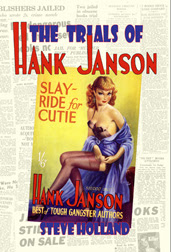
As the paperback boom died out in the wake of the Hank Janson trial, Watt began turning out stories for Paget Publications' saucy magazines Jaunty, Sprite, Kitty, etc. before reappering at Spencer's with a series of western novels in 1962-64.
I have found no more of John F. Watt's work after that date, but there is every chance that there is a great deal yet to discover... this outline dips into a writing career that lasted over thirty years and at least 57 novels. I hope someone out there will be able to let us know more about this fascinating author.
.
Saturday, April 14, 2012
Friday, April 13, 2012
Comic Cuts -13 April 2012
Last chance to take advantage of our special 10% off offer
The new Bear Alley Books book, Gwyn Evans: The Lunatic, the Lover and the Poet goes on sale today, so if you preordered a copy, you should be seeing it some time next week. This will be your last chance to get the book at the cheaper price... but I will hold the offer open over the weekend as it was a bit of a late announcement. If you're a fan of old pulp-style illustrations, I think you'll like the book, whether you've heard of Evans or not.
To those of you who have never heard of Evans, he was a writer of crime and detection yarns in the 1920s and 1930s, probably best known for writing Sexton Blake yarns and creating the character Hercules Esq. The latter earned Evans a fortune, which he blew in two weeks of wild partying in London's Bohemia. This book is based in part on the memories of Gwyn's contemporaries who paint a portrait of a man who wasted his talents. His handsome looks and generous nature were lost to drink and, at the age of only 39, so was his life. Gwyn Evans: The Lunatic, the Lover and the Poet tells the full, tragic story.
It has been a while since I ran any news about British comics, and this seems an opportune time to do it as we will shortly be seeing the relaunch of no less than two comics.
First, CLiNT. Come May 9th, we shall be seeing CLiNT 2.1 released, a 100-page bumper issue with a new look, new logo and four new stories. The new line-up will include Supercrooks by Mark Millar & Lenil Yu, the story of a group of failed supercriminals who head to Spain for one last heist. The strip is already in production as a movie at Universal, co-written, produced and directed by cult-favourite Spanish director, Nacho Vigalondo (Timecrimes, Extraterrestrial). Next up is the much anticipated The Secret Service by Millar & Dave Gibbons which is also likely to be heading to the big screen soon via director Matthew Vaughan.
Aside from Millar, the new line-up also includes Death Sentence by Monty Nero & Mike Dowling and a new chapter of Rex Royd by Frankie Boyle.
As if that isn't enough the following issue will see the launch of Kick-Ass spin-off Hit-Girl by Millar & John Romita Jr. and, waiting in the wings is Jonathan Ross's new collaboration with Bryan Hitch, America's Got Powers.
Then there's the relaunch of Strip Magazine. The comic has had a bit of a rough ride getting into comic shops, with lengthy delays occurring due to problems shipping the magazine from Bosnia where the paper is printed. The first issue (due 20 October 2011) made it into comic shops on 2 November; issue two, rescheduled for 1 December arrived 14 December. There have only been two issues of the monthly released so far in 2012, the latest arriving in comic shops only on 4 April.
In January, editor John Freeman announced that the magazine was going to be available on the news stands from issue 7 in May. "The initial plan for the title's news stand presence is to target a selected range of top high street stores, but not supermarkets at this time," John announced. However, heavy snow has caused delays in the release of issue four, so to enable the magazine to relaunch on time, the next issue will be a double issue number five, wrapping up a number of storylines; there will be no issue 6 and instead of issue 7, I believe Strip's debut on the news stands will be with a new issue one.
The relaunch is planned for the end of May and will include at least two new strips: "Black Dragon" by Richmond Clements & Nick Dyer and "Crucible" by John Freeman & Smuzz.
I managed to let the 2000AD anniversary slip by without any mention at all. All I can really say is that 2000AD seems to be in good condition for a comic that is not only thirty-five years old and has had the same lead character for the same length of time. The latest Judge Dredd epic, "Eve of Destruction", is by John Wagner, who is also writing Strontium Dog with Carlos Ezquerra drawing; Pat Mills has been writing Flesh recently and Nikolai Dante is being drawn by John M. Burns; and Brendan McCarthy seems to be chanelling Gong in "The Zaucer of Zilk". Meanwhile over in the Megazine I'm waiting on a new Anderson Psi Division yarn. So that's me happy.
Richard Herrero has produced a fantastic video featuring every single Prog, every annual, special and a variety of related publications, fanzines with interviews and odds 'n' sods related to the weekly. It's a long and fascinating trip, well worth watching all the way through.
Random scannery: As this has been a week for backwards glances at my past, it seems apt to run with some old science fiction paperbacks from the post-WWII era, as that was what I became known for even before the comics' indexes. My fascination came about because of the amazing names under which these books appeared, chief amongst them Vargo Statten and Volsted Gridban... but let's not forget Vektis Brack, Bengo Mistral, Drax Amper and a few dozen others.
The first weird name I wanted to explore back in... oh, it must have been about 1979 or 1980... was Astron del Martia. Astron was of particular interest because the name was created by Stephen D. Frances (a.k.a. Hank Janson) and the first novel was written by John Russell Fearn; the other three novels that appeared at the time were clearly written by an author who had little idea about what science fiction was; two were first person narratives and were written in the faux American style commonly used in crime novels of the same period. Interstellar Espionage was a sequel to Spawn of Space by Franz Harkon, published by Scion in 1951, both featuring the adventures of Security Officer 'Dog' and other members of the Space Express Company. Space Pirates is certainly by the same author while Dawn of Darkness could be by another hand entirely.
Before I go, a quick update on my attempt to cut down on my smoking habit. You'll be pleased (maybe even amazed) that I've not had a cigarette for a week. I had the final half of a cigarette around 1:30 pm, just after lunch, on Thursday the 5th April. I've been aided by the use of one of those battery-powered electronic cigarettes and it does seem to be working. I'm not out of the woods yet — I still feel the urge to smoke twenty times a day — but I am finding that the cigarette substitute is helping. And after a couple of days when I went a bit mad with it, I'm now starting to ween myself off that before it, too, becomes an addiction.
So how's the Kindle Fund doing? Well, the electronic cigarette cost £42.98 — as much as a week's worth of cigarettes! — but I'm still making a saving. If I change the accounting period (so to speak) so that it runs Friday through Thursday, as it was on a Thursday that I gave up, I can bring the figure right up to date and cover the whole of the period between 31st March to the 12th April. The figure's not so good as I have to take into account the purchase of the e-cigarette... but it's still almost doubled since I last took account and I expect it to leap next week.
Kindle Fund: £27.22
Talking of next week. We'll have a "mystery that has me mystified" tomorrow and a cover gallery for Sunday. I'll sort out something for next week over the weekend... at the moment it'll be a nice surprise for me, too.
Thursday, April 12, 2012
Approaching Fifty part 4: Getting into research
Some final random jottings inspired by my approaching fiftieth birthday.
My fascination with research developed out of the early good experiences I had with my contact with writers and other researchers. If you go right back to the earliest contact I had with an author, that would be Malcolm Saville around 1971-72, when I was nine or so. I was a member of the Lone Pine Club around that time and ordered a signed copy of Where's My Girl? when it was released in 1972.
What prompted me to write to Saville was that I could not get hold of a copy of The Secret of Grey Walls, one of his Lone Pine novels. I wrote to Saville suggesting that he should reprint the book and, lo and behold, Collins put out a hardback edition in 1972.
Now, I'm not suggesting for a minute that the appearance of the book was a direct result of my letter to Saville but that's what it felt like. Come on... I was nine!
I wrote to Howard Baker at around the age of twelve to ask about his Magnet reprints. I had read some of the Billy Bunter novels — available at our little local library — but the Howard Baker reprints were completely different to anything I had seen before. They reprinted issues of the original Magnet storypaper from the 1920s and 1930s (sometimes earlier), including the back-up stories, which I often found as fascinating as the lead feature. One favourite was "The Sea Spider" by George E. Rochester, which was spread across three different volumes. Another Rochester story, "For the Glory of France!" appeared in a volume I bought at Clark's, the book shop, at the pocket-money stretching price of £3.50. The book was the fifth volume of Magnet reprints containing the complete Courtfield Cracksman series and was the only volume not available at Chelmsford Library. Since I was now attending school in town, I had access to the big library. My junior library ticket allowed me to get four books out at once, twice as many as our local library allowed. Not only that, but Clarks and Smiths both carried paperbacks in abundance and, on Thursdays, there was a second-hand market where you could pick up paperbacks for 10p and if you returned them you would get 5p back.
But back to writing to Howard Baker. I don't have the reply any more, but I do remember writing a series of questions, not just one. All I can remember now is that one of the questions was whether The Gem was another paper like The Magnet.
I got into the habit of writing to people fairly early and those early experiences of getting friendly replies only encouraged me to write to more people. When it came to doing the school project I described yesterday, it seemed only natural to write to anyone I could find an address for.
A major influence in that direction was Mike Ashley. Everything I read of his seemed to contain quotes from people who were actually involved and hearing those first person stories — in his history of science fiction magazines, for instance — made the history that much more interesting as you were listening to someone who had actually lived it. Mike's books also had bibliographies and that led me to other books. And lists. I loved lists.
The other big influence was Bill Lofts. I'm not sure why I wrote to Bill, although it may well have been to discover the connections between authors active in the 1950s that I was growing interested in and Bill's great love, Sexton Blake. We corresponded heavily for years, but it was some while before I realised that I had heard from Bill years before. A scribbled note up the side of one of his letters was instantly recognisable as the same hand who had replied to my letter to Howard Baker. Bill's handwriting was unmistakable... and almost unreadable. In later years I transcribed a couple of things for him and occasionally had to leave gaps where his handwriting was so illegible it was incomprehensible.
We would occasionally meet up at a department store in Oxford Street and chat about some of the authors and collectors he had met. Bill and I collaborated on an article for The Book and Magazine Collector which was my first paid feature. More importantly, he talked about some of the nuts and bolts of doing research, like going to Somerset House to find birth, marriage and death information, or Companies House to try and find information about publishers.
In research you often find yourself travelling over the same ground time and time again, looking for a crack in the armour of some mystery. I find myself returning time and time again to certain authors to see what else can be discovered about them. My latest book, Gwyn Evans: The Lunatic, the Lover and the Poet, is the result of revisiting an author I first wrote about a decade ago. Bear Alley was started so that I could share bits of research with anyone who might find it of interest. The beauty of the blog format is that I don't have to have the whole story; on more than one occasion I've admitted defeat with research and there's even an irregular feature here called "mysteries that have me mystified" for just such occasions.
I have a broad interest in what I consider literature for the masses — story papers, magazines, paperback originals. For years these areas were like a newly discovered country with only a handful of us traipsing around wondering what we would find. Twenty or so years ago, there was a growth in academic interest in what was dubbed "trash aesthetics". I was rather pleased to see that my books and articles were often cited, not because I had a desire to see my name in print (I've seen it so often it doesn't fill me with quite so much excitement these days) but because it means someone has read something I've written and found something of interest in it.
Bear Alley continues to exist for the same reason. OK, so we don't get the traffic of Craig's List but it's comforting to know that over 100 people return to these pages every day to find out what has been posted. And another 700-800 drop by on a daily basis, some of them newcomers who have stumbled onto the site after Googling something they have been researching themselves. Knowing that people actually read these posts keeps me going. Getting feedback is always exciting. Sending people off via links, usually to somewhere like Amazon, to find books they might enjoy... that's also exciting. Bringing lost comic strips to light or compiling little galleries of paperback covers is a joy to me. I hope it brings you some joy, too.
My fascination with research developed out of the early good experiences I had with my contact with writers and other researchers. If you go right back to the earliest contact I had with an author, that would be Malcolm Saville around 1971-72, when I was nine or so. I was a member of the Lone Pine Club around that time and ordered a signed copy of Where's My Girl? when it was released in 1972.
What prompted me to write to Saville was that I could not get hold of a copy of The Secret of Grey Walls, one of his Lone Pine novels. I wrote to Saville suggesting that he should reprint the book and, lo and behold, Collins put out a hardback edition in 1972.
Now, I'm not suggesting for a minute that the appearance of the book was a direct result of my letter to Saville but that's what it felt like. Come on... I was nine!
I wrote to Howard Baker at around the age of twelve to ask about his Magnet reprints. I had read some of the Billy Bunter novels — available at our little local library — but the Howard Baker reprints were completely different to anything I had seen before. They reprinted issues of the original Magnet storypaper from the 1920s and 1930s (sometimes earlier), including the back-up stories, which I often found as fascinating as the lead feature. One favourite was "The Sea Spider" by George E. Rochester, which was spread across three different volumes. Another Rochester story, "For the Glory of France!" appeared in a volume I bought at Clark's, the book shop, at the pocket-money stretching price of £3.50. The book was the fifth volume of Magnet reprints containing the complete Courtfield Cracksman series and was the only volume not available at Chelmsford Library. Since I was now attending school in town, I had access to the big library. My junior library ticket allowed me to get four books out at once, twice as many as our local library allowed. Not only that, but Clarks and Smiths both carried paperbacks in abundance and, on Thursdays, there was a second-hand market where you could pick up paperbacks for 10p and if you returned them you would get 5p back.
But back to writing to Howard Baker. I don't have the reply any more, but I do remember writing a series of questions, not just one. All I can remember now is that one of the questions was whether The Gem was another paper like The Magnet.
I got into the habit of writing to people fairly early and those early experiences of getting friendly replies only encouraged me to write to more people. When it came to doing the school project I described yesterday, it seemed only natural to write to anyone I could find an address for.
A major influence in that direction was Mike Ashley. Everything I read of his seemed to contain quotes from people who were actually involved and hearing those first person stories — in his history of science fiction magazines, for instance — made the history that much more interesting as you were listening to someone who had actually lived it. Mike's books also had bibliographies and that led me to other books. And lists. I loved lists.
The other big influence was Bill Lofts. I'm not sure why I wrote to Bill, although it may well have been to discover the connections between authors active in the 1950s that I was growing interested in and Bill's great love, Sexton Blake. We corresponded heavily for years, but it was some while before I realised that I had heard from Bill years before. A scribbled note up the side of one of his letters was instantly recognisable as the same hand who had replied to my letter to Howard Baker. Bill's handwriting was unmistakable... and almost unreadable. In later years I transcribed a couple of things for him and occasionally had to leave gaps where his handwriting was so illegible it was incomprehensible.
We would occasionally meet up at a department store in Oxford Street and chat about some of the authors and collectors he had met. Bill and I collaborated on an article for The Book and Magazine Collector which was my first paid feature. More importantly, he talked about some of the nuts and bolts of doing research, like going to Somerset House to find birth, marriage and death information, or Companies House to try and find information about publishers.
In research you often find yourself travelling over the same ground time and time again, looking for a crack in the armour of some mystery. I find myself returning time and time again to certain authors to see what else can be discovered about them. My latest book, Gwyn Evans: The Lunatic, the Lover and the Poet, is the result of revisiting an author I first wrote about a decade ago. Bear Alley was started so that I could share bits of research with anyone who might find it of interest. The beauty of the blog format is that I don't have to have the whole story; on more than one occasion I've admitted defeat with research and there's even an irregular feature here called "mysteries that have me mystified" for just such occasions.
I have a broad interest in what I consider literature for the masses — story papers, magazines, paperback originals. For years these areas were like a newly discovered country with only a handful of us traipsing around wondering what we would find. Twenty or so years ago, there was a growth in academic interest in what was dubbed "trash aesthetics". I was rather pleased to see that my books and articles were often cited, not because I had a desire to see my name in print (I've seen it so often it doesn't fill me with quite so much excitement these days) but because it means someone has read something I've written and found something of interest in it.
Bear Alley continues to exist for the same reason. OK, so we don't get the traffic of Craig's List but it's comforting to know that over 100 people return to these pages every day to find out what has been posted. And another 700-800 drop by on a daily basis, some of them newcomers who have stumbled onto the site after Googling something they have been researching themselves. Knowing that people actually read these posts keeps me going. Getting feedback is always exciting. Sending people off via links, usually to somewhere like Amazon, to find books they might enjoy... that's also exciting. Bringing lost comic strips to light or compiling little galleries of paperback covers is a joy to me. I hope it brings you some joy, too.
Wednesday, April 11, 2012
Approaching Fifty part 3: The Incredible Shrinking Project
More random jottings inspired by my approaching fiftieth birthday.
I started writing in the late 1970s as a direct result of my interest in science fiction. In the run-up to our A-levels, we were given a free hand to pick a project to write-up. I loved doing these and, bizarrely, two of my old school projects have survived — one on trees and one on Winston Churchill. Although I collect, I'm not a hoarder, so if I lose interest in something I tend to junk it the next time I'm having a clear-out. I have almost nothing left from my schooldays, yet these two projects have survived. The only things I regret not having are the 50-page handwritten Steel Claw story I wrote when I was 15 or 16 and this particular school project.
It was inspired by a book called The History of the Science Fiction Magazine by Mike Ashley... or, rather, four books, as there were four volumes. What I was going to do was research and write-up the history of British SF magazines up to around 1955. Which, by coincidence, was roughly about the point where the third volume ended. And just so you're not confused about the tone that last sentence was written in, I mean it was no coincidence at all.
Now, I'm not sure if I actually owned a single British SF magazine at that point. I was certainly buying The Magazine of Fantasy and Science Fiction and Analog by then and it was partly because of this that I landed on the idea of doing the project on science fiction magazines. You see, my English teacher at KEGS was the almost legendary Mr McCallum and not only did he also read SF but he had back issues of Analog which he allowed me to borrow.
Although I've emphasised the influence of Mike Ashley's History of the Science Fiction Magazine, this was not intended to be a rip-off. I fully intended doing some genuine research and to this end contacted the Science Fiction Foundation (SFF) which, back then, was based in Dagenham. I travelled up there a couple of times to dig through copies of old British SF magazines, fanzines and whatever else I could lay my hands on in the time I had.
And, talking of time, I managed to keep the guardians of the SFF library busy long after they expected to have the place closed up for the evening. I'm pretty sure it was Malcolm Edwards who, on one of my visits, asked how much longer I was going to be and I, unaware of time passing when I have my head buried in a book, suddenly realised it was seven in the evening. It was also on these trips that I discovered authors with weird names like Vargo Statten, Volsted Gridban and Astron Del Martia. But that's another story entirely.
The background I gathered on these trips to the SFF showed me what a lot of work I still needed to do. I got in touch with Mike Ashley and with Phil Harbottle and, through them, was able to contact some of the contributors to these old magazines — authors like Syd Bounds were still active and some of those involved editorially like Walter Gillings were also still alive.
But it was about this time that the project began to shrink. The first British SF magazine is generally thought of as Scoops, the weekly boys' paper from 1934. Well, I hadn't had much chance to look at Scoops, so I thought that would best be left to one side so I could concentrate on later titles from 1937-56, which still left me with about 30 magazines that had published some 270 issues between them.
Time moved on. My attempts to contact Walter Gillings proved fruitless and I'd hoped to get a first hand account of his work on the pre-war Tales of Wonder. Still, never mind, I still had lots to talk about even if I concentrated on post-World War II titles. In fact, there was probably too much if I was to try to cover every SF magazine from the post-war decade... wouldn't it be easier to concentrate on just those magazines that came out shortly after the war... say, between 1945 and 1949. That ruled out all the Spencer mags, Authentic and Science-Fantasy, which would be a big saving in time and effort.
But even that brief post-war period involved one of the various titles edited by Walter Gillings — the 3-issue post-war Fantasy — and, with time now running short, I reluctantly decided not to cover it as I had received no reply to my letters. And New Worlds was a bit of a non-starter as well. Whilst the original editor (Ted Carnell) was gone, I had been in touch with the original publisher... only to find that his memory was pretty poor. In one of his letters he'd mistaken John Russell Fearn for Eric Frank Russell.
So my project that had originally intended to span twenty plus years and over thirty magazines eventually came together as the study of a single magazine, Outlands, which had lasted just one issue in 1946. But I had some fine information as I had spoken and corresponded not only to the editor but to some of his contributors as well. Where contributors were deceased I had tried to speak to their relatives, which lead to an almost surreal phone conversation with Mrs. Eric Frank Russell, who seemed to think that I was some kind of literary vampire hoping to suck on the blood of her late husband's work, which, she told me in no uncertain terms, I would not be doing because she'd burned the lot. This was all quite upsetting, especially as everyone else I had contacted had been so friendly and as helpful as they could be. I was quite thin-skinned back then.
I have to cut this rather long story short — much as I did back when I originally wrote it up. Sadly, I never saw the original project again but it got good marks. It had included some of the stories that were intended for future issues of Outlands and for a while I thought of publishing the lost second issue. But that notion fizzled out eventually.Maybe it's something I should think about again. It's too late for the 50th anniversary (1996), but it's only four years until the 70th. Maybe I'll try to reassemble my original notes.
My instincts tell me it will sell almost as many as Les Johnson's original magazine, which wasn't many. I recall him saying that he still had plenty of copies left over and we even considered putting a free copy of issue one in with every issue two!
I started writing in the late 1970s as a direct result of my interest in science fiction. In the run-up to our A-levels, we were given a free hand to pick a project to write-up. I loved doing these and, bizarrely, two of my old school projects have survived — one on trees and one on Winston Churchill. Although I collect, I'm not a hoarder, so if I lose interest in something I tend to junk it the next time I'm having a clear-out. I have almost nothing left from my schooldays, yet these two projects have survived. The only things I regret not having are the 50-page handwritten Steel Claw story I wrote when I was 15 or 16 and this particular school project.
It was inspired by a book called The History of the Science Fiction Magazine by Mike Ashley... or, rather, four books, as there were four volumes. What I was going to do was research and write-up the history of British SF magazines up to around 1955. Which, by coincidence, was roughly about the point where the third volume ended. And just so you're not confused about the tone that last sentence was written in, I mean it was no coincidence at all.
Now, I'm not sure if I actually owned a single British SF magazine at that point. I was certainly buying The Magazine of Fantasy and Science Fiction and Analog by then and it was partly because of this that I landed on the idea of doing the project on science fiction magazines. You see, my English teacher at KEGS was the almost legendary Mr McCallum and not only did he also read SF but he had back issues of Analog which he allowed me to borrow.
Although I've emphasised the influence of Mike Ashley's History of the Science Fiction Magazine, this was not intended to be a rip-off. I fully intended doing some genuine research and to this end contacted the Science Fiction Foundation (SFF) which, back then, was based in Dagenham. I travelled up there a couple of times to dig through copies of old British SF magazines, fanzines and whatever else I could lay my hands on in the time I had.
And, talking of time, I managed to keep the guardians of the SFF library busy long after they expected to have the place closed up for the evening. I'm pretty sure it was Malcolm Edwards who, on one of my visits, asked how much longer I was going to be and I, unaware of time passing when I have my head buried in a book, suddenly realised it was seven in the evening. It was also on these trips that I discovered authors with weird names like Vargo Statten, Volsted Gridban and Astron Del Martia. But that's another story entirely.
The background I gathered on these trips to the SFF showed me what a lot of work I still needed to do. I got in touch with Mike Ashley and with Phil Harbottle and, through them, was able to contact some of the contributors to these old magazines — authors like Syd Bounds were still active and some of those involved editorially like Walter Gillings were also still alive.
But it was about this time that the project began to shrink. The first British SF magazine is generally thought of as Scoops, the weekly boys' paper from 1934. Well, I hadn't had much chance to look at Scoops, so I thought that would best be left to one side so I could concentrate on later titles from 1937-56, which still left me with about 30 magazines that had published some 270 issues between them.
Time moved on. My attempts to contact Walter Gillings proved fruitless and I'd hoped to get a first hand account of his work on the pre-war Tales of Wonder. Still, never mind, I still had lots to talk about even if I concentrated on post-World War II titles. In fact, there was probably too much if I was to try to cover every SF magazine from the post-war decade... wouldn't it be easier to concentrate on just those magazines that came out shortly after the war... say, between 1945 and 1949. That ruled out all the Spencer mags, Authentic and Science-Fantasy, which would be a big saving in time and effort.
But even that brief post-war period involved one of the various titles edited by Walter Gillings — the 3-issue post-war Fantasy — and, with time now running short, I reluctantly decided not to cover it as I had received no reply to my letters. And New Worlds was a bit of a non-starter as well. Whilst the original editor (Ted Carnell) was gone, I had been in touch with the original publisher... only to find that his memory was pretty poor. In one of his letters he'd mistaken John Russell Fearn for Eric Frank Russell.
So my project that had originally intended to span twenty plus years and over thirty magazines eventually came together as the study of a single magazine, Outlands, which had lasted just one issue in 1946. But I had some fine information as I had spoken and corresponded not only to the editor but to some of his contributors as well. Where contributors were deceased I had tried to speak to their relatives, which lead to an almost surreal phone conversation with Mrs. Eric Frank Russell, who seemed to think that I was some kind of literary vampire hoping to suck on the blood of her late husband's work, which, she told me in no uncertain terms, I would not be doing because she'd burned the lot. This was all quite upsetting, especially as everyone else I had contacted had been so friendly and as helpful as they could be. I was quite thin-skinned back then.
I have to cut this rather long story short — much as I did back when I originally wrote it up. Sadly, I never saw the original project again but it got good marks. It had included some of the stories that were intended for future issues of Outlands and for a while I thought of publishing the lost second issue. But that notion fizzled out eventually.Maybe it's something I should think about again. It's too late for the 50th anniversary (1996), but it's only four years until the 70th. Maybe I'll try to reassemble my original notes.
My instincts tell me it will sell almost as many as Les Johnson's original magazine, which wasn't many. I recall him saying that he still had plenty of copies left over and we even considered putting a free copy of issue one in with every issue two!
Tuesday, April 10, 2012
Approaching Fifty part 2: The Doll's Bad News
I used to keep a list of all the books I'd read. I don't know what happened to the list but it would have looked a bit odd to anyone who read it. I read whatever I found around me, mostly the paperbacks that my Dad had just read, which were for the most part crime and thrillers. He also read westerns but they never really caught my imagination; my sister, on the other hand, became a fan of Louis L'Amour and other western writers. My Nan was devoted to historical novels by the likes of Jean Plaidy but could never persuade me that they were worthy of my attention, not when she also had Agatha Christie novels on her shelves, which were much more to my taste.
At the same time, I was working my way through the shelves of our local library. Thanks to my only having a children's library ticket, this meant I only had access to the children's section and only two books at a time, which meant I was slowly but steadily working my way through the works of Enid Blyton, Capt. W. E. Johns, Anthony Buckeridge and Malcolm Saville. And American authors like Wilbur Price, Franklin W. Dixon, Carolyn Keene and multi-author series like the Three Investigators books, introduced by Alfred Hitchcock.
All I can remember about the list was that, at some point, my top two authors were Franklin W. Dixon and John Creasey. Not my favourite authors... I'd simply read more books by those two than any other writer. If you'd asked me to name my favourite author, I would probably have said the name of whoever's book I happened to be reading at the time. I was rather caught out this way during my interview for the local grammar school as the book I was reading was Twelve Chinks and a Woman by James Hadley Chase. Actually, it those more PC times — 1973 — it had been retitled The Doll's Bad News and that was the book I had tucked in my pocket at the interview.
In 1974 IPC launched Speed & Power and I began picking up the new fortnightly magazine alongside my weekly Valiant. Eventually I dropped the latter in 1975 as most of my favourite strips (including "The Steel Claw" and "The Wild Wonders") had disappeared. Not that I dropped comics entirely... Top Secret Picture Library had launched in July 1974; then, in September 1975 I started picking up Vulcan, which had loads of my favourite characters in stories I'd never seen. Speed & Power folded in November '75, so I read Look & Learn for a while; then a new comic called Action appeared in February '76, two months before Vulcan was merged into Valiant and I found myself reading my old favourite again!
What really interested me about Speed & Power was the science fiction stories. The magazine reprinted 27 stories by Arthur C. Clarke and 4 by Isaac Asimov, serialised over the 87 issues. The majority were illustrated by Mike Whittlesea and to this eleven-year-old they were an inspiration. Science fiction wasn't new to me as I'd watched Star Trek, read some of the James Blish adaptations and even one or two novels — a couple by Edgar Rice Burroughs, including A Princess of Mars and The Gods of Mars, and some of John Creasey's Doctor Palfrey global catastrophe stories, for instance.
Reading the Arthur C. Clarke stories coincided with a growing interest in reading about astronomy and rocketry. I had seen various moon missions and even moon landings over the previous few years and, according to Speed & Power, it was surely only a matter of a few years before we were sending spaceships to Mars. Mankind was about to visit Barsoom! I was this close to living in a science fiction world!
Monday, April 09, 2012
Approaching Fifty part 1: Robot Footballers
I'm approaching fifty and it's supposed to be a time of reflection and reassessment. Bugger that. What I'm going to do instead is show you the first comic strip I can clearly remember. I must have seen strips before — my Dad used to get the Daily Mirror so I would have read Garth and The Perishers — but it was this particular strip that so caught my imagination that I instantly became a comic fan.
The comic is Valiant and the date is February 8th, 1969. When I saw this particular comic it was already a year or so old. It belonged to the older brother of a friend on mine, a guy called Roy who lived up the road from where I grew up just outside Chelmsford. I'm seven or eight and was around Roy's house when I spotted a small pile of colourful comics. Glancing through them I came to rest on a page featuring a story called ‘The Steel Claw’ and found the heroes of the stories in the following situation:
Louis Crandell and Blackie, Louis’ newspaper boy sidekick, were being held captive by an evil supercriminal known as The Question, and forced to play a deadly game of football against robots. Blackie was held by a giant mechanical hand next to the goalpost at one end of the indoor pitch; should the robots score he would be blown to smithereens, and as the episode opened it looked like Blackie was about to receive his free ticket to kingdom come.
The robot about to rocket the ball towards the back of the net was too far away for Crandell to tackle; he knelt, took aim, and fired a bullet from the finger of his artificial hand...
A couple of things strike me as I look back over what I’ve just written: where did those super criminals get all their money from for those extraordinary gadgets? I guess they must have had a stash of kidnapped scientists in some hideaway turning out the technology, but to maintain such an empire would have cost a fortune — no wonder they always had to dream up multi-zillion pound scams and hold the world to ransom. Imagine what would happen if the ball had hit: a few perfectly serviceable robots get blown up too, a chunk of the Question’s HQ would be destroyed. The maintenance on such a place would have been the dream of every cowboy builder in the world. Where were the pipe fitters? The glaziers and plasterers? Can you still get the parts for those old robots?
An attack of misty-eyedness almost stops me asking And why? Why would they always go to such elaborate lengths to create a robot football game just to blow up a newspaper boy?
Of course, I never asked those questions when I was a kid. If you go through life questioning everything you’d soon lose your sense of wonder and comics wouldn’t be fun any more. You didn’t question strips like ‘The Steel Claw’ — you KNEW that he had a floating metal hand which defied all the laws of aerodynamics, physics and gravity. You can scientifically prove beyond a shadow of doubt that the bumble bee cannot fly, which only proves that fact is stranger than fiction and some things you just have to believe in. And I was a fat little kid, y’know; intensely shy. All I ever wanted to be was invisible.
I beat Valiant into the world by a couple of months. Given the lead time it takes for a new comic to be put together, chances are we were conceived about the same time, although I doubt if the editors had any notion that, fifty years later, their creations would be the subject of a globally-available ramble from a forty-nine-year-old who still gets a thrill out of re-reading those old stories.
(* The Steel Claw © IPC Media.)
The comic is Valiant and the date is February 8th, 1969. When I saw this particular comic it was already a year or so old. It belonged to the older brother of a friend on mine, a guy called Roy who lived up the road from where I grew up just outside Chelmsford. I'm seven or eight and was around Roy's house when I spotted a small pile of colourful comics. Glancing through them I came to rest on a page featuring a story called ‘The Steel Claw’ and found the heroes of the stories in the following situation:
Louis Crandell and Blackie, Louis’ newspaper boy sidekick, were being held captive by an evil supercriminal known as The Question, and forced to play a deadly game of football against robots. Blackie was held by a giant mechanical hand next to the goalpost at one end of the indoor pitch; should the robots score he would be blown to smithereens, and as the episode opened it looked like Blackie was about to receive his free ticket to kingdom come.
The robot about to rocket the ball towards the back of the net was too far away for Crandell to tackle; he knelt, took aim, and fired a bullet from the finger of his artificial hand...
A couple of things strike me as I look back over what I’ve just written: where did those super criminals get all their money from for those extraordinary gadgets? I guess they must have had a stash of kidnapped scientists in some hideaway turning out the technology, but to maintain such an empire would have cost a fortune — no wonder they always had to dream up multi-zillion pound scams and hold the world to ransom. Imagine what would happen if the ball had hit: a few perfectly serviceable robots get blown up too, a chunk of the Question’s HQ would be destroyed. The maintenance on such a place would have been the dream of every cowboy builder in the world. Where were the pipe fitters? The glaziers and plasterers? Can you still get the parts for those old robots?
An attack of misty-eyedness almost stops me asking And why? Why would they always go to such elaborate lengths to create a robot football game just to blow up a newspaper boy?
Of course, I never asked those questions when I was a kid. If you go through life questioning everything you’d soon lose your sense of wonder and comics wouldn’t be fun any more. You didn’t question strips like ‘The Steel Claw’ — you KNEW that he had a floating metal hand which defied all the laws of aerodynamics, physics and gravity. You can scientifically prove beyond a shadow of doubt that the bumble bee cannot fly, which only proves that fact is stranger than fiction and some things you just have to believe in. And I was a fat little kid, y’know; intensely shy. All I ever wanted to be was invisible.
I beat Valiant into the world by a couple of months. Given the lead time it takes for a new comic to be put together, chances are we were conceived about the same time, although I doubt if the editors had any notion that, fifty years later, their creations would be the subject of a globally-available ramble from a forty-nine-year-old who still gets a thrill out of re-reading those old stories.
(* The Steel Claw © IPC Media.)
Sunday, April 08, 2012
John Griffiths (1926-2012)
John Griffiths, a regular cover artist for Penguin Books in the 1960s and 1970s, died on 13 March 2012, aged 85. Griffiths, born in London on 2 August 1926, worked in a drawing office and advertising agency, where he met his wife-to-be, Barbara Sparks. After marrying in 1950 he attended a working men's college, which led to a foundation course at Camberwell and then to the Royal College of Art; he remained at the RCA as a junior tutor. He also produced illustrations for the BBC's Time and Tune and covers for Penguin Books.
Like many Penguin artists, Griffiths was paired up with certain authors, amongst them Eric Linklater and John Wyndham; it was Griffiths who visualised Wyndham's Triffids as stumpy-legged bulbs with a whip-like flagellum. He also illustrated Fred Hoyle's The Black Cloud (1960) and John Christopher's The Death of Grass (1963)
Griffiths also illustrated Penguin's Progress, Sir Allen Lane's history of Penguin published in 1960 to celebrate the company's 25th anniversary.
Griffith lived in Teston, Kent, where he spent most of his career as a freelance illustrator, his most regular client being a New Zealand-based educational publisher. During slack periods he returned to teaching at Goldsmiths, St Martin's School of Art, Medway College of Design and Maidstone College of Art. He eventually retired and became a carer to his ailing wife, who died in 2004. Two years before his death, Griffiths went to live with his daughter in south-west France.
Obituary: The Guardian (3 April 2012).
Like many Penguin artists, Griffiths was paired up with certain authors, amongst them Eric Linklater and John Wyndham; it was Griffiths who visualised Wyndham's Triffids as stumpy-legged bulbs with a whip-like flagellum. He also illustrated Fred Hoyle's The Black Cloud (1960) and John Christopher's The Death of Grass (1963)
Griffiths also illustrated Penguin's Progress, Sir Allen Lane's history of Penguin published in 1960 to celebrate the company's 25th anniversary.
Griffith lived in Teston, Kent, where he spent most of his career as a freelance illustrator, his most regular client being a New Zealand-based educational publisher. During slack periods he returned to teaching at Goldsmiths, St Martin's School of Art, Medway College of Design and Maidstone College of Art. He eventually retired and became a carer to his ailing wife, who died in 2004. Two years before his death, Griffiths went to live with his daughter in south-west France.
Obituary: The Guardian (3 April 2012).
Saturday, April 07, 2012
Rylee Ltd.
A recent post on Norman Pett's Jane listed a Birmingham company called Rylee Ltd. amongst his publishers. A little investigating turns up the fact that Rylee Ltd. began as a commericial photographers, possibly in around 1932-33, based at Sheepcote Street, Edgbaston, Birmingham 15.
Shortly after the end of World War II, they expanded their business into publicity, printing and publishing. As well as publishing Norman Pett's Jane's Journal in 1946, their main early endevour appears to be the magazine New Plays Quarterly, which ran from 1947 to 1965. Other early titles include The Thesis Library series of non-fiction books, which included:
A Handbook of Self-Analysis by Theodore Faithfull. London, Rylee, 1948.
Letters to Margaret: A Simple Introduction to Psychology by Theodore Faithfull. London, Rylee, 1948.
The Value of Neurosis by C. Wilfred Wall. London, Rylee, 1948.
Religion and Psychotherapy: A Plea for Co-operation [3rd edition] by A. Graham Ikin. London, Rylee [Published for the British Federation of Psychologists], Dec 1948.
A Handbook of Sex Education by Theodore Faithfull. London & Birmingham, Rylee, 1950 [1951].
Rylee (who maintained an office in London, hence the given place of publication for many of their books) also published slim illustrated books such as Modern Locomotives (1948) and Objects to Paint and Trace (c.1949), alongside various plays by Denis Ogden, Gordon Glennon, Eardley Wedlake, Caswell Garth, Ivan Butler, William Dinner & William Morum, Muriel Box (and one with Sydney Box), Darrell Wilde, I. O. Evans, etc.
They also began publishing novels with Angela Darling by Gordon Grinstead (1949), but were primarily children's book publishers, authors in the early 1950s including W. Lindsay Cable, Rita Coatts, Leslie Frewin and A. Harcourt Burrage.
The company then seems to run out of steam , but continued publishing books for young children. In the mid-1960s, they published a range of classics (Treasure Island, Alice in Wonderland, What Katy Did, What Katy Did Next, Black Beauty, etc.).
Rylee Ltd. moved to 27 Augustus Road, Edgbaston, Birmingham 15 around 1948 anda a second company, Rylee & Willington Ltd., of the same address, was launched as advertising and publicity consultants around 1953, which became Rylee (Advertising) Ltd. in around 1955 but had disappeared by 1957. Another company, Rylee Photography sprang up in around 1961 and ran alongside Rylee Ltd. at the same address in Augustus Road until 1968.
I believe the business was then sold as, in 1969, the Pageant Books series — published by Rylee at 161 Queen Victoria Street, London EC4 — was launched, featuring translations of Italian books such as Animals of the Forest by Mina Ripani, The Living Sea by Giuseppe Zanini, Legends from the South Seas by Elena S. Tessadri and Far West by Pacifico Fiori — mostly translated from titles published by Milan-based publisher Signorelli.
Their last traced title, Switzerland and Liechenstein by John & Moira Hawkes, was published in 1973.
(* More an excuse to run some more Janeiana than serious research! Still, someone might find it useful. My thanks to Derek Wilson for the scans of the Jane Calendar advert. The 1947 calendar was published by Rylee, but I believe the 1948 calendar wasn't, but was distributed by Pett to friends at Christmas.)
Shortly after the end of World War II, they expanded their business into publicity, printing and publishing. As well as publishing Norman Pett's Jane's Journal in 1946, their main early endevour appears to be the magazine New Plays Quarterly, which ran from 1947 to 1965. Other early titles include The Thesis Library series of non-fiction books, which included:
A Handbook of Self-Analysis by Theodore Faithfull. London, Rylee, 1948.
Letters to Margaret: A Simple Introduction to Psychology by Theodore Faithfull. London, Rylee, 1948.
The Value of Neurosis by C. Wilfred Wall. London, Rylee, 1948.
Religion and Psychotherapy: A Plea for Co-operation [3rd edition] by A. Graham Ikin. London, Rylee [Published for the British Federation of Psychologists], Dec 1948.
A Handbook of Sex Education by Theodore Faithfull. London & Birmingham, Rylee, 1950 [1951].
Rylee (who maintained an office in London, hence the given place of publication for many of their books) also published slim illustrated books such as Modern Locomotives (1948) and Objects to Paint and Trace (c.1949), alongside various plays by Denis Ogden, Gordon Glennon, Eardley Wedlake, Caswell Garth, Ivan Butler, William Dinner & William Morum, Muriel Box (and one with Sydney Box), Darrell Wilde, I. O. Evans, etc.
They also began publishing novels with Angela Darling by Gordon Grinstead (1949), but were primarily children's book publishers, authors in the early 1950s including W. Lindsay Cable, Rita Coatts, Leslie Frewin and A. Harcourt Burrage.
The company then seems to run out of steam , but continued publishing books for young children. In the mid-1960s, they published a range of classics (Treasure Island, Alice in Wonderland, What Katy Did, What Katy Did Next, Black Beauty, etc.).
Rylee Ltd. moved to 27 Augustus Road, Edgbaston, Birmingham 15 around 1948 anda a second company, Rylee & Willington Ltd., of the same address, was launched as advertising and publicity consultants around 1953, which became Rylee (Advertising) Ltd. in around 1955 but had disappeared by 1957. Another company, Rylee Photography sprang up in around 1961 and ran alongside Rylee Ltd. at the same address in Augustus Road until 1968.
I believe the business was then sold as, in 1969, the Pageant Books series — published by Rylee at 161 Queen Victoria Street, London EC4 — was launched, featuring translations of Italian books such as Animals of the Forest by Mina Ripani, The Living Sea by Giuseppe Zanini, Legends from the South Seas by Elena S. Tessadri and Far West by Pacifico Fiori — mostly translated from titles published by Milan-based publisher Signorelli.
Their last traced title, Switzerland and Liechenstein by John & Moira Hawkes, was published in 1973.
(* More an excuse to run some more Janeiana than serious research! Still, someone might find it useful. My thanks to Derek Wilson for the scans of the Jane Calendar advert. The 1947 calendar was published by Rylee, but I believe the 1948 calendar wasn't, but was distributed by Pett to friends at Christmas.)
Friday, April 06, 2012
Comic Cuts - 6 April 2012
Hopefully you've seen the announcement that the Gwyn Evans bio is now finished and due out next week. I'm still waiting on the proof to arrive but I went over and over the layouts so I'm hoping that there won't be any problems. The spent Sunday finishing the last few pages and produced a final PDF file in the early hours of Monday morning. The idea was to give it a quick check over when I woke up the next day and order up the proof, but every time I thought I'd finished I'd tweak something and have to save another "final" version.
I finally ordered the proof Monday night and spent the next few hours putting together the information that I posted to Bear Alley Books and an announcement for Bear Alley. On Tuesday morning I remembered to put up a link from Bear Alley, checked my mail and — hurrah! — had my first order come in. Thanks, Frank.
So now that the Gwyn Evans is so close to publication — and the devilish cover is the perfect publication for Friday the 13th — I'm already working on the next Bear Alley Books' title. I've signed a deal to reprint the Sexton Blake Annual. I'm a huge fan of Sexton Blake and the four Blake annuals haven't been available for seventy years. Four annuals appeared between 1938 and 1942 (there was a break in 1939), all with paper covers. They haven't survived in great numbers and I've thought for years that they would make a great set if they were reprinted. Well, I thought it was time to put my money where my mouth was, contacted the copyright holder and we hammered out a deal.
The plan is to publish the four at around six weekly intervals between May and September. I've only just started work on them so I don't know how much cleaning up the pages will need but I suspect I'll probably begin with the 1940 volume as, of the four in my collection, that's the one in the best condition. The idea is to make them exact reproductions of the originals — the only difference will be to the rear cover adverts. At a rough guess, the final price will be £17.99 plus p&p but there will definitely be a big saving for anyone who orders all four. I'm going to stick my neck on the line and say that Bear Alley Books has never missed a release date... so if you order them, they will turn up on time.
I'll have some more details next week but for those of you who want a sneak peak, here's the cover for the 1940 annual.
I mentioned recently that my 50th birthday was fast approaching and I've decided that I've got to catch up with the 21st century. So I'm planning to buy a Kindle. The new Kindle Touch is out and we're on the edge of 3G coverage so I'm aiming for their 3G version. The price: £169 plus I'm going to need the UK power adaptor. So I need to find £182 from somewhere.
Now, I've been a quite heavy smoker for thirty-five years and the money I burn in a month would easily pay for one. Some years back I was smoking thirty plus a day, but I managed to cut back four or five years ago so, recently, I've probably been smoking 20-24 a day, depending on how much time I'm left on my own. Non-smokers might find this screwy but, left to my own devices, muscle memory kicks in and I can find myself with a lit cigarette and not remember lighting it.
The plan is to cut right back and, ultimately, to give up completely. I made the decision a couple of weeks ago and I've managed to cut down without too much suffering. This is my second full week and I'm averaging something like 14 a day. The money I'm saving goes into the Kindle Fund.
How this works: To make the sums easier, we'll say that I was smoking a packet a day of the cheapest cigarettes at a cost of £6 a day. 20 x 7 days is 140 cigarettes costing £42 — 30p each. As I started on 24 March, I'm counting the week as running from Saturday through Friday; I smoked 93 cigarettes in the 7 days between 24- 30 March, a saving of 47 x 30p = £14.10. So after Week One the Kindle Fund stands at £14.10 — so that's the power adaptor paid for already!
I'll let you know how I do on Week Two next week. This time I'm determined to cut down and quit which is why I'm making this public and setting myself a target. If you want to support the Kindle Fund you can do it quite a few ways: the best way would be buy any of the books from Bear Alley Books; another easy way is if you order anything from Amazon, rather than go straight to the Amazon site, come to Bear Alley and use the search box over in the left hand column; there's also a PayPal link for donations over on the left.
Today's Random Scans are a companion piece to the Tarzan-esque covers I posted back on 16 March. The first two are further adventures of Jacare by Victor Norwood and the latter two are Azan the Apeman by Marco Garon or Marco Garron... the name varied. Victor was a real guy, but I've always suspected that the latter were the work of David A. Griffiths, based on the two that I have. If anyone can supply decent cover scans of the other four Azan novels, I'd be grateful as I've only even found very poor scans on the web.
Next week... possibly a bit of a mixed bag as I've not had much of a chance to finalise anything. All I know is that I'm sneaking in a little 'Jane' tomorrow.
I finally ordered the proof Monday night and spent the next few hours putting together the information that I posted to Bear Alley Books and an announcement for Bear Alley. On Tuesday morning I remembered to put up a link from Bear Alley, checked my mail and — hurrah! — had my first order come in. Thanks, Frank.
So now that the Gwyn Evans is so close to publication — and the devilish cover is the perfect publication for Friday the 13th — I'm already working on the next Bear Alley Books' title. I've signed a deal to reprint the Sexton Blake Annual. I'm a huge fan of Sexton Blake and the four Blake annuals haven't been available for seventy years. Four annuals appeared between 1938 and 1942 (there was a break in 1939), all with paper covers. They haven't survived in great numbers and I've thought for years that they would make a great set if they were reprinted. Well, I thought it was time to put my money where my mouth was, contacted the copyright holder and we hammered out a deal.
The plan is to publish the four at around six weekly intervals between May and September. I've only just started work on them so I don't know how much cleaning up the pages will need but I suspect I'll probably begin with the 1940 volume as, of the four in my collection, that's the one in the best condition. The idea is to make them exact reproductions of the originals — the only difference will be to the rear cover adverts. At a rough guess, the final price will be £17.99 plus p&p but there will definitely be a big saving for anyone who orders all four. I'm going to stick my neck on the line and say that Bear Alley Books has never missed a release date... so if you order them, they will turn up on time.
I'll have some more details next week but for those of you who want a sneak peak, here's the cover for the 1940 annual.
I mentioned recently that my 50th birthday was fast approaching and I've decided that I've got to catch up with the 21st century. So I'm planning to buy a Kindle. The new Kindle Touch is out and we're on the edge of 3G coverage so I'm aiming for their 3G version. The price: £169 plus I'm going to need the UK power adaptor. So I need to find £182 from somewhere.
Now, I've been a quite heavy smoker for thirty-five years and the money I burn in a month would easily pay for one. Some years back I was smoking thirty plus a day, but I managed to cut back four or five years ago so, recently, I've probably been smoking 20-24 a day, depending on how much time I'm left on my own. Non-smokers might find this screwy but, left to my own devices, muscle memory kicks in and I can find myself with a lit cigarette and not remember lighting it.
The plan is to cut right back and, ultimately, to give up completely. I made the decision a couple of weeks ago and I've managed to cut down without too much suffering. This is my second full week and I'm averaging something like 14 a day. The money I'm saving goes into the Kindle Fund.
How this works: To make the sums easier, we'll say that I was smoking a packet a day of the cheapest cigarettes at a cost of £6 a day. 20 x 7 days is 140 cigarettes costing £42 — 30p each. As I started on 24 March, I'm counting the week as running from Saturday through Friday; I smoked 93 cigarettes in the 7 days between 24- 30 March, a saving of 47 x 30p = £14.10. So after Week One the Kindle Fund stands at £14.10 — so that's the power adaptor paid for already!
I'll let you know how I do on Week Two next week. This time I'm determined to cut down and quit which is why I'm making this public and setting myself a target. If you want to support the Kindle Fund you can do it quite a few ways: the best way would be buy any of the books from Bear Alley Books; another easy way is if you order anything from Amazon, rather than go straight to the Amazon site, come to Bear Alley and use the search box over in the left hand column; there's also a PayPal link for donations over on the left.
Kindle Fund: £14.10
Today's Random Scans are a companion piece to the Tarzan-esque covers I posted back on 16 March. The first two are further adventures of Jacare by Victor Norwood and the latter two are Azan the Apeman by Marco Garon or Marco Garron... the name varied. Victor was a real guy, but I've always suspected that the latter were the work of David A. Griffiths, based on the two that I have. If anyone can supply decent cover scans of the other four Azan novels, I'd be grateful as I've only even found very poor scans on the web.
Next week... possibly a bit of a mixed bag as I've not had much of a chance to finalise anything. All I know is that I'm sneaking in a little 'Jane' tomorrow.
Labels:
Comics News
Subscribe to:
Posts (Atom)