Saturday, July 23, 2011

Desmond Bagley: Bibliography and bonus cover gallery

(* I'm running the cover gallery/bibliography in reverse order so that I don't have to repost it... the main gallery will appear tomorrow.)

In 2009, Harper published a series of eight "2-in-1" omnibus editions, the covers of which I've appended to the following bibliography. Most (if not all) of the books contained additional stories or features by/about Bagley.

Bagley also wrote one short story as Simon Bagley, which I don't think has ever been included in any bibliography of his work previously.

Novels
The Golden Keel. London, Collins, 1963; Garden City, N.Y., Doubleday, 1964; abridged for children (by Michael Thomas), London, Hutchinson, 1977.
High Citadel. London, Collins, 1965; Garden City, N.Y., Doubleday, 1965.
Wyatt’s Hurricane. London, Collins, 1966; Garden City, N.Y., Doubleday, 1966; abridged for children (by Jennifer Bassett), Oxford, Oxford University Press, 1992.
Landslide. London, Collins, 1967; Garden City, N.Y., Doubleday, 1967; abridged for children (by Lewis Jones), London, Collins, 1979.
The Vivero Letter. London, Collins, 1968; Garden City, N.Y., Doubleday, 1968.
The Spoilers. London, Collins, 1969; Garden City, N.Y., Doubleday, 1970.
Running Blind. London, Collins, 1970; Garden City, N.Y., Doubleday, 1971; abridged for children (by Michael Thomas), London, Hutchinson, 1975.
The Freedom Trap. London, Collins, 1971; Garden City, N.Y., Doubleday, 1972; as The Mackintosh Man, Doubleday, 1972.
The Tightrope Men. Collins, 1973; Garden City, N.Y., Doubleday, 1973.
The Snow Tiger. London, Collins, 1975 [1974]; Garden City, N.Y., Doubleday, 1975.
The Enemy. London, Collins, 1977; Garden City, N.Y., Doubleday, 1978; abridged for children (by Ralph Mowat), Oxford, Oxford University Press, 1991.
Flyaway. London, Collins, 1978; Garden City, N.Y., Doubleday, 1979.
Bahama Crisis. London, Collins, 1980; New York, Summit Books, 1983.
Windfall. London, Collins, 1982; New York, Summit Books, 1982.
Night of Error [completed by Joan Bagley]. London, Collins, 1984; New York, St. Martin’s Press, 1987.
Juggernaut [completed by Joan Bagley] London, Collins, 1985; New York, St. Martin’s Press, 1987.

Omnibus
Five Novels (contains The Golden Keel, High Citadel, The Vivero Letter, Running Blind, The Tightrope Men). London, Collins, 1979.
Running Blind and The Freedom Trap [and ‘A Matter of Months’]. London, Harper, Jun 2009.
The Tightrope Men and The Enemy. London, Harper, Jun 2009.
Flyaway and Windfall [and ‘The Circumstances Surrounding the Crime’]. London, Harper, Jun 2009.
The Golden Keel and The Vivero Letter. London, Harper, Jun 2009.
Wyatt’s Hurricane and Bahama Crisis [and ‘Introduction’, Crime Wave]. London, Harper, Nov 2009.
High Citadel and Landslide [and ‘My Old Man’s Trumpet’]. London, Harper, Nov 2009.
The Spoilers and Juggernaut [and ‘The House of the Lions’]. London, Harper, Nov 2009.
The Snow Tiger and Night of Error. London, Harper, Nov 2009.

Short Stories
My Old Man's Trumpet (Argosy, Jan 1957)
Welcome, Comrade (as Simon Bagley; Magazine of Fantasy & Science Fiction, Apr 1964)
A Matter of Months (Winter Crimes 8, 1976)
The House of the Lions (The Spoilers and Juggernaut, London, Harper, 2009)

Non-fiction
The Circumstances Surrounding the Crime (I, Witness: True Personal Encounters with Crime, by Members of the Mystery Writers of America, 1978)
A Little Piece of Britain (In Britain, 24 Feb 1980)
Introduction (Crime Wave: World’s Winning Crime Stories 1981, selected by an international jury, London, Collins, 1981).


Friday, July 22, 2011

Comic Cuts - 22 July 2011

The big news from me is that the third volume of Eagles Over the Western Front is due back from the printers next week... and I announced that on Wednesday, leaving me with little to say here.

Um... oh, yes, I had some odds and ends (some old models, a few books, some old film-related ephemera) that went into auction this week and raised over £100 towards paying off the computer. Financially, I've spent the past couple of years ticking over, which you can look at two ways: on the plus side I've managed to get through this recession without going under - and there are a lot of freelancers suffering at the moment - and weathered the move we were forced into last summer; on the bad side, the money I've earned gets spent immediately, so I'm not putting money aside for emergencies (like, say, a new computer) or the future (paying towards my pension). Hence taking on extra work and selling off some bits and bobs just to get my bank account back in balance.

The extra work at the moment is helping out with some images for the Look and Learn picture library. By the time you read this I'll have cropped, rotated and supplied metadata for about 400 Vanity Fair cartoons like the above. The subject above is 'Spy' (Leslie Ward), who was actually the regular artist of these cartoons, although this one is by Jean de Paleologu.

I have some other odd and ends that I'm going to be selling off - some duplicates of comics and the like - but I may well put them up here first so that the regular readers of Bear Alley get first refusal. It's finding the time to sort them out, scan covers, write notes and post them that's the problem. You can do your bit by keeping Bear Alley Books busy with orders, or just by ordering stuff from Amazon through the links I put up, or the search box that sits over to the left of this column. Doesn't matter what it is - books or bath plugs or whatever. It doesn't cost you a penny extra, but I can earn a few pence as I've "recommended" a purchase. It isn't much - in fact I can give you the exact figure... it's £6.49 so far this month - but it all adds up and keeps me afloat.

Following on from this week's comic strip, here are some covers by 'The Champions' artist John Vernon. Vernon is probably best known for his work on 'Skid Solo' in Tiger, which he drew for many years from 1965 on. He was active in comics from the early-1960s until the mid-1980s. prior to which he had worked in theatre publicity and as a book cover artist. You can get an inkling of the diversity of his art from the three covers below.


Next week... more 'The Man Who Searched for Fear' plus our regular recent releases and upcoming releases columns - yes, it's that time of the month already. This weekend's cover gallery will be Desmond Bagley and I've more in the works.

Thursday, July 21, 2011

Wednesday, July 20, 2011

Eagles news

The third volume of Eagles Over the Western Front is now at the printers and should be back some time next week. Pre-ordered copies will be dispatched within 24 hours of me receiving the printed copies. Don't forget that we also have an option for ordering all three books for those of you who have yet to see the series.

The Champions part 3


(* Matchbox® is now a registered trademark of Mattel Inc.)

Tuesday, July 19, 2011

Monday, July 18, 2011

The Champions part 1

The Champions was - or at least appears to be - a 10-page promotional comic for Matchbox, the popular toy brand created by Lesney Prodcts in 1953, which collected together a series of 10 one-page adverts that appeared in Tiger in 1972. At the time, Lesney were facing stiff competition from other UK brands, especially in the US where Mattel introduced their Hot Wheels line in 1967. By 1969, sales of Matchbox cars had plunged, the competition also felt here in the UK.

According to Wikipedia:
Lesney's response to this was relatively quick — but not quick enough to avoid major financial worries — creating the "Superfast" line. This was effectively a transformation of the 1969 line to include low-friction wheels (at first narrow, since the company needed time to retool the series to accommodate wide tyres), often accompanied with new colors. The result was, at first, a strange but interesting line of fast-wheeling cars, trucks, and trailers, basically complete in 1970. Racing track sets and the like were also released to allow children to race their cars. Starting in 1970 and particularly in 1971, new models appeared with wider tyres, and older models (including trucks still in the line) were retooled to fit slicks. The King Size range was similarly updated, including a division into Super Kings (mostly trucks, but also with mag wheels) and Speed Kings (cars). A short-lived series of rechargeable electric cars, called Scorpions, was released as well, to compete with similar products from Hot Wheels (Sizzlers) and Corgi (ElectroRockets).
This helped Lesney reestablish itself in the market, as would the resulting advertising the company produced. Eventually, Matchbox was sold to Tyco Toys in 1993 and was subsequently purchased by Mattel in 1996.

'The Champions' followed the exploits of Matchbox Team Surtees, a tie-in with the sponsorship deal Matchbox had with Formula 2 contenders Surtees Racing Organisation, set up by racing driver John Surtees in 1970. One of his drivers, Mike Hailwood, won the 1972 European F2 Championship, the story of which is revealed through the following series of adverts.


My thanks to Richard Sheaf for sending over scans. We will have more episodes for you tomorrow.

 
(* Matchbox® is now a registered trademark of Mattel Inc.)

Sunday, July 17, 2011

Henry Kuttner: Cover Gallery

Henry Kuttner was one of the finest science fiction writers of the American pulp era, active from the appearance of his first story in 1936 until his death in 1958. The best of his work, much of which appeared under pen-names, notably Lewis Padgett and Lawrence O'Donnell, was written to various degrees in collaboration with his wife, C. L. Moore, herself a noted SF and fantasy writer.

The assignment of stories to one or either author has been the cause of much debate, although it is generally noted that almost everything following their marriage in 1940 was a collaboration. Kuttner himself, writing to Donald B. Day, who was then compiling his Index to the Science Fiction Magazines 1926-1950, stated that stories appearing under his wife's name were exclusively written by her and that she was responsible for almost all stories as Lawrence O'Donnell, with the exception of "This Is The House" (Astounding, February 1946), which was by Kuttner, and "Fury" (Astounding, 3 pts., May–July 1947), which was by Moore & Kuttner.

I was fortunate to have a reasonably good education in old American pulp stories: during the 1970s boom in SF, when I was reading everything I could lay my hands on, Kuttner was a regular in many anthologies. And you could still get hold of some of his older collections (back in the day before charity shops began throwing pre-decimal books out as worthless junk). There have, in recent years, been several substantial reprint volumes of Kuttner's work published in the USA (Two-Handed Engine from Centipede Press, various titles from the Haffner Press) but nothing here in the UK; there's not a single Kuttner book in print over here. It's about time Kuttner was rediscovered.

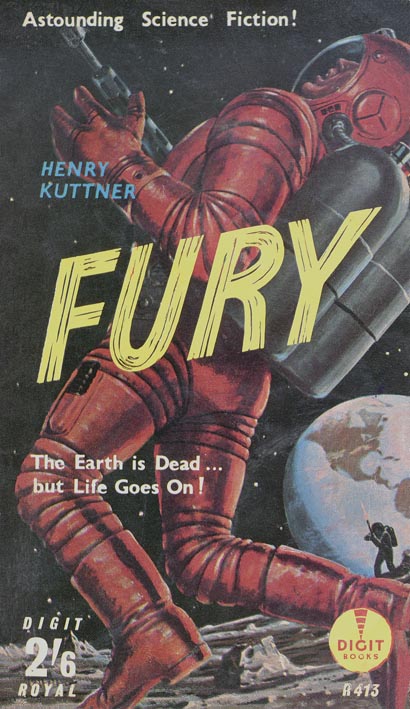
Fury [with C. L. Moore, uncredited] (New York, Grosset & Dunlap, 1950)
Digit Books R413, 1960, 156pp, 2/6. Cover by Ed Emshwiller (US reprint)
Mayflower 2779, 1963, 190pp, 3/6. Cover by unknown
Mayflower-Dell 2779, Jun 1966, 190pp, 3/6. Cover by unknown
Hamlyn 0600-33651-4, 1978, 208pp, 80p. Cover by unknown
---- [2nd imp.] 1981, 208pp, £1.25. Cover by unknown
Gollancz 0575-07141-9, 2000, 208pp. Cover: design

The Murder of Ann Avery (New York, Permabooks, 1956)
Banner Books 106, n.d. (1960), 2/-.

Man Drowning (New York, Harper & Brothers, 1952)
Four Square Books 341, 1961, 160pp, 2/6. Cover by Josh Kirby

Ahead of Time
Four Square Books 371, 1961, 160pp, 2/6. Cover by Josh Kirby
----, 2nd imp., 1964, 2/6.
New English Library 1990, [3rd imp.] Oct 1967, 160pp, 3/6. Cover by unknown [in the style of Rene Magritte]

No Boundaries, with C. L. Moore
Consul Books SF1025, 1961, 159pp, 2/6. Cover by unknown

Mutant (New York, Gnome Press, 1953)
Mayflower B27, 1962, 192pp, 2/6. Cover by unknown
Hamlyn 0600-36320-1, 1979, 214pp, 90p. Cover by Peter Elson

Tomorrow and Tomorrow by Lewis Padgett
Consul Books 1265, 1963, 106pp, 2/6. Cover by unknown

The Far Reality by Lewis Padgett
Consul Books 1266, 1963, 155pp, 2/6. Cover by Josh Kirby

Bypass to Otherness
Consul Books 1269, 1963, 154pp, 2/6. Cover by unknown (signature indecipherable)

Return to Otherness
Mayflower 7401, 1965, 288pp, 5/-. Cover by unknown (Josh Kirby?)

The Best of Kuttner 1
Mayflower 0547, Nov 1965, 286pp, 5/-. Cover by Jacks (Josh Kirby)


The Best of Kuttner 2
Mayflower 0547, 1966, 288pp, 5/-. Cover by Jacks (Josh Kirby)

The Dark World
Mayflower 1657, 1966, 127pp, 3/6. Cover by unknown (Josh Kirby?)

Clash by Night [with C. L. Moore, selected by Peter Pinto]
Hamlyn 0600-32150-9, 1980, viii+215pp. Cover by Chris Moore?

Chessboard Planet, and other stories [with C. L. Moore]
Hamlyn 0099-33270-1, 1983, 187pp.

The Proud Robot: The Complete Galloway Gallegher Stories (as by Lewis Padgett, New York, Gnome, 1952)
Hamlyn 0600-38404-7, 1983, 189pp. Cover by unknown

Saturday, July 16, 2011

Sexton Blake, Detective (1908)

The play Sexton Blake, Detective commenced at the Crown Theatre, Peckham, on Monday, February 24, 1908 for six nights and one matinee. Later moved to the Star Theatre, Liverpool (six nights from Monday April 6, 1908), then to Shakespeare Theatre, Clapham Junction, London (six nights from April 13, 1908), then to Grand Theatre, Brighton (six nights from April 20, 1908), Woolwich (six nights from April 27, 1908). Later shows include the Rotunda Theatre, Liverpool (from July 27), the County Theatre, Reading (from August 10) and the Princess’s Theatre, Glasgow (from August 31). The play continued to be performed around the country until September 20, 1909.

John M(arlborough) East (1860-1924), a Shakespearean actor and theatre manager realised the potential of Sexton Blake and interested Percy Nash (1869-1958) in a dramatic project to bring Blake to the stage. Nash negotiated a deal with Amalgamated Press and Brian Daly commenced work on a freely adapted version of W. Murray Graydon’s ‘Five Years After’ which had appeared in a double-length Christmas number (6 December) of Union Jack in 1906. He cut out the second villain and substituted—all with Graydon’s approval—an unprincipalled adventuress by the name of Philadelphia Kate who had appeared in another Blake story.

A company called Melodramatic Productions Syndicate Ltd. was floated on February 20, 1908, a month after a special performance at the King’s Theatre, Hammersmith, and a revised version of the play opened at the Crown Theatre, Peckham, on Monday, February 24, 1908. East, still busy with a pantomime at the same theatre, was still unhappy with the production and, once free of his commitments, took control, casting himself as a Bill Sykes character by the name of Simon Faggus.

The basic plot involved the the wicked Philadelphia Kate (Miss East Robertson) whose influence over the weakwilled ne’er do well Randolph Lovell (Charles Est) was contrasted with the virtuousness of  his cousin, Marjory Lovell (Lily Hammond) and her pure and philanthropic John Blackburn (Brian Daly), a local farmer.

Randolph will inherit Cossington Hall upon the death of the squire, Marmaduke Lovell, and hires Simon Faggus (East) to kill him and place the blame on Blackburn’s son, Roger (William Felton). The mystery was enhanced by Roger’s disappearance and the mystery of Squire Lovell’s death had confounded the investigations of Sergeant Widgeon of the Yard for five years until Sexton Blake came upon the scene.

The play was very popular as it toured around the North of England and apparently seven touring companies were put on the road and the original play was still being performed ten years later.

East produced a number of other plays during this period based on various popular crime stories, amongst them Tracked by Wireless by William Le Queux and Convict 99 by Marie Connor Leighton and her husband Robert Leighton (which was reprinted in Union Jack in 1909) and a second Sexton Blake play, Hush Money; or, The Disappearance of Sexton Blake, Detective (produced c.1909).

East and Daly later collaborated on the movie The Romany Rye (1915); Daly acted in quite a few films during the early years of the Great War.

SEXTON BLAKE, DETECTIVE


Synopsis of scenery:
Act 1. (Scene 1) Farmer Blackburn’s Garden – Summer-time. (Scene 2) A Lane at Cossington – Winter. (Scene 3) The Library at Cossington Hall.
Act 2. (Scene 1) In the London Slums. Five years later. (Scene 2) The Mission Hall in the slums.
Act 3. (Scene 1) The Old Wharf at Rotherhithe. (Scene 2) Sexton Blake’s Rooms in Baker Street. (Scene 3) The Library at Cossington Hall.
Act 4. (Scene 1) Birdcage Walk, St. James’s Park, by Night. (Scene 2) Interior of a Church in the West End of London.

Characters
Sexton Blake_____________ The Celebrated Detective
Tinker__________________  Sexton Blake’s Young Assistant
Pedro__________________  The Famous Bloodhound
Inspector Widgeon________  A Scotland Yard Detective
Squire Marmaduke Lovell___ Owner of Cossington Hall
John Blackburn___________ Farmer. The Squire’s Tenant
Roger Blackburn__________ His Son
Reverend Edward Grey_____ A Clergyman
Simon Faggus____________ A Professional Burglar
Mrs. Blackburn___________ John Blackburn’s Wife
Euphemia_______________ Maid-of-all-Work. Afterwards a Music-hall Artiste
Marjorie Lovell___________ Roger Blackburn’s Fiancee
Philadelphia Kate_________ An Adventuress
Loafers, Villagers, Policemen, etc., etc.

BEAR ALLEY BOOKS

BEAR ALLEY BOOKS
Click on the above pic to visit our sister site Bear Alley Books