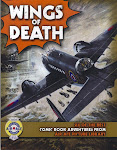
Brand new Commando issues are out today! Take to the trenches with our “Angels on Wheels”, discovery the lineage of the lost son of a German Count, delve once more into no man’s land to rescue the final Weekes’ sibling, and fight the Fokker Scourge! Plus, get your copies of 5179 or 5181 for your chance to win a model CORGI Sopwith F1 Camel AND a Fokker D.VII!
5179: Harriet’s War
In the dark, the cries of the wounded men on the front line echoed, their hoarse voices calling for the ‘angels on wheels’ to come save them. One such angel was Harriet Weekes, an ambulance driver in the First Aid Nursing Yeomanry. As the fourth and only female Weekes sibling, Harriet had joined up to do her part in the war just like her brothers. Some said she was reckless. Some said she drove like a bat out of Hades. But when there were people who needed her help, she was an angel on wheels.
Issue 4 of ‘The Weekes’ War’!
Story: Andrew Knighton
Art: Khato
Cover: Ian Kennedy
5180: Father and Son
For many generations, there had been a Count von Regenskirch in the German Army. This duty had passed from father to son – but then, during the First World War, the Count was killed and his small son disappeared.
But that child was not dead. Grown to manhood, he now stood proudly in military uniform. But it was the wrong uniform, the wrong country, and he was now fighting against Germany. What strange twist of fate had caused this mystery?
Story: CG Walker
Art: Carmona
Cover: Ian Kennedy
Originally Commando No. 1530 (July 1981). Reprinted No. 2875 (August 1995).
5181: Tommy’s War
November 11th, 1918. Armistice.
The war was over… or so most thought, but some still held to the regime of battle, and kept a tight hold of their prisoners.
All the Weekes family wanted was to be together again, but Tommy lay far away on the other side of the shrapnel filled fields
of No Man’s Land. It was all or nothing, and the Weekes family would do anything to get Tommy back!
Issue 5 of ‘The Weekes’ War’!
Story: Iain McLaughlin
Art: Defeo & Morhain
Cover: Ian Kennedy
5182: Battling Boneshakers
They were “wood-and-wire wonders”, these early aircraft of World War One – hard enough to fly, let alone fight in! To make things worse for the pilots of the newly formed Royal Flying Corps, the enemy were quick enough to perfect a gun that fired successfully through the propeller arc of their Fokker Eindeckers.
Men like Gus Mathieson had their work cut out to survive – even using their puny pistols until a British gun could be developed to counter the “Fokker Scourge”.
Story: KP MacKenzie
Art: Gordon C Livingstone
Cover: Ian Kennedy
Originally Commando No. 2906 (November 1995).
Thursday, November 29, 2018
Wednesday, November 28, 2018
Rebellion Releases (2000AD)
Rebellion releases for 28 November 2018.
2000AD Prog 2109
Cover: Cliff Robinson / Dylan Teague
JUDGE DREDD: THE SMALL HOUSE by Rob Williams (w) Henry Flint (a) Chris Blythe (c) Annie Parkhouse (l)
BRINK: HIGH SOCIETY by Dan Abnett (w) INJ Culbard (a) Simon Bowland (l)
SINISTER DEXTER: THE SEA BENEATH THE CITY by Dan Abnett (w) Steve Yeowell (a) John Charles (c) Ellie De Ville (l)
KINGDOM: ALPHA AND OMEGA by Dan Abnett (w) Richard Elson (a) Abigail Bulmer (c) Ellie De Ville (l)
Dredd: Final Judgement by Alex De Campi, Arthur Wyatt and Henry Flint
Rebellion ISBN 978-1781-08662-9, 29 November 2018, 98pp, £12.99 / $17.99. Available via Amazon.
The comic-book sequel to the cult movie Dredd reaches its epic final story with the clash that fans have been waiting for – Judge Dredd versus Judge Death!
Mega-City One, the cusp of the 22nd century. Eight hundred million people are living in the ruin of the old world, a planet devastated by atomic war. Only one thing fighting for order in a metropolis teetering on the brink of chaos – the men and women of the Hall of Justice. One such lawman is Judge Joe Dredd, who is about to be confronted with his strangest and most challenging case yet.
Dredd: Final Judgement brings the comic book tie-ins to Alex Garland’s Dredd movie to a close with a story that will shatter the lawman’s world! Scripted by Arthur Wyatt and Alex De Campi, and illustrated by Henry Flint.
Judge Dredd: The Complete Case Files #32 by John Wagner, Roland Grey, Gordon Rennie, John Smith, Simon Fraser, Arthur Ranson, Simon Davis, Peter Doherty, Laurence Campbell, Dylan Teague, Kevin Brighton, Jock, Chris Weston, Paul Marshall, Cam Kennedy, Siku, Fraser Irving, Henry Flint, Steve Parkhouse, Ben Oliver, John Higgins, Carlos Ezquerra, Patrick Goddard and Dylan Teague.
Rebellion ISBN 978-1781- 08661-2, 29 November 2018, 306pp, £19.99 / $24.99. Available via Amazon.
Mega-City One – a nightmarish enclosure located along the Eastern Seaboard of North America. Only the Judges – powerful law enforcers supporting the despotic Justice Department – can stop total anarchy running rife on the crime-ridden streets. Toughest of them all is Judge Dredd – he is the law and these are his stories... Judge Dredd assesses the performance of a promising young cadet, Rico – another clone of Judge Fargo. Earning his badge, Rico is soon assigned to the troubled Sector House 108 – where everything he has learnt is put to the test!
Ken Reid's Creepy Creations
Rebellion ISBN 978-1781-08660-5, 29 November 2018, 117pp, £17.99 / $21.99. Available via Amazon.
Beware all ye who open this book! The creatures contained within, are some of the most bizarre, hilarious and hideous ever to haunt the pages of a comic! For the first time ever, marvel at The Many-Headed Monster from Monmouth! Tremble at the sight of Terry the Tellible! Recoil in horror from The Fork-Eating Spaghetti Spook! And much more besides! A testament to Ken Reid's artistic genius and his hugely creative imagination, these illustrations have been collected and lovingly restored in all their (creepy) glory.
Sniper Elite: Resistance by Keith Richardson and Patrick Goddard
Rebellion ISBN 978-1781-08659-9, 29 November 2018, 98pp, £12.99 / $16.99. Available via Amazon.
Spinning out of the world-wide smash video game series, Sniper Elite, the legendary sniper for the Special Operations Executive, Karl Fairburne, must parachute into occupied France on a mission to destroy a secret weapon, but instead of a silent mission of sabotage he finds the local resistance compromised and the SS waiting to play a deadly game of cat and mouse in the terrified streets of an ancient town.
2000AD Prog 2109
Cover: Cliff Robinson / Dylan Teague
JUDGE DREDD: THE SMALL HOUSE by Rob Williams (w) Henry Flint (a) Chris Blythe (c) Annie Parkhouse (l)
BRINK: HIGH SOCIETY by Dan Abnett (w) INJ Culbard (a) Simon Bowland (l)
SINISTER DEXTER: THE SEA BENEATH THE CITY by Dan Abnett (w) Steve Yeowell (a) John Charles (c) Ellie De Ville (l)
KINGDOM: ALPHA AND OMEGA by Dan Abnett (w) Richard Elson (a) Abigail Bulmer (c) Ellie De Ville (l)
Dredd: Final Judgement by Alex De Campi, Arthur Wyatt and Henry Flint
Rebellion ISBN 978-1781-08662-9, 29 November 2018, 98pp, £12.99 / $17.99. Available via Amazon.
The comic-book sequel to the cult movie Dredd reaches its epic final story with the clash that fans have been waiting for – Judge Dredd versus Judge Death!
Mega-City One, the cusp of the 22nd century. Eight hundred million people are living in the ruin of the old world, a planet devastated by atomic war. Only one thing fighting for order in a metropolis teetering on the brink of chaos – the men and women of the Hall of Justice. One such lawman is Judge Joe Dredd, who is about to be confronted with his strangest and most challenging case yet.
Dredd: Final Judgement brings the comic book tie-ins to Alex Garland’s Dredd movie to a close with a story that will shatter the lawman’s world! Scripted by Arthur Wyatt and Alex De Campi, and illustrated by Henry Flint.
Judge Dredd: The Complete Case Files #32 by John Wagner, Roland Grey, Gordon Rennie, John Smith, Simon Fraser, Arthur Ranson, Simon Davis, Peter Doherty, Laurence Campbell, Dylan Teague, Kevin Brighton, Jock, Chris Weston, Paul Marshall, Cam Kennedy, Siku, Fraser Irving, Henry Flint, Steve Parkhouse, Ben Oliver, John Higgins, Carlos Ezquerra, Patrick Goddard and Dylan Teague.
Rebellion ISBN 978-1781- 08661-2, 29 November 2018, 306pp, £19.99 / $24.99. Available via Amazon.
Mega-City One – a nightmarish enclosure located along the Eastern Seaboard of North America. Only the Judges – powerful law enforcers supporting the despotic Justice Department – can stop total anarchy running rife on the crime-ridden streets. Toughest of them all is Judge Dredd – he is the law and these are his stories... Judge Dredd assesses the performance of a promising young cadet, Rico – another clone of Judge Fargo. Earning his badge, Rico is soon assigned to the troubled Sector House 108 – where everything he has learnt is put to the test!
Ken Reid's Creepy Creations
Rebellion ISBN 978-1781-08660-5, 29 November 2018, 117pp, £17.99 / $21.99. Available via Amazon.
Beware all ye who open this book! The creatures contained within, are some of the most bizarre, hilarious and hideous ever to haunt the pages of a comic! For the first time ever, marvel at The Many-Headed Monster from Monmouth! Tremble at the sight of Terry the Tellible! Recoil in horror from The Fork-Eating Spaghetti Spook! And much more besides! A testament to Ken Reid's artistic genius and his hugely creative imagination, these illustrations have been collected and lovingly restored in all their (creepy) glory.
Sniper Elite: Resistance by Keith Richardson and Patrick Goddard
Rebellion ISBN 978-1781-08659-9, 29 November 2018, 98pp, £12.99 / $16.99. Available via Amazon.
Spinning out of the world-wide smash video game series, Sniper Elite, the legendary sniper for the Special Operations Executive, Karl Fairburne, must parachute into occupied France on a mission to destroy a secret weapon, but instead of a silent mission of sabotage he finds the local resistance compromised and the SS waiting to play a deadly game of cat and mouse in the terrified streets of an ancient town.
Monday, November 26, 2018
Ken Reid's Creepy Creations
The latest reprint from the Treasury of British Comics line is another from Ken Reid, who is having something of a revival, thanks to the appearance of Faceache last year and the two volumes of Odhams Comics' reprints earlier this year. All for the good, because Reid's work deserves to be saved from obscurity.
The latest volume gathers up 91 'Creepy Creations' from the pages of Shiver & Shake. Introductions by Antony Reid, Ken's son, and Ken's biographer Irmantas Povilaika put the strip into context: Ken's increasing boredom with drawing the same characters week after week led him to suggest a series featuring fantastic imagery of barmy animals to Power Comics editor Bob Bartholomew. Rejected, the idea went into the drawer, revived when his income plunged in 1969 and offered to MAD Magazine and Topps. A stumbling start on a series of 55 cards ground to a halt after a year in development.
The idea was revived in 1972 as a back cover feature for IPC's upcoming new comic, Shiver and Shake. Readers would contribute ideas and sketches for Ken to draw, winning themselves a £1 prize. Ken went on to draw 73 of the 79 episodes for the weekly (two were by Reg Parlett and four by Robert Nixon), plus a handful of others for annuals and specials.
All showed Ken's delight in combining horror and humour. Alien monsters oozed out of Ken's pens and terrifying vegetables and ghastly insects threatened to chomp down on any reader who came within reach. Creatures that were mostly teeth and claws were named with artful alliteration: the gruesome green-fingered gardener from Greenwich, the fanged fiend from Finland, the fearsome food-muncher of Snortlewick, the prune-eating plonk from Perivale, and so on... Goonish names given to hairy, horned, horrors with warts, spines and twisted limbs.
Pre-dating the likes of Flanimals by years, the book will appeal to that same age group of 8-12-year-olds – the age of the children who wrote in with their suggestions and sketches that Ken turned into his creature feature each week. And, of course, the nostalgic fifty-somethings who remember Ken's creepy creations first time around. I always had a soft spot for 'The Chelmsford Chaser' as that's where I grew up!
The good news is that Ken's World-Wide Weirdies is also to be reprinted in 2019.
Ken Reid's Creepy Creations. Rebellion ISBN 978-1781-08660-5, 29 November 2018, 112pp, £16.99 (hardcover). Available via Amazon.
The latest volume gathers up 91 'Creepy Creations' from the pages of Shiver & Shake. Introductions by Antony Reid, Ken's son, and Ken's biographer Irmantas Povilaika put the strip into context: Ken's increasing boredom with drawing the same characters week after week led him to suggest a series featuring fantastic imagery of barmy animals to Power Comics editor Bob Bartholomew. Rejected, the idea went into the drawer, revived when his income plunged in 1969 and offered to MAD Magazine and Topps. A stumbling start on a series of 55 cards ground to a halt after a year in development.
The idea was revived in 1972 as a back cover feature for IPC's upcoming new comic, Shiver and Shake. Readers would contribute ideas and sketches for Ken to draw, winning themselves a £1 prize. Ken went on to draw 73 of the 79 episodes for the weekly (two were by Reg Parlett and four by Robert Nixon), plus a handful of others for annuals and specials.
All showed Ken's delight in combining horror and humour. Alien monsters oozed out of Ken's pens and terrifying vegetables and ghastly insects threatened to chomp down on any reader who came within reach. Creatures that were mostly teeth and claws were named with artful alliteration: the gruesome green-fingered gardener from Greenwich, the fanged fiend from Finland, the fearsome food-muncher of Snortlewick, the prune-eating plonk from Perivale, and so on... Goonish names given to hairy, horned, horrors with warts, spines and twisted limbs.
Pre-dating the likes of Flanimals by years, the book will appeal to that same age group of 8-12-year-olds – the age of the children who wrote in with their suggestions and sketches that Ken turned into his creature feature each week. And, of course, the nostalgic fifty-somethings who remember Ken's creepy creations first time around. I always had a soft spot for 'The Chelmsford Chaser' as that's where I grew up!
The good news is that Ken's World-Wide Weirdies is also to be reprinted in 2019.
Ken Reid's Creepy Creations. Rebellion ISBN 978-1781-08660-5, 29 November 2018, 112pp, £16.99 (hardcover). Available via Amazon.
Saturday, November 24, 2018
Lunt Roberts
LUNT ROBERTS
by
Robert J. Kirkpatrick
Lunt Roberts was probably best-known for his illustrations for eight of Malcolm Saville’s stories (between 1945 and 1957) and the two “Jimmy” books by Richmal Crompton (1949 and 1951). He was also a cartoonist, working in particular for The Bystander, The Humorist and Punch, and he also worked a number of children’s comics.
He was born in Secunderabad, India, on 28 August 1894, and christened Richard John Lunt Roberts. His father, Richard Roberts (born in 1849 in Caernarvon, Wales) was a railway storekeeper with the India Railway. He had married Florence Emily Bear in October 1888 in India, although she died on 19 November 1890, and he then married Gertrude Annie Lunt, born in 1872 in Victoria, Australia (to English parents), at St. Thomas’s Cathedral, Bombay, on 26 November 1893. They went on to have two further children: Myfanwy Gwynedd (born in 1896) and, after the family had returned to Wales in the late 1890s, Thomas Llewelyn, born in Aber, Caernarvonshire, on 10 September 1899. At the time of the 1901 census, the family was boarding in a farmer’s house, “Penrybryn,” in Aber.
Ten years later, they had moved to “Sharur,” Llandudno (then in Caernarvonshire), with Richard John Lunt Roberts recorded as a part-time student. Soon after this, in 1913, he moved to London, where he worked as a graphic artist and joined the London Sketch Club. (It is not known where he received his early artistic training). A year later, on 27 August 1914, he enlisted as a Private in the 1/6th Royal Welsh Fusiliers, securing a commission as a Second Lieutenant on 25 June 1915. In October 1915 he was sent to Gallipoli, only to be caught up in appalling weather a month later, and being evacuated to Egypt and admitted to hospital in Giza, Cairo, on 4 December 1915. He subsequently returned to his battalion, where, in early 1916, he began drawing and painting army life, and later, after the armistice, exploring Egypt and producing pictures of the people and scenery. (For more on Lunt Roberts time in Egypt, and in particular the art that he produced there, see here.)
He returned to England in June 1919, and enrolled at the Leicester School of Art, where he studied alongside his brother Thomas, and acted with the Art Students Union. Two years later he began his career as an illustrator, with contributions to The Yellow Magazine, and, in 1922, to Gaiety, The Boys’ Friend and, most notably, The Bystander, to which he contributed cartoons and, later, illustrations for short stories, until 1934.
His career as a book illustrator began in 1922, with illustrations for Dugout Doggerels from Palestine, a book of wartime verse by John N. More. Between 1927 and 1933 he illustrated eight Enid Blyton short stories in Cassell’s Children’s Annual and Bo Peep’s Bumper Book. In 1934, he illustrated Wonderful London Today, a collection of pieces by James A. Jones that had originally appeared in The Evening News. (They both collaborated on a second book, London’s Eight Millions, three years later.)
In the meantime, Lunt Roberts had continued to contribute to a number of periodicals, including The Tatler, The Red Magazine, The Strand Magazine, London Opinion, The Passing Show, The Sheffield Weekly Telegraph, The Hull Daily Mail and The Graphic. He also went on to work for George Newnes’s magazine The Humorist, and Punch. He was also still working as a graphic artist, for example designing posters for the London Underground.
In 1923, Lunt Roberts was living at 30 Kemplay Road, Hampstead. The following year, in Lewisham, Kent, he married Hilda Plant (born in Gresford, Flintshire, on 18 December 1896, and the daughter of John Plant, a brick and terracotta works manager). In 1932, they moved to 22 Kemplay Road, and by 1939 they had moved to 14 Overdale Avenue, New Malden, Surrey, with Lunt Roberts working as an Editorial Artist with The London Evening News (where he remained until the 1960s) and having been elected President of the London Sketch Club in the same year. During the Second World War he worked as an illustrator for the Ministry of Information.
He began to be in demand as a book illustrator after 1944, when he illustrated Malcolm Saville’s Trouble at Townsend. He went on to illustrate a further seven of Saville’s children’s stories, plus novels by authors such as Douglas V. Duff, Angus Macvicar, Judith M. Berrisford, Ursula Bloom, Kathleen Fidler and Gerald Bowman. He also illustrated several books for younger children, including stories by Enid Blyton, and a series of books starring the ventriloquist’s dummy Archie Andrews. In 1949 he illustrated Richmal Crompton’s Jimmy, published by George Newnes (after the stories had earlier been published in The Star newspaper with illustrations by Thomas Henry), followed by Jimmy Again in 1951. (In total, 62 of the 87 “Jimmy” stories were published by George Newnes in these two books, and these were re-issued in three paperbacks by Armada in 1965, under the titles Jimmy, Jimmy Again and Jimmy the Third, all with the Lunt Roberts illustrations. Roberts also illustrated a Just William’s Magic Painting Book).
He also worked on a handful of comics in the late 1940s/1950s, including the Amalgamated Press’s Knockout and Rocket and Beaverbrook’s TV Comic (for which he drew a “Mr Pastry” strip between 1951 and 1958, with one the strips, “Mr Pastry’s Sportsday”, being issued as a “T.V. Comic Mini Book” in 1951). He also illustrated three more Enid Blyton stories in The Jack and Jill All Colour Gift Book (published by The News of the World) in 1950, 1951 and 1952, which were reprinted in My Own Storybook in 1956. He also contributed to annuals such as The Daily Mail Annual and The Swift Annual.
He also did many illustrations for The Wide World Magazine in the 1950s.
Lunt Roberts’s last major work appeared in 1965, in With Lewis and Clark Through the Rockies, a factual account of an 1806 expedition by Meriwether Lewis and William Clark written by Gerald Bowman. (He had earlier illustrated Bowman’s account of Roald Amundsen’s journey to the North Pole in 1911, and his account of the first overland crossing of Antarctica in 1957-58 by Sir Vivian Fuchs and Sir Edmund Hillary. All three books were published by Frederick Muller.)
In the meantime, he and his wife had become active members of the local Coombe Wood Golf Club. He was its Captain in 1948, and his wife served as Secretary of the Ladies Section between 1952 and 1975.
He died, at his home in Overdale Avenue, on 21 October 1981, leaving an estate valued at £41,376. His wife died, also at Overdale Avenue, on 11 November 1987, leaving £101,688.
Lunt Roberts’s brother Thomas taught art at Lutterworth Grammar School for many years from the 1930s to the early 1960s. He married May Winifred Blaxley (born in Leicester on 13 August 1901) in Leicester in 1933, and they lived at 205 Knighton Road until they died. May Roberts died on 15 March 1982, and he died on 29 April 1988, leaving an estate valued at £115,920.
PUBLICATIONS
Illustrated by Lunt Roberts
Dugout Doggerels from Palestine by John N. More, Heath Cranton, 1922
Wonderful London Today by James A. Jones, John Long, 1934
Tindertoken School by W.R. Henderson, Blackie & Son, 1934 (dustwrapper) (re-issue)
The Hospital Centenary Gift Book, George G. Harrap & Co., 1935 (with other artists)
London’s Eight Millions by James A. Jones, John Long, 1937
Mr Jones Comes to Stay by Joyce Glover, George G. Harrap & Co., 1942
Trouble at Townsend by Malcolm Saville, Transatlantic Arts Co., 1944
Life in many Lands: 1. Life in Other Homes by L. Edna Walker, James Nisbet & Co., 1944 (with other artists)
Looking for Trouble by Douglas V. Duff, Hollis & Carter, 1945
A Book of Swimming by Janet Bassett Lowke, Puffin, 1945
Danger Chasers by Douglas V. Duff, Hollis & Carter, 1946
Caravan for Three by Ursula Bloom, University of London Press, 1947
Kalee and Other Stories by F.G. Turnbull, Sampson Low, Marston & Co., 1947
Let’s Find Hidden Treasure by Trevor Henley, Venturebooks, 1947
The Riddle of the Painted Box by Malcolm Saville, Noel Carrington, 1937
Redshank’s Warning by Malcolm Saville, Lutterworth Press, 1948
Two Fair Plaits by Malcolm Saville, Lutterworth Press, 1948
Teddy Tail’s Book of Children’s Songs, Ken Publications, 1949
Jimmy by Richmal Crompton, George Newnes Ltd., 1951
The Fencer’s Companion by Leon Bertrand, Gale & Polden, 1949
The Flying Fish Adventure by Malcolm Saville, John Murray, 1950
Stubby Sees it Through by Angus Macvicar, Burke Publishing Co., 1905
Jimmy Again by Richmal Crompton, George Newnes Ltd., 1951
Archie and the Engine Driver and Other Stories, Macmillan & Co., 1951
Admiral Archie and Other Stories, Macmillan & Co., 1951
Archie Guy Fawkes and Other Stories, Macmillan & Co., 1951
Mr Pastry’s Sportsday, TV Comic, 1951
Unwritten Contract by Henry Longhurst, Professional Golfers’ Co-operative Association, 1952
The Secret of the Hidden Pool by Malcolm Saville, John Murray, 1953
Round the Year Storybook, P.R. Gawthorn Ltd, 1953 (with other artists)
Storiau Munudau Hamdenn i Blant by Trevor Williams, 1953-1954 (4 volumes)
Pete, Pam and Jim, the Investigators by Kathleen Fidler, Lutterworth Press, 1954
Rustlers in the New Forest by Judith M. Berrisford, Macmillan & Co., 1954
Adventure on the Alm by Nancy Martin, Macmillan & Co., 1955
On Guard Spot by Enid Blyton, News of the World, 1955
Spring Comes to Nettleford by Malcolm Saville, Children’s Book Club, 1955 (re-issue) (dustwrapper)
Final Performance: A Mystery with Music by Reginald Masters, Macmillan & Co., 1956
Fun and Adventure by Thomas Wright & Mary Wilson, Macmillan & Co., 1956
Young Johnnie Bimbo by Malcolm Saville, John Murray, 1956
The Fourth Key by Malcolm Saville, John Murray, 1957
Just William’s Painting Book, Publicity Products, 1957
Achievement; An Anthology of Ends Attained ed. by D.W. Barker, Macmillan & Co., 1957
Stories for Me by Eileen Ryder, Macmillan & Co., 1957 (6 volumes) (with Esmé Jeudwine)
Children’s Favourite Stories in Pictures, Associated Newspapers, 1957 (with other artists)
Mystery in Maori Land by John Hornby, Macmillan & Co., 1958
Fun and Adventure, Book 2 by Thomas Wright & Mary Wilson, Macmillan & Co., 1960
With Fuchs and Hillary Across Antarctica by Gerald Bowman, Frederick Muller, 1961
English by Stages by Isaac Morris, Macmillan & Co., 1962
Stirring Stories for Girls ed. by Eric Duthie, Odhams Press, 1963 (with other artists)
With Amundsen at the North Pole by Gerald Bowman, Frederick Muller, 1963
Two Stories: The Sire de Maletroit’s Door and A Lodging for the Night by Robert Louis Stevenson, adapted by Linton Stone, Macmillan & Co., 1964
With Lewis and Clark Through the Rockies by Gerald Bowman, Frederick Muller, 1965
Jimmy by Richmal Crompton, Armada, 1965
Jimmy Again by Richmal Crompton, Armada, 1965
Jimmy the Third by Richmal Crompton, Armada, 1965
Labels:
Artist,
Lunt Roberts
Friday, November 23, 2018
Comic Cuts - 23 November 2018
Things might be changing here at Bear Alley for a while. It's no secret that I've been looking for work for a few months and it now looks as if I've been successful, at least in the short term. I still have a couple of meetings to get through, so wish me luck!
It will likely mean that I might be posting less for the next three or four months. I'm not planning a shut down or anything that drastic, but if you wander by on a Friday morning and don't see the usual whaffle from me revealing all the news that's fit to print from my mostly incredibly dull life, you'll know why. If it all pans out, the workload is going to be quite intense.
Not that I've had my feet up all week. I have a couple of things on the go. Bubbling under everything else, I've had a little annual indexing project running for months, I've started on gathering material for a pitch for a book, and had some actual paying work to contend with. The latter takes precedence, obviously, so I currently find myself with a couple of essays partly written, some annuals partly indexed, and the pitch developed only in rough and in no fit state to present to anyone.
Mind you, my life is littered with half-finished projects. Some that I regret the most is a history of The Man in the Iron Mask – the French historical/Alexander Dumas one, which I beavered away on for some weeks back in January 2009. I wrote 20,000 words and then had to take on some work that would pay the rent. I still have them, but, nine years on, I haven't a clue what I was planning or where to pick up the thread of what I was writing. The Valiant Index consists of about 40,000 words of notes, but that at least can be picked up at some stage. Ditto the long-planned expansion of The Mike Western Story.
One day...
I've finally caught up with season two of Colony, a science fiction series about the aftermath of an alien invasion. Usually these would turn into SF westerns, with groups of survivors in communities that resemble the old-style wild west. Not this one. This is far more urban guerilla warfare than cowboys vs. raiders. More V or Falling Skies than Defiance. The really big difference is that you don't meet the aliens, nor do we know what their motives are.
By coincidence, I'm reading Steel Beach by John Varley, which is part of his loosely connected Eight Worlds series. That, too, begins with an alien invasion of Earth, scattering a meagre handful of survivors around the solar system... but we never meet the aliens and have no idea of what they look like, what they want or what their plans are; they just arrived, stomped all over humanity and, within days, owned the planet. Two hundred years on, we still know nothing about them. I have to admit that I rather like that. Ditto Cloverfield, which doesn't waste time trying to explain the monsters – how can you assign human motivation to these alien creatures? They're beyond comprehension.
On TV, the motives are rather simpler. Conquest makes a little sense if the Earth has something the aliens need, although it would have to be in huge quantities to make the expenditure worth while. If they can get dozens, if not hundreds, of spaceships from their planet into Earth orbit, its not a power source – they clearly have that covered already. It's not water because it has got to be cheaper to make water (mix one oxygen to two hydrogen) than to ship it interstellar distances; humans as a food source are going to be a bit stringy unless we're bulked up like Mr Universe. No, most reasons TV uses for alien invasion don't make much sense.
In Colony the Hosts, as the aliens are known, have assigned humans to various positions, some of power in the Transitional Authority and others making up an Elite overseeing the military occupation of sectors divided by vast walls dropped into place by the aliens. Movement between these "blocs" is strictly limited. Resistance results in being sent to labour camps or, worse, off-planet to the Factory
In Los Angeles, Will Bowman (Josh Holloway) and his family, wife Katie (Sarah Wayne Callies), and children Bram and Gracie, are separated from younger son Charlie, caught in another block when the wall descends. The first season established the basic situation, saw Will join the Redhats, a militarised police force set up to quell insurrection from the resistance movement, of which Katie is part.
As the second season opens, Will has gained a pass to Santa Monica where Charlie was lost and Katie is trying to resist aiding the Resistance and putting her family in danger now that her main contact Broussard is in hiding. Katie's sister, Maddie, has become the lover of Nolan Burgess, a figure in the Transitional Authority. Bram has been captured trying to escape under the wall.
I think this latest batch of thirteen episodes was even better than the first season's ten. There's a lot going on as Will tries to bring Charlie home and Katie is dragged back into the Resistance to team up with Broussard, who is trying to get a piece of alien tech out of the city. A new resistance movement, the Red Hand, begins targeting anyone they think of as collaborating or aiding the Hosts; and the authorities are preparing for something they're calling The Greatest Day with a zeal usually reserved for religion.
Cut to the chase... I really enjoyed this show. There was a lot of new plot developments as well as plenty of action. With a limited number of episodes (compared to the 22 normally given to a show on the major networks in the USA), the story isn't stretched to the point you start shouting at the TV; it feels as if the status quo of the show has been truly shaken up and the plot moved on. All the actors do a fine job, but I have to confess a soft spot for Peter Jacobson as the weasily Snyder, Governor of Los Angeles in Season One who is demoted to warden of a labour camp outside the walls for most of Season Two before he weasels his way back into Los Angeles. The soft spot is a patch of quicksand – he's not a nice man, after all – but it's a soft spot nonetheless.
Sadly, Season Three is the last, but it may be a while before I get around to it.
If I have the weekend to myself, I normally choose a show that Mel wouldn't be especially interested in – the last couple of times she's had to attend shows over a weekend have coincided with the release of Iron Fist and Daredevil from Netflix, which I've been able to binge watch. This weekend I hadn't anything saved up, so I rewatched a couple of films instead, two old favourites that I haven't seen for a while.
First up, The Flight of the Phoenix (1965), based on the novel by Elleston Trevor. James Stewart heads a fantastic cast as a grouchy pilot flying a mixed group of oil company workers, a couple of soldiers and a doctor to Benghazi when a sandstorm shuts down the engines of his Fairchild C-82 Packet cargo plane. Stuck in the Sahara, and too off-course to be found, the survivors face the prospect of dying from thirst, reacting to the prospect in a variety of ways.
One, a German engineer, quietly examines the wreckage and determines that there might be a way to reconstruct a serviceable aircraft using the one working engine, with its passengers lying on the wings.
My second choice was The Thing from Another World (1951) based on the John W. Campbell story 'Who Goes There?'. I heard recently that Campbell had written the story, originally published under the pen-name Don A. Stuart in 1938, as a novel, which he cut down for publication. There is a kickstarter to publish the novel, Frozen Hell, which must be one of the most successful kickstarters of all time: the publishers wanted $1,000 and currently there has been $129,000 pledged by over 4,000 people!
The film is a black & white classic. An isolated group in the Arctic (Antarctic in the original story) discover a circular flying craft has crashed into the ice. Their attempts to recover it using thermite to melt the ice result in the craft exploding but they are able to recover what appears to be a figure in the ice, which they take back to their base. The block melts and the alien creature rampages around the base and its vicinity, picking off any dogs and humans who get in its way.
A plant-based lifeform, it is almost impossible to kill. Also, the chief scientist on the base chooses to hide some of the things he has discovered about the creature, leading to a conflict between those who want to kill the alien and those who hope to communicate with it.
Both films have been remade. The Thing (1982), directed by John Carpenter, is considered a cult classic, but it's a very different film, one that I happen to like. There was a prequel, also released under the title The Thing (2011) which I've seen once and I can't really remember anything about it, good or bad. The Flight of the Phoenix remake (2004) starred Denis Quaid with Giovanni Ribisi as the designer who rebuilds the plane. It's half an hour shorter, and pointless if you have access to the original.
Our random scans this week are a little selection of books by screenwriter William Goldman, who died on 16 November at the age of 87. He was a prolific writer of screenplays, novels and non-fiction books, famously of Adventures in the Screen Trade. I almost chose Marathon Man as one of my weekend watches, but I recently rewatched another of his films, All the President's Men, about the Watergate scandal. Here's the Guardian obituary if you want to discover more about him... you've probably seen more movies written by Goldman than you realise.
It will likely mean that I might be posting less for the next three or four months. I'm not planning a shut down or anything that drastic, but if you wander by on a Friday morning and don't see the usual whaffle from me revealing all the news that's fit to print from my mostly incredibly dull life, you'll know why. If it all pans out, the workload is going to be quite intense.
Not that I've had my feet up all week. I have a couple of things on the go. Bubbling under everything else, I've had a little annual indexing project running for months, I've started on gathering material for a pitch for a book, and had some actual paying work to contend with. The latter takes precedence, obviously, so I currently find myself with a couple of essays partly written, some annuals partly indexed, and the pitch developed only in rough and in no fit state to present to anyone.
Mind you, my life is littered with half-finished projects. Some that I regret the most is a history of The Man in the Iron Mask – the French historical/Alexander Dumas one, which I beavered away on for some weeks back in January 2009. I wrote 20,000 words and then had to take on some work that would pay the rent. I still have them, but, nine years on, I haven't a clue what I was planning or where to pick up the thread of what I was writing. The Valiant Index consists of about 40,000 words of notes, but that at least can be picked up at some stage. Ditto the long-planned expansion of The Mike Western Story.
One day...
I've finally caught up with season two of Colony, a science fiction series about the aftermath of an alien invasion. Usually these would turn into SF westerns, with groups of survivors in communities that resemble the old-style wild west. Not this one. This is far more urban guerilla warfare than cowboys vs. raiders. More V or Falling Skies than Defiance. The really big difference is that you don't meet the aliens, nor do we know what their motives are.
By coincidence, I'm reading Steel Beach by John Varley, which is part of his loosely connected Eight Worlds series. That, too, begins with an alien invasion of Earth, scattering a meagre handful of survivors around the solar system... but we never meet the aliens and have no idea of what they look like, what they want or what their plans are; they just arrived, stomped all over humanity and, within days, owned the planet. Two hundred years on, we still know nothing about them. I have to admit that I rather like that. Ditto Cloverfield, which doesn't waste time trying to explain the monsters – how can you assign human motivation to these alien creatures? They're beyond comprehension.
On TV, the motives are rather simpler. Conquest makes a little sense if the Earth has something the aliens need, although it would have to be in huge quantities to make the expenditure worth while. If they can get dozens, if not hundreds, of spaceships from their planet into Earth orbit, its not a power source – they clearly have that covered already. It's not water because it has got to be cheaper to make water (mix one oxygen to two hydrogen) than to ship it interstellar distances; humans as a food source are going to be a bit stringy unless we're bulked up like Mr Universe. No, most reasons TV uses for alien invasion don't make much sense.
In Colony the Hosts, as the aliens are known, have assigned humans to various positions, some of power in the Transitional Authority and others making up an Elite overseeing the military occupation of sectors divided by vast walls dropped into place by the aliens. Movement between these "blocs" is strictly limited. Resistance results in being sent to labour camps or, worse, off-planet to the Factory
In Los Angeles, Will Bowman (Josh Holloway) and his family, wife Katie (Sarah Wayne Callies), and children Bram and Gracie, are separated from younger son Charlie, caught in another block when the wall descends. The first season established the basic situation, saw Will join the Redhats, a militarised police force set up to quell insurrection from the resistance movement, of which Katie is part.
As the second season opens, Will has gained a pass to Santa Monica where Charlie was lost and Katie is trying to resist aiding the Resistance and putting her family in danger now that her main contact Broussard is in hiding. Katie's sister, Maddie, has become the lover of Nolan Burgess, a figure in the Transitional Authority. Bram has been captured trying to escape under the wall.
I think this latest batch of thirteen episodes was even better than the first season's ten. There's a lot going on as Will tries to bring Charlie home and Katie is dragged back into the Resistance to team up with Broussard, who is trying to get a piece of alien tech out of the city. A new resistance movement, the Red Hand, begins targeting anyone they think of as collaborating or aiding the Hosts; and the authorities are preparing for something they're calling The Greatest Day with a zeal usually reserved for religion.
Cut to the chase... I really enjoyed this show. There was a lot of new plot developments as well as plenty of action. With a limited number of episodes (compared to the 22 normally given to a show on the major networks in the USA), the story isn't stretched to the point you start shouting at the TV; it feels as if the status quo of the show has been truly shaken up and the plot moved on. All the actors do a fine job, but I have to confess a soft spot for Peter Jacobson as the weasily Snyder, Governor of Los Angeles in Season One who is demoted to warden of a labour camp outside the walls for most of Season Two before he weasels his way back into Los Angeles. The soft spot is a patch of quicksand – he's not a nice man, after all – but it's a soft spot nonetheless.
Sadly, Season Three is the last, but it may be a while before I get around to it.
If I have the weekend to myself, I normally choose a show that Mel wouldn't be especially interested in – the last couple of times she's had to attend shows over a weekend have coincided with the release of Iron Fist and Daredevil from Netflix, which I've been able to binge watch. This weekend I hadn't anything saved up, so I rewatched a couple of films instead, two old favourites that I haven't seen for a while.First up, The Flight of the Phoenix (1965), based on the novel by Elleston Trevor. James Stewart heads a fantastic cast as a grouchy pilot flying a mixed group of oil company workers, a couple of soldiers and a doctor to Benghazi when a sandstorm shuts down the engines of his Fairchild C-82 Packet cargo plane. Stuck in the Sahara, and too off-course to be found, the survivors face the prospect of dying from thirst, reacting to the prospect in a variety of ways.
One, a German engineer, quietly examines the wreckage and determines that there might be a way to reconstruct a serviceable aircraft using the one working engine, with its passengers lying on the wings.
My second choice was The Thing from Another World (1951) based on the John W. Campbell story 'Who Goes There?'. I heard recently that Campbell had written the story, originally published under the pen-name Don A. Stuart in 1938, as a novel, which he cut down for publication. There is a kickstarter to publish the novel, Frozen Hell, which must be one of the most successful kickstarters of all time: the publishers wanted $1,000 and currently there has been $129,000 pledged by over 4,000 people!
The film is a black & white classic. An isolated group in the Arctic (Antarctic in the original story) discover a circular flying craft has crashed into the ice. Their attempts to recover it using thermite to melt the ice result in the craft exploding but they are able to recover what appears to be a figure in the ice, which they take back to their base. The block melts and the alien creature rampages around the base and its vicinity, picking off any dogs and humans who get in its way.
A plant-based lifeform, it is almost impossible to kill. Also, the chief scientist on the base chooses to hide some of the things he has discovered about the creature, leading to a conflict between those who want to kill the alien and those who hope to communicate with it.
Both films have been remade. The Thing (1982), directed by John Carpenter, is considered a cult classic, but it's a very different film, one that I happen to like. There was a prequel, also released under the title The Thing (2011) which I've seen once and I can't really remember anything about it, good or bad. The Flight of the Phoenix remake (2004) starred Denis Quaid with Giovanni Ribisi as the designer who rebuilds the plane. It's half an hour shorter, and pointless if you have access to the original.
Our random scans this week are a little selection of books by screenwriter William Goldman, who died on 16 November at the age of 87. He was a prolific writer of screenplays, novels and non-fiction books, famously of Adventures in the Screen Trade. I almost chose Marathon Man as one of my weekend watches, but I recently rewatched another of his films, All the President's Men, about the Watergate scandal. Here's the Guardian obituary if you want to discover more about him... you've probably seen more movies written by Goldman than you realise.
Labels:
Comics News
Wednesday, November 21, 2018
Mike Noble (1930-2018)
Mike Noble, one of the last surviving greats from the days of painted photogravure comics, died on Thursday, 15 November, aged 88. Bill Storie and I interviewed Mike back in 1993 for Comic World and the results were published in issue 15 (May 1993).
Although Mike Noble has worked in comics for 40 years, a new generation of fans will be seeing his work on 'Fireball XL5' for the first time in the pages of Thunderbirds: The Comic shortly, having already produced posters and covers for both Thunderbirds Poster Magazine and Stingray: The Comic, his first work in comics for some years. Steve Holland and Bill Storie take the opportunity of his return to look back over Mike's career.
Mike Noble’s work will be known to more collectors than they may realise. British anonymity may mean you don’t recognise the name but you will know his work; perhaps you remember ‘Timeslip’, ‘Follyfoot’, ‘The Tomorrow People’ or ‘Space 1999’ for Look-In in the 1970s, or ‘Fireball XL5’ or ‘Zero X’ for TV Century 21 in the 1960s? Perhaps even ‘The Lone Ranger’ for TV Comic or Express Weekly before that?
Mike Noble was amongst the group of artists who provided TV Century 21 with a stream of classic colour artwork during the 1960s, a master of hardware and airbrushed space-scapes, he was ranked alongside Ron Embleton and Eric Eden in the early issues, bringing Gerry Anderson’s space-faring marionettes to life. Having proved his mastery of science fiction, he was equally at home with the more down to earth drama of ‘Follyfoot’ and ‘Black Beauty’ – two of the most popular wonder-horse shows of the seventies.
Mike was educated at South West Essex Tech. & School of Art, and at St. Martin’s in London. "When I left, I worked in an advertising studio in Holborn prior to my compulsory Nation Service in 1949," he recalls. "I acquired a taste for illustration of a more adventurous kind whilst in the drawing office of the 8th Royal Tank Regiment and spent quite a bit of time drawing tanks and military hardware."
Returning to civilian life, he gained a position at the Billy Cooper Studio in Oxford Street which specialised in fashion drawing, cartooning and magazine illustration. "I worked under an artist called Leslie Caswell [a noted fashion illustrator who later drew strips for the Daily Herald] for about a year, learning the rudiments of strip illustration, and was able after a time to do my own artwork for publication through contacts acquired by my employer."
His first strip work was the half-page black & white ‘Simon and Sally’ in Robin and a regular weekly editorial illustration, ‘Life With Sally’, about a teenage girl, for Woman in 1953. In 1959 he began a two year run on ‘The Lone Ranger’ in Express Weekly, which later transferred to TV Comic. He continued to draw the strip for fifteen months before launching a new western adventure, ‘The Range Rider’ in 1961. He followed the latter with humorous strips for TV Comic which included ‘Popeye’ in full colour for the front cover and ‘Beetle Bailey’ in black & white.
But it is his association with TV Century 21 that showed Noble as a master of the space hardware strip. His work appeared within the first few issues, first adapting Gerry Anderson’s string-driven ‘Fireball XL5’, showing a natural ability to draw military and scientific spaceware and adding a dynamic and colourful realism to the sometimes static puppet faces. Noble used photographic reference constantly for Steve Zodiac and his crew: "I always endevoured to keep as close to the likeness of the characters as possible. For the Gerry Anderson series I gave the characters more realism that the puppets on TV, which the editor allowed - after all, it was worth taking advantage of the flexibility of drawing over the constraints imposed by the TV screen. The smaller the figure, the easier the task became because only the main features needed emphasising and if they were dark or fair, tall or short, fat or thin, this was enough for identification."
The emphasis placed these days on fully painted artwork ignores the fact that there were many great colour artists producing comic strips in the UK as early as the 1930s when photogravure printing was first used for Mickey Mouse Weekly. The gravure printing threw up its own problems: "I draw in pencil on CS10 (Bristol 4) board and finish in black indian ink," says Noble. "When I was drawing for TV 21 I was obliged to use a set list of coloured inks as the printers in those days required it for the gravure press. Nowadays you can use more or less anything, but I continued to use coloured inks for many years as they seemed to give the best results. I did have a problem on one occasion when I first started ‘Fireball XL5’: the indigo ink which I used for the space background contained – unknown to me – an element of black in it which, when reproduced, turned into a nasty grey colour like washing up water. Needless to say, I switched to Prussian Blue pretty quickly!"
Noble quickly developed a weekly routine for producing his richly coloured pages: "First I made sure that I had all the references I required for the particular episode I was working on. Then I would sketch out where each frame would go on the two pages, allowing for large, panoramic views in some, or facial close-ups in others, pencil in roughly the characters from the script frame by frame, working out where the speech balloons would go and whether I had room for everything that was required. When I was satisfied with that I would do all the detailed pencil drawing with shading and deep shadows up to finished standard. Both pages being done, I would then ink in with black ink and rule the frames with a ruling pen. Any airbrush spraying would be done next - space, skies if required, and finally each frame would be coloured in separately until the job was completed.
"I would allow roughly two days for each stage of the work – pencilling, inking, and colouring – but the length of time taken would often depend on whether the story had crowds of people in it or lots of complicated looking machinery or buildings to draw. Obviously if the story one week depicted a spaceship and crew stranded in the desert or on a bare planet with quite a few close-ups of the characters, then that was comparatively quick and easy. Six days would be the average for a double page spread and about four days for black and white. Often the coloured inks required three or four coats to bring the colour up to the strength we wanted. Also, I’m not the world’s quickest artist!"
During his time with TV 21, Noble would draw the adventures of ‘Zero X’; for those not familiar with the future envisaged by Gerry Anderson, the Zero X was the first manned spacecraft to land on Mars, as revealed in the 1966 movie, Thunderbirds Are Go!. On a later Zero X mission to Mars, SPECTRUM agent Captain Black mistakenly destroys a deserted alien city - only to precipitate an alien war-of-nerves, as seen in the series Captain Scarlet, which Mike also drew. When the later Joe 90 comic met with less success than its older companions (TV 21 and Lady Penelope were selling 1.3 million copies a week at their peak!), Noble appeared in the relaunched TV 21 & Joe 90 with a brief run on their 'Star Trek' strip before moving to the newly founded Look-In which featured adaptations of TV shows from Independent Television, and for whom Noble drew everything from ‘Follyfoot’ and ‘The Adventures of Black Beauty’ to ‘The Tomorrow People’, ‘Space 1999’ and ‘Worzel Gummidge’. Various family health problems hastened his decision to retire from comic strips in the 1980s, concentrating his efforts on more lucrative magazine covers and advertising.
Having drawn so many strips over the years, Mike finds it difficult to decide which is his favourite, saying "I tend to make the work on hand as enjoyable as possible and hope that the readers enjoy it too. If pressed, I think it would be ‘Captain Scarlet’ and ‘Zero X’ in TV 21 and ‘Follyfoot’ and ‘Worzel Gummidge’ in Look-In – but I might change my mind tomorrow."
The regular weekly production schedule on British comics allowed little time for artists to meet up - and in many cases the usual anonymity of the strips meant that few artists knew who their contemporaries were anyway. Noble however rated two of his co-workers on TV Century 21 highly: "Ron Embleton and Frank Bellamy had an influence on my work. When I was younger I really admired Alex Raymond’s work on ‘Rip Kirby’ in the Daily Mail. I think many of us did."
Were their any strips he would have liked to have drawn?
"I rather fancied doing ‘Thunderbirds’ but I never got the opportunity." Until recently, that is, having now drawn covers and posters for the new Thunderbirds comic. American style superhero comics are, however, not such an attraction: "I don’t know if my style is robust enough for Superman! I have done a similar character for a Nat West Bank publication called Our World".
The return to Thunderbirds and his return to comic strips is unlikely to tempt him out of retirement full time, however: "I’m doing a little commission work just now," he says, "paintings of local landscapes, houses and such like, so I’ve not committed myself to anything specific yet, but I certainly won’t rule it out."
(* Mike Noble video interview by Chris Thompson, who has his own YouTube channel.)
MIKE NOBLE: FROM A TO XL5
Although Mike Noble has worked in comics for 40 years, a new generation of fans will be seeing his work on 'Fireball XL5' for the first time in the pages of Thunderbirds: The Comic shortly, having already produced posters and covers for both Thunderbirds Poster Magazine and Stingray: The Comic, his first work in comics for some years. Steve Holland and Bill Storie take the opportunity of his return to look back over Mike's career.
Mike Noble’s work will be known to more collectors than they may realise. British anonymity may mean you don’t recognise the name but you will know his work; perhaps you remember ‘Timeslip’, ‘Follyfoot’, ‘The Tomorrow People’ or ‘Space 1999’ for Look-In in the 1970s, or ‘Fireball XL5’ or ‘Zero X’ for TV Century 21 in the 1960s? Perhaps even ‘The Lone Ranger’ for TV Comic or Express Weekly before that?
Mike Noble was amongst the group of artists who provided TV Century 21 with a stream of classic colour artwork during the 1960s, a master of hardware and airbrushed space-scapes, he was ranked alongside Ron Embleton and Eric Eden in the early issues, bringing Gerry Anderson’s space-faring marionettes to life. Having proved his mastery of science fiction, he was equally at home with the more down to earth drama of ‘Follyfoot’ and ‘Black Beauty’ – two of the most popular wonder-horse shows of the seventies.
Mike was educated at South West Essex Tech. & School of Art, and at St. Martin’s in London. "When I left, I worked in an advertising studio in Holborn prior to my compulsory Nation Service in 1949," he recalls. "I acquired a taste for illustration of a more adventurous kind whilst in the drawing office of the 8th Royal Tank Regiment and spent quite a bit of time drawing tanks and military hardware."
Returning to civilian life, he gained a position at the Billy Cooper Studio in Oxford Street which specialised in fashion drawing, cartooning and magazine illustration. "I worked under an artist called Leslie Caswell [a noted fashion illustrator who later drew strips for the Daily Herald] for about a year, learning the rudiments of strip illustration, and was able after a time to do my own artwork for publication through contacts acquired by my employer."
His first strip work was the half-page black & white ‘Simon and Sally’ in Robin and a regular weekly editorial illustration, ‘Life With Sally’, about a teenage girl, for Woman in 1953. In 1959 he began a two year run on ‘The Lone Ranger’ in Express Weekly, which later transferred to TV Comic. He continued to draw the strip for fifteen months before launching a new western adventure, ‘The Range Rider’ in 1961. He followed the latter with humorous strips for TV Comic which included ‘Popeye’ in full colour for the front cover and ‘Beetle Bailey’ in black & white.
But it is his association with TV Century 21 that showed Noble as a master of the space hardware strip. His work appeared within the first few issues, first adapting Gerry Anderson’s string-driven ‘Fireball XL5’, showing a natural ability to draw military and scientific spaceware and adding a dynamic and colourful realism to the sometimes static puppet faces. Noble used photographic reference constantly for Steve Zodiac and his crew: "I always endevoured to keep as close to the likeness of the characters as possible. For the Gerry Anderson series I gave the characters more realism that the puppets on TV, which the editor allowed - after all, it was worth taking advantage of the flexibility of drawing over the constraints imposed by the TV screen. The smaller the figure, the easier the task became because only the main features needed emphasising and if they were dark or fair, tall or short, fat or thin, this was enough for identification."
The emphasis placed these days on fully painted artwork ignores the fact that there were many great colour artists producing comic strips in the UK as early as the 1930s when photogravure printing was first used for Mickey Mouse Weekly. The gravure printing threw up its own problems: "I draw in pencil on CS10 (Bristol 4) board and finish in black indian ink," says Noble. "When I was drawing for TV 21 I was obliged to use a set list of coloured inks as the printers in those days required it for the gravure press. Nowadays you can use more or less anything, but I continued to use coloured inks for many years as they seemed to give the best results. I did have a problem on one occasion when I first started ‘Fireball XL5’: the indigo ink which I used for the space background contained – unknown to me – an element of black in it which, when reproduced, turned into a nasty grey colour like washing up water. Needless to say, I switched to Prussian Blue pretty quickly!"
Noble quickly developed a weekly routine for producing his richly coloured pages: "First I made sure that I had all the references I required for the particular episode I was working on. Then I would sketch out where each frame would go on the two pages, allowing for large, panoramic views in some, or facial close-ups in others, pencil in roughly the characters from the script frame by frame, working out where the speech balloons would go and whether I had room for everything that was required. When I was satisfied with that I would do all the detailed pencil drawing with shading and deep shadows up to finished standard. Both pages being done, I would then ink in with black ink and rule the frames with a ruling pen. Any airbrush spraying would be done next - space, skies if required, and finally each frame would be coloured in separately until the job was completed.
"I would allow roughly two days for each stage of the work – pencilling, inking, and colouring – but the length of time taken would often depend on whether the story had crowds of people in it or lots of complicated looking machinery or buildings to draw. Obviously if the story one week depicted a spaceship and crew stranded in the desert or on a bare planet with quite a few close-ups of the characters, then that was comparatively quick and easy. Six days would be the average for a double page spread and about four days for black and white. Often the coloured inks required three or four coats to bring the colour up to the strength we wanted. Also, I’m not the world’s quickest artist!"
During his time with TV 21, Noble would draw the adventures of ‘Zero X’; for those not familiar with the future envisaged by Gerry Anderson, the Zero X was the first manned spacecraft to land on Mars, as revealed in the 1966 movie, Thunderbirds Are Go!. On a later Zero X mission to Mars, SPECTRUM agent Captain Black mistakenly destroys a deserted alien city - only to precipitate an alien war-of-nerves, as seen in the series Captain Scarlet, which Mike also drew. When the later Joe 90 comic met with less success than its older companions (TV 21 and Lady Penelope were selling 1.3 million copies a week at their peak!), Noble appeared in the relaunched TV 21 & Joe 90 with a brief run on their 'Star Trek' strip before moving to the newly founded Look-In which featured adaptations of TV shows from Independent Television, and for whom Noble drew everything from ‘Follyfoot’ and ‘The Adventures of Black Beauty’ to ‘The Tomorrow People’, ‘Space 1999’ and ‘Worzel Gummidge’. Various family health problems hastened his decision to retire from comic strips in the 1980s, concentrating his efforts on more lucrative magazine covers and advertising.
Having drawn so many strips over the years, Mike finds it difficult to decide which is his favourite, saying "I tend to make the work on hand as enjoyable as possible and hope that the readers enjoy it too. If pressed, I think it would be ‘Captain Scarlet’ and ‘Zero X’ in TV 21 and ‘Follyfoot’ and ‘Worzel Gummidge’ in Look-In – but I might change my mind tomorrow."
The regular weekly production schedule on British comics allowed little time for artists to meet up - and in many cases the usual anonymity of the strips meant that few artists knew who their contemporaries were anyway. Noble however rated two of his co-workers on TV Century 21 highly: "Ron Embleton and Frank Bellamy had an influence on my work. When I was younger I really admired Alex Raymond’s work on ‘Rip Kirby’ in the Daily Mail. I think many of us did."
Were their any strips he would have liked to have drawn?
"I rather fancied doing ‘Thunderbirds’ but I never got the opportunity." Until recently, that is, having now drawn covers and posters for the new Thunderbirds comic. American style superhero comics are, however, not such an attraction: "I don’t know if my style is robust enough for Superman! I have done a similar character for a Nat West Bank publication called Our World".
The return to Thunderbirds and his return to comic strips is unlikely to tempt him out of retirement full time, however: "I’m doing a little commission work just now," he says, "paintings of local landscapes, houses and such like, so I’ve not committed myself to anything specific yet, but I certainly won’t rule it out."
Labels:
Mike Noble,
Obituary
John Allard (1928-2018)
John Allard, artist, writer and editor, who, for fifty years, helped chronicle the fantastic adventures through time and space of the Daily Mirror's 'Garth', died on Wednesday, 7 November, aged 90.
Allard left school at the age of 14, his exams disrupted by teachers receiving their call-up and having spent long hours in air-raid shelters. He worked for three months for the Inland Revenue, during which time he inquired about a position as an apprentice artist at the Daily Mirror. Art had been his favourite subject at school – the youthful Allard having drawn comics for his friends to read for a penny a story.
Of his interview he recalls: “Steve Dowling impressed upon me that it was a very precarious occupation, but he was offering me a job with one of the greatest cartoonists to work with. I would go to St. Martin’s in Charing Cross Road two days a week to study life drawing, which is the basis for all strip cartooning. My mates were eager to see my drawings of nudes, though these were usually hefty, middle-aged ladies. The other three days I was working on the strips.
“My memories are those of an adolescent to whom the strip-cartoonists were minor gods. It was small scale - even the fearsome [Guy 'Bart'] Bartholomew was someone you saw toddling off to El Vinos every lunchtime in his black homburg, black jacket and pinstripe trousers."
The artists worked at Geraldine House in a small office with three drawing desks shared by the artists. “I didn’t have a desk of my own – I just used any desk that was available. When I wasn’t required for doing strips and doing other runabout jobs, Steve Dowling had me copying ‘Terry and the Pirates’ strips because ‘Terry and the Pirates’ was the standard that we went by. You can see the influence on Steve Dowling, most noticeably by his use of silhouettes – Milton Caniff, who did Terry, was very good in using dramatic silhouettes and movie sequences.”
'Garth' was launched on Saturday, 24th July 1943, with Allard working closely with Steve Dowling. Dowling was every inch a gentleman: charming, even tempered, moustache neatly trimmed, wearing a dapper dogstooth suit, his hat set at a jaunty angle, a keen countryman and horse rider, having moved to a converted malthouse near Hastings in Sussex.
Dowling and Allard formulated a method of working whereby Allard would sketch out the strips which Dowling would then correct, inking in the main figures, leaving Allard to complete the inking of the backgrounds and do the lettering, a system which continued essentially the same for 25 years, with a break between 1946 to 1948 when Allard was called up for his national service in the R.A.F. and the task of inking fell of Dowling’s other occasional assistant, Dick Hailstone.
Allard remained Dowling’s assistant until 1969, when Dowling retired to run a farm and riding school, his last contribution to 'Garth' appearing in The Daily Mirror Book for Boys 1970.
Allard took over the strip full-time, working with writer Jim Edgar until 1971, when Frank Bellamy was invited to take over the strip and Allard found himself relegated to drawing backgrounds for some months before Bellamy took over the strip full-time.
Allard remained on the staff of the Mirror, guiding the cartoon page, of which he became Cartoon and Crossword Editor in 1986, and contributing illustrations to various features that appeared in the paper over the years, including illustrations for the 'Fishing with the Experts' column. launched in 1973, the 'Mind Bogglers' puzzle feature (1982-84) and 'Saturday Brain Teaser' (1991-92). His greatest achievement during that time was to return the full page of strips to the Mirror for the first time since 1962, although he will also be remembered as the creator of 'Scorer', the adventures of footballer Dave Storry, which ran for over 21 years from 1989 and for overseeing the return of 'Jane' (1985-90).
His association with Garth continued throughout this period. Allard co-scripted the strip with Edgar in 1977-83, returning again to write and co-write a number of serials from 1989. He also co-wrote 'The Perishers' with Maurice Dodd for some time.
Allard retired from the Daily Mirror in May 1993 but continued to write for 'Garth' until 1994. The Mirror discontinued the strip in 1997, but has been running reprints since 2011.
John Allard lived in Feering, near Kelvedon, Essex, with June Allard.
(* Garth, The Perishers © MGN Ltd.)
Allard left school at the age of 14, his exams disrupted by teachers receiving their call-up and having spent long hours in air-raid shelters. He worked for three months for the Inland Revenue, during which time he inquired about a position as an apprentice artist at the Daily Mirror. Art had been his favourite subject at school – the youthful Allard having drawn comics for his friends to read for a penny a story.
Of his interview he recalls: “Steve Dowling impressed upon me that it was a very precarious occupation, but he was offering me a job with one of the greatest cartoonists to work with. I would go to St. Martin’s in Charing Cross Road two days a week to study life drawing, which is the basis for all strip cartooning. My mates were eager to see my drawings of nudes, though these were usually hefty, middle-aged ladies. The other three days I was working on the strips.
“My memories are those of an adolescent to whom the strip-cartoonists were minor gods. It was small scale - even the fearsome [Guy 'Bart'] Bartholomew was someone you saw toddling off to El Vinos every lunchtime in his black homburg, black jacket and pinstripe trousers."
The artists worked at Geraldine House in a small office with three drawing desks shared by the artists. “I didn’t have a desk of my own – I just used any desk that was available. When I wasn’t required for doing strips and doing other runabout jobs, Steve Dowling had me copying ‘Terry and the Pirates’ strips because ‘Terry and the Pirates’ was the standard that we went by. You can see the influence on Steve Dowling, most noticeably by his use of silhouettes – Milton Caniff, who did Terry, was very good in using dramatic silhouettes and movie sequences.”
'Garth' was launched on Saturday, 24th July 1943, with Allard working closely with Steve Dowling. Dowling was every inch a gentleman: charming, even tempered, moustache neatly trimmed, wearing a dapper dogstooth suit, his hat set at a jaunty angle, a keen countryman and horse rider, having moved to a converted malthouse near Hastings in Sussex.
Dowling and Allard formulated a method of working whereby Allard would sketch out the strips which Dowling would then correct, inking in the main figures, leaving Allard to complete the inking of the backgrounds and do the lettering, a system which continued essentially the same for 25 years, with a break between 1946 to 1948 when Allard was called up for his national service in the R.A.F. and the task of inking fell of Dowling’s other occasional assistant, Dick Hailstone.
Allard remained Dowling’s assistant until 1969, when Dowling retired to run a farm and riding school, his last contribution to 'Garth' appearing in The Daily Mirror Book for Boys 1970.
Allard took over the strip full-time, working with writer Jim Edgar until 1971, when Frank Bellamy was invited to take over the strip and Allard found himself relegated to drawing backgrounds for some months before Bellamy took over the strip full-time.
Allard remained on the staff of the Mirror, guiding the cartoon page, of which he became Cartoon and Crossword Editor in 1986, and contributing illustrations to various features that appeared in the paper over the years, including illustrations for the 'Fishing with the Experts' column. launched in 1973, the 'Mind Bogglers' puzzle feature (1982-84) and 'Saturday Brain Teaser' (1991-92). His greatest achievement during that time was to return the full page of strips to the Mirror for the first time since 1962, although he will also be remembered as the creator of 'Scorer', the adventures of footballer Dave Storry, which ran for over 21 years from 1989 and for overseeing the return of 'Jane' (1985-90).
His association with Garth continued throughout this period. Allard co-scripted the strip with Edgar in 1977-83, returning again to write and co-write a number of serials from 1989. He also co-wrote 'The Perishers' with Maurice Dodd for some time.
Allard retired from the Daily Mirror in May 1993 but continued to write for 'Garth' until 1994. The Mirror discontinued the strip in 1997, but has been running reprints since 2011.
John Allard lived in Feering, near Kelvedon, Essex, with June Allard.
(* Garth, The Perishers © MGN Ltd.)
Labels:
John Allard,
Obituary
Rebellion Releases (2000AD)
Rebellion releases for 21 November 2018.
Judge Dredd Megazine 402
Cover: Phil Winslade
More action and adventure in the future-shocked world of Judge Dredd! Corruption needs rooting out in "Riot in Iso-Block 9"; the Dark Judges build a new kingdom in "The Torture"; Metta Lawson leads the defence of Badrock in Lawless: "Ashes to Ashes"; Psi-Judge Lillian Storm investigates a body-stealing case in Storm Warning; and Blunt enters the crystal mines. Plus a special tribute to Carlos Ezquerra.
JUDGE DREDD: RIOT IN ISO-BLOCK 9 by Alex De Campi (w) Mack Chater (a) Jose Villarrubia (c) Annie Parkhouse (l)
LAWLESS: ASHES TO ASHES by Dan Abnett () Phil Winslade (a) Ellie De Ville (l)
STORM WARNING: OVER MY DEAD BODY by John Reppion, Leah Moore (w), Jimmy Broxton (a)
BLUNT II by TC Eglington (w) Boo Cook (a) Simon Bowland (l)
THE DARK JUDGES: THE TORTURE GARDEN by John Wagner (w) Nick Percival (a) Annie Parkhouse (l)
Features: Carlos Ezquerra obituary
Bagged reprint: Hail to the King: A celebration of the work of Carlos Ezquerra - Alan Grant, Pat Mills, John Wagner (w) Carlos Ezquerra (a)
2000AD Prog 2108
Cover: Pye Parr
JUDGE DREDD: THE SMALL HOUSE by Rob Williams (w) Henry Flint (a) Chris Blythe (c) Annie Parkhouse (l)
SKIP TRACER: LEGION by James Peaty (w) Colin MacNeil (a) Dylan Teague (c) Ellie De Ville (l)
BRINK: HIGH SOCIETY by Dan Abnett (w) INJ Culbard (a) Simon Bowland (l)
THARG'S 3RILLERS: INFESTINAUTS ARE GO! by Arthur Wyatt (w) Pye Parr (a+l)
KINGDOM: ALPHA AND OMEGA by Dan Abnett (w) Richard Elson (a) Abigail Bulmer (c) Ellie De Ville (l)
Judge Dredd Megazine 402
Cover: Phil Winslade
More action and adventure in the future-shocked world of Judge Dredd! Corruption needs rooting out in "Riot in Iso-Block 9"; the Dark Judges build a new kingdom in "The Torture"; Metta Lawson leads the defence of Badrock in Lawless: "Ashes to Ashes"; Psi-Judge Lillian Storm investigates a body-stealing case in Storm Warning; and Blunt enters the crystal mines. Plus a special tribute to Carlos Ezquerra.
JUDGE DREDD: RIOT IN ISO-BLOCK 9 by Alex De Campi (w) Mack Chater (a) Jose Villarrubia (c) Annie Parkhouse (l)
LAWLESS: ASHES TO ASHES by Dan Abnett () Phil Winslade (a) Ellie De Ville (l)
STORM WARNING: OVER MY DEAD BODY by John Reppion, Leah Moore (w), Jimmy Broxton (a)
BLUNT II by TC Eglington (w) Boo Cook (a) Simon Bowland (l)
THE DARK JUDGES: THE TORTURE GARDEN by John Wagner (w) Nick Percival (a) Annie Parkhouse (l)
Features: Carlos Ezquerra obituary
Bagged reprint: Hail to the King: A celebration of the work of Carlos Ezquerra - Alan Grant, Pat Mills, John Wagner (w) Carlos Ezquerra (a)
2000AD Prog 2108
Cover: Pye Parr
JUDGE DREDD: THE SMALL HOUSE by Rob Williams (w) Henry Flint (a) Chris Blythe (c) Annie Parkhouse (l)
SKIP TRACER: LEGION by James Peaty (w) Colin MacNeil (a) Dylan Teague (c) Ellie De Ville (l)
BRINK: HIGH SOCIETY by Dan Abnett (w) INJ Culbard (a) Simon Bowland (l)
THARG'S 3RILLERS: INFESTINAUTS ARE GO! by Arthur Wyatt (w) Pye Parr (a+l)
KINGDOM: ALPHA AND OMEGA by Dan Abnett (w) Richard Elson (a) Abigail Bulmer (c) Ellie De Ville (l)
Saturday, November 17, 2018
Murray Urquhart
MURRAY URQUHART
by
Robert J. Kirkpatrick
Murray Urquhart was, first and foremost, a painter, who had a long and critically successful, if apparently financially unrewarding, career. He only illustrated around a dozen books, all children’s books, although his talent was such it is a pity, and perhaps a mystery, as to why he didn’t illustrate more. His private life was also something of a mystery until one of his sons revealed all in a magazine article in 2013.
Murray Urquhart was born on 24 April 1880 in Kirkcudbright, Scotland, and named Murray McNeel Caird Urquhart. His father, Andrew John Urquhart (1849-1880) was a surgeon; his mother, Helen Crokat McNeel Caird (1848-1880) was the daughter of Alexander McNeel Caird, the Procurator Fiscal for Wigtownshire.
As both his parents died soon after his birth (on 2 August and 7 May 1880 respectively) he was initially brought up by his grandparents in Portpatrick, Wigtownshire – his grandfather was the Rev. Andrew Urquhart. He was then taken in by his aunt, Sarah Urquhart, at 33 Woodburn Terrace, Edinburgh. He was educated at Merchiston Castle School, Edinburgh, and then appears to have set out for a career in the legal profession – in the 1901 census he was recorded at 33 Woodburn Terrace as a law student, living with his brother Robert and his aunt Jemima. However, shortly after this he enrolled at the Edinburgh School of Art. A prize-winner there in 1903, he subsequently moved on to study at the Slade School of Art (1903-1904), the Westminster School of Art (where his tutor was Walter Sickert), and finally at the Academié Julian in Paris, where he stayed for two years.
He subsequently began exhibiting his paintings – over his lifetime he exhibited with the Royal Academy (20 times between 1912 and 1961), the Royal Society of British Artists (he was elected a Member in 1914), the Royal Hibernian Academy, Glasgow Institute of Fine Arts, the Royal Institute of Painters in Watercolours, and the New English Art Club.
At the same time as his career as a painter was taking off, he began his sporadic career as an illustrator, illustrating three children’s adventure stories for the publisher T.C. & E.C. Jack in 1907. A year later he illustrated two books for Blackie & Son and W. & R. Chambers, and in 1911 he illustrated a re-telling for children of Walter Scott’s The Fortunes of Nigel for T.C. & E.C. Jack.
Between 1907 and 1909 he was recorded living at 58 Belsize Road, Hampstead, and then, in 1910 and 1911, at 22 St. George’s Square, Primrose Hill. In April 1911, in Bridport, Dorset, he married his first wife, Bertha Rendall, a schoolteacher born in Bridport on 14 December 1883, the daughter of Edward Pratt Rendall, a twine manufacturer. Their first child, Andrew, was born in Bridport in April 1914, and their second, Brian, in February 1919. In The New York Review of Books in February 2013, Brian (who was a former Undersecretary-General of the United Nations) wrote that “Painting took absolute priority in [Urquhart’s] life, and his wife and children—not to mention national events and international disasters—were all secondary. He painted during daylight hours wherever he happened to be. What he did for money remained a mystery, except that we evidently had very little of it and lived in a primitive farm cottage without electricity or running water.”
He went on: “The Great War presented a problem for my father, who would do anything to avoid military service. Was he mortally afraid of violent death? Or did he consider that painting was the only thing that he had the right and obligation to do? In any case, his obsession was such that he would hide, take a false name—anything to escape conscription.” However, he didn’t indicate what his father actually did during the war – it appears that he spent at least part of the war working as an assistant master at Sea Bank School, Alnmouth, Northumberland, presumably filling-in for staff who had joined the forces. (A report in The Newcastle Journal, 19 December 1916, recorded that he designed the costumes and painted the scenery for an end-of-term entertainment.)
In 1925, in the words of Brian Urquhart, Murray “carrying his easel and paintbox, rode away on his bicycle and never came home again.” Two years later, on 30 September 1927, at the Roslyn Hill Chapel, Hampstead, he married (by the rites and Ceremonies of the Protestant Dissenters) Agatha Muriel Anne Snow, his cousin. Born on 24 November 1881, she was the daughter of Edmund Newman Snow, a wine merchant, and Anne Henryson, neé Caird. There is no evidence that he and his first wife were divorced, other than in the 1939 Register, where Bertha Urquhart was recorded as a divorcee living at 5 Downs Road, Bristol, still working as a teacher.
Urquhart illustrated his last three children’s books in 1924 and 1925. Despite his talent as an illustrator, he does not appear to have worked for or contributed to any periodicals, other than a few cartoons for Punch.
In the early-mid 1930s he and his wife lived at the Well House, Meopham, Kent, and then moved briefly to 15A Cromwell Place, Kensington (1937-1940), from where he exhibited with the London Portrait Society. They then moved to Church Street, Bishop’s Lydeard, Somerset, where Urquhart became an active member of the Society of Somerset Artists, becoming a vice-president in 1944 and Chairman in 1949.He remained there for several years, although it is not known when he left. He died on 12 April 1972 at Graysholt Nursing Home, Alton, Hampshire, his second wife also dying in 1972 in Surrey. He did not leave a will. His son Brian noted that “he neglected to make any effort to sell his pictures.” although many have come up for auction since his death and realized respectable sums. His first wife died in Westbury-on-Trym, Bristol, on 18 July 1984 (aged 101), leaving an estate valued at just under £40,000.
As a painter, Murray Urquhart was best-known for his portraits and landscapes, although he did paint other subjects, including, in 1912, two large historical panels for the reading room in the Glyndwr Institute in Machynlleth, Wales, and interiors and fairground scenes. In 2011 he was included in the centenary exhibition of the Camden Town Group at the Fine Art Society, not as a member of the group but as a follower. As an illustrator, his work, albeit minimal in quantity, has been overlooked, yet it was, in its own way, as good as many of his contemporaries. His black and white illustrations have a certain painterly quality which is rather rare in the type of children’s books he was illustrating, and he was not afraid to draw scenes from an unusual viewpoint. Why he didn’t do more of this sort of work is not known – perhaps he felt it was beneath his dignity, or didn’t pay enough, or he was simply too busy painting his portraits and landscapes.
PUBLICATIONS
Illustrated by Murray Urquhart
The Adventure League by Hilda T. Skae, T.C. & E.C. Jack, 1907
In a Hand of Steel, or The Great Thatchmere Mystery by Paul Creswick, T.C. & E.C. Jack, 1907
Braves White and Red: A Tale of Adventure in the North-West by Argyll Saxby, T.C. & E.C. Jack, 1907
Twin Brothers: The Adventures of Two Little Runaways by Frances Palmer, Blackie & Son, 1908
Tales from the Arabian Nights, W. & R. Chambers, 1908
Contraband Tommy: A Tale of the Dreadnought Era by Charles Gleig, T.C. & E.C. Jack, 1911
The Fortunes of Nigel by Walter Scott, re-told by Alice F. Jackson, T.C. & E.C. Jack, 1911
The Secret Service Submarine by Guy Thorne, Thomas Nelson & Sons, 1915
The Life of Nelson by Robert Southey, Charles H. Kelly, 1917(?) (re-issue)
John of the Fens: A Story of Stuart Times by Bernard Gilbert, Oxford University Press, 1924
His Highness: A Public School Story by Gunby Hadath, Thomas Nelson & Sons, 1924
The Red House of Boville by H. Elrington, Thomas Nelson & Sons, 1925
Friday, November 16, 2018
Comic Cuts - 16 November 2018
For comics' fans, the news was dominated this week by the death of Stan Lee. Normally I try to stick to writing about British artists as there are other websites far better versed in American comics where you can get your information. In this instance, I had written a piece for The Guardian, filed some six years ago; the Harlan Ellison piece used in July was written in 2013.
Also, we mustn't forget that Lee was instrumental in the development of Marvel UK, so I can legitimately count his as an important creative talent involved in British comics, and that's ignoring the huge amount of material written by Lee that was reprinted here in the UK most notably in Odhams' "Power Comics".
There's rarely the space to include everything in an obituary, especially now that newspapers are slimming down and giving over less space to paying tribute to those who have passed on. A few years ago, most British papers would have carried an obituary for Carlos Ezquerra or John Armstrong, but the broadsheets of old have halved the space they give over to obituaries. This especially limits the scope of those considered a little more esoteric. Comic strip creators fall into that esoteric area: for starters, most of them were anonymous toilers and it's the strips rather than the names of the artist or writer that is remembered; secondly, not everyone has created such a memorable character as Judge Dredd, who becomes known to the wider population. Anyone reading this is likely to know of Sleaze Castle, to give an example, but who outside of our circle will have heard of it?
Back in the day, editors could be persuaded that someone deserved to be included in their obituary pages; nowadays, unless they've heard of them, there's almost no chance.
Enough death for now. Let's think about something a bit more cheerful. My recent Ebay sales have hit the £120 mark, which is going to be put towards buying a new TV. The old one, which we bought second-hand about eight years ago, has started flickering every time you turn it on – it settles down after a while and, annoyingly, the picture of absolutely fine. But the flickering is lasting longer and longer – it's now up to ten minutes before it settles – and I doubt if it's going to get any better. We shall be looking for a bargain on Black Friday.
There are still quite a few things to be had on my Ebay sellers page, including some Modesty Blaise, lots of issues of Cinefex, the special effects magazine, and even a Dragon's Dream edition of Dan Dare: Rogue Planet. Some of these I'm going to be de-listing soon, so take a look and, in most cases, I'm open to offers.
Mel and I have been trying to catch up on Warehouse 13, which we've had sitting around on DVD for some years... there's just too many good TV shows on for us to watch everything we want, but we're going through a phase of wanting less depressing Scandi-noir-esque police dramas and have been seeking out more shows just for their entertainment value.
Warehouse 13 is as daft as a brush. Although not created by the same people, it shared a TV station (SyFy) and a tendency towards lightheartedness with another show, Eureka, so much so that there were cross-over episodes between the two shows.
The titular warehouse is a vast complex in South Dakota where a secret agency stores supernatural artefacts. The warehouse is watched over by Artie Nielson (Saul Rubinek), under the direction of a group known as the Regents, and it is he, as caretaker, who sends out agents Pete Lattimer (Eddie McClintock) and Myka Bering (Joanne Kelly) to investigate weird happenings that may be related to ungathered artefacts.
These artefacts are usually related to historical, mythological or fictional figures or events which have imbued the artefact with power. A pen, a mirror, a film projector, a necklace... even an innocent bell can prove dangerous if it was owned by a murderer or somehow misused by its owner. Artefacts that can freeze people, or freeze time, or transport them to other dimensions or into other bodies... there's no limit to what the agents might stumble upon. The gadgets and gizmos have a steampunk feel to them, especially the communication devices and the Tesla guns used by the agents.
By Season 3, which is what we've been watching, things have started to get serious, with the Regents under attack from a disaffected former artefact owner, Walter Sykes. A newly arrived agent is turned by Sykes, or so it seems, and loses his life. This has emotional ramifications for Claudia, who assists Saul at the warehouse and has become more of a field agent during Myka's (between seasons) departure.
Warehouse 13 is an entertaining mix of X-Files and Moonlighting, a lot of weight resting on the shoulders of the two leads. Thankfully they have a chemistry that makes watching the show a pleasure and while they're bickering and banter can sometimes get a bit annoying (you wouldn't want to be the driver on a long trip with these two arguing on the back seat) it doesn't distract from the overall fun of the show. There are some great guest characters, such as H. (for Helena) G. Wells (Jaime Murray), and Kate Mulgrew turns up in this series as Pete Lattimer's mum, Jane.
Random scans...
Also, we mustn't forget that Lee was instrumental in the development of Marvel UK, so I can legitimately count his as an important creative talent involved in British comics, and that's ignoring the huge amount of material written by Lee that was reprinted here in the UK most notably in Odhams' "Power Comics".
There's rarely the space to include everything in an obituary, especially now that newspapers are slimming down and giving over less space to paying tribute to those who have passed on. A few years ago, most British papers would have carried an obituary for Carlos Ezquerra or John Armstrong, but the broadsheets of old have halved the space they give over to obituaries. This especially limits the scope of those considered a little more esoteric. Comic strip creators fall into that esoteric area: for starters, most of them were anonymous toilers and it's the strips rather than the names of the artist or writer that is remembered; secondly, not everyone has created such a memorable character as Judge Dredd, who becomes known to the wider population. Anyone reading this is likely to know of Sleaze Castle, to give an example, but who outside of our circle will have heard of it?Back in the day, editors could be persuaded that someone deserved to be included in their obituary pages; nowadays, unless they've heard of them, there's almost no chance.
Enough death for now. Let's think about something a bit more cheerful. My recent Ebay sales have hit the £120 mark, which is going to be put towards buying a new TV. The old one, which we bought second-hand about eight years ago, has started flickering every time you turn it on – it settles down after a while and, annoyingly, the picture of absolutely fine. But the flickering is lasting longer and longer – it's now up to ten minutes before it settles – and I doubt if it's going to get any better. We shall be looking for a bargain on Black Friday.
There are still quite a few things to be had on my Ebay sellers page, including some Modesty Blaise, lots of issues of Cinefex, the special effects magazine, and even a Dragon's Dream edition of Dan Dare: Rogue Planet. Some of these I'm going to be de-listing soon, so take a look and, in most cases, I'm open to offers.
Mel and I have been trying to catch up on Warehouse 13, which we've had sitting around on DVD for some years... there's just too many good TV shows on for us to watch everything we want, but we're going through a phase of wanting less depressing Scandi-noir-esque police dramas and have been seeking out more shows just for their entertainment value.
Warehouse 13 is as daft as a brush. Although not created by the same people, it shared a TV station (SyFy) and a tendency towards lightheartedness with another show, Eureka, so much so that there were cross-over episodes between the two shows.
The titular warehouse is a vast complex in South Dakota where a secret agency stores supernatural artefacts. The warehouse is watched over by Artie Nielson (Saul Rubinek), under the direction of a group known as the Regents, and it is he, as caretaker, who sends out agents Pete Lattimer (Eddie McClintock) and Myka Bering (Joanne Kelly) to investigate weird happenings that may be related to ungathered artefacts.
These artefacts are usually related to historical, mythological or fictional figures or events which have imbued the artefact with power. A pen, a mirror, a film projector, a necklace... even an innocent bell can prove dangerous if it was owned by a murderer or somehow misused by its owner. Artefacts that can freeze people, or freeze time, or transport them to other dimensions or into other bodies... there's no limit to what the agents might stumble upon. The gadgets and gizmos have a steampunk feel to them, especially the communication devices and the Tesla guns used by the agents.
By Season 3, which is what we've been watching, things have started to get serious, with the Regents under attack from a disaffected former artefact owner, Walter Sykes. A newly arrived agent is turned by Sykes, or so it seems, and loses his life. This has emotional ramifications for Claudia, who assists Saul at the warehouse and has become more of a field agent during Myka's (between seasons) departure.
Warehouse 13 is an entertaining mix of X-Files and Moonlighting, a lot of weight resting on the shoulders of the two leads. Thankfully they have a chemistry that makes watching the show a pleasure and while they're bickering and banter can sometimes get a bit annoying (you wouldn't want to be the driver on a long trip with these two arguing on the back seat) it doesn't distract from the overall fun of the show. There are some great guest characters, such as H. (for Helena) G. Wells (Jaime Murray), and Kate Mulgrew turns up in this series as Pete Lattimer's mum, Jane.
Random scans...
Labels:
Comics News
Thursday, November 15, 2018
Commando 5175-5178
Brand new Commando issues are released today! Watch as friends from South Africa fight in the Battle of Cambrai, the Angel of Mons visits the trenches, and we meet the next two Weekes' siblings in Issues 2 and 3 of 'The Weekes' War'!
5175: Michael’s War
While his family fought on land and the sea, Lieutenant Michael Weekes took to the sky in his Armstrong Whitworth FK8, sweeping over German archies in the lead up to the Saint‑Mihiel offensive. Reconnaissance and fighter, Michael’s plane did more than its fair share of shooting.
But after crash-landing behind enemy lines, armed with only his Webley revolver and wits, Michael Weekes came face to face with a front of a different kind…
Issue 2 of ‘The Weekes’ War’
Story: Richard Davis
Art: Morhain & Defeo
Cover: Ian Kennedy
5176: Flames of War
A line on a map separated British and German colonies in East Africa, but that meant nothing to Tom Denning and Hans Block. They had always been friends as boys, but when war came in 1914, they were put on opposite sides. It made them enemies.
And then they were both posted to France to experience the horrors of trench warfare at first hand. There their friendship would face its toughest test ever in the flames of war…
Story: Ian Clark
Art: Ibanez
Cover: Ibanez
Originally Commando No. 2918 (January 1996).
5177: Billy’s War
Lieutenant Billy Weekes wanted desperately to see some action aboard the British Destroyer HMS Meadfoot. He had two brothers in the trenches, one in the skies, and a sister on the front line as an ambulance driver. They would all have amazing stories about their war experiences, but Billy… all he had to talk about was the weather reports.
That is, until a U-boat went rogue after ignoring the order to return to port, and the HMS Meadfoot was tasked with bringing it in.
Issue 3 of ‘The Weekes’ War’
Story: Heath Ackley
Art: Klacik & Defeo
Cover: Ian Kennedy
5178: The Condemned Men
The chances of survival were poor for the officers and men in action in the trenches during the First World War. They all knew it, and courageously got on with the dangerous job at hand.
One British officer found this harder than most, though. He was as brave as the next man, but he had a secret he knew he must try to keep to himself – a secret so frightening it will chill your blood…
Story: Sean Blair
Art: Olivera
Cover: Ian Kennedy
Originally Commando No. 3257 (July 1999).
5175: Michael’s War
While his family fought on land and the sea, Lieutenant Michael Weekes took to the sky in his Armstrong Whitworth FK8, sweeping over German archies in the lead up to the Saint‑Mihiel offensive. Reconnaissance and fighter, Michael’s plane did more than its fair share of shooting.
But after crash-landing behind enemy lines, armed with only his Webley revolver and wits, Michael Weekes came face to face with a front of a different kind…
Issue 2 of ‘The Weekes’ War’
Story: Richard Davis
Art: Morhain & Defeo
Cover: Ian Kennedy
5176: Flames of War
A line on a map separated British and German colonies in East Africa, but that meant nothing to Tom Denning and Hans Block. They had always been friends as boys, but when war came in 1914, they were put on opposite sides. It made them enemies.
And then they were both posted to France to experience the horrors of trench warfare at first hand. There their friendship would face its toughest test ever in the flames of war…
Story: Ian Clark
Art: Ibanez
Cover: Ibanez
Originally Commando No. 2918 (January 1996).
5177: Billy’s War
Lieutenant Billy Weekes wanted desperately to see some action aboard the British Destroyer HMS Meadfoot. He had two brothers in the trenches, one in the skies, and a sister on the front line as an ambulance driver. They would all have amazing stories about their war experiences, but Billy… all he had to talk about was the weather reports.
That is, until a U-boat went rogue after ignoring the order to return to port, and the HMS Meadfoot was tasked with bringing it in.
Issue 3 of ‘The Weekes’ War’
Story: Heath Ackley
Art: Klacik & Defeo
Cover: Ian Kennedy
5178: The Condemned Men
The chances of survival were poor for the officers and men in action in the trenches during the First World War. They all knew it, and courageously got on with the dangerous job at hand.
One British officer found this harder than most, though. He was as brave as the next man, but he had a secret he knew he must try to keep to himself – a secret so frightening it will chill your blood…
Story: Sean Blair
Art: Olivera
Cover: Ian Kennedy
Originally Commando No. 3257 (July 1999).
Subscribe to:
Posts (Atom)