

Again, nothing is known about Gale apart from a single contribution to Swift Annual 1961 (1960) and a couple of illustrated books.
Illustrated Books
From the Earth to the Moon by Jules Verne, adapted and simplified by Michael West; illus. by W. J. Gale & D. R. Baker. London, Longmans, Green & Co., 1950.
A Mouthful of Magic by Helen Morgan. London, George C. Harrap & Co., 1963.
Wednesday, December 13, 2006

Walkden Fisher
 Walkden Fisher contributed only a single item to Swift Annual 4 (1958), a double-page feature on underground trains. Nowadays he is remembered as a pioneer in slot car racing and as a contributor of illustrations to Eagle. 'Running a Model Railway' began a twelve-issue run in Vol.1 no.22 (8 September 1950) and he later produced the feature 'Railway Wonders' (1954) as well as a number of centre-spread cutaway drawings. Fisher is something of a footnote in Eagle fandom but he almost contributed to the historic debut issue.
When Marcus Morris was putting together a dummy to present to publishers, Fisher drew a comic strip, 'Hiawatha', from the epic poem 'The Song of Hiawatha' by Henry Wadsworth Longfellow. Although the dummy was accepted by Hulton Press, Hiawatha did not appear in the new paper.
Walkden Fisher was born in Birkdale in 1913, the grandson of Alderman Thomas Fisher, a freeman of the borough and one of Southport's civic fathers. He was educated at King George V School and then studied at the Victoria School of Art, Southport, for five years. An early hobby of his art school days was making puppet theatres and, after building a theatre in his cellar, he and other students performed plays.
He began his artistic career illustrating books written by Ellison Hawks, a Hull-born journalist and photographer who had worked as advertising manager for Meccano Ltd. and then as a general editor for Amalgamated Press and editor of The Dog Owner. Hawks had been producing dozens of books on science, astronomy and aircraft since around 1910 and Fisher's association with him lasted for over a decade. Ellison Hawks, who lived in Ainsdale, Southport, published a number of books himself which Fisher illustrated, including a reprint of a comic strip, 'Jasper', which he had produced for a local newspaper or magazine.
Fisher joined the R.A.F. as a draughtsman, spending two years in charge of the drawing office of 231 Group South-East Asia Command in Calcutta, where he also painted security posters for the USAF.
Fisher was introduced to Marcus Morris by Harold Johns, another student at the local art school, and 'Fish', as he was known, was one of the group that celebrated with Marcus and Frank Hampson when a telegram arrived from Hultons confirming that they wanted to publish Morris's new paper. Although Hiawatha was not to become a regular feature of the new weekly, Fisher was involved with the Bakehouse group of artists under Frank Hampson as a model maker, producing models of spaceships like the Anastasia and other items associated with Dan Dare, including a table-top model of Space Fleet Headquarters. When the studio moved south to Epsom, Fisher would often make the trip with his models.
He was associated with the Eagle for ten years (1949-59), taking a full week to produce watercolour illustrations for the centre-spreads (which he also wrote the text for). He also produced the character Mr. Therm for a strip sponsored by the Gas Council.
In the mid-1950s, rail racing -- racing model railways -- was a popular hobby , later to be superceded by slot car racing. Walkden Fisher was a keen enthusiast and was a member of the Southport Model Engineering Club and the Auto Road Racing Association who used to meet in the cellar of his house near Southport's town centre. Still a keen model maker, he had created the scenary for the ARRA track as well as building his own cars which, at that time, usually had bodies sculpted out of balsa wood.
Fisher became heavily involved as art editor of Model Car magazine and a technical editor of the American magazine Model Car and Track. He also freelanced illustrations to catalogues and brochures.
Fisher would go on sketching holidays with his friend Harold Johns and at one time another artist, Dave Jones, had an article relating to Fisher on the web, although I tried to find it again this evening without success. To quote this article:
Walkden then introduced me to Harold Johns, again a very accomplished watercolourist and Illustrator, and they both invited me to go on a sketching holiday to the Lake District for two weeks. Naturally I jumped at the chance. Walkden's love of the Lake District certainly is reflected in his work and, being from the Eskdale area of the Lake District myself, I would like to think that there is some element of " continuation " of this in my work and that both Walkden’s and Harold’s initial faith in my ability was somehow justified.In the 1970s he was semi-retired and a one-man exhibition of his work was held at Southport's Atkinson Gallery in April 1973. A year later, Fisher was elected to be a life Fellow of the Royal Society of Arts. In later years he also contributed cartoons to the Salvation Army magazine War Cry.
I suppose that, in some respects, I was thrown in at the deep end in so much as both Walkden and Harold painted exclusively in Water colours, not the easiest medium for a beginner! However, I was encouraged to use the best quality materials from the word go. As will be seen, I still use watercolours for my Landscape work. I did try oils with, what I felt was, limited success. I feel that the subtlety of Water colours suits my way of painting Landscapes whereas the "solidity" of oil paints suits my aircraft work.
I would like to stress that I was encouraged very much to do “my own thing” and that neither Walkden nor Harold actually showed me how they painted. I was left to my own devices and strongly encouraged to develop my own style which is extremely difficult when learning from the best. When I had completed a painting I would take it to show them for their criticism and comments. This way, I feel, I learnt quickly and it wasn't too long before I was having work accepted for the annual local artists exhibition run by the Southport “Palette Club " which has a history dating back to 1921 and is generally recognised as being one of the more prestigious exhibitions in the North West of England.
These sketching holidays in the Lake District were always for a fortnight, giving us ample opportunity to drive and walk to any number of places that we chose to visit. Each day after breakfast we would study our maps and choose one or two places, within easy reach of each other that looked like they may be worth sketching. Not all our choices proved to be suitable; however, I was always encouraged to sketch something even if only a gnarled old tree trunk! When the choice did not produce a scene suitable for a finished sketch Walkden would invariably lie on the ground, pull his cap over his eyes and gently puff away on his pipe assuring Harold and myself that he was O.K. and simply "soaking in the atmosphere" and that he had plenty of material already. Walkden didn't drive and was dependant upon Harold and myself to get him from A to B. I recall Walkden mentioning that he had driven before the war and on one occasion had gone up to the Lakes driving a Morgan three wheeler pretty well flat out all the way.
Harold was a very active person, enjoying golf as much as his sketching and painting. On our sketching trips he would disappear into the distance eager to get to where we were going and be well into his first sketch before Walkden and I arrived. On the other hand Walkden had a very "laid back" approach to life and when at home wouldn't rise until lunchtime and would paint in the evening into the small hours of the morning preferring the quiet of the night in his studio.
For many years Fisher, who was married and had a son, lived in Princes Street, Southport. He died in 1979, aged 66. Some of his artwork was subsequently published as fine art prints by a local firm, Hesketh Publishing.

Illustrated Books
This Wonderful World by Ellison Hawks. Southport, Ellison Hawks, 1947.
Adventures of Jasper. Southport, Ellison Hawks, 194?.
Comic Clippings - 13 December
 Perfectly Normal Productions and BBC Audiobooks have announced that they have signed a deal to create "compelling, high quality audio entertainment for bite-size delivery direct to home computers, portable media players and mobile phones."
Releases from BBC Audiobooks are expected to begin in 2007 and amongst the characters included in the series are several drawn from IPC Media's library of characters, such as 'The Steel Claw'; they are also doing a tongue-in-cheek series featuring detective Sexton Blake, featuring Simon Jones (star of The Hitchhiker's Guide to the Galaxy) as Blake, Wayne Forester as Tinker and other characters played by Andrea Sadler and Graham Hoadly.
The podcasts are being produced by Dirk Maggs, whose previous credits include the recent resurrection of The Hitchhiker's Guide to the Galaxy and a whole bunch of comic strip adaptations, including Superman on Trial (1988), Batman: The Lazarus Syndrome (1989), The Adventures of Superman (two series, 1990-91), Superman: Doomsday and Beyond (1993), Batman: Knightfall (1994), The Amazing Spiderman (1995) and Judge Dredd (1995).
I remember meeting Maggs many years ago when he was recording Spider-Man at a little studio in Shepherd's Bush some time in (late?) 1994. Nice guy. Hope that Sexton Blake isn't too tongue-in-cheek. There was quite a bit of humour in Blake anyway, usually from Mrs. Bardell and her malapropisms, especially when Gwyn Evans was writing the stories.
- Paul Gravett's article on Herge and Tintin appeared in The Independent on Sunday on, um, Sunday. 'Father of Tintin: Hip Hip Herge!' (10 December). 'Tintin at the Top' is Erica Wagner's review of the Tintin exhibition in Paris. The much-heralded Tintin movie that was announced some time ago by Amblin Entertainment is, apparently, still in development, according to this report 'Tintin not forgotten' (29 November).
- Comic World News has a review of The Mammoth Book of New Manga edited by Ilya.
- The WildStorm trade paperback edition of Albion will be out on time despite delays being announced a while back.
(The picture at the top is a scan from a photocopy of a page of Blasco's original Steel Claw artwork, hence the rather poor quality of some of the lettering (which had yellowed badly). The photocopy was done about 12 years ago at Fleetway's Deptford warehouse just before all the artwork disappeared to Birmingham where it was to be stored. Last year I saw the artwork again when IPC moved their archive back to London... and now it's moving back to Birmingham again. Logically, that means it should be back in London in around 2017. Maybe I can get some more photocopies then... )
Tuesday, December 12, 2006
Jill Francksen
 Jill Francksen (sometimes spelled Franksen) contributed to Swift Annual 5 (1958) and 7 (1960) plus Robin Annual 9 (1961). I've not been able to find out anything about Francksen beyond a decade's worth of illustrated books. There was a J. H. Francksen who lived in Harrow Road, E.10 in 1939-57, but whether that's Jill is impossible to tell.
Illustrated Books
How to Survive Matrimony by Herald Froy. London, Frederick Muller, 1958.
Manual of Modern Manners. A practical up-to-date guide for all occasions by Judith Listowel. London, Odhams Press, 1959.
A Robin Story Book, ed. Marcus Morris; illus. with Sabine Schweizer. London, Hulton Press, 1959.
Tubby the Odd-Job Engine by Eileen Gibb. London, Hulton Press, 1959.
Can This Be Love? by Herald Froy. London, Frederick Muller, 1960.
The Modern Hostess. Entertaining with ease and economy on all occasions by Judith Listowel. London, Odhams Press, 1961.
Maybe You're Just Inferior. Head-shrinking for fun and profit by Herald Froy. London, Frederick Muller, 1961.
O Mistress Mine; or, How to Go Roaming by Herald Froy. London, Arthur Barker, 1962.
Every Girl is Entitled to a Husband by Nina Farewell. London, Arthur Barker, 1963.
366 Goodnight Stories, illus. with others. Feltham, Paul Hamlyn, 1963; New York, Golden Pleasure Books, 1963.
Tooters, Tweeters, Strings & Beaters. An instrument book for all young readers by Joan Fisher; illus. with Art Seiden. London, Odhams Books, 1965.
Toiz and Gaems (indorz) by R. P. A. Edwards & Vivian Gibbon. London, Burke Books, 1966.
Plaeing Outdorz by R. P. A. Edwards & Vivian Gibbon. London, Burke Books, 1967.
What Things Are Made Of by R. P. A. Edwards & Vivian Gibbon. London, Burke Books, 1968.
(* Illustration from Swift Annual 5, © Look and Learn Magazine Ltd.)
Monday, December 11, 2006
Serge Drigin
 Serge Drigin, sometimes spelled Sergie, Sergey or Serge R. Drigin, was a Russian artist, born on 8 October 1894, who, without formal training, became a successful illustrator in the UK in the 1920s. Formerly a sailor, he illustrated dozens of stories for The Detective Magazine, Modern Boy and Chums and produced many startling covers for various magazines published by George Newnes in the 1930s, including Scoops, Air Stories, War Stories, Fantasy, and others. In around 1941, he was working for War Artists & Illustrators, based in central London, who supplied material to War Illustrated and Sphere amongst others.
In around 1934-35, he briefly turned to comics and drew varioius episodes for Film Picture Stories and the serial 'The Flying Fish' in Sparkler. He returned after the war, when paper shortages meant that illustrators were finding work thin on the ground. He produced numerous one-off strips in 1947-48, mostly for Scion Ltd. In 1948, Drigin began drawing strips for Manchester-based J. B. Allen, producing a number of series for Allen's Comet, Sun and Merry-Go-Round comics until 1949.
In the 1950s, he was still very active, contributing features and artwork to various annuals, including Swift and Eagle, but seems to have grown inactive around the mid-1950s.
Drigin lived at various addresses in south London, at 82 Christchurch Road, S.W.2 [1930/32], 99 Holmdene Avenue, Brixton, S.E.24 [1932/33], 26 Elmcourt Road, Gipsy Hill, S.E.27 [1933/39], 36 Palace Road, Tulse Hill, S.W.2 [1940/53].
Drigin was married three times, firstly to Ruth Evelene Baker at Totnes, Devon, in 1923, with whom he had a daughter Shirley N., born 1927 (who later became a veterinary assistant in South Africa). Ruth Drigin was living at 2 Avenue House, Walton Street, Chelsea, S.W.3 [1928-29] and remarried in 1929 to William Jewell.
Serge Drigin was subsequently married at Lambeth in 1931 to Eva Walker (1905-1993) and, at Fulham in 1954, to Joan Octavia A. Nicholle (1916-1992).
Drigin, who was naturalised in 1932, died in Lambeth, his death registered in 2Q 1977 under the name Sergie Drigin.
Illustrated Books
Skazka o rybakie i rybkie by E. Venskii. Rostov na Donu, 1919.
Heroes of Old India by Percy Pigott. London, Theosophical Publishing House, 1926.
The History of Spiritualism by Sir Arthur Conan Doyle. London, Cassell, 2 vols, 1926.
At School on the Ocean by Alfred Judd. London, Thomas Nelson & Sons, 1928.
The Mystery of the Gap by C. W. C. Drury. London, Sheldon Press, 1929.
The Sky Trackers by J. E. Gurdon. London & New York, Frederick Warne & Co., 1931. The Boys' World of Adventure. London, C. Arthur Pearson, 1937.
Vanished Whaler by Arthur Catherall. London, Thomas Nelson & Sons, 1939.
A25 Speaks: The Adventures of a Ten-shilling Note. Bickley, University of London, 1942.
Action on the Rolling Road by Norman Lee. London, Oxford University Press/Humphrey Milford, 1945.
Men of the Ice-Breaker Sedov by K. S. Badigin (Hero of the Soviet Union), translated by F. Smitham. London, Hutchinson's Books for Young People, 1945.
"Operations Successfully Executed" by Percy F. Westerman. London & Glasgow, Blackie & Son, 1945.
The Lost Gold Bars by Wilfred Robertson. London, Oxford University Press, 1946.
The King's Highway by Commander J. G. Bower. London, University of London, 1948.
Space Ship to Venus by John Nicholson. Bath, Venturebooks Ltd., 1948.
Cloud Island. A mystery of the sky by Vernon Noble. London, Thomas Nelson & Sons, 1949.
Behind the Wall by Monica Marsden. Leeds, E. J. Arnold & Son (Adventure Series 1), 1950.
The Boy from B'Gomi by Leslie T. Barnard. Leeds, E. J. Arnold & Son (Adventure Series 11), 1950.
Four in the Half-Deck by Francis Knight. London, Thomas Nelson & Sons, 1950.
The Spanish Main by Bernard Buley. Edinburgh & London, W. & R. Chambers, 1950.
Caravan Adventure by Monica Marsden. Leeds, E. J. Arnold & Son (Adventure Series 13), 1951.
Happy Adventurer. An autobiography by Admiral Lord Mountevans (E. R. G. R. Evans). London, Lutterworth Press, 1951; New York, Wilfred Funk, 1951.
"On My Right" by James W. Kenyon. London, Thomas Nelson & Sons, 1951.
Lost With All Hands by Arthur Catherall. London, Thomas Nelson & Sons, 1955.
Air, Land and Sea: A Cavalcade of Transport. London & Glasgow, Collins, n.d. (1950s?)
Sunday, December 10, 2006
Roland Davies
 Roland Oxford Davies was a highly prolific artist with a career spanning six decades during which time he carved out two careers, one as a cartoonist and humorous comic artist and a second as an illustrator dedicated to speed. His paintings of cars and trains emphasised speed and even his most famous cartoon creation, Steve from 'Come on Steve', had a turn of speed that was unexpected from a cart horse.
Far from being the slow, plodding creature that people might have expected from seeing horses from milk rounds or rag and bone carts, Steve was youthfully exhuberant, always wanted to keep up with the latest fashions and changing attitudes of the human society that surrounded him. Many of the strips drew their humour from Steve's curiosity, his ability (or inability) to interpret (or misinterpret) headlines from newspapers or his attempts to emulate the people he sees on his daily travels.
The Steve cartoons were an absolute delight and hugely popular in the 1930s. The title, 'Come on Steve' derived from the racetrack cries as punters urged on one of their favourite jockeys, Steve Donoghue (1884-1945), winner of six Derbys. Although Donoghue retired in the mid-1930s, when Davies started his cartoon in 1932, Donoghue was still a force to be reckoned with and, teamed up with Brown Jack, was still winning races in his early fifties.
Davies had first tried selling the strip as a daily to the Evening Standard but it was turned down; 'Come on Steve' soon found a home at the Sunday Express where editor John Gordon recognised its potential and requested it start the following week. The first strip appeared on 6 March 1932 and, ofter a few years, Davies bought himself a stop-frame camera and spent seven months making Steve Steps Out (1936). Approaching distributors Butcher Film Service Ltd., Davies secured a contract for six more knockabout animated cartoons featuring the horse. Davies put together a team of animators (including a young Carl Giles) under the banner Roland Davies Films Ltd. and Steve of the River (1936), pastiching Edgar Wallace's famous creation Sanders, was a great improvement on the first. Over the next few months Davies and his team produced a further four films, Steve's Treasure Hunt, Steve Cinderella, Steve's Cannon Crackers and Steve in Bohemia (all 1937). The last of the Steve cartoons was to be in colour but Steve Goes to London was never put into production.
The cartoon, however, continued to appear in the Sunday Express until 1939 and then switched to the Sunday Dispatch where he was to appear for another ten years.
 Davies, born in Stourbridge, Worcestershire, on 22 July 1904 (not 1910 as stated in The World Encyclopaedia of Comics), and studied art at Ipswich Art School (1919-21) before joining a firm of lithographers and produced cinema posters for a printing firm in West Drayton, in the London borough of Hillingdon. During this time he also freelanced cartoons to Motor Cycle magazine and illustrations to Autocar, Chums and Modern Boy before achieving a hit with 'Come on Steve'.
The success of the strip led to other work, including 'Larry Leopard' for the Daily Express Children's Own supplement (1933-34), 'Percy the Policeman' for the Sunday Express and 'Bessie' for the News Chronicle. In addition, he was also drawing sports cartoons for the Sunday Express and a daily pocket cartoon for the Evening News.
The Steve cartoons inspired two early books based on the cartoon drawings for Steve Steps Out and Steve of the River, published by the Children's Press in 1937 but the closure of his animation studio (which, apart from Steve, only produced one other cartoon, an advert for Ford Tractors) opened the way for other work. Now a full-time freelance, Davies began drawing 'Whoopee Hank, the Slapdash Sheriff' (1938-39) and 'Contrary Mary' (1938-40) for D. C. Thomson's new comic paper, The Beano. 'Boney the Brave (He Lives in a Cave)' (1939) was another Beano strip and 'Bandy Legs' appeared briefly in Magic Comic (1940-41), but by then the war was biting and Thomsons were forced to reduce page-counts and switch their surviving papers to a fortnightly schedule.
Davies established himself with the newly launched Knockout Comic from Amalgamated Press, beginning with 'Gummy' and 'Charlie Chasem' in 1939, and during the war, he produced a number of books, including Great Deeds of the War (1941) and Knights of the Air (1943). With the end of the war, Davies continued to produce books for newcomer Perry Colour Press for whom he created a number of new books about Steve, including Steve Goes to London (the lost Steve cartoon) and various others, ending with Steve and the Burglar and Steve and the Rading Car in 1949; that year, Collins published a scarce "Come on Steve" Annual 1950.
It was in Knockout that a new Davies emerged. Following the demise of Steve in the Sunday Dispatch and in book form, Davies reinvented himself as an adventure artist when he began drawing 'Sexton Blake' in 1949 and adapted the M-G-M movie Ambush for the same paper in 1950. Some of his Blake serials, which he continued to draw until 1952, were later reprinted in Knockout in 1961-62 with Blake's name changed to Pete Maddon.
Not that Davies had turned his back on his more humorous style, illustrating the 1949 edition of the Teddy Tail Annual and producing 'Norman and Henry Bones' for TV Comic (1953) and 'Roddy the Road Scout' (1954-1963?) and 'The Topple Twins (1954-55) for Swift. Throughout the 1950s and 1960s he switched between the two styles, even in the same comic, thus alongside 'Jack and His Baby Jet' in TV Comic, Davies was also drawing 'Red Ray, Space Raynger', 'Wyatt Earp' (1957-59) appeared in Swift alongside Roddy and Davies even adapted 'Dixon of Dock Green' (1960-61) in the same paper.
Davies spread his wings widely over these decades, producing illustrations for books and comics, features for Comet, Sun, Girl, Boys' World, Wham! and others, strips for Super Detective Library, Eagle ('Knights of the Road', 1960), School Friend, Princess and Woman's Realm. In the early 1970s he could be found contributing a series of strips based on Walt Disney properties to Disneyland: 'Jungle Book' (1971), 'Peter Pan' (1971) and 'Winnie the Pooh' (1972). At the same time he was writing and illustrating a series of children's books featuring a character named Tim who appeared in a vaiety of guises, as a cowboy, an airman and an engine driver. In 1971, Davies also illustrated a range of Magic Roundabout spin-off books.
His last known comic strip, 'The Bantam Battlers', appeared in Victor in 1975. Davies, now in his seventies, retired after nearly fifty years as an illustrator, cartoonist and comic strip artist to take up painting. He staged several successful exhibitions in the 1980s. He died on 10 December 1993, aged 89.
 (* I was intending to illustrate this with a variety of different strips by Roland Davies... but it took so long to write that it's now the wee hours of the morning and the idea of digging out piles of comics to scan is the furthest thing from my mind. Hopefully the tiny handful of Steve strips above will inspire someone to do a more comprehensive collection.
(I was very surprised to find that the 'Come on Steve' animated cartoons have their very own fanclub who collect the films and hope to create a new live-action Steve movie on 9.5 mm film entitled Steve Saves the Day. According to the website, the film will be produced in 2007. Could this mean that the six Steve cartoons might also be made available somehow?)
Update (22 August 2008): The new movie appears to have stalled and the website mentioned has disappeared. However, I have recently heard from Adrian Roper, who set up Roland Davies Animation in January 1998, located in Ipswich, Suffolk, and named after the creator of Come on, Steve with the permission of Davies' daughter.
Adrian is working on various projects, including a short documentary entitled Roland Davies, the Forgotten Animator using old archive footage of Ipswich, and newly shot footage. In 2002, he began work on a colour animation based on one of Davies' old cartoons, Steve in Bohemia. The project ground to a halt due to the work and time involved. Adrian is selling off the 400 pencil drawings and 50 colour cels that were created for the project.
A DVD containing all six of the Come on Steve animations is available. Price £12 + 75p postage in the UK. Cheque or PO payable to G. L. Newnham, 22 Warren Place, Calmore, Southampton SO40 2SD.
Comic Clippings - 10 December
This week's annuals' sales chart: Doctor Who Annual (29,838) is in the top 10 seller's list for a second week but still a long way behind the Christmas best-seller, The Sound of Laughter by Peter Kay (76,952). Heading up the charts are The Beano Annual (14, up from 18, with sales of 22,359), Bratz Annual (15,405, giving it a boost from 47 to 19) and Match Annual (14,938, helping it jump from 31 to 23).
(* The Look and Learn preview giveaway came out with the Guardian yesterday and will hopefully give the relaunch a boost. I was a little disappointed by the newspaper format, which is considerably smaller than the relaunched magazine will be, and the quality of the paper isn't as good... but when you're printing over half a million copies to hand out for free some sacrifices have to be made. The preview raises awareness of the magazine and should net us a few subscriptions.
(We took another leap towards completing our podcast, 'Princess Marigold and the Magic Spell', the other day; all five episodes are now complete with a few minor tweaks required before we set it loose on the world. It's aimed at 5-7-year-olds, so don't expect a labyrinthine plot and complex characterisation... but everyone who has heard it so far thought it was fun and that includes some young kids who have been our guinea-pigs... er... I mean, our focus group. With Christmas only two weeks away it looks like it will now debut in early 2007.
(If it's a success, I hope we get the opportunity to do some more.... I'm half-way through the script for 'Island of Secrets' which is a kind of old-fashioned adventure story that you don't get nowadays in which a family crash-land an aeroplane on a deserted island that turns out not to be as deserted as they first think. But don't hold your breath... if we get the go-ahead to do it, it will be months before we're finished because we're doing this on a shoe-string budget and everyone involved has to earn a living. Oh, for that lottery win... )
- 'We never lose our annual obsession' by Catherine Jones from the Western Mail (7 December) talks about the recent rash of Best of books. From the same issue, 'Instructions for making your own Tardis a must-have gift in Wales this Christmas' by Hannah Jones. The reviewer for The Scotsman (3 December) has a theory as to why it's selling so well: "Everyone is buying two copies. One of them is given to the children, who promptly scribble on it with felt-tip pens and crayons. The other is shrink-wrapped in cellophane and kept in a dry environment in order to be sold on eBay to a fanatical collector in 20 years."
(* The Look and Learn preview giveaway came out with the Guardian yesterday and will hopefully give the relaunch a boost. I was a little disappointed by the newspaper format, which is considerably smaller than the relaunched magazine will be, and the quality of the paper isn't as good... but when you're printing over half a million copies to hand out for free some sacrifices have to be made. The preview raises awareness of the magazine and should net us a few subscriptions.
(We took another leap towards completing our podcast, 'Princess Marigold and the Magic Spell', the other day; all five episodes are now complete with a few minor tweaks required before we set it loose on the world. It's aimed at 5-7-year-olds, so don't expect a labyrinthine plot and complex characterisation... but everyone who has heard it so far thought it was fun and that includes some young kids who have been our guinea-pigs... er... I mean, our focus group. With Christmas only two weeks away it looks like it will now debut in early 2007.
(If it's a success, I hope we get the opportunity to do some more.... I'm half-way through the script for 'Island of Secrets' which is a kind of old-fashioned adventure story that you don't get nowadays in which a family crash-land an aeroplane on a deserted island that turns out not to be as deserted as they first think. But don't hold your breath... if we get the go-ahead to do it, it will be months before we're finished because we're doing this on a shoe-string budget and everyone involved has to earn a living. Oh, for that lottery win... )
Friday, December 08, 2006
Pamela Degil
I was just about to say that it sounds like a typo because I couldn't find any mention of anyone called Degil when I stumbled across a couple of books illustrated by Degil. It's a very, very uncommon surname: I've found one reference to an Adile Degil in the 1861 UK census and a handful of Degils in the USA. The name appears to be of French origin. Otherwise, nothing. I can't even find anyone of that surname in the phonebook. Frankly, I'm stumped.
Illustrated Books
The House in the Holly Bush by Josephine Hatcher. London, Burke Publishing Co., 1960.
The Gasworks Alley Gang Goes West by Josephine Hatcher. London, Burke Publishing Co., 1961.
Illustrated Books
The House in the Holly Bush by Josephine Hatcher. London, Burke Publishing Co., 1960.
The Gasworks Alley Gang Goes West by Josephine Hatcher. London, Burke Publishing Co., 1961.
Eric Dadswell
 An artist I would love to know more about. I was something of a fan of Eric Dadswell's art long before I knew his name as he was the artist of 'Sexton Blake' in Valiant in 1968-70, already running when I started buying the paper. I've not been able to find out much about him since. He was an excellent draughtsman and drew in a realistic style which, I strongly suspect, is why he was often given adaptations of TV shows or true story features to draw. He was a prolific artist for Hulton in the 1950s -- Eagle, Girl Annual -- and probably spent the early sixties working on romance comics (Valentine) and libraries; he then pops up in Valiant in 1965, drawing 'Twelve Guilty Men' and later 'Sexton Blake', whom he based on Lawrence Payne, the star of the Blake TV show. Some years earlier, Dadswell had drawn a newspaper strip version of 'The Grove Family', based on Britain's first TV soap, although the earliest work I have so far traced is 'The Fleet Family' in the early issues of Swift (1954).
What happened to Dadswell after 1970 is anybody's guess.
Illustrated Books
Lone Ranger Adventure Stories (stories by David Roberts). London, Adprint, 1960.
Bonanza (stories by George Anderson), illus. with Desmond Walduck. Paulton & London, Purnell & Sons, 1961.
Klondike (stories by George Anderson), illus. with Pat Williams. Paulton & London, Purnell & Sons, 1961.
Tales of Wells Fargo (stories by Arthur Groom). Paulton & London, Purnell & Sons, 1961.
Emergency -- Ward 10 Girls' Annual, illus. with Angus McBride. Paulton & London, Purnell & Sons, 1962.
Emergency - -Ward 10 Girls' Annual, illus. with Ken Houghton. Paulton & London, Purnell & Sons, 1963.
Trapped in the Well by Faith Graham. London, Pitman Publishing, 1965.
(* The illustration is from Swift Annual 1 (1954) and is © Look and Learn Magazine Ltd.)
Wednesday, December 06, 2006
Trigan Empire vol.7
 Just a brief note to say that the seventh volume of The Trigan Empire--The Collection series is out now. Chronologically, this is book 3 in the series and I'm pleased to say that we're now heading towards the end of the series with the eighth volume already started (book 2 in the series, 'Revolution in Zabriz'). The next Storm book, volume 6, is now coming out in February as there have been a number of other projects clogging up the schedule, not least the brand new Storm story, 'Naval of the Double God', which is to begin serialisation in the Dutch comic magazine Myx in the next few weeks. The new album is the work of writer Martin Lodewijk and artists Romano Molenaar and Jorg de Vos.
The next issue of The Worlds of Don Lawrence, the newsletter of the Don Lawrence Fanclub, is also due shortly.

Philip Mendoza [Montague Phillip Mendoza]
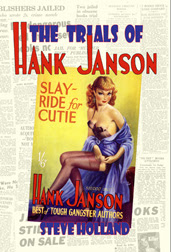
Philip Mendoza has always intrigued me because I've never been able to find out too much about him yet he connects two of my favourite hobbies, British comics and British paperbacks. Mendoza was an artist for the Amalgamated Press dating back to to 1951. Prior to that he had been an illustrator for magazines, newspapers and books and had met Stephen Frances who invited him to produce covers for his publishing company, Pendulum Publications. Around 1979, I picked up a little short story anthology entitled Jinn and Jitters, which was possibly the first Mendoza artwork I ever saw. When Steve Frances came to write Hank Janson, it was Mendoza who supplied the shadowy Hank Janson silhouette as well as a couple of covers, the only two not drawn by Heade.
Some years later, a friend of mine gave me some rather tatty copies of Playhour nursery comic as they contained some strips by Jesus Blasco. On the back cover was a strip relating the adventures of Gulliver Guinea-Pig, with colour art by Philip Mendoza. Fast forward to now and I'm working for the company that owns the rights to Gulliver and those beautifully painted pages. (You can find a few hundred Mendoza images at the Look and Learn website by following this link.)
Something that is always mentioned about Philip Mendoza was the fact that he was related to Daniel Mendoza, the famous bare-knuckle boxer of the late 18th and early 19th centuries. There's a useful entry on Daniel at Wikipedia which will save me some time talking about his career.
As I don't have that startling fact to dazzle anyone with, I'll try to prove how Philip Mendoza is related to the comedian (and comic strip star) Peter Sellers via Daniel Mendoza, thus connecting Philip Mendoza with another favourite hobby of mine, old radio comedy and The Goons. You'll just have to go with me on this one as I've no intention of putting in a thousand footnotes.
Peter Sellers was born Richard Henry Sellers, the son of William Sellers and Agnes (Peg) Marks who were married in 1923. Agnes was the daughter of Solomon Marks and Welcome Mendoza who were married in 1877. Welcome Mendoza was the daughter of Isaac Mendoza who was the son of Daniel Mendoza the boxer.
A nice easy line to trace.
Philip, meanwhile, was the son of Alfred Moses Mendoza and his wife Annie (nee Dobby). Alfred was the son of Mordecai Mendoza and his wife Rosetta (nee Lesser) who married in 1856. Moderecai was the son of Moses Mendoza and his wife Mariam (nee Mattatya) who married in 1821. Moses was the son of Mordecai Mendoza and his wife Zipporah (nee Levy) who married in 1798. Mordecai was the son of Moses Mendoza and his wife Judith.
Now, Moses was the seventh child of Aaron Mendoza, who had been born in Spain in 1709 but came to England where he married Benvenida Tubi (also Spanish) in 1730. Aaron's second child was Abraham Mendoza, who married Esther Lopez in 1752 and their son Daniel -- the boxer -- was born in 1765. Which makes Philip Mendoza's great-great-great-grandfather the uncle of Daniel Mendoza.
Ta da! (*It's starting to get chilly... so the above is from 'Gulliver Guinea-Pig's Search for Summer' from Playhour, 24 January 1959. © Look and Learn Magazine Ltd.)
Some years later, a friend of mine gave me some rather tatty copies of Playhour nursery comic as they contained some strips by Jesus Blasco. On the back cover was a strip relating the adventures of Gulliver Guinea-Pig, with colour art by Philip Mendoza. Fast forward to now and I'm working for the company that owns the rights to Gulliver and those beautifully painted pages. (You can find a few hundred Mendoza images at the Look and Learn website by following this link.)
Something that is always mentioned about Philip Mendoza was the fact that he was related to Daniel Mendoza, the famous bare-knuckle boxer of the late 18th and early 19th centuries. There's a useful entry on Daniel at Wikipedia which will save me some time talking about his career.
As I don't have that startling fact to dazzle anyone with, I'll try to prove how Philip Mendoza is related to the comedian (and comic strip star) Peter Sellers via Daniel Mendoza, thus connecting Philip Mendoza with another favourite hobby of mine, old radio comedy and The Goons. You'll just have to go with me on this one as I've no intention of putting in a thousand footnotes.
Peter Sellers was born Richard Henry Sellers, the son of William Sellers and Agnes (Peg) Marks who were married in 1923. Agnes was the daughter of Solomon Marks and Welcome Mendoza who were married in 1877. Welcome Mendoza was the daughter of Isaac Mendoza who was the son of Daniel Mendoza the boxer.
A nice easy line to trace.
Philip, meanwhile, was the son of Alfred Moses Mendoza and his wife Annie (nee Dobby). Alfred was the son of Mordecai Mendoza and his wife Rosetta (nee Lesser) who married in 1856. Moderecai was the son of Moses Mendoza and his wife Mariam (nee Mattatya) who married in 1821. Moses was the son of Mordecai Mendoza and his wife Zipporah (nee Levy) who married in 1798. Mordecai was the son of Moses Mendoza and his wife Judith.
Now, Moses was the seventh child of Aaron Mendoza, who had been born in Spain in 1709 but came to England where he married Benvenida Tubi (also Spanish) in 1730. Aaron's second child was Abraham Mendoza, who married Esther Lopez in 1752 and their son Daniel -- the boxer -- was born in 1765. Which makes Philip Mendoza's great-great-great-grandfather the uncle of Daniel Mendoza.
Ta da!
 (*It's starting to get chilly... so the above is from 'Gulliver Guinea-Pig's Search for Summer' from Playhour, 24 January 1959. © Look and Learn Magazine Ltd.)
Tuesday, December 05, 2006
Christine Gittings
 A slightly random entry. I believe Christine Gittings was a sub-editor on Jack & Jill comic in the mid-1950s (there was certainly a Miss C. Gittings writing captions for them briefly). Possibly (probably?) the same Christine Gittings who wrote the following series of six little (32-page) children's books:
Animal Friends series:
__1: Rodney the Snake Charmer, illus. Edward Ormond. London, Oxford University Press, 1957.
__2: Digger Was a Piebald Mole, illus. Kenneth Hauff. London, Oxford University Press, 1957.
__3: Acrobats of Beechy Wood, illus. Edward Ormond. London, Oxford University Press, 1957.
__4: Spinycoat the Hedgehog, illus. Edward Ormond. London, Oxford University Press, 1957.
__5: Topsy & Turvy Tortoise, illus. Edward Ormond. London, Oxford University Press, 1957.
__6: Stareybob the Friendly Toad, illus. Edward Ormond. London, Oxford University Press, 1957.
A little earlier, Christine Gittings is credited with a number of short stories sold to Gerald G. Swan, notorious 'mushroom' publisher of the 1940s and early 1950s, including 'Arachne' in Weird Story Magazine 2 (1946), 'Oh! To Be a Wasp' in Fairies Album 1949 (1948) and 'Beneath the Mountain' in Weird & Occult Library 2 (1960), although the latter was probably sold in the 1940s.
But is she the same Christine Gittings who wrote a lengthy book of poetry entitled Dreamer's Canvas (London, The Mitre Press, 1976)?
(* The rather poor picture I nabbed from a recent eBay sale.)
Monday, December 04, 2006
Comic Clippings - 4 December
A positive review of Great British Comics by Paul Gravett & Paul Stanbury in The Times, 'The Comic Strip Grows Up' (25 November) adds an interesting list of the year's sbest-selling graphic novels: V For Vendetta (Titan Books, 11,104 sales in 2006), Watchmen (Titan Books, 3,971), The Complete Maus (Penguin, 3,634), The Uncanny X-Men: Dark Phoenix (Panini Books, 3,472) and Battle Royale (Panini Books, 3,380).
Meanwhile, sales figures for week-ending 25 November have appeared and record weekly sales for annuals thus: Doctor Who Annual (20,695), The Beano Annual (16,212), Match Annual
(11,501) and Bratz Annual (9,046).
The Observer had an article on the increasing sales of annuals and compilations on Sunday (3 December) under the title 'Guzzle a Festive Dish of Cow Pie' by Vanessa Thorpe. The Daily Mirror (4 December) also reviewed some of the recent reprints under the headling 'Nostalgic Buyers Make the Latest Retro Books Festive Smash Hits'.
More news from hither and yon:
Meanwhile, sales figures for week-ending 25 November have appeared and record weekly sales for annuals thus: Doctor Who Annual (20,695), The Beano Annual (16,212), Match Annual
(11,501) and Bratz Annual (9,046).
The Observer had an article on the increasing sales of annuals and compilations on Sunday (3 December) under the title 'Guzzle a Festive Dish of Cow Pie' by Vanessa Thorpe. The Daily Mirror (4 December) also reviewed some of the recent reprints under the headling 'Nostalgic Buyers Make the Latest Retro Books Festive Smash Hits'.
More news from hither and yon:
- 'Jock Keeps It Real With "Faker"'. An interview with 2000AD and DC Comics artist Jock can be found at Comic Book Resources (1 December).
- 'Enter Sandman' by Peter S. Scholtes. An interview with Neil Gaiman in the Minneapolis City Pages (28 November).
- 'Tardis of Delights'. Review of Great British Comics by Gravett & Stanbury in The Guardian (25 November).
- 'Graphic History ... Is Here To Stay'. Review of Osprey's new line of graphic novels in the Honolulu Star Bulletin (3 December).
- Garth Ennis & Steve Dillon's Preacher is heading for the small screen according to The Hollywood Reporter (29 November); information via Superhero Hype.
Sunday, December 03, 2006
John Brinkley
John Brinkley contributed to Swift Annual 3 to 5 (1956-58). No idea if he's the same guy who wrote the following books but there's a possibility.
Non-fiction
Design for Print. A handbook of design and reproductive processes. London, Sylvan Press, 1949.
Graphic Design. With special reference to lettering, typography and illustration, with John Lewis. London, Routledge & Kegan Paul, 1954.
Lettering Today. A survey and reference book, ed. John Brinkley. London, Studio Vista, 1964.
Non-fiction
Design for Print. A handbook of design and reproductive processes. London, Sylvan Press, 1949.
Graphic Design. With special reference to lettering, typography and illustration, with John Lewis. London, Routledge & Kegan Paul, 1954.
Lettering Today. A survey and reference book, ed. John Brinkley. London, Studio Vista, 1964.
Subscribe to:
Posts (Atom)
BEAR ALLEY BOOKS

Click on the above pic to visit our sister site Bear Alley Books