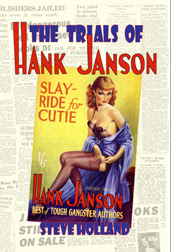
"Will shock those who regard drug-addiction as something that affects other countries, not our own," said Kenneth Robinson, M.P. "Should be compulsory reading for every doctor and politician who opposed the ban on heroin."
Raymond Vincent Thorp was born in Thornton Heath, Surrey, on 29 September 1930, the son of Alfred Henry Thorp (1882-1953), a house decorator, and Beatrice Alice Stacey (1884-1961), married in 1904, who went on to have six children. Thorp, the youngest of the six, later described his childhood as "Drab, colourless, dismal, best forgotten." His father, who, by the 1930s, ran a tiny building business, died while Thorp was jailed in Brixton.
Educated—thanks to a scholarship—at a grammar school in South London, he left at 16 to enter an office in Kingsway where he was promoted after a year to Junior Export Clerk. A growing interest in swing music and jazz took him to clubs along Oxford Street and in Soho where he started smoking "charge". He soon became a dealer in half crown bags of marijuana and was soon in court, pleading guilty on 10 September 1951; a week later he was released into the custody of his sister (his father was, at the time, hospitalised due to complications arising from an earlier fall that had caused a split skull).
Soon after, he began dealing in cocaine, was almost sacked from work for smoking hemp, and moved into a bedsit in Bayswater; he moved permanently into a flat the West End in the spring of 1952, from where he dealt hash, hemp and heroin. Thorp was arrested and charged with possession of cocaine, entering a guilty plea when he was charged a week later and sentenced to six months.
Released in November 1953, he moved into a bed-sit in W2, where he started dealing again, and later moved to the East End in Cable Street and then Rowton House, all the time pushing hash but earning very little. Whilst renting rooms in Camden Town and Kentish Town he was on National Assistance, which barely covered his rent; he added to it by conning kids with phoney drugs. He was arrested for petty larceny in June 1954 and sentenced at Clerkenwell to four months at Pentonville. He was released on 21 August 1954.
After a few month odd-jobbing in Oxford and London, Thorp sold his story to Reynolds News, where he featured on Sunday, 28 November 1954. Derek Agnew, a newspaper journalist, records in Viper that he met Thorp in a rundown flat in Piccadilly in the summer of 1955 and worked with him for some months on the book, which he (Agnew) wrote an introduction and afterword, and almost certainly ghosted the rest.
Viper was published by Robert Hale in 1956.
What became of him after that, I have no idea. A couple of phone book entries list him as living in Bayswater in the early 1980s. He was living at 6 Effra Court, Brixton Hill, London SW2 when he died on 12 September 1990.
Saturday, September 10, 2016
Friday, September 09, 2016
Comic Cuts - 9 September 2016
The humdrumery of life continues. Midweek I went to the dentists to (finally!) have one of my back molars removed. This is the tooth that was originally going to be crowned, but as we began taking the final steps (I'd even paid the deposit), my dentist decided that the tooth couldn't be saved and removal was the best option.
It's a deep tooth, so I was referred to a specialist. Mel and I—she being my "responsible adult"—arrived at 9:15 am, signed a couple of forms, and I was in the dental surgeon's chair by 9:30. An anaesthetist said, "You'll feel a little scratch on the back of your... there, that's it," and that's all I remember.
The next thing I'm aware of is sitting in the little recovery room mumbling my date of birth and, for all I know, my bank account details. The nurse who deciphered my answer (I had a mouth packed with gauze) left and ordered us a taxi. I'm a bit hazy on the taxi ride, but remember getting home around 11. Mel nipped off to pick up some prescription tablets that they wanted me to take and I sat on the sofa, a bit dazed, watching the TV.
I decided to sleep off the effects of the anaesthetic, so I got my head down for a couple of hours, waking up again around 1:45. Apart from the bloody gauze, which I removed, and a slight jaw ache, which was being controlled by painkillers, I felt surprisingly chipper. You hear horror stories of people coming down from anaesthetic, but not for one moment did I believe I was at Hogwarts. I spent the afternoon splitting my time between the TV and catching up with a bit of work; had my first cup of coffee at 6:30—having let it cool right down—and had dinner at 8:30—again, having let it cool down.
Everything felt so normal that I let my guard down and had a moment of panic when, taking an Ibuprofin, I didn't swallow and the pill wedged itself into the hole left by the removed tooth. I had to fish it out with my fingers in front of a mirror, which won't register so high on the ten-point scale of, say, picking up a kitten to pulling a bloody body out of a foxhole at The Somme, but which was, momentarily, the worst thing that had ever happened to anyone, anywhere, ever.
My latest book, "Iron Mask" The Story of Harry Bensley's "Walking Round the World" Hoax, is now being stocked at the delightful Wivenhoe Bookshop. Someone from the local history society had spotted a copy of the book I'd given to the tiny local museum for their reference and asked at the shop if they had a copy. The first I knew of it was when an e-mail arrived asking if copies were available.
So I exchanged slippers for shoes and walked the 100 yards to the shop and dropped one in (the last one I had to hand, as it happened). Fortunately, I'd just ordered up some more for myself, which arrived this week, so I was able to fulfill the order and issued my first invoice for the book. A whole six copies, the profits from which immediately went towards buying us dinner down at the Crown. "Towards", not "paid for". This book-selling lark doesn't pay so well.
You can still buy it from Bear Alley Books, but hopefully this will get it to a different audience.
Random scans. Couldn't resist putting together a handful of covers celebrating my getting doped up to the eyeballs.
Labels:
Comics News
Thursday, September 08, 2016
Commando issues 4947-4950
Commando issues on sale 8th September 2016.
Commando No 4947 – The Experts
Lieutenant Doug MacKay was a non-nonsense agent of the Special Operations Executive — used to doing things by the book.
When tasked with uncovering vital intelligence plans from a Nazi safe deep behind enemy lines, the unyielding operator did not expect to be paired with Private Alex Drake, a former criminal but an expert safecracker.
Drake was under no illusion that if ever it looked like they might be captured, his SOE mentor would rather kill him in case he cracked under interrogation. It was an uneasy alliance, to say the least.
Story: Ferg Handley
Art: Carlos Pino
Cover: Carlos Pino
Commando No 4948 – The Golden Gun
A real hero’s gun.
A Colt .45, the long barrel gleaming with gold plate, cunningly engraved. The butt of ivory, the whole weapon as perfectly balanced as a bird and on a hair trigger.
Many a time cowboy film star Brad Landon had got himself out of a movie tight corner with a lightning draw and the bang-bang of a blank from the Golden Colt. But now he was Lieutenant Brad Landon, British army, and in the thick of the Dunkirk retreat. The draw had to be faster, and the golden gun was spitting real lead instead of blanks…
Introduction
Unusual, almost fabled objects such as our eponymous handgun have been a Commando staple throughout the decades. They are a good device for propelling a plot forward and also, as you’ll see here, a handy way to geographically move the story along too — from a rear guard action at the beaches of Dunkirk to the arid deserts of North Africa.
The late Ken Barr’s rendering of the Golden Gun itself is wonderfully lurid and dramatic too. It’s almost as if this book was tailor-made for the gold Collection itself.—Scott Montgomery, Deputy Editor
Story: Newark
Art: Alonso
Cover: Ken Barr
The Golden Gun, originally Commando 249 (February 1967), re-issued as Commando No 903 (January 1975)
Commando No 4949 – Flying Feud
As a tail gunner on an Avro Lancaster bomber, Sergeant Lex Duffield was used to danger in the sky.
However, more even danger soon appeared in the unlikely form of a fellow Lanc rear gunner — the reckless and short-tempered Sergeant Tommy Deakin — and inevitably they clashed.
Fate soon intervened and they faced a threat neither could possibly have imagined — and they would just have to work together to survive.
Story: George Low
Art: Jaume Forns
Cover: Ian Kennedy
Commando No 4950 – Master Spy
A good spy never gets caught. He tries to become so much part of the enemy set-up that he’s never even suspected…until it’s too late. And, even then, the best of the breed always have an escape route — even although it’s back into the lion’s den!
Introduction
I’ve always maintained that espionage is fairly difficult to tackle successfully in comics because, as a genre, it tends to involve lone characters telling us what is going on in their heads via lengthy thought balloons.
However, author Alan Hemus takes advantage of our 63-page format to give us an excellent set-up and back story for our hero, Georg Hofmann. We get a chance to see what motivates him to risk his life as he works under deep cover amongst an insidious enemy.
Master Spy has a great script and art, all perfectly topped off by Ian Kennedy’s stunning cover.—Scott Montgomery, Deputy Editor
Story: Alan Hemus
Art: Rezzonico
Cover: Ian Kennedy
Master Spy, originally Commando No 2489 (July 1991)
Wednesday, September 07, 2016
2000AD 1997 + Rebellion releases for September
2000AD Prog 1997, released Wednesday, 7 September 2016
Cover by Cliff Robinson
Judge Dredd: Ladykiller by John Wagner (w) Carlos Ezquerra (a) Annie Parkhouse (l)
Scarlet Traces: Cold War by Ian Edginton (w) D'Israeli (a) Annie Parkhouse (l)
Jaegir: Warchild by Gordon Rennie (w) Simon Coleby (a) Len O'Grady (c) Simon Bowland (l)
Outlier: Survivor Guilt by TC Eglington (w) Karl Richardson (a) Ellie De Ville (l)
Anderson : Psi Division by Emma Beeby (w) Nick Dyer (a) Richard Elson (c) Ellie De Ville (l)
Misty
Welcome to my world of mystery and shadows where the unusual is usual…where the unexpected is expected. MOONCHILD. Like her grandmother before her, Rosemary Black has discovered that she has the power to move things with her mind. A crescent shape on her forehead marks Rosemary as the Moonchild. While her jealous mother forbids her to use her new found abilities, the actions of a school bully push Ms Black closer and closer towards temptation and revenge. THE FOUR FACES OF EVE. Eve Marshall develops amnesia after an accident. Unable to remember anything about her past and haunted by nightmares involving the tragic deaths of three other girls, Eve sets out to discover the chilling truth of who…or what she really is. These eerie encounters are brought to you by Pat Mills, John Armstrong, Malcolm Shaw, Brian Delaney and, of course, your friend, Misty!
Rebellion 978-1781-08452-6, 8 September 2016. Buy from Amazon.
The Mighty One: My Life in the Nerve Centre by Steve MacManus
1973, a 20-year-old Steve MacManus joined Fleetway Publications as a sub-editor on one of the UK’s top adventure titles, Valiant. Within six years, he would rise to become editor of the company’s most celebrated weekly, 2000 AD, shepherding it through its ‘Golden Age’ as he commissioned hit series such as The Ballad of Halo Jones, Sláine, Bad Company, Rogue Trooper, Nemesis the Warlock and more. For many he remains the definitive editor of the multi-award-winning SF anthology. Now, in this warm and witty memoir, MacManus lifts the lid on the fiercely creative environment that was British comics in the 1970s and ‘80s. With keen insight, he reveals how against all odds 2000 AD became a global phenomenon.
Rebellion 978-1781-08475-5, 8 September 2016. Buy from Amazon.
Tuesday, September 06, 2016
Then: The sad story of William Dyson
I've just started reading Rob Hansen's massive history of British science fiction fandom, Then, and finding it fascinating. Although I was only ever on the periphery of fandom—a member, at times, of the British Fantasy Society and the British SF Association, but never that active—I've always found its history fascinating. It dates back to my school days and a project I did about early British SF magazines (which eventually became about one British SF magazine, but that's another story). While I was researching, I read Walter Gillings' "The Impatient Dreamers" series and was, for the first time, introduced to early SF fandom.
Some years later, Rob Hansen published a fanzine called Then, which detailed far more of fandom's history from the 1930s through the 1970s.. Now there's a massive volume, published by David Langford's Ansible Editions, that expands Rob's work even further—it's now a 454 page monster with some 228,000 words and hundreds of photographs to break up the tightly set text and now available in both hardcover and softcover.
Amazingly, for all its depth, there are still stories to be discovered. On page 27, for instance, I read: "At some point in 1936 one of the Leeds group's earliest members, W. A. Dyson of Huddersfield, was killed in an accident." Behind those twenty-or-so words lies a rather tragic tale...
William Aldwyn Dyson was born in 1916, the son of Henry Cresswell Dyson (1873-1944) and his wife Amelia Mary (nee Morgan, 1876-1954), who had married in 1904. Daughters, Hilda Mary (later Barker, 1904-1986) and Irene Maud (1906- ), were born soon after. The family lived at 10 Leeds Road, North Huddersfield, in 1911, and Mr. Dyson, who had been born in Huddersfield, made his living as a foreman in a local cotton and wool dyeing business.
It was a trade his son would try to follow him in. In 1933, when the family were living at Arnold Street, Birkby, Huddersfield, William began attending Leeds University, travelling in every day from Birkby to study colour chemisty, with a view to taking up dyeing. In May 1936, when he was in his third year and preparing to take his B.Sc. degree, he began sitting his City and Guilds exams.
On Friday, the 8th of May, at about 5pm, a few hours before he was due to sit his fourth and final exam, William's body was discovered by a member of staff in the basement of the chemistry department at the University, an area not usually frequented by students as it was used primarily as a store-room. His face was covered with a large wad of cotton wool which had been saturated with chloroform. A doctor was called and William was removed to the General Infirmary, but was pronounced dead on arrival.
Foul play was not suspected and William's father, Henry, by now a partner in the firm of Tom Liversidge & Sons of Canal Bank Works, Huddersfield, admitted that his son had been considerably depressed during the previous week, telling the Yorkshire Post:
Despite this reassurance, William had taken a flask of chloroform down to the basement below the chemistry department where he sat down on a bale of wool. The inquest recorded a verdict of suicide while temporarily insane.
"It was the first death in British fandom," records Rob Hansen.
Some years later, Rob Hansen published a fanzine called Then, which detailed far more of fandom's history from the 1930s through the 1970s.. Now there's a massive volume, published by David Langford's Ansible Editions, that expands Rob's work even further—it's now a 454 page monster with some 228,000 words and hundreds of photographs to break up the tightly set text and now available in both hardcover and softcover.
Amazingly, for all its depth, there are still stories to be discovered. On page 27, for instance, I read: "At some point in 1936 one of the Leeds group's earliest members, W. A. Dyson of Huddersfield, was killed in an accident." Behind those twenty-or-so words lies a rather tragic tale...
William Aldwyn Dyson was born in 1916, the son of Henry Cresswell Dyson (1873-1944) and his wife Amelia Mary (nee Morgan, 1876-1954), who had married in 1904. Daughters, Hilda Mary (later Barker, 1904-1986) and Irene Maud (1906- ), were born soon after. The family lived at 10 Leeds Road, North Huddersfield, in 1911, and Mr. Dyson, who had been born in Huddersfield, made his living as a foreman in a local cotton and wool dyeing business.
It was a trade his son would try to follow him in. In 1933, when the family were living at Arnold Street, Birkby, Huddersfield, William began attending Leeds University, travelling in every day from Birkby to study colour chemisty, with a view to taking up dyeing. In May 1936, when he was in his third year and preparing to take his B.Sc. degree, he began sitting his City and Guilds exams.
On Friday, the 8th of May, at about 5pm, a few hours before he was due to sit his fourth and final exam, William's body was discovered by a member of staff in the basement of the chemistry department at the University, an area not usually frequented by students as it was used primarily as a store-room. His face was covered with a large wad of cotton wool which had been saturated with chloroform. A doctor was called and William was removed to the General Infirmary, but was pronounced dead on arrival.
Foul play was not suspected and William's father, Henry, by now a partner in the firm of Tom Liversidge & Sons of Canal Bank Works, Huddersfield, admitted that his son had been considerably depressed during the previous week, telling the Yorkshire Post:
He repeatedly told me that he was afraid he would not be successful in passing his examination, but in spite of the fact that I told him not to worry he has been worrying a good deal. Some weeks ago he was confined to bed for seven weeks through fluid on the knee as a result of overstrain when taking part in athletic competitions.An inquest was held on the following Monday during which it was revealed that William's injury would have prevented him from playing football for the whole of the next season. His head of department, Professor F. M. Rowe, described him as a brilliant student and had told him that he had no need to worry about the results as he had passed far stiffer examinations during his time at the university.
The doctor had warned him that he would never be able to take part in athletics to the same extent again, and the two things together had caused him to be extremely depressed.
Despite this reassurance, William had taken a flask of chloroform down to the basement below the chemistry department where he sat down on a bale of wool. The inquest recorded a verdict of suicide while temporarily insane.
"It was the first death in British fandom," records Rob Hansen.
Labels:
Science Fiction,
Then
Monday, September 05, 2016
Misty
Misty holds something of a privileged position amongst British comics' fans in these days of websites, chat groups and file sharing. It was one of the first girls' titles that the curious fan could read, dipping into stories they—the widely skewed towards male audience for file sharing comics—would almost certainly not have read back in 1978 to 1980 when Misty was originally appearing.
There is a familiarity to Misty that is attractive to those of us who grew up on 2000AD—the longer stories, the splash panels (or even splash pages) that dramatically introduce each episode... it's a title that anyone reading boys' comics from that period will find comfortably familiar.
Perhaps not surprising, as the creator behind Misty was none other than Pat Mills, who helped launch Battle Picture Weekly, Action, 2000AD... he also had a hand in Jinty and Misty, building on the work of Gerry Finley-Day and Wilf Prigmore who helped revolutionise the content, throwing out stories featuring ponies and fashion models and installing creepy, Gothic horror yarns and tales of sacrifice and determination as young girls overcome tragic circumstances and terrible accidents to win through in the end.
From the perspective of a fifty-something man rather than a twelve-year-old girl, the source material for "Moonchild", the opening story in this new collection, is rather obvious. Rosemary Black lives in a house without electricity of modern conveniences, which makes her a target for bullies at school who think she is weird and that her mother is a witch. Rosemary’s widowed mum is a stern disciplinarian, convinced her daughter has wickedness in her and that beating her is the only solution, despite being warned by the courts about her violence.
After a nasty prank by bully Norma Sykes goes horribly wrong, resulting in her hair catching fire, Rosemary is seen by the school nurse, who asks about the crescent-shaped scar on her forehead, which seems to be hot to the touch. Rosemary herself feels a power coursing through her at times of stress, causing a bookshelf to fall on Norma and the bike of her friend Anne to jerk aside when she is almost hit by a lorry. A doctor tests her and discovers she has telekinetic powers that seem to be growing stronger as Rosemary learns about her grandmother who also had a similar scar.
Meanwhile, Norma and her gang are planning to make Rosemary suffer through making one of her dreams come true: a birthday party that they plan to make very special.
After only a couple of episodes, the debt to Stephen King's Carrie was so obvious that the reader is left waiting for Rosemary to go "the full Carrie" which undercuts any surprise the ending may have. Of course, the 12-year-old audience wouldn't have that problem, but it probably explains why I thought "The Four Faces of Eve" was by far the better of the two stories here.
The set up is genuinely mysterious: Eve Marshall dreams of an aircrash, a young girl crying for help as the plane explodes… the same dream every night for six months. Her mother says the dream is a consequence of the fire at their home that left Eve needing skin grafts during her year-long hospital stay. Although she struggles to remember anything, she is suspicious that her mum and dad lack any parental affection and wonders why no friends have visited. The hospital is like a prison.
Her parents whisk her away to a remote country house one night where the sparse decoration of her new bedroom reminds her—her first memory of the past—that she once had cat posters on the wall. Her mother seems to only guess at what posters she once had and her father’s tax returns reveal he has no daughter…!
There is genuine tension in the story. Eve is isolated: no friends, no family and no memories. The plot unfolds slowly. A burglary at the home reveals that fingerprints match those of a Margaret Hawthorne, who died with her family in a car accident a year earlier. Later, she discovers she is the spitting image of another girl, Lucy Bartram, who was run over by a bus around the same time.
The truth is eked out over the 12 episodes and it will keep you gripped right to the end.
The artwork for the stories has the clarity, dynamism and motion typical of British artists John Armstrong and Brian Delaney, who were both superb at capturing the emotional range of the girls' comics (far greater than the gritted teeth and surprise required of most boys' comics).
Hopefully the two reprints here will do well enough for Rebellion to consider more of the same now that they own the rights to Misty and its many companions from the 1970s and 1980s.
Misty, Rebellion ISBN 978-1781-08452-6, 8 September 2016, 112pp, £14.99, available from Amazon.
Saturday, September 03, 2016
Invasion Colchester 2016
Invasion Colchester took place today around the centre of town. It's essentially a huge excuse to cosplay and raise money for charity that has been running since 2011. (You can discover the history behind Invasion Colchester here.) The best thing about it is how actively everyone gets involved and while there are many cosplayers running around and many bucket carriers collecting money, there's no chugging ("charity mugging") and loads of young kids dressed up and joining in the fun, interacting with the older cosplayers and having a great, safe time.
Illustrators #15
The latest issue of Illustrators (Summer 2016) has articles on two artists I've met... well, one of them I interviewed over the phone, but it still counts. Dave McKean arrived on the comics' scene like a thunderstorm, his painted artwork for Black Orchid and Arkham Asylum beautiful and darkly menacing at the same time; his covers for Sandman then blew away an audience that wasn't the core comics' fan, a base he continues to attract with his ongoing collaborations with Neil Gaiman.
And then there are his childrens' books illustrations, which are eclectic, multimedia art projects (such as the recent Black Dog project which is to be performed at the Tate in November) and even movies. McKean hasn't stood still since the early days of art fanzine Meanwhile and his first graphic novel, Violent Cases.
Diego Cordoba's article on McKean dips into all these areas in a lengthy and gorgeously illustrated overview of his career. Many of the illustrations are new to me as they include murals painted for some of Heston Blumenthal's restaurants, posters, CD and book covers and as yet unseen new material.
Sam Peffer I knew better, having met and chatted with him at many book fairs; I ran some of his autobiographical writings in my paperbacks fanzine PBO almost exactly twenty years ago. Sam died in 2014, aged 92, so it's nice to see a tribute to his work appearing here. Gary Lovisi draws extensively from Sam's unpublished autobiography for information and from his years painting paperback covers for Pan for most of his illustrations.
The most interesting aspect of the article is where Sam's reference photos are run against the finished pieces, which often featured his wife, Kitty.
The third big feature this issue concerns artist Andy Thomas, whose action paintings of the Wild West owe much to Frederic Remington and C. M. Russell. The artist, born and raised in Missouri, where he still resides, is inspired by the old Wild West and Civil War era which he has been depicting for twenty-five years or so, at first selling his paintings through art fairs and later finding wider commercial success.
Wrapping up the issue is a look at the whimsical fantasy paintings of Jonathan Ball, who is interviewed about his use of computers and 3D software.
For more information on Illustrators and back issues, visit the Book Palace website, where you can also find details of their online editions, and news of upcoming issues. Issue 16 will feature Neil Adams, Paul Slater, Cecil Glossop and Will Davies.
Labels:
Illustrators,
Review
Subscribe to:
Posts (Atom)