Friday, September 18, 2009

Comic Cuts: 18 September 2009

After a few weeks where I've hardly had any news I'm pleased to say that things are moving again on the book front. Above you'll see proofs for the Frank Bellamy's World War 1 and Frank Bellamy's Complete Swift Stories which will be coming out from Book Palace Books in November. I've been talking about these all year and--at last!--we're close to signing them off and getting the printing presses rolling.

Both are going to be limited editions: the World War 1 has a print run of 1,250 but the Complete Swift is going to be limited to 220 copies and a real collectors' item, bound in red leather. If all goes to plan (and if 2009 has taught be anything it is that plans can go awry!) copies of the World War 1 book will be signed by both myself (as editor) and Norman Boyd, who has written the introduction.

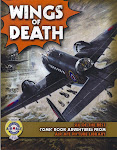
Next... I've signed on to do three more war books for Carlton that will be published in the spring of 2010, namely Wings of Death (Air Ace #2), No Surrender (War #4) and Hit the Dirt (Battle #3). These will be slimmer than the previous volumes but will be more wallet-friendly in these days of recession and credit crunch.

As usual I have until yesterday to get them turned around, so next week I'm taking a break from writing reviews. Yes, I'm still churning them out... over 90 so far and still quite a stack to do. If you want some idea of why I've been a bit slack updating the news on Bear Alley, here's a quick list of subjects I've had to tackle this week: psychiatry, appropriate technology, classic Greek history, the 9/11 terrorist attacks, 17th century political philosophy, a western, Freud, Jung, Nietzsche, the Holocaust, punk and the Angry Young Men. Throw in a cuddly toy and you'll begin to get some notion of why I've been struggling to get my head around anything else. Trying to condense books that tackle such huge subjects and review them in under 150 words and make sure that review number 90 doesn't read like a retread of reviews 89, 88, 87 or any of the others isn't nearly as easy as it sounds.

But another bit of good news is keeping me cheery. I've got a deal in place to do Eagles Over the Western Front in book form, so I'll begin work on that at the earliest possible moment I get. It will mean re-scanning the whole thing (the scans I've been using here are a rough-and-ready set we had produced for reference and aren't up to scratch as far as printing goes) so it won't be happening instantly but it's a step in the right direction as far as Bear Alley Books goes.

All in all, I have to say it's been a good week as far as news goes. Hope yours was as good.

Thursday, September 17, 2009

A Day in the Life of a Cartoonist

I stumbled across this recently when I was sorting through a pile of books. It comes from a pocket book magazine entitled Winter Pie, published in November 1946. The 'Pie' series was published quarterly--plus an additional Christmas number--by Hutchinson for a few years during and after the war (1943-50) and is probably best remembered these days because it contained a number of stories by Frank Richards featuring the exploits of the boys of Carcroft School. But the magazine was a real miscellany of features, stories, photos, cartoons and profiles.

Here we have a day in the life of cartoonist Leslie Starke whose work appeared in Punch, Lilliput, John Bull, Men Only, Sketch, Illustrated, etc. A Scot, Starke was born in Fife in 1905 and died in 1974.

(* Winter Pie probably © Hutchinson & Co.)

Wednesday, September 16, 2009

The Misadventures of Jane

Simple mention of the name Jane should be enough of a clue for most readers to know the subject of Titan's latest book is the famous character whose adventures appeared in the Daily Mirror for many years. The Misadventures of Jane reprints two long strips from Jane's wartime adventures when Jane was the pin-up of choice of the British Army, Navy and Air Force. Although Norman Pett had created her in the early 1930s, the strip debuting shortly before Christmas in 1932, she was originally the star of one-off situations. It wasn't until the arrival of Don Freeman six years later that she became the star of continuity strips.

Strips being the apt word. Increasingly, the attractive flapper of the early Thirties became more sultry and less clothed. Pett was always at his best when using live models. His model for Jane was Crystabel Leighton-Porter, who was working at a Birmingham telephone exchange and modelling part-time when discovered by Pett in 1939. Her arrival coincided with the advent of war and, with hundreds of thousands of young men posted away from parents, wives and families, Jane reached her pinnacle. During the war there was a degree of freedom allowed that had not existed a few years earlier: artistic photos of nudes, whilst not encouraged, were not discouraged from open sale and Jane also reflected this new freedom. Although there had been many a glimpse of thigh above the stocking line, Jane finally revealed all in 1944.

While Crystabel moved into variety and burlesque shows during the war years (and would later star in the 1949 The Adventures of Jane movie), Pett found himself another model, Betty Burton, although photographs of Crystabel filled the pages of Jane's Journal, which Pett published in the years immediately after the war. These Journals were filled with pin-up art, photographs, stories and comic strips, some of which make a very welcome appearance in the Titan volume. For many fans these will be the draw (the black & white strips having already appeared in the earlier, now out-of-print, Jane at War) as the Journals contained much of Pett's best work.

Overall it's a nice selection. Even the strips that have appeared before are reproduced better (and on far superior paper) than in the Jane at War collection. An excellent feature from the pages of the Canadian magazine The Maple Leaf (18, 19 & 24 July 1945) offers a detailed background to the strip and an excellent introduction to Pett and his work.

The timing of the collection couldn't be better: as we remember the 70th anniversary of the Second World War what better way to celebrate than with Jane, the forces sweetheart.

The Misadventures of Jane. Titan Books ISBN 978-1848561670, 25 September 2009.

Tuesday, September 15, 2009

Winsor McCay

For an artist so well known, you would think Winsor McCay's birth date would be easy to establish. For American artists (on which subject I'm definitely not an expert) I usually make Wikipedia my first port of call. Here I learned that there was quite a bit of confusion about McCay and his origins.

"He claimed to have been born in Spring Lake, Michigan, in 1871, but his gravestone says 1869, and census reports state that he was born in Canada in 1867." Hmmm....

The New York Times obituary for McCay says he died (on 26 July 1934, which sources all seem to agree upon) at the age of 62. "Winsor Zenic McCay was born at Spring Lake, Mich., where his father was a lumberman." The implication is that he was born in 1871/72.

This is roughly what McCay said in census returns. The 1910 census finds him living in Brooklyn, aged 40 and said to be born in Michigan of Canadian parents. The 1920 census gives the same information, with McCay's age increased to 50.

However, working backwards, the 1900 census return gives his date of birth as September 1868. McCay (listed as Windsor McCay), is already married to Maude Lenore McCay (nee Dufour) and the two were living in Cincinnati, Ohio.

With no 1890 census data to check, we have to take a 20 year leap back to the next census return available. Here the McCay family are listed under their birth name of McKay and the five family members are living in Spring Lake, Ottawa County, Michigan. We can now introduce McCay's parents: Robert and Jeannette, both listed as 38-year-olds from Canada. Their children are Zenas W. McKay (12), Arthur (10) and Mary (4). Zenas was born in Canada and the other two in Michigan.

(* Since Mary isn't going to be mentioned again, IGI records show that she was born Mary C. McKay at Spring Lake on 21 May 1876. Neither of her siblings are listed.)

Continuing our trip backwards to 1870, Robert (29) and Jennie (28) are already in Spring Lake, with sons Zenas (3) and Arthur (2). Again, Arthur is the only child born in Michigan.

As you'll have seen from the above, Winsor McCay's age changes over the years. The 1870 census was taken on 16 August 1870 and his age as of his last birthday was 3. This implies that he was born between 17 August 1866 and 16 August 1867 and, if we are to believe he was born in September that would have to be September 1866. The 1880 census returns were made on 2 June 1880 and 12 years of age implies a birth between 3 June 1867 and 2 June 1868, or September 1867. By 1900 he was claiming to have been born in September 1868.

So why all the changes of dates?

One explanation can be spied if you work the information from the other direction. A bit of good fortune means that a little searching reveals that Robert McKay, the son of Donald and Christiana McKay, was living in West Zorra Township, Oxford, Ontario, Canada, when he married Janett Murrey, daughter of Peter and Mary Murrey, on 8 January 1866. Robert was aged 23 and his new wife 25. In the 1870 census they give their ages as 29 and 28, and 38 and 38 in 1880. I don't know if social convention frowned upon a man marrying an older woman but the slippage of two years by Jannett/Jeanette McKay may explain why their sons also managed to lose a year or two in the same period.

And, should Zenas Winsor McKay have been born on 26 September 1866, that was only 7 weeks after his parents married.

So take your pick... 1866 or 1867 are both likely. But probably not 1868 or 1869 and definitely not 1871.

A sad note regards McKay's brother Arthur. In 1900, as Arthur McCay, aged 31, he is an inmate of North Michigan Asylum, Grand Traverse, Michigan. He is still an inmate in 1930 (in the latter two decades the institution has been renamed Traverse City State Hospital), the last US census currently available.

Zenas Winsor McCay was reputedly named after his father's employer Zenas G. Winsor, about whom there is plenty known as he was well covered in the book American Biographical History of Eminent and Self-Made Men with Portrait Illustrations on Steel: Michigan Volume (Cincinnati, Western Biographical Publishing Company, 1878), pp.134-35.

Winsor's post-1868 biography isn't quite so well covered but the Pioneer Society of Michegan papers for 1891 notes Winsor's death at Chattanooga, Tennessee, on 3 August 1890. He and his wife were visiting their daughter, Mrs. George W. Wheeland and her family. He had not been well for some time, but his immediate cause of death was typhoid fever.

Monday, September 14, 2009

Comic Cuts 14 September 2009

No comic strip today. I've been busy with proofs and haven't had any time to line anything up. I have a few little features that I'll be posting over the next couple of days and the regular daily strip will be back shortly, once I'm caught up.

Roy Norton: The Man Who Died Twice

Almost unknown today, Roy Norton was a newspaperman and author who contributed dozens of stories and articles to pulp and slick magazines for thirty plus years from around 1905. His name cropped up in the SF Encyclopedia work I've been doing, much of which involves tracking down birth and death dates. We already had the years (1869-1942). Even if I couldn't come up with an actual date, it should have been relatively easy to find where he was born as his life encompassed six available US census records.

And that's where I came unstuck, because the guy I found who seemed to be the guy I was looking for—he was a newspaperman, born in Illinois—but this Roy E. Norton was born in September 1867 according to the 1900 US census.

At that time he was living in San Jose, California, with his wife of five years, Anna S. Norton (b. California, Aug 1874), and sons Selkirk Norton (b. California, Mar 1898) and Robert Norton (b. California, Aug 1896).

Having a son named Selkirk makes life rather easier tracking the family. In 1910 Alma was the head of household, with no sign of her husband, and working as a vocal teacher. Both sons were still living with her. Selkirk, born on 13 March 1898, went eventually to Washington, where he died on 6 April 1982.

But no sign of his father in 1910. And no sign of him in either the 1870 or 1880 census.

But definitely a sign of him in 1917, when it was announced that Roy Norton, Story Writer, had been a victim of an auto collision. The New York Times (16 July 1917) carried the news from Los Angeles that, injured when a car in which he was riding crashed into another automobile, the popular short story writer had died early in the morning of 15 July without regaining consciousness.

"For a time there was doubt whether the man killed was really Roy Norton, the author, but tonight Charles E. Van Loan identified the body as that of the story writer."

The biographical details that followed in the obituary noted that Norton had "married Miss Anna Katherine Selkirk of San Francisco in 1884." This would appear to confirm that the man found in the 1900 census was, indeed, our man.

Only it wasn't. On 21 July 1917, the New York Times published a retraction: "The report from Los Angeles that Roy Norton, the author, had been killed in an automobile accident on July 15 was denied yesterday by the local office of Curtis Brown, his literary representatives. A. W. Barmby, manager of the New York office, said that he had received a cablegram from Mr. Brown in London saying that Mr. Norton was alive and well and engaged in literary work in London."

Roy Norton continued to publish more stories and novels, proving that reports of his death were indeed a little premature. He eventually died at the age of 72 at his home in Freeport, Long Island, following a heart attack on 28 June 1942.

Roy Norton was born LeRoy Elisha Norton in Kewanee, Illinois, on 30 September 1869, the son of Frank Elijah Norton and his wife Ellen Frances (nee Way). He was educated at the Denver School of Mines and prospected for gold in California and Alaska in 1890-92 and again just before the turn of the century.

However, some of the occupations given to Roy E. Norton in his obituary in the New York Times would appear to confirm that my original Roy E. Norton (the one we presumed died in 1917) is, in fact, the author Roy E. Norton. According to the Times, Norton was involved in various newspapers, founding the San Bernardino Sun in 1892, serving as editor of The San Jose Herald in 1899 and working on the staffs of The Seattle Star, The Portland (Ore.) Journal and The San Francisco Chronicle. But while he supposedly was editor on the San Jose Herald in 1899, newspaperman Roy Norton—the Roy Norton I thought had died in 1917—was living in San Jose. To confirm conclusively that the two were one and the same person, the Times obituary notes that Norton was survived by two sons, Robert P. Norton of Long Island City and Kirk (an abbreviated version of Selkirk) Norton of Seattle. Norton had married his first wife in San Bernardino on 26 November 1895 (rather than 1894, as the Times had reported).

In 1901, accompanied by the writer Rex Beach, he crossed Alaska from Nome to the Arctic Ocean with a dog team, the first white men ever to make the trip. Between 1903-05 he returned to mining, acting as manager of the Golconda mine in Oregon. In 1906 he was chief engineer for the construction of the Cuban Railroad.

For the next twenty years, Norton made his home mostly in London and Torquay, Devonshire, England. Between 1904 and 1911 he travelled in Europe and the Far East—The Times notes trips through Europe, Turkey and North Africa—with four trips to the U.S.A. He was in California in 1908 when he married his wife, Dorothy (b. Brooklyn, NY, 5 June 1883). He travelled extensively in Russia in 1910 and, in 1911, he and his wife were in Berlin, Germany, before moving back to the UK in May 1913, working for the Curtis Brown News Bureau as a journalist. Precisely what his duties involved were I don't know, but an article about Emperor William II of Germany, published in Contemporary Review in December 1914 and soon after as a pamphlet, was translated into French, German, Dutch, Swedish and Spanish. He served as a captain in the British Army Intelligence in France during part of the war.

After the war he continued to travel widely, to France, Belgium, Germany and Switzerland, leading an exploration party through the Sinai Peninsula in Northern Arabia. He also directed engineering work in the Sahara Desert for the French Government in 1926, two of his engineering accomplishments in this period being the designing of golf courses in Biskra (French Algeria) and Tunis.

Roy and Dorothy Norton returned to the USA permanently in 1926, although they continued to visit the UK, and I can find no trace of them in the 1930 census.

Having shown that the Roy Norton married to Anna Selkirk Norton in 1900 is the same person as Roy Norton the writer, we still have a few things to resolve. For starters that September 1867 birth date. Almost certainly a transcription error, a 9 becoming a 7. You'd be surprised how riddled with mistakes the census records are.

A little trickier is where Roy Norton was born. In 1900 he was said to have been born in Illinois, and this seems to be confirmed by the New York Times who gave Kewanee, Illinois, as his birth place. But his applications for passports say that he was born in Memphis, Tennessee, and an IGI record gives two possible birth places: one states Kewanee, Illinois, while a second describes him as "of Kingsville. Ashtabula, Ohio". It is from IGI records that we know his full proper name and the names of his parents (his father's name is confirmed, by the way, on one of his passport applications, which notes that he, Frank E. Norton, was born in Maine).

The Times (again), notes that Norton had a brother "Gale Norton of Seattle". I'm reasonably sure this is Gale Norton, a hardware salesman, living in Seattle at the time of the 1930 census with his wife Leora and two children (Raymond and Gale) and mother Ella (although her name has also been given as Ellen). Gale, aged 55, was born in Iowa, c. 1874, so was a younger sibling of LeRoy. In the 1920 census their names are given as G. Norman Norton (43), W. Leora (34), W. Raymond (6) and F. Ella Norton (76). In 1910, Gale has become Norman G. Norton (34), living with his mother Ella S. (68) and brother Dean S. (36). In 1900, still as Norman G. Norton (24, born Iowa, July 1875), he is living at the home of his mother, Ella F. Norton (58, b. Ohio, July 1841).

Thanks to his brother, we now find the family in the 1880 census, living in Nodaway, Page, Iowa, where Frank E. Norton is working as a farmer. The family is listed as F. E. Norton (44), Ella F. Norton (38), Lee Roy Norton (10), Dean (7) and Gail (4). As Gale was born in Iowa, we might presume they had been there for at least four years.

Dean, incidentally, subsequently also moved to Washington and worked as a fiscal agent for a mining company. He is thought to have died around 31 January 1935.

Although I can find no trace of the family in the 1870 census, the earliest record I have of Roy/LeRoy/Lee Roy Norton is 1880, which gives his place of birth as Illinois.

Norton stood a half-inch under six feet, had brown hair, grey eyes and a dark complexion according to his passport application. Between 1910 and 1924 his stories were popular in Hollywood with no less than fifteen stories and novels adapted into silent movies (The Plunderer twice). Today he's all but forgotten. Except here... and we're left wondering why fellow writer Charles Van Loan would have identified a mystery victim of a car accident as Roy Norton... and whether it had anything to do with Norton's work for British Army Intelligence or was simply a mistake?

Novels
The Vanishing Fleets. New York, D. Appleton & Co., 1908.
The Toll of the Sea. New York, D. Appleton & Co., 1909.
The Garden of Fate. New York, 1910; London, Everett & Co., 1911.
The Plunderer, illus. Douglas Duer. New York, W. J. Watt & Co., 1912; London, Mills & Boon, 1914.
The Mediator, illus. Douglas Duer. New York, W. J. Watt & Co., 1913; London, Mills & Boon, 1916.
The Boomers, illus. W. Goldbeck. New York, W. J. Watt & Co., 1914; London, Mills & Boon, 1914.
The Man of Peace. London & New York, Oxford University Press/H. Milford, 1915
The Flame. A story of what might have been. London, Mills & Boon, 1916.
The Unknown Mr. Kent. New York, George H. Doran Co., 1916; London, Mills & Boon, 1916.
Drowned Gold. Boston & New York, Houghton Mifflin Co., 1919; London, Skeffington & Co., 1919.
The Scamps. London, Skeffington & Co., 1920.
The Turned Worm. London, Skeffington & Co., 1920.
Mixed Faces. New York, W. J. Watt & Co., 1921.
The Caves of Treasure. London, Hodder & Stoughton, 1925.
The Land of the Lost. London, Hodder & Stoughton, 1925.
The Shaman. London, Hodder & Stoughton, 1926.
The Benevolent Liar. London, Hodder & Stoughton, 1927.
The Crusader's Casket. London, Hodder & Stoughton, 1928.
The Liberator. London, Hodder & Stoughton, 1928.
The Frozen Trail. New York, E. J. Clode, 1932.
Below the Rio Grande. New York, E. J. Clode, 1933; London, George G. Harrap, 1934.
The Blossom Belle. New York, Curtiss Press, 1934; London, Philip Allan, 1937.
Tangled Trails. New York, E. J. Clode, 1934; London, G. G. Harrap & Co., 1935.
The Canyon of Gold. New York, The Macaulay Co., 1935; London, George G. Harrap, 1936.
Big Jim. London, Cassell & Co., 1937.

Novels as Norman Way
Mary Jane's Pa. New York, The H. K. Fly Co., 1909.
Captains Three. New York, E. J. Clode, 1912.
The Moccasins of Gold, illus. A. W. Parson, New York, E. J. Clode, 1912; as Red Gold, Grant Richards, 1913; as by Roy Norton, London, Mills & Boon, 1918.

Non-fiction
Guilty: The Magazine-Gun Tragedy, with William C. Hallowell. Chicago, Laird & Lee, 1904.
The Man of Peace. London, Oxford Pamphlets, 1915.

(* This would have been impossible to cobble together without the help of Victor Berch, John Herrington and Al Hubin to whom I owe many thanks.)

Saturday, September 12, 2009

Arthur Ransome's Swallows & Amazons

A few years ago, on one of those lazy, hot summer days, I was strolling around town wondering what to do for lunch. What I really fancied was lazing around in the park with a picnic, which I hadn't done for years. Not since I was a kid. Well, not on my own anyway. And here I was on my own, so I needed something to read.

A quick trawl around the charity shops turned up just the right book: Swallowdale by Arthur Ransome. I hadn't read any of the Swallows and Amazons books since school, but it was one of my favourite children's series, up there with Jennings and the Lone Pine novels.

So I sat in the park, reading and munching on a sandwich. The sandwich finished, I kept reading. Eventually the heat and the need to do some shopping put an end to this tranquil idyll, but I'd got through a good chunk of the book and it was just as good as I remembered.

Over the past couple of years I've picked up other Swallows and Amazons books whenever I've stumbled across them at the right (cheap) price. As I can never remember which ones I've bought recently and which ones I remember from when I was a kid, as usual I've ended up with duplicates of some titles. Not intentionally, but it does mean I can offer you this little cover gallery.

The covers I remember are the 1970s Puffin reprints which, I'm pretty sure, had covers based on Ransome's original illustrations. In about 1985, Puffin reprinted the whole series with new painted covers by Anthony Kerins. Then there was a reprint by Red Fox in 1993, who produced another edition in 2001.

The gallery below is a mixture of these different series. Hope you enjoy it.

SWALLOWS AND AMAZONS

Swallows and Amazons. London, Jonathan Cape, 1930.

Swallowdale. London, Jonathan Cape, 1931.

Peter Duck. London, Jonathan Cape, 1932.

Winter Holiday. London, Jonathan Cape, 1933.

Coot Club. London, Jonathan Cape, 1934.

Pigeon Post. London, Jonathan Cape, 1936.

We Didn't Mean to Go to Sea. London, Jonathan Cape, 1937.

Secret Water. London, Jonathan Cape, 1939.

The Big Six. London, Jonathan Cape, 1940.

Missee Lee. London, Jonathan Cape, 1941.

The Picts and the Martyrs. London, Jonathan Cape, 1943.

Great Northern?. London, Jonathan Cape, 1947.

Swallows and Amazons Forever [abridged edition of Coot Club and The Big Six].
London, Puffin Books, 1983.

Coots in the North, and Other Stories, ed. Hugh Brogan. London, Jonathan Cape, 1988. [[Don't have this one. Apparently this collection contains the incomplete novel that Ransome was working on when he died.]]

(* A fuller set of scans of covers for the various books can be found here.)

Friday, September 11, 2009

Comic Cuts 11 September 2009

I'm still waiting on news for my proposed slate of Bear Alley Books comics' titles (for which I apologise: it's very frustrating but beyond my control) so I've spent what I jokingly call my 'spare' time pulling together a collection of essays to celebrate 25 years since my very first 'book' was published. Actually it wasn't a book at all, just a set of duplicated pages held together with a staple entitled Scion and Dragon Books. It was published by Richard Williams, a book dealer based in Scunthorpe who published 15 of my paperback checklists between 1984 and 1990.

25 years later my bibliography is a bit more extensive and the checklists tend to be forgotten as they're long out of print and horrendously out of date. In that 25 years I've written something like 1,500 articles, news and reviews columns, introductions and lists... and I'm not counting this blog which is shortly to hit 750,000 words. I'm a bit amazed by these numbers myself. In the 1990s I was writing over 400,000 words a year—far more than I write now. I'm slowing down (and getting more rambling) in my old age!

To celebrate those 25 years, I've pulled together a collection of some of my favourite essays. Back in the '90s I was a regular contributor to Crime Time magazine, writing a regular column on any subject that grabbed my fancy each issue. The result was a series of pieces about authors (and a couple of film-makers) that I was interested in, ranging from 1950s British gangster writers like 'Ben Sarto' and 'Griff' to classic American hardboiled writers W. R. Burnett and James M. Cain. Along the way I also tackled Ed (Plan 9 From Outer Space) Wood, the pulp origins of hardboiled fiction, and the highest-selling American crime writer of them all, Mickey Spillane.

The book is called Mean Streetmaps and it will contain 16 essays. Someone's proofing the text for me at the moment and I'm hoping to have it out within a few weeks. I'm working on a micro-site for the book at the moment and as soon as that's ready I'll post a cover, contents page and details of how to order.

Back in December last year I mentioned that I was planning a yard sale. Not in the traditional sense of selling stuff out of a yard, but in the sense of clearing shelf-space by the yard.

Well, I finally got around to starting the big clear-out. I spent Sunday morning at the local boot fair selling off a load of old toys and tat that has been cluttering up cupboards for years, plus five large and two small trays of books. And we managed to sell over half of them, a total of over 200 books.

The frustrating thing is that not one of them was actually from a shelf, so I've not made any impact at all in that direction. I did recently sell some comic collections, but they only accounted for about six inches of shelf space. But between that and the boot fair, I've got rid of about 4 yards of books, so I'm off to a good start.

(By the way, anything I think will be of interest to readers of Bear Alley, I'll offer here first, once I can get a list together.)

Between finishing up Mean Streetmaps, writing reviews (oh, yes, that's still ongoing!) and sorting out books, I'm running late on answering e-mail queries so if you've written in asking questions in the last couple of weeks I apologise. I'm trying to catch up with the backlog but work has to come first.

Talking of work... my occasional employer, The Guardian newspaper, is giving away comics for the next week, starting tomorrow (Saturday) with an issue of Jackie, the Valentine Day issue from 1975. Over the following six days they'll give away the following comics: Sunday (Observer)—The Beano (#2000 from 1980); Monday—Roy of the Rovers (the 1981 issue when Roy is shot); Tuesday—Bunty (the 1972 Summer Special); Wednesday—The Dandy (the last Korky the Cat cover from 1984); Thursday—Tammy (the very first issue from 1974); and finally, on Friday—Whizzer & Chips.

You can see what the comics look like at the head of this column. I'm told that they're being reprinted in their original format.

Sunday, September 06, 2009

Barbara Lou the Kinkajou part 4

(* A huge thanks to John Rivers for the scans.)

Rodolphe Louis Mégroz

One of the names that cropped up when I was compiling the recent Golden Galley Press list was R. L. Megroz, and a little bit of digging turned up quite a bit of information on his career...

Rodolphe Louis Mégroz, was born in St. George Hanover Square, London, on 2 August 1891, the eldest child of Swiss-born Rodolphe Frederic Mégroz (c.1855-1899) and his wife Alice Jane (née Bull, 1862-?), who had married in 1890. He later described his ancestry to Who's Who as a mix of Pyrenean brigands and East Anglian farmers. His siblings included Theodore Frederic Megroz (1892- ), Rose Elise Megroz (1894- ) and Alice Beatrice Megroz (1895- ) and Maude May Megroz (1896-1897).

Rodolphe Frederic worked as a valet; in 1891 he was at Escrick Park, Escrick in York, possibly in service to a member of the 10th Royal Hussars who appear to be housed at Escrick Park. Alice, meanwhile, was living at 40 Alderney Street, St. George Hanover Square.

Life was clearly tough for the family following the death of Rodolphe Frederic Mégroz in 1899. Theodore Megroz was to be found in the Alexandra Orphanage in 1901, while widowed Alice was living in Dover, Kent, with daughters Rose and Alice, and working as a stewardess on the Channel Boat. Rodolphe Louis was educated at various institutions, including the Gordon Boys Home.

At the age of 17, Mégroz joined Farrow's Bank as a clerk, learned shorthand and accounts and became a cashier in 1911. He joined up immediately at the outbreak of the Great War and served with the West Yorkshire Regiment at Gallipoli in 1915, taking part in the landings at Suvla Bay. In 1916 he was to be found in Egypt as a shorthand writer in the Chief Censor's office. He spent two years in Egypt before returning to England at the end of the war to become an Education Instructor and an officer before being discharged at the end of 1919.

His first book of verse, Personal Poems, had already been published and, under the scheme for ex-servicemen which paid his fees and a grant, he enrolled in a Journalism Diploma course at London University, studying for the next two years whilst freelancing for various papers. During the 1920s and 1930s he wrote numerous books of literary criticism and biography and edited many anthologies of verse and letters, as well as writing numerous poems, book reviews, essays and articles for journals. He was also a playwright, his plays including Rossetti (with Herbert de Hamel), Mr Absalom (with Alan Sullivan), Mosquito Day and other plays for the BBC, and St Genevieve (with Leighton Lucas).

He married Phyllis Deborah Marks in 1921, with whom he had three daughters: Alison A. (m. John G. Lord, 1953), Christina and Monica J. (m. Anthony J. W. Taylor, 1950)); they separated in 1926 and divorced in 1931 (Phyllis, also a writer, subsequently married Horace C. Cummins in 1943 and died in 1973) and Rodolphe was married to Isabel L. Walton that same year.

During the Second World War Mégroz worked for the BBC European News Service. He then edited publications for the Overseas Food Corporation from 1949-51.

Mégroz lived at 116 Tufnell Park Road, London N.7 from at least 1932 until shortly before his death on 30 September 1968, aged 77. His last residence was Cheverells, Pickford House, Markyate, Hertfordshire. Some of his papers can be found at the University of Reading.

PUBLICATIONS

Non-fiction
Personal Poems. London, E. Matthews, 1919.
Walter de la Mare. A biographical and critical study. London, Hodder & Stoughton, 1924.
A Talk with Joseph Conrad and a Criticism of His Mind and Method. London, Elkin Mathews, 1926.
Francis Thompson. The Poet of Earth in Heaven. A study in poetic mysticism and the evolution of love-poetry. London, Faber & Gwyer, 1927.
Shakespeare as a Letter-Writer and Artist in Prose. London, Wishart & Co., 1927.
The Story of Ruth. An idyll. London, E. Mathews & Marrot, 1927.
The Three Sitwells. A biographical and critical study. London, Richards Press, 1927.
Dante Gabriel Rossetti, Painter Poet of Heaven in Earth. London, Faber & Gwyer, 1928.
For Fathers. A book of domestic letters, with extracts from diaries, histories and biographies. London, Hodder & Stoughton, 1928.
Letters of Women in Love Disclosing the Female Heart from Girlhood to Old Age. London, Thornton Butterworth, 1929.
Joseph Conrad's Mind and Method. A study of personality in art. London, Faber & Faber, 1931.
Ronald Ross, Discoverer and Creator, with a preface by Osbert Sitwell. London, G. Allen & Unwin, 1931.
Rhys Davies. A critical sketch. London, W. & G. Foyle, 1932.
Five Novelist Poets of To-day. London, Joiner & Steele, 1933.
Modern English Poetry, 1882-1932. London, I. Nicholson & Watson, 1933.
English Poetry for Children. A tract for the times. London, Fenland Press, 1934.
From the Scrip of Eros. Poems. London, Fenland Press, 1934.
A Guide to Poetry for Reciters and Teachers. London, Sir I. Pitman, 1934.
Dramatic Verse from Shakespeaere and his Contemporaries. An anthology for verse-speakers and schools. London, Sir I. Pitman & Sons, 1935.
Modern Poems for Children. An anthology for school and home, with Isabel Megroz. Wisbech, Fenland Press, 1935.
A Treasury of Modern Poetry. An anthology of the last forty years. London, Sir I. Pitman & Sons, 1936.
The Lear Omnibus. London, T. Nelson & Sons, 1938.
A Book of Lear, ed. R. L. Megroz. Harmondsworth, Penguin Books 234, 1939.
The Dream World. A survey of the history and mystery of dreams. London, Bodley Head, 1939.
The Real Robinson Crusoe. Being the life and strange surprising adventures of Alexander Selkirk of Largo, Fife, Mariner. London, Cresset Press, 1948.
Profile Art Through the Ages. A study of the use and significance of profile and silhouette from the stone age to puppet films. London, Art Trade Press, 1948.
Thirty-one Bedside Essays. Oxford, Pen-in-Hand Publishing Co., 1949.
Pedagogues Are Human. An anthology of pupils and teachers, grave and gay, from British and American fiction, biography, diaries, letters and verse. London, Rockliff, 1950.

Ghosted
How to Play Snooker by Stenley Newman [with C. D. Dimsdale]. London, Sir I. Pitman & Sons, 1936.
Billiards and Snooker for Amateur Players by Horace Lindrum [with C. D. Dimsdale]. Harmondsworth, Penguin Books 119, 1937.

Non-fiction as C. D. Dimsdale
Babies. A miscellany of the literature of infancy. London, Golden Galley Press, 1948.
Come Out of Doors. A guide for nature-lovers, illus. C. F. Tunnicliffe. London, Hutchinson & Co., 1951.
The Story of Grass. 1960. [reported but untraced]
Countryside and Coast. 1964. [reported but untraced]

Others
The Cook's Paradise. Being William Verral's 'Complete System of Cookery', published in 1759. With Thomas Gray's Cookery notes in holograph, introduction and appendices by R. L. Mégroz. London, Sylvan Press, 1948.

(* Our column header is a silhouette of Mégroz drawn by Hubert Leslie, 1949.)

Saturday, September 05, 2009

Barbara Lou the Kinkajou part 3

(* A huge thanks to John Rivers for the scans. We'll have the final extract from the story tomorrow.)

BEAR ALLEY BOOKS

BEAR ALLEY BOOKS
Click on the above pic to visit our sister site Bear Alley Books