

Another Swift Annual artist whom I know nothing about. He contributed to only one edition, Swift Annual 1962 (1961), uncredited, and also to Robin Annual 6 (1958). Bowe also illustrated material in Boy's Own Paper and a feature in Girl Annual 8 (1959) and then, seemingly, nothing until 1974 when he was drawing 'At the End of the Rainbow' in Bonnie. He illustrated some books as early as 1948 so that gives him a career span of at least 26 years.
Illustrations
Let's Have a Story by Enid Blyton. London, H. A. & W. Pitkin, 1948.
We Want a Story by Enid Blyton. London, H. A. & W. Pitkin, 1948.
The Bard's Cloak by Percy G. Griggs. London, H. A. & W. Pitkin, 1950.
Tiger Hawk by George E. Rochester. London, H. A. & W. Pitkin, 1956.
Ten-Week Stables by Sylvia Scott White. London, Lutterworth Press, 1960.
Monday, November 20, 2006

Noel B. Ranns and Stella Ranns
Stella Ranns was credited with a contribution to Swift Annual 1 (1954) while Noel B. Ranns contributed to Swift Annual 2 (1955). Stella Jean Ranns (b. 26 May 1919) died in October 2003, aged 84, but I'm pleased to say that her husband Noel is still with us and has replied to a letter I sent a few days ago, although he tells me he moved house two weeks ago, so I was lucky to have the letter forwarded.
Noel was a book publisher's Production Manager by trade and worked for Hulton Press in the mid-1950s in their book department. As such he was partly responsible for the Swift Annual and tells me that neither he nor his wife were regular writers. "I cannot remember what our contributions were about... I can only imagine that my wife and I were filling an empty page!"
He was not connected with the Periodical Division which was responsible for the weekly magazines, although his sons, both born in the 1940s , were raised on Swift, Robin and Eagle.
He later worked as a printer salesman for Taylor, Garnett, Evans and was production manager for Anthony Blond Ltd.
Update: 6 January 2010
I've received a note from Peter Morris, whose parents lodged with Noel Ranns in the 1950s, to say he has learned that Noel Ranns died on 17 July 2009, aged around 91.
All I can add to the above is that he was born in 1917 in Durham (his birth registered in the Sunderland district) and he was married twice: to Stella Jean Dockeray at Hyde, Cheshire, in 1942 and then (following her death) to Nina Margaret Wilson-Turner in November 2003 in North Walsham, Norfolk. She died in November 2005, aged 85.
He lived at 4 Vancouver Road, Forest Hill, S.E.23 between at least 1948-61; then 7 The Glebe, Chislehurst [1963/66]; then Burwood Farm, Rotherfield [1970/71]. When I contacted Ranns in 2006, he had just moved into sheltered accommodation.
Paul Rigby (1924-2006)
 Paul Rigby, Australian political cartoonist who moved to London to work on The Sun in 1969, returning to Australia in 1975 and then moving to the New York Post in 1977, died on 15 November. Many readers will remember Rigby's habit of hiding a small boy and his dog in all of his cartoons.
Obituaries have appeared in a number of Australian, British and American newspapers, including The West Australian (with a follow-up including comments from Rigby's son and a full obituary) and The Australian (plus follow-up full obituary). The London Times obituary appeared today.
Sunday, November 19, 2006
Hilda Boswell
 Hilda Boswell produced a single contribution to Swift Annual 1961 (1960) but is very well known to collectors of Enid Blyton's books as she produced a number of dust jacket illustrations. Some very nice examples can be found at Heather's Blyton Pages where the author notes, "The gorgeous illustrations have made copies of [these books] with an intact dust jacket incredibly difficult to find -- they are snapped up by collectors immediately!"
Hilda Boswell was born in London on 8 October 1903, the daughter of an architect, and studied at Hornsey School of Art and the Regent Street Polytechnic. She lived in north London from the age of 11 until her death. In the late 1930s, she began producing comic strips for some of the Amalgamated Press comics, The Butterfly, Sparkler, Crackers and Jingles.
She began writing children's books in the early 1940s. Working mostly in watercolour, she often producing illustrations for her own books. She produced some notable (and collectable) volumes, including the 'treasury' series of titles which included Hilda Boswell's Treaury of Nursery Rhymes, Hilda Boswell's Treaury of Fairy Tales, Hilda Boswell's Treasury of Poetry and Hilda Boswell's Treasury of Children's Stories.
Boswell died in London on 30 October 1976.
 Books for children
Edward and Gumbo. London, R. A. Publishing Co., 1943.
Golden-Leaf. London, R. A. Publishing Co., 1943?
Jenny's Fairy Year. A story about the seasons. London, "Token" Productions, 1945.
The Whimsical Piglet. London, 1948.
The Little Birthday Horse. London, Hutchinson's Books for Young People, 1950.
Fairy Tales. London, Collins, 1954.
The Lucky Ladybirds. London, Collins, c.1954?
Sooty the Little Black Engine. London, Collins, c.1954?
Mother Goose Nursery Rhymes and Stories. London & Glasgow, Sunshine Press, 1956.
Nursery Rhyme-Land. London, The Children's Press, 1959.
My Book of Fairy Tales. London, Infants Colour Books, 1959.
Hilda Boswell's Treasury of Nursery Rhymes. London, Collins, 1960.
Jingle Time. A book of nursery verses for children. London & Glasgow, Collins, 1960.
Hilda Boswell's Treasury of Fairy Tales. London, William Collins Sons & Co., 1962.
Our Favourite Story Book. London, Collins, 1962.
Hilda Boswell's Little Boy Blue Nursery Rhymes. London & Glasgow, Collins, 1964.
Little Crazy Car. London & Glasgow, Collins, 1965.
The Good Luck Engine. London & Glasgow, Collins, 1966.
Hey, Diddle Diddle! Nursery rhymes. London, Collins, 1966.
Hilda Boswell's Treasury of Poetry. London & Glasgow, Collins, 1968.
Hilda Boswell's Treasury of Children's Stories. A new anthology of stories for the young. London, Collins, 1971.
Hilda Boswell's Omnibus. A treasury of favourites. London, Collins, 1972.
Mother Hubbard's Nursery Rhyme Book. London & Glasgow, Collins, 1976.
A Hilda Boswell Little Treasury [Blue, Orange, Green, Yellow]. London, Collins Colour Cubs, 4 vols, 1980; reissued as Hilda Boswell's Red Treasury, Hilda Boswell's Blue Treasury, Hilda Boswell's Yellow Treasury and Hilda Boswell's Green Treasury, London, Carnival, 1988.
Illustrations
The Omnibus Reader Book Two by Anita Richards. London, Thomas Nelson & Sons, 1940?
Chippity Cuckoo by Edith M. Bell. London & Redhill, Lutterworth Press, 1944.
The Pigs Give a Party by Beatrice Lomax. Manchester, H. A. & W. W. Pitkin, 1945.
Lollipop Wood by John Paddy Carstairs. London, Hutchinson's Books for Young People, 1946.
The Tabby Fur Family by Tracey May. London, R. A. Publishing Co., 1948.
Titania Had a Daughter by Joyce Cecilia Dixon. London, C. & J. Temple, 1948.
Biddy the Brownie by M. Vera Armstrong. London & New York, Frederick Warne & Co., 1949.
Snowdrop and the Seven Dwarfs by Derek McCulloch (Uncle Mac). London, Sampson Low Marston, 1949.
Grimm's Fairy Tales. London, Collins' Clear-Type Press, n.d. (1950s?).
At the Market by D. Gwyneth M. Thomas. Edinburgh, McDougall's Educational Co., 1955.
A Visit to the Farm by D. Gwyneth M. Thomas. Edinburgh, McDougall's Educational Co., 1955.
Nine New Fairy Stories by Michael West. London, Longman, 1957.
Brownies and Boggarts, adapted by Esmee Mascall from The Brownies by Mrs. Ewing. Edinburgh, McDougall's Educational Co., 1957.
Snowball Sees the World by Florence Edwards. Edinburgh, McDougall's Educational Co., 1957.
The End of the Rainbow by Christine Chaundler. Edinburgh, McDougall's Educational Co., 1958.
Pinocchio. The story of a puppet, adapted by Esmee Mascall. Edinburgh, McDougall's Educational Co., 1958.
The Magic Chestnut by Edith Ellen Ellsworth. London, Lutterworth Press, 1961.
New Vanguard readers [series] by Pearl Kettles & Ruby A. D. Macdonald. Edinburgh, McDougall Educational Co., 1962- .
A Child's Garden of Verses by Robert Louis Stevenson. London, Collins, 1963.
(* The top picture comes from Robin Annual 6 (1958) and is © Look and Learn Magazine Ltd.)
Farewell, My Lovely
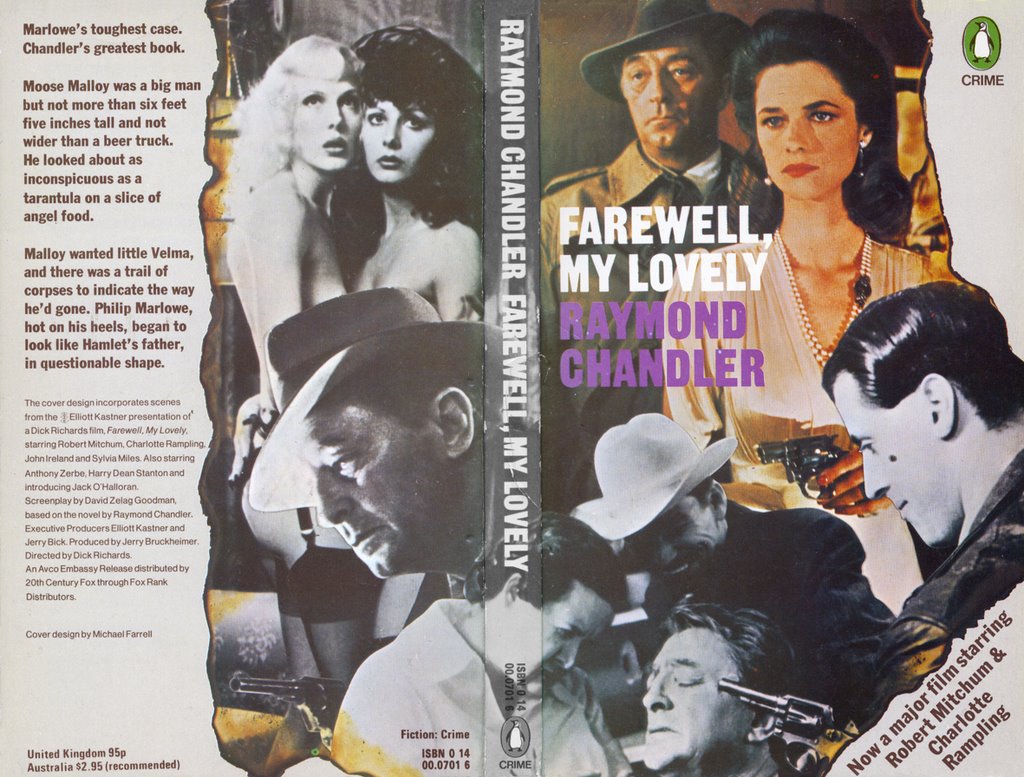
 Back in 1995, Penguin Books celebrated their 60th anniversary and made quite a splash with merchandising -- the 'Penguin Sixties' range of booklets was probably the most visible bit of merchandise. One of my favourites was a deck of Penguin cards which included the covers of 52 classic Penguin titles including, as the 10 of diamonds, Raymond Chandler's Farewell, My Lovely, first published by Penguin back in 1949. The early issues were in the classic green livery of the Penguin mystery and crime series with variations in the cover lettering for the first 7 impressions (1949, 1950, 1952, 1954, 1956, 1959, 1961); the 8th impression (1966) introduced a cover illustration for the first time; the 9th impression (1971) was a radical redesign by James Tormey which encompassed all of Chandler's Penguin novels as they were reissued over the next two years. The 1975 11th impression introduced a movie tie-in cover design (by Michael Farrell) based on the Robert Mitchum movie. There have been quite a few new cover designs over the last thirty years but these are the editions I have in my collection, starting with the 6th and 7th impressions.


Saturday, November 18, 2006
Derek Latymer-Sayer (Derrick Latimer Sayer)
 As you'll see from the picture above, the author/artist of 'The Teeming Pool' (Swift Annual 1963) is credited as Derek Latymer-Sayer. Turns out his name is actually Derrick Latimer Sayer and he was long associated with art in Chelsea and Westminster.
Born 27 August 1917, he attended the Royal Grammar School, High Wycombe, before studying at Chelsea School of Art under Henry Moore and Graham Sutherland. This was followed by a period at Ben Nicholson's studio in Paris. According to this biographical sketch (which is much the same as this biographical sketch):
With the same co-operative idealism of Nicholson and the St. Ives Group, he founded the Mousehole Group Art School in 1936 in collaboration with George Lamborn and Guy Allen. Sadly this venture was short lived, but those early experiences provided a perfect start that served him well as he put his graphic detail talent to excellent use for the major advertising campaigns and book illustrations.Sayer worked as a staff artist on a local magazine during the war. His work was exhibited widely and he illustrated a wide range of books. He died in London in late 1991, aged 74.
During the time that he was producing commercial work, he showed with a variety of galleries including the Redfern, Leicester and Storran Galleries. Derrick was also a natural teacher and by 1966 this became his full time career until he retired as head of Art for Chelsea & Westminster Adult Education Institute.
Derricks work developed around a number of themes with references being made to Nicholson's linear abstraction, but also incorporating the Neo-Romantics' sense of man in nature. Derrick preferred to put women in nature, where the timeless forms were suspended in rock formations and incorporating the gentle curves of scarcely visible nudes. His abstract work was radically different to his life work, being bold, expressive and richy textural.
Ten of Derricks works have been chosen by The Healing Arts (Chelsea Westminster Hospital Arts Project) to hang in their important permanent collection alongside such Luminaries as Patrick Heron, Mary Feddon, Alan Jones, Howard Hodgkin, Jeffrey Courtney and Sian Tucker.
Non-fiction
Teach Yourself Indoor Aquaria. London, British Universities Press Ltd., 1954.
Illustrated Books
Houses of Parliament by Philip Butler; photographs by Derrick L. Sayer in collaboration with Guy Allan & John Livesey. London, Lincolns-Prager, 1948.
Westminster Abbey by Meadows White; photographs by Derrick L. Sayer in collaboration with Guy Allen & John Livesey. London, Lincolns-Prager, 1948.
London Treasures by Meadows White; photographs by Derrick L. Sayer. London, Lincolns-Prager, 1951.
Animal Sounds by George Frederick Mason, ed. by Philip Street; illustrated by the author & Derrick Sayer. London, Phoenix House, 1959.
Animal Tracks by George Frederick Mason, ed. by Philip Street; illustrated by the author & Derrick Sayer. London, Phoenix House, 1959.
Cats' A.B.C. by Beverley Nichols. London, Jonathan Cape, 1960; combined with Cats' X.Y.Z. as Cats' A-Z, London, W. H. Allen, 1977.
Cats' X.Y.Z. by Beverley Nichols. London, Jonathan Cape, 1961; combined with Cats' A.B.C. as Cats' A-Z, London, W. H. Allen, 1977.
About the Underwater World by John B. Richards. London, Ward Lock & Co., 1960.
Akuny the Beautiful Girl, and other stories by Edith Garvie. London, Thomas Nelson & Sons, 1965.
(* The Swift Annual illustration above is © Look and Learn Magazine Ltd.; below is an example of his abstract art, some of which can be seen (and bought) at the Whittington Fine Art gallery site.)

Friday, November 17, 2006
Richard Jennings
 I've been doing some research for work into... ah, but I don't want to spoil it. Anyway, one of the alleyways I wandered down was the old Eagle strip, 'Storm Nelson', so I thought I'd jump ahead on my Swift Annual artists and see what I could find out about Richard Jennings, who was Storm's main artist for many years.
Richard Edward Jennings was born in Hampstead on 20 May 1921, and grew up suffering from asthma, although, as he later recalled, he still managed to scrape into the cricket eleven at school. At 16 he earned a free place at the Central School of Arts, although he was only two years into the course when the Second World War broke out. Jennings was keen to get into the Air Force but was grounded due to poor eyesight. He was shipped out to the Middle East where he worked with Air/Sea Rescue.
Back in civvies, he received a grant to continue his education but, having enjoyed the experience of travelling, he "packed a rucksack and hit the road," first working as a fisherman, spending his spare time painting murals in a boathouse. The owner of a large brewery saw these paintings and hired him to travel around Devon decorating pubs and small hotels. "That was living it up!" he later recalled. "With my paints and brushes (and dog!) chugging about on my old mo'bike -- and getting paid for it!"
After nearly two years he returned to London and, whilst delivering some artwork to an agency, he bumped into an artists' agent who broke the news that a new magazine called Eagle was just about to be launched. Jennings took over the 'Tommy Walls' advertising strip that appeared in colour on the inside back cover, his first episode appearing in Octoebr 1950. "From the start I was fascinated by Tommy Walls, wretched boy! He did all the things I knew I could do, if only I could get enough Walls Ice Cream!"
Jennings wrote many of his own scripts and remained on the strip for three years. In the early 1950s, Jennings was married. "My poor wife soon discovered that she'd also married TW... I even had to take my work and Tommy with me on my honeymoon! Of course there were many problems, mostly concerned with deadlines and printing dates, often working through the night on alterations -- all artists on Eagle were up against this problem of deadlines, and it is said that a small 'plane was on 'standby' to rush a Tommy Walls episode to the printers. True or false, I don't know."
In 1953, Jennings was offered a new strip: "Then came an idea from our brilliant editor, Marcus Morris. He called in Guy Morgan, the senior script writer of a famous film studio, to produce a new adventure series. I was asked to do the artwork and 'Storm Nelson' was launched. My experiences in Air/Sea Resuce during the War were a great help -- though I remember a furious letter from a retired Admiral. 'Damnit, Sir, don't ya know how an aircraft carrier should be moored!?!' In spite of his diagrams and the passing of years, I still don't know -- mooring aircraft carriers was never my strong point!"
Storm Nelson was a maritime adventurer whose adventures took him around the world. Launched on his first adventure on 2 October 1953, Storm would keep sailing his ship the Silver Spray through the pages of Eagle until 3 March 1962, with Jennings taking only a nine-month sabatical in 1955-56. After a while, Guy Morgan (writing as Edward Trice) left the strip and Jennings once again took up his pen to write the stories as well as producing the artwork.
"I acquired an old tub of a boat which, by coincidence, was already named White Spray. With the salt spray in my eyes, I kidded myself that I was Storm Nelson! Years passed and S.N. sailed on as the old Eagle suffered take overs and machinations of rival publishers." Eventually, a new editor put paid to Storm's adventures.
Jennings had also been drawing other features, including 'Seeing Stars' for Eagle, 'The Fighting Tomahawks' for Junior Mirror (both 1954), 'The Further Adventures of Robinson Crusoe' for Swift (1957-58) and various contributions to Swift Annual. Jennings also shared some of the duty drawing the advertising strip 'Adventures of the Bovril Brigade' (1961) with Frank Hampson.
With the end of 'Storm Nelson', Jennings switched briefly to scriptwriting only, adapting 'The Lost World' from the novel by Sir Arthur Conan Doyle for artist Martin Aitchison; he returned to drawing again with 'Island of Fire' which ran in Eagle between July and October 1962. After exactly twelve years on the paper Jennings found himself out in the cold.
He spent a year drawing 'The Daleks' for the back page of TV Century 21 in 1965 but drifted away from comics. "FOr 18 months [I] worked as a long-distance lorry driver. Not very exciting but I was broke! I took my ancient jeep up to the Yorkshire Dales where I travelled around painting pub signs and portraits. Obviously trying to recapture my youth!"
Jennings, with the assistance of his daughter, retired to Cornwall where he continued to paint and studied Eastern philosophies. He died of pneumonia at Camborne, Cornwall, on 19 January 1997, aged 75. He was survived by his daughter Ceilia who travelled back from New Zealand to be with her father in his last days. He was cremated at Kernow Chapel, Penmount, Truro, with one of his unfinished paintings.
Thankfully, Jennings was one of the handful of Eagle artists who was aware of the appreciation fans had for his artwork. He attended the Eagle Convention in 1980 where he was presented with an award from members of the Astral Group at the Convention dinner. Fifteen years later, he was invited by Howard Corn to pen a biographical article for Eagle Times (from which much of the above information has been drawn).
(* The Storm Nelson pic above comes from vol.4 no.31 (6 November 1953) of Eagle and is © Dan Dare Corporation Ltd. Some additional pictures can be found here, including some scans from an original 'Storm Nelson' board.)
Marvelman in the news
 The long-running problems over Marvelman/Miracleman have resurfaced with this report on Heidi MacDonald's The Beat. Heidi cites an interview with Alan Moore on Fanboy Radio in which Moore raises questions about whether Warrior had the rights to revive Marvelman in 1982. About 40 minutes 15 second in, Moore states:
A couple of days ago I went down to a local recording studio where they were going to be filming an interview with me relating to Mr. Mick Anglo, who was the original creator of Marvelman. I created my revival of Marvelman in the early '80s on the understanding that this character had lapsed into receivership with the bankruptcy of the company thathad published his adventures. And that was the entire basis upon which I wrote all of my Marvelman stories and, when I handed over the character to Neil Gaiman, on which Neil wrote all of his. We've since found out that apparently this was all a pack of lies from the beginning, that Mick Anglo had always owned Marvelman, that the company that published him had not gone bankrupt, that the rights to Marvelman had always, or should always, have been with Mick Anglo. Mick Anglo's now 90, he's looking after his equally aged wife and he could do with a bit of support. And there are some people helping him try to win back the rights that were taken away from him.Since lawyers and money are involved trying to revolve the mess I'm not going to comment except to say that I don't think everything is as clear cut as Alan believes. Mick Anglo and his artists were working under the standard conditions that all artists worked under which means the publisher bought all rights outright. This was accepted practise in those days and it was only many years later that creator rights became an issue. I'm not saying that it was right, I'm just saying that's the way it was.
Now, if that gets resolved, then I suppose, in the future, there would be some possibility, with Mick Anglo's approval, of then putting Marvelman material into some available form. At the moment, with all the various people claiming ownership of something which was apparently Mick Anglo's all the time, this is probably not the time to actually talk about any possibilities or details but, yes, it's a work that I remain very proud of and which I was pleased to learn that Mick Anglo himself had also enjoyed a great deal. That meant a lot to me. So if all of this ungodly mess gets sorted out and if it ends up as it should do with Mick Anglo having the rights to Marvelman returned to him free and clear, then who knows what the possibilities might be in the future. If the book ever does come out, it would be free of any of these rather shady complications that have hung over the character for the past twenty years.
It's something that I would like to see. Whether it will ever happen, that depends on a lot of things that are well out of my control, but who knows. Keep your fingers crossed and maybe one day.
Alan is perfectly correct in saying that the publisher -- Len Miller & Co. (Hackney) Ltd. -- didn't go bankrupt. However, it did go into voluntary liquidation. The decision was made at a meeting of directors on 21 June 1972 and the company was officially wound up on 24 September 1974. From my non-lawyerly perspective, that means that any copyrights held by the company did not go into the hands of a liquidator or trustee in bankruptcy to be sold off as an asset of the company. It was a decision made by the directors (Florrie Miller, Arnold Miller and Doreen Lewis), debts and wages were paid off and the company was shut down. The contents of a warehouse full of old unsold copies of magazines was sold off; a British dealer by the name of Brian Jepson bought a lot of it and others may have tapped into the same source. That's why you can occasionally find mint condition Miller comics, although that's increasingly rare these days.
So where did that leave the copyright of Marvelman? The question that needs answering is: when a company shuts down voluntarily, do the copyrights held by that company remain with that company despite the fact that it no longer exists, or do the rights revert to the original creators, or do they become public domain?
I'll leave the lawyers to answer that one. Personally, I suspect I'm like most comic fans who just want to see Marvelman/Miracleman back in print. It would be great to see Mick Anglo get some reward for his past efforts (I've interviewed Mick and he was very chatty, despite that fact that he claimed he didn't do interviews) but, at the same time, I don't think there was any attempt at malicious copyright theft when the idea of reviving Marvelman was floated. Plenty of dodgy practices happened afterwards if rumours are to be believed, but that's an entirely separate issue and not what we're talking about here.
So, here I am, fingers crossed, hoping that the whole thing can be resolved.
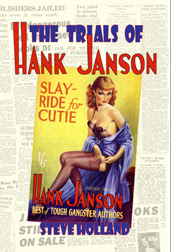
 (* The illustration is My Gun Speaks For Me and Muscles For Hire by Johnny Dekker (London, Martin & Reid, 1951). It seemed appropriate as 'Johnny Dekker' was none other than Mick Anglo. Mick wrote quite a few books back in the late 1940s and early 1950s including crime -- very much in the style of Peter Cheyney's Lemmy Caution -- romances and at least one western. He's also written quite a few other books over the years, mostly nostalgia, and was working on a biography of Custer and a book of anecdotes about his time in the Far East during the war when he was working for SEAC and drawing cartoons for military papers.)
Wednesday, November 15, 2006
Comic Clippings - 15 November
According to a report in The Scotsman (15 November), the Glasgow Anti-Racist Alliance (GARA) is asking for the reprint of the first (1939) Dandy Monster Comic to be removed from bookstores because of the use of the word "nigger" in its 'Smarty Granda' strip. The strip, drawn by Dudley Watkins, ran for 125 episodes in The Dandy (1937-40) and appeared in the first three editions of the Dandy Monster Comic.
Anita Shelton, a spokeswoman for GARA, is quoted as saying "This kind of thing cannot be permitted with ease at this point in our development as a society. It is an outrage and is terribly disturbing."
I don't really want to get into this, but the annual was published in 1938 when attitudes were very different. You can find it dispicable or offensive -- it was -- but you can't whitewash history or brush it under the carpet. This is a book for collectors, a slipcased facsimile, and anyone buying it knows exactly what they're buying.
Despite Anita Shelton's outrage, not one complaint has been lodged with the Commission for Racial Equality about the book. It has, however, leapt to #32 in the Amazon.co.uk book chart, above the 2007 Beano Annual (#35), the 2007 Dandy Annual (#135) and the facsimile of the first annual to feature The Broons (#244). I wonder if the publicity has given sales a boost?
More newsy-type stuff:
- Eddie Campbell is interviewed on Australian radio show Faster Than Light on 20 November, available now as a podcast or iTunes link.
- Looking through the rest of the Faster Than Light blog, I noticed they had reviewed a book I've not heard of before: Plastic Culture: How Japanese Toys Conquered the World by Woodrow Phoenix. Phoenix was a graphic designer and artist who worked quite widely in British comics in the 1980s and 1990s (Escape, Blast, Manga Mania, etc.) as well as working directly for Japan's Comic's Morning. His entry on Wikipedia mentions many other projects. Here's the Amazon description of the book:
In "Plastic Culture", British comics artist and illustrator Woodrow Phoenix explores our relationship to toys in the twenty-first century, with particular emphasis on Japan - an exporter of both merchandise and ideas. Plastic Toys based on comics, movies and TV shows from "Astro Boy", "Godzilla" and "Gatchaman", to "Power Rangers", "Sailor Moon" and "Pokemon" have had a powerful effect on the West, and have kick-started trends in design and pop culture that have crossed from Japan to the West and back East again. With its blend of incisive analysis and stylish photography, this is a book that will appeal to a wide range of readers: from those interested in the latest trends in contemporary art, to toy collectors young and old, and to anyone with an interest in Japan's influence on contemporary pop culture.
- 'Looking Back at Seven Soldiers with Grant Morrison' -- interview at Newsarama.
- Alan Moore in The Simpsons: I mentioned this a couple of days ago and the Northants News ('Writer Drawn into Simpsons' Show', 8 November) has some details of the plotline. Only visit the link if you don't mind spoilers.
Victor Bertoglio
 Victor Bertoglio produced the above illustration for Swift Annual 1963 (1962) having already worked for the annual the previous year. He had earlier supplied illustrations to Eagle Annual and probably others. He also produced illustrations for Illustrated London News in the 1940s/50s.
He was born Vittorio Giuseppe Bertoglio was born on 6 July 1911, the sixth child of Milan-born waiterPietro Ermengildo Bertoglio and his English wife, Helena Isabella (nee Brand). He grew up in St Pancras and studied at St Martin's School of Art. He married Edith Emery in London in 1935.
He lived at 24 Crouch Hall Road, Crouch End N8, before moving to Thatch Cottage, Farley Green, Shere, near Guildford, Surrey, in the mid-1950s.
He died in 1974 in Surrey aged 63.
PUBLICATIONS
Illustrations
A Bride for Cathay by Beatrice Redfern. London & Redhill, Lutterworth Press, 1947.
More Adventures of the Brydons by Kathleen Fidler. London & Redhill, Lutterworth Press, 1947.
The Pilgrim's Progress by John Bunyan. London & Redhill, Lutterworth Press, 1947.
South With Shackleton by L. D. A. Hussey; with a foreword by Lord Mountevans. London, Sampson Low, 1949.
Beyond the Burma Road by Percy F. Westerman. London & Glasgow, Blackie & Son, 1949.
Casper Clinton, China Coaster by Peter Wickloe. London & Glasgow, Blackie & Son, 1951.
The Young Marchesa. A story of Malta by Sheila Davies. London, Sampson Low, 1951; New York, Dodd, Mead, 1951.
Hurricane Harland Blows In by Tom Allum. London & Glasgow, Blackie & Son, 1953.
Hurricane Harland Hits Out by Tom Allum. London & Glasgow, Blackie & Son, 1954.
The Black Bog Mystery by Lane Mitchell. London & Glasgow, Blackie & Son, 1954.
The "Dark Secret" by Percy F. Westerman. London & Glasgow, Blackie & Son, 1954.
The Taking of the Gry by John Masefield. London, Longmans, Green & Co., 1954.
Hurricane Harland Takes the Plunge by Tom Allum. London & Glasgow, Blackie & Son, 1955.
Silent Takes the Trail by Hoole Jackson. London & Glasgow, Blackie & Son, 1955.
What Katy Did [and] What Katy Did at School by Susan M. Coolidge; with an introduction by Margaret Tempest. London, Collins, 1955.
Two Girls and a Boat by C. Salter. London & Glasgow, Blackie & Son, 1956.
Hurricane Harland Crashes the Gate by Tom Allum. London & Glasgow, Blackie, 1958.
Stories from Many Lands, ed. G. C. Thornley. Harlow, Longman, 1964.
Progressive Picture Compositions by Donn Byrne. London, Longmans, 2pts, 1967.
All Work and No Play—. London, Collier-Macmillan, 1971.
Tuesday, November 14, 2006
Ursula Blau
I'm updating this entry because I had a very pleasant surprise phone call today... from someonewho introduced themself as Liz Frisch... none other than Ursula Blau. Now in her eighties, I'd written to her only a couple of days ago; we spoke for only a few minutes during which time I explained why I was trying to contact her and explained that, under her maiden name, she had been credited with contributions to Swift Annual 3-8 (1956-61) and Robin Annual 4-8 (1956-60). This came as something of a surprise as she had no memory of contributing, although she admitted that her memory was no longer so good.
Ursula (Ulla E.) Blau was born in Vienna, the daughter of Dr Karl Blau, a civil servant, and his wife Helga, and studied at the Central School of Arts & Crafts, London. She was married to Otto Robert Frisch, OBE (1904-1979) on 14 March 1951. The couple had two children, Monica Eleanor and David Anthony.
Otto Frisch was a physicist, born in Austria, who studied in Vienna and worked in Germany and England before the Second World War. His aunt was also a noted physicist Lise Meitner and the two were to account for some of the discoveries of Otto Hahn and Fritz Strassmann who had discovered that uranium bombarded by neutrons produced a lighter element, barium. Frisch coined the term 'fission' for the process.
In 1939, he was offered a position at the University of Birmingham, then transferred to Liverpool Institute in 1940. Here he worked with Joseph Chadwick who moved to the USA in 1943. Frisch followed and was part of the team at Los Alamos, New Mexico, who conducted research into the atomic bomb under Robert Oppenheimer.
Returning to England in 1945 he held a post at the Atomic Energy Research Establishment at Harwell before taking up the Jack son Chair of Physics at Trinity College, Cambridge. He remained at Cambridge until retiring in 1972.
Liz Frisch, widowed now for over twenty-five years, still lives in Cambridge and, despite her age, is still as active as she can be. She has been closely associated with some of the schools in the local area. To Trinity College she donated many family papers relating to her husband and his work; she recalled with some delight that her husband had also been something of an artists, drawing illustrations for some of the books he worked on over the years. One idea they had was to produce a book about physics for children which Liz would illustrate. Liz contacted a local school and asked if she could attend some classes and sketch some of the children as they worked. This led to a strong connection between the Frisch family and the school; with students visiting theire home and Otto Frisch giving talks at the school.
Liz also recalls working on a children's educational publication, Child Education, and suspects that her contributions to Swift and Robin annuals were produced through the Boland art agency. She was primarily a book illustrator although she has produced paintings over the years. In fact, some of her work was exhibited as recently as October 2006 at an exhibition of paintings by the Cambridge Drawing Society.
 Children's Books (as Ursula Blau)
Fun to Make from Odds and Ends. London, Thomas Nelson & Sons, 1963.
Children's Books (as Ulla Frisch)
Pictures to Play With. London, Faber & Faber, 1977; New York, Taplinger Pub. Co., 1994.
Get Busy, Get Better. London, Faber & Faber, 1979.
Illustrations (as Ursula Blau)
Ten Tales for the Very Young by Marjorie Poppleton. London, University of London Press, 1953.
Josephine Jane by Joyce Reason. London, Lutterworth Press, 1970.
Rettende Flugel by Ernst Wetter; adapted and edited by K. J. H. Creese. Edinburgh, Oliver & Boyd, 1972.
Ursula (Ulla E.) Blau was born in Vienna, the daughter of Dr Karl Blau, a civil servant, and his wife Helga, and studied at the Central School of Arts & Crafts, London. She was married to Otto Robert Frisch, OBE (1904-1979) on 14 March 1951. The couple had two children, Monica Eleanor and David Anthony.
Otto Frisch was a physicist, born in Austria, who studied in Vienna and worked in Germany and England before the Second World War. His aunt was also a noted physicist Lise Meitner and the two were to account for some of the discoveries of Otto Hahn and Fritz Strassmann who had discovered that uranium bombarded by neutrons produced a lighter element, barium. Frisch coined the term 'fission' for the process.
In 1939, he was offered a position at the University of Birmingham, then transferred to Liverpool Institute in 1940. Here he worked with Joseph Chadwick who moved to the USA in 1943. Frisch followed and was part of the team at Los Alamos, New Mexico, who conducted research into the atomic bomb under Robert Oppenheimer.
Returning to England in 1945 he held a post at the Atomic Energy Research Establishment at Harwell before taking up the Jack son Chair of Physics at Trinity College, Cambridge. He remained at Cambridge until retiring in 1972.
Liz Frisch, widowed now for over twenty-five years, still lives in Cambridge and, despite her age, is still as active as she can be. She has been closely associated with some of the schools in the local area. To Trinity College she donated many family papers relating to her husband and his work; she recalled with some delight that her husband had also been something of an artists, drawing illustrations for some of the books he worked on over the years. One idea they had was to produce a book about physics for children which Liz would illustrate. Liz contacted a local school and asked if she could attend some classes and sketch some of the children as they worked. This led to a strong connection between the Frisch family and the school; with students visiting theire home and Otto Frisch giving talks at the school.
Liz also recalls working on a children's educational publication, Child Education, and suspects that her contributions to Swift and Robin annuals were produced through the Boland art agency. She was primarily a book illustrator although she has produced paintings over the years. In fact, some of her work was exhibited as recently as October 2006 at an exhibition of paintings by the Cambridge Drawing Society.

Fun to Make from Odds and Ends. London, Thomas Nelson & Sons, 1963.
Children's Books (as Ulla Frisch)
Pictures to Play With. London, Faber & Faber, 1977; New York, Taplinger Pub. Co., 1994.
Get Busy, Get Better. London, Faber & Faber, 1979.
Illustrations (as Ursula Blau)
Ten Tales for the Very Young by Marjorie Poppleton. London, University of London Press, 1953.
Josephine Jane by Joyce Reason. London, Lutterworth Press, 1970.
Rettende Flugel by Ernst Wetter; adapted and edited by K. J. H. Creese. Edinburgh, Oliver & Boyd, 1972.
Carol Barker
Carol Barker seems an interesting subject, and not quite as elusive as some of the other artists covered these past couple of days, although the majority of the information I've found comes from a slim entry in Contemporary Authors.
Born on 16 February 1938, Carol Minturn Barker has been a freelance author and illustrator since 1958. She attended Bournemouth College of Art, Chelsea Polytechnic and Central School of Arts and Crafts and studied privately at her father's studio. She made her single contribution to Swift Annual 1962 (1961). According to Dictionary of British Book Illustrators by Brigid Peppin & Lucy Micklethwait, "Her work, in pen and ink, watercolour, collage and wax, is decorative rather than spatial in character. H. E. Bates wrote Achilles the Donkey around her pictures."
It would seem that she married and became Carol Dunkerton and she has two sons.
Novels
The Boy and the Lion. London, Dennis Dobson, 1968; The Boy and the Lion on the Wall, New York, F. Watts, 1969.
King Midas and the Golden Touch. London, F. Watts, 1972.
Non-fiction
Birds and Beasts. New York, Watts, 1971.
The Alphabet. London, Hamlyn, 1973.
How the World Began. London, Abelard-Schuman, 1974.
An Oba of Benin. London, Macdonald & Jane's, 1976.
A Prince of Islam. London, Macdonald & Jane's, 1976.
Arjun in His Village in India. Oxford, Oxford University Press, 1979.
Village in Nigeria. London, Black, 1984.
Ananda in Sri Lanka. A story of Buddhism. London, Hamish Hamilton, 1985.
The United Nations. Its work in the world. London, Macdonald, 1986.
A Question of Refugees. London, Macdonald, 1988.
The Tibetans. Life in exile. London, Mantra, in association with the Tibet Foundation, 1998.
Illustrations
The Cat's Cradle-Book by Sylvia Townsend Warner (dustjacket). London, Chatto & Windus, 1960.
Achilles the Donkey by H. E. Bates. London, Dennis Dobson, 1962; New York, Franklin-Watts, 1962.
Gilbert and Sullivan by Norman Wymer. London, Methuen, 1962.
Achilles and Diana by H. E. Bates. London, Dennis Dobson, 1963.
A Storyteller's Choice. A selection of stories with notes on how to tell them by Eileen Colwell. London, Bodley Head, 1963.
Achilles and the Twins by H. E. Bates. London, Dennis Dobson, 1964.
Farmer Barnes Buys a Pig by John Cunliffe. London, Deutsch, 1964.
Quest for Prehistory by Noel Lloyd & Geoffrey Palmer. London, Dennis Dobson, 1965.
Farmer Barnes and Bluebell by John Cunliffe. London, Deutsch, 1966.
Rain and Shine. Nursery rhymes for the four seasons. London, Blackie, 1966.
The Kitchen Madonna by Rumer Godden. London, Macmillan, 1967.
It's Snowing Outside by Janet McNeill. London, Macmillan, 1968.
Lost in a Shop by Richard Parker. London, Macmillan, 1968.
The Bald Twit Lion by Spike Milligan. London, Dennis Dobson, 1968.
Pillycock's Shop by Margaret Mahy. London, Dobson, 1969.
The Princess and the Clown by Margaret Mahy. New York, F. Watts, 1971; London, Dobson, 1971.
Dragons, Dragons, Dragons, selected by Helen Hoke. New York, Franklin Watts, 1972.
The Sun People by Sandie Oram. London, Macdonald & Co., 1972.
Emma Borrows a Cup of Sugar by Nicholas Fisk. London, Heinemann, 1973.
If You Shold Meet a Crocodile, and other verse by Margaret Mayo. London, Kaye & Ward, 1974.
Devils, Devils, Devils, selected by Helen Hoke. London, Franklin Watts, 1975.
A Touch of Gold. Stories from the Greek myths, retold by Miriam Hodgson. London, Methuen Children's, 1983.
Buddhist Stories by John Snelling. Hove, Wayland, 1986.
The Life of the Buddha by John Snelling. Hove, Wayland, 1987.
Harold Beards
 Harold Beards produced a number of pages for Swift Annual on a variety of subjects
 Beards was a cartoonist and postcard artist. He was contributing to Printers' Pie as early as 1934. Also contributed to Daily Mail Boys Annual (Associated Press, 1956), The Wolf Cub Annual 1960 (C. Arthur Pearson, 1959), Daily Sketch Children's Annual (Associated Newspapers, 1963) and probably many others.
 The pictures at the head and tail of this little entry show some of the diverse subjects he covered in Swift Annual, where he contributed pages between number 5 (1958) and the 1963 cover-dated issue (1962). The images from Swift Annual are © Look and Learn Magazine Ltd. The postcards I've nabbed from eBay. Both the above seem to date from around 1951.
Illustrations
Africa and Southern Asia by Martin Simons. London, Hulton Educational, 1954.
Opera Stories for Young People by Gladys Davidson. London, Cassell, 1958.
Wool Merchants of the Fifteenth Century by G. Scott Thomas. London, Longmans, Green, 1958.
Spiked Shoes by Jim Peters & Robert J. Hoare. London, Children's Book Club, 1959.
Robin Hood, retold by Ronald D. K. Storer. Oxford, Oxford University Press, 1971.

George Bass
 Another artist whom I can find nothing about. Like Barcilon below, George Bass contributed to Swift Annual 1963 (1962) only. This example illustrates the story 'Walter Wins a Sword' by John Baldwinson, set in the days of Good Queen Bess.
Subscribe to:
Posts (Atom)
BEAR ALLEY BOOKS

Click on the above pic to visit our sister site Bear Alley Books